Key takeaways
- Both tools are enterprise-only with custom pricing and no self-serve option -- budget conversations happen before you see a dashboard
- BrandRank.AI structures its platform around three clear pillars: AI Search Visibility, Brand Vulnerability, and Content Readiness. Bluefish is broader, covering AI monitoring, GEO optimization, and agentic commerce
- Bluefish starts around $4,000/month and explicitly targets Fortune 500 brands; BrandRank.AI serves large brands too (Nestlé, P&G) but its pricing is less publicized
- Bluefish has a stronger story around AI commerce and agentic shopping -- relevant if your brand sells products through AI channels
- Neither platform offers built-in content generation or AI crawler logs, which limits how far they can take you from "monitoring" to "fixing"
- If you want a platform that goes beyond monitoring to actually help you create content that ranks in AI search, tools like Promptwatch are worth considering alongside either of these
Overview
BrandRank.AI
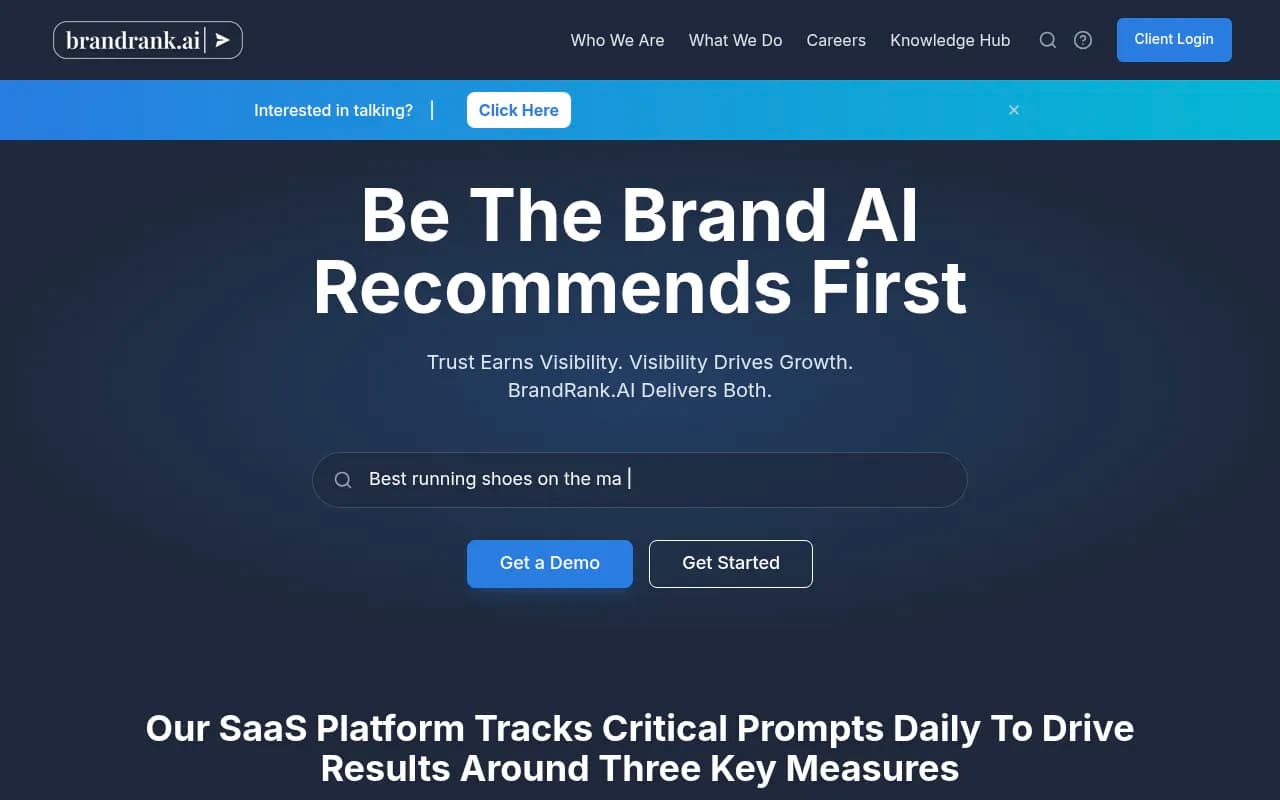
BrandRank.AI describes itself as an enterprise AI visibility platform built around what it calls the "Answer Economy." The core idea: trust drives AI recommendations, and if AI engines don't trust your brand, you won't get recommended. The platform tracks daily prompt performance across ChatGPT, Perplexity, Claude, Gemini, and other AI engines, and organizes its analysis into three buckets: whether you show up (AI Search Visibility), what AI says about you when you do (Brand Vulnerability), and whether your site is technically ready for AI crawlers (Content Readiness).
Clients include Nestlé Canada, P&G, Fifth Third Bank, and Bitdefender -- a mix of CPG, financial services, and tech. The Sr. Director at Nestlé Canada called it his "crystal ball," which is a good sign that the monitoring side of the product resonates.
Bluefish
Bluefish pitches itself as the AI marketing platform for Fortune 500 brands, and it leans hard into that positioning. Where BrandRank.AI is focused on brand trust and visibility, Bluefish frames its value around "authority, influence, and control" -- a slightly different angle that includes not just where you appear but how AI models perceive and represent your brand.
Its four pillars are Impact and Influence, Actionability, Control and Differentiation, and Enterprise Scale. The platform covers AI monitoring, GEO optimization, measurement, and AI commerce -- that last one being a meaningful differentiator. Bluefish has published research showing that Super Bowl ads influence AI recommendations, which suggests they're doing interesting work on the relationship between offline marketing and AI visibility.
Side-by-side comparison
| Feature | BrandRank.AI | Bluefish |
|---|---|---|
| Pricing model | Custom enterprise (contact for quote) | Custom enterprise (~$4,000/mo+, annual) |
| Free trial | No | No |
| Self-serve signup | No | No |
| AI engines monitored | ChatGPT, Perplexity, Claude, Gemini + others | ChatGPT, Perplexity + others (not fully listed) |
| Daily prompt tracking | Yes | Yes |
| Brand sentiment/vulnerability | Yes (dedicated pillar) | Yes (brand reputation monitoring) |
| Content readiness scoring | Yes | Not explicitly featured |
| AI commerce / agentic shopping | Not prominently featured | Yes (dedicated pillar) |
| GEO optimization guidance | Content Readiness pillar | Yes (GEO Measurement pillar) |
| Content generation | No | No |
| AI crawler logs | No | No |
| Competitive benchmarking | Yes (Category Answer Share) | Yes |
| Custom audiences/personas | Not specified | Yes |
| Enterprise infosec compliance | Not specified | Yes (passes infosec reviews) |
| API / data export | Not specified | Yes (data team customization) |
| Target customer | Enterprise brands, agencies | Fortune 500 marketing teams |
Head-to-head feature deep-dive
AI search visibility tracking
Both platforms track how brands appear across AI engines on a daily basis. BrandRank.AI is explicit about its metrics: Frequency of Rank, Category Answer Share, and Competitive Positioning. These are clean, understandable KPIs that a brand manager can report upward without needing to explain what they mean.
Bluefish's monitoring is described as "real-time visibility into brand reputation and performance across all AI native experiences," which sounds comprehensive but is harder to evaluate without a demo. The emphasis on going "beyond superficial metrics" suggests the platform has depth, but the website doesn't show you what those metrics actually are.
Verdict: BrandRank.AI is more transparent about what it measures. Bluefish likely has comparable depth but keeps its cards closer to its chest.
Brand vulnerability and sentiment
This is where BrandRank.AI has a genuinely distinct angle. Its Brand Vulnerability pillar tracks credibility and trust, product performance, and accuracy and sentiment -- essentially asking "when AI talks about my brand, is it saying accurate, positive things?" That's a different question from "do I show up?" and it matters a lot for brands in regulated industries or those with reputation risks.
Bluefish covers brand reputation monitoring too, but it's framed more as part of the broader monitoring suite rather than a standalone analytical lens. The "Impact and Influence" pillar suggests Bluefish thinks about this at a strategic level -- understanding how AI "thinks" about your brand -- but the specifics aren't as clearly laid out.
Verdict: BrandRank.AI has a more developed framework for brand vulnerability specifically. If that's your primary concern, it's the more purpose-built option.
Content readiness and optimization
BrandRank.AI's Content Readiness pillar covers Content Accessibility, Depth of Content and Schema, and Content Liquidity (bot-friendliness). This is essentially a technical audit of whether your site is set up for AI crawlers to read and use your content. It's a useful diagnostic, though it stops short of telling you what content to create or helping you create it.
Bluefish has a GEO Measurement pillar and published a blog post in April 2026 titled "A Better Approach to AI-Optimized Content," suggesting they're developing content optimization guidance. But again, neither platform generates content for you.
Verdict: BrandRank.AI has a more structured content readiness framework. Neither platform closes the loop with actual content creation -- that's a gap both share.
AI commerce and agentic shopping
This is Bluefish's clearest differentiator. AI Commerce is one of its four core pillars, covering how brands appear in agentic commerce scenarios -- think AI agents making purchase recommendations or completing transactions on behalf of users. For consumer brands selling through AI channels, this is increasingly important.
BrandRank.AI doesn't prominently feature commerce tracking. Its focus is more on brand recommendation and trust in informational AI responses.
Verdict: Bluefish wins here, clearly. If your brand sells products and you care about AI-driven commerce, Bluefish is the more relevant platform.
Enterprise features and compliance
Bluefish explicitly calls out that it "consistently passes infosec reviews with ease" -- a statement that matters a lot when you're selling to Fortune 500 procurement teams. It also offers custom data segmentation, custom audiences, and tailored measurement frameworks.
BrandRank.AI's enterprise credentials come through its client list (Nestlé, P&G, Fifth Third Bank) rather than explicit feature callouts. The platform is clearly enterprise-capable, but the website doesn't address infosec or data governance directly.
Verdict: Bluefish is more explicit about enterprise compliance. For large organizations with strict procurement requirements, that transparency matters.
Pricing and accessibility
| Plan | BrandRank.AI | Bluefish |
|---|---|---|
| Entry point | Custom (contact sales) | ~$4,000/month (reported) |
| Contract type | Not specified | Annual standard |
| Free trial | No | No |
| Self-serve option | No | No |
Neither platform lets you try before you buy. Both require a sales conversation. Bluefish's reported $4,000/month starting price puts it at the high end of the market -- comparable to Profound and above most mid-market GEO tools. BrandRank.AI's pricing is opaque enough that you can't compare without a call.
For teams that want to start smaller and scale up, platforms with transparent self-serve pricing (like Promptwatch, which starts at $99/month) are worth evaluating alongside these enterprise options.

Pros and cons
BrandRank.AI
Pros:
- Clear three-pillar framework makes it easy to understand what you're buying
- Brand Vulnerability analysis is a genuinely useful lens that competitors underemphasize
- Content Readiness scoring gives technical teams actionable diagnostics
- Proven enterprise client base (Nestlé, P&G, Bitdefender)
- Daily prompt tracking with competitive benchmarking
Cons:
- No self-serve trial -- you're committing to a sales process before seeing anything
- Pricing is completely opaque
- No content generation or AI writing tools
- No AI crawler logs
- AI commerce tracking not a core feature
- Website is light on product screenshots and specifics
Bluefish
Pros:
- AI Commerce pillar is a real differentiator for consumer brands
- Strong enterprise compliance story (infosec, data governance)
- Custom audiences and tailored measurement frameworks
- Research-driven approach (Super Bowl ads / AI visibility study is genuinely interesting)
- Broader platform scope covering monitoring, optimization, and commerce
Cons:
- Starts around $4,000/month -- one of the priciest options in the market
- Annual contracts standard, so you're locked in
- Website is heavy on positioning language, light on actual feature specifics
- No content generation
- No AI crawler logs
- No free trial or self-serve option
Who should pick which tool
Pick BrandRank.AI if:
- Brand trust and reputation accuracy in AI responses is your primary concern
- You want a structured framework (Visibility / Vulnerability / Readiness) that maps cleanly to internal reporting
- You're in a regulated industry where what AI says about you matters as much as whether you appear
- Your team is mid-to-large enterprise but not necessarily Fortune 500 scale
Pick Bluefish if:
- You're a Fortune 500 brand with a formal procurement process and infosec requirements
- AI commerce and agentic shopping are part of your marketing strategy
- You need custom data segmentation and audience-level analysis
- You want a platform that covers the full stack from monitoring to GEO measurement to commerce
Consider alternatives if:
- You want transparent pricing and a self-serve trial
- You need content generation alongside monitoring
- You want AI crawler logs to understand how AI engines are actually reading your site
- You're an agency or mid-market brand that doesn't need Fortune 500-grade enterprise features
Final verdict
BrandRank.AI and Bluefish are both credible enterprise platforms, but they're optimized for slightly different problems. BrandRank.AI is the cleaner choice if brand trust and vulnerability analysis are your focus -- its three-pillar framework is well-structured and its client list proves it works at scale. Bluefish is the better fit if you're a large consumer brand that needs to track AI commerce alongside traditional visibility, and if enterprise compliance is a hard requirement.
The honest limitation of both: they're monitoring platforms. Neither helps you create the content that would actually improve your scores. If you want a platform that finds the gaps and helps you fill them, that's a different category of tool entirely.