Key Takeaways
- Pricing gap is massive: Bluefish starts around $4,000/month with annual contracts, while Profound runs $1,000-$3,000+/month -- both require custom quotes, but Profound is significantly cheaper for most teams
- Target audience split: Bluefish explicitly targets Fortune 500 brands with enterprise infosec and custom audiences; Profound serves mid-market to enterprise (MongoDB, Ramp, Zapier) with faster onboarding
- Optimization vs monitoring trade-off: Profound includes autonomous marketing agents and prompt volume data for content creation; Bluefish focuses on "understanding how AI thinks" but offers less actionable tooling
- AI engine coverage: Profound monitors 10+ engines including DeepSeek and shopping features; Bluefish covers major engines but emphasizes depth over breadth
- Data access: Profound provides API access and developer docs; Bluefish keeps data more locked down with custom segmentation for enterprise clients
- Speed to value: Profound offers self-serve signup and faster implementation; Bluefish requires sales demos and longer enterprise sales cycles
Overview
Both Bluefish and Profound are enterprise-grade platforms for tracking and optimizing brand visibility in AI search engines like ChatGPT, Perplexity, Claude, and Gemini. They emerged in 2024-2025 as the AI search market exploded, and both target marketing teams trying to figure out how their brands show up when millions of people ask AI for recommendations.
The core difference: Bluefish positions itself as the "AI marketing platform of choice for the Fortune 500" with emphasis on influence, control, and understanding how AI "thinks." Profound markets itself as an Answer Engine Optimization (AEO) platform with autonomous agents, prompt volume data, and tools to actually create optimized content.
Bluefish
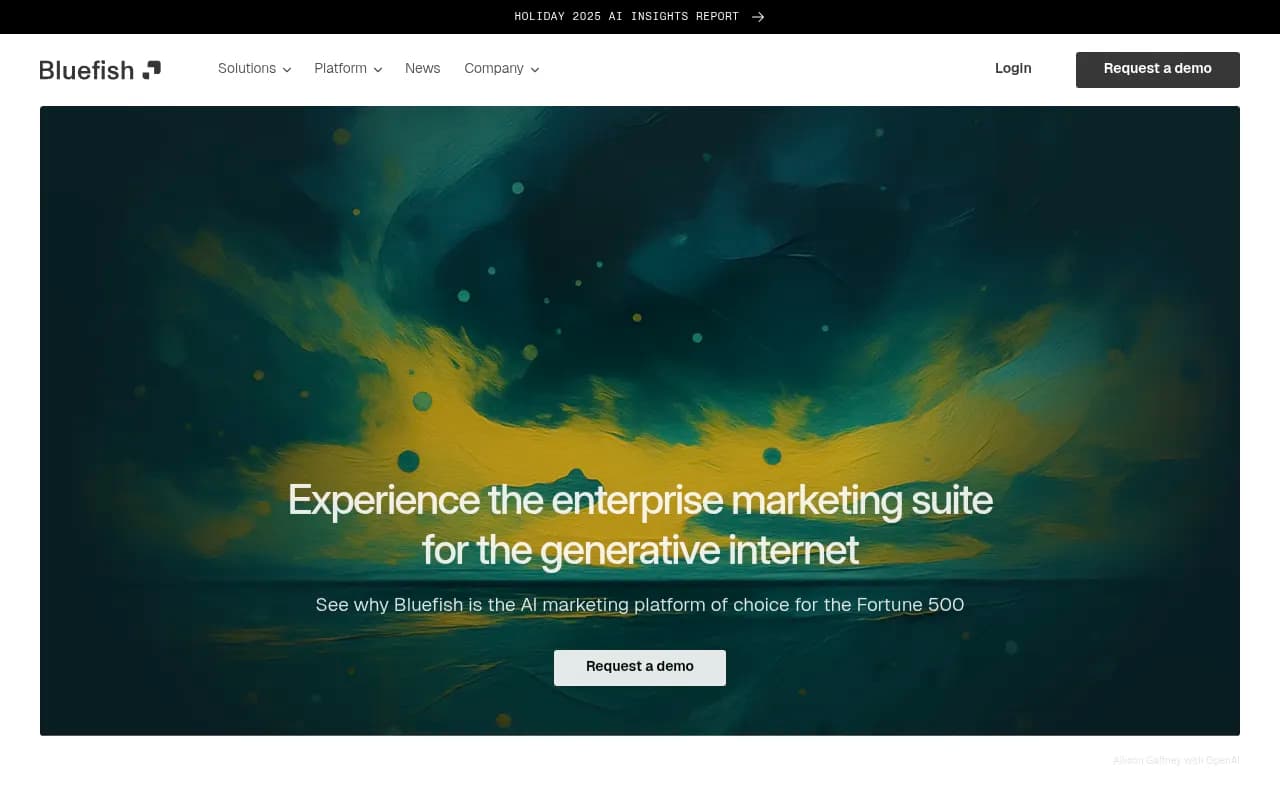
Bluefish is an enterprise AI marketing suite built for large brands with complex needs. It tracks brand reputation across AI search engines and agentic commerce, with features like custom audiences, tailored prompts, and deep competitive analysis. The platform emphasizes "impact and influence" over superficial share-of-voice metrics, and sells itself on passing infosec reviews and providing control that "generic datasets" can't match.
Key selling points: Fortune 500 client base, enterprise scale, custom measurement frameworks, "understanding how AI thinks."
Profound
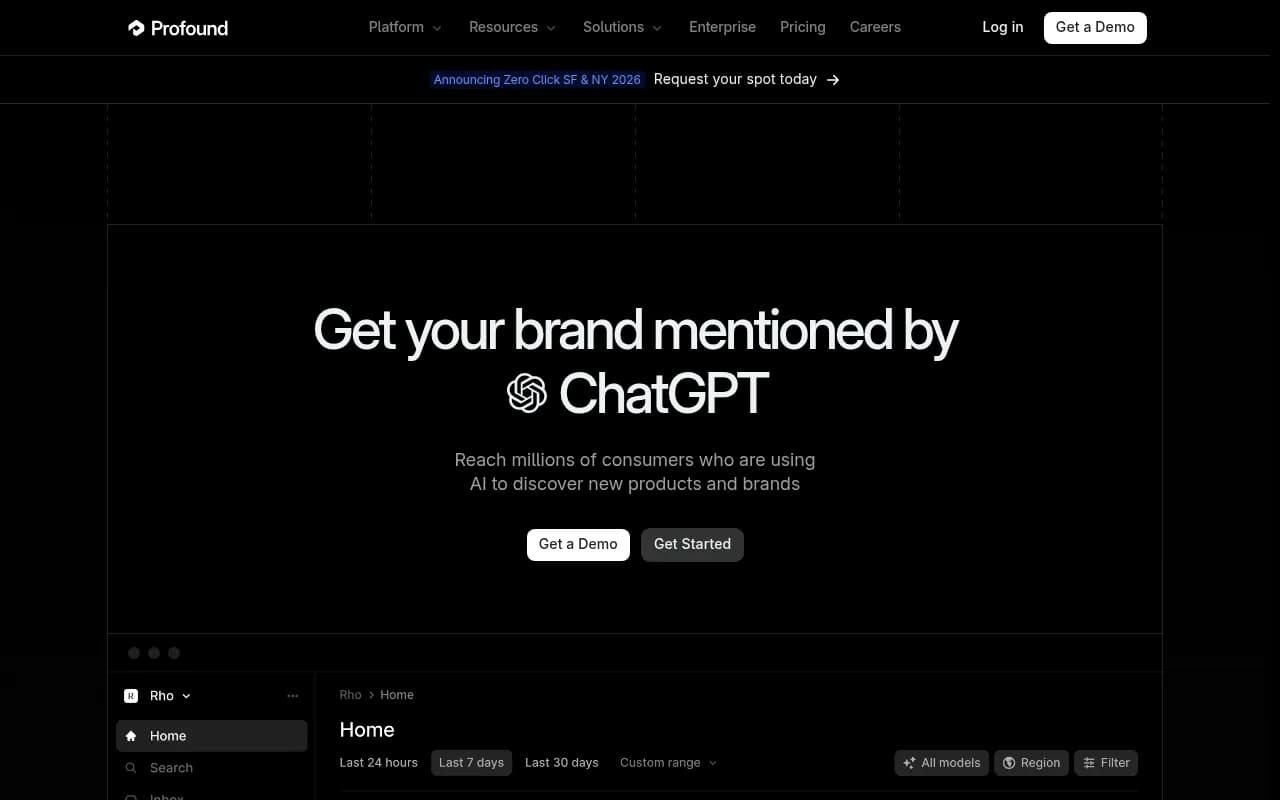
Profound is an AEO platform that combines visibility tracking with autonomous marketing agents. It monitors 10+ AI engines, provides prompt volume estimates (what millions of people actually ask), tracks AI crawler behavior, and includes agent-based content creation tools. Used by MongoDB, Ramp, and Zapier, it targets teams that want to move fast and optimize, not just monitor.
Key selling points: Prompt volumes, autonomous agents, API access, SOC 2 certification, faster implementation.
Side-by-Side Comparison
| Feature | Bluefish | Profound |
|---|---|---|
| Starting price | ~$4,000/month | ~$1,000-$3,000/month |
| Contract type | Annual standard | Custom (likely annual) |
| Free trial | No | No |
| Self-serve signup | No (demo required) | Yes (platform.tryprofound.com) |
| AI engines covered | Major engines (ChatGPT, Perplexity, etc.) | 10+ (ChatGPT, Perplexity, Claude, Gemini, Grok, Copilot, Meta AI, DeepSeek, AI Overviews) |
| Prompt volume data | Not mentioned | ✓ (core feature) |
| AI crawler analytics | Not mentioned | ✓ (Agent Analytics) |
| Content creation tools | Not mentioned | ✓ (Autonomous agents) |
| Shopping tracking | ✓ (AI Commerce) | ✓ (Shopping feature) |
| API access | Not mentioned | ✓ (Developer docs available) |
| Custom audiences | ✓ (enterprise feature) | Not mentioned |
| SOC 2 certified | Passes infosec reviews | ✓ |
| Target market | Fortune 500 | Mid-market to enterprise |
| Implementation speed | Slower (enterprise sales) | Faster (self-serve option) |
Pricing and contracts
Neither platform publishes transparent pricing, but the gap is significant.
Bluefish starts around $4,000/month with annual contracts standard. Pricing scales based on number of brands, markets, and features. The platform is explicitly built for enterprise budgets -- they mention "consistently passing infosec reviews" and custom segmentation, which signals long sales cycles and six-figure annual commitments.
Profound runs an estimated $1,000-$3,000+/month for most teams, also with custom enterprise pricing. While still expensive, it's 50-70% cheaper than Bluefish at the entry level. Profound offers a self-serve signup flow (platform.tryprofound.com/welcome), which suggests faster onboarding and less enterprise friction.
| Plan tier | Bluefish | Profound |
|---|---|---|
| Entry point | ~$4,000/month | ~$1,000-$3,000/month |
| Mid-market | Custom quote | Custom quote |
| Enterprise | Custom (likely $10k+/month) | Custom (likely $5k+/month) |
| Annual commitment | Standard | Likely |
| Free trial | None | None |
Verdict: Profound is significantly cheaper for teams that don't need Fortune 500-level customization. Bluefish's pricing reflects its positioning as a premium enterprise tool.
AI engine coverage and monitoring depth
Both platforms monitor the major AI search engines, but with different emphases.
Bluefish covers ChatGPT, Perplexity, and other major engines with a focus on "depth and control." The website emphasizes custom audiences, tailored prompts, and competitive differentiation -- suggesting they prioritize quality of insights over breadth of coverage. They track AI commerce (shopping recommendations) and brand reputation, but don't mention specific engine counts.
Profound explicitly monitors 10+ engines: ChatGPT, Perplexity, Claude, Gemini, Grok, Microsoft Copilot, Meta AI, DeepSeek, Google AI Overviews. The platform includes shopping tracking, AI crawler analytics (which bots hit your site and when), and prompt volume data (what people actually ask). This breadth matters if you want a complete picture across all AI channels.
Verdict: Profound wins on breadth and transparency. Bluefish likely covers the same engines but doesn't advertise it -- they're selling depth and customization instead.
Content optimization and creation
This is where the platforms diverge sharply.
Bluefish emphasizes "AI Optimization (GEO)" as one of its four pillars, but the website doesn't detail what that means in practice. There's no mention of content creation tools, prompt research, or automated workflows. The focus is on measurement frameworks and understanding "how AI thinks" -- which sounds strategic but leaves you to figure out the execution.
Profound includes autonomous marketing agents as a core feature. The homepage shows an "AEO-Optimized FAQ Generator" agent that scrapes web pages, determines search queries, researches Perplexity FAQs, and generates content. They advertise "agents for every function of your marketing team" and provide templates. This is a fundamentally different product -- it's not just monitoring, it's helping you create the content that will rank.
Profound also provides prompt volume data, which shows you what millions of people are asking AI. This is the research layer you need before creating content. Bluefish doesn't mention this capability.
Verdict: Profound is built for teams that want to optimize and create. Bluefish is built for teams that want to measure and understand. If you need help actually producing content that ranks in AI search, Profound is the clear choice.
Enterprise features and data access
Bluefish leans hard into enterprise positioning: "consistently passes infosec reviews," custom audiences, tailored prompts, deep segmentation. The platform is designed for large marketing teams with complex approval processes and data governance requirements. They emphasize control and differentiation, which translates to more customization but also more friction.
Profound is SOC 2 certified and provides API access with developer documentation. The platform includes integrations and a partner program. This is a more modern SaaS approach -- secure enough for enterprise, but flexible enough for mid-market teams to move fast. The self-serve signup option is a huge difference from Bluefish's demo-required flow.
| Feature | Bluefish | Profound |
|---|---|---|
| Security certifications | Passes infosec reviews | SOC 2 |
| API access | Not mentioned | ✓ |
| Developer docs | Not mentioned | ✓ |
| Custom audiences | ✓ | Not mentioned |
| Self-serve signup | No | Yes |
| Partner program | Not mentioned | ✓ |
Verdict: Bluefish for Fortune 500 teams with long procurement cycles. Profound for everyone else who wants enterprise security without enterprise friction.
AI crawler analytics and technical depth
This is a critical feature that most AI visibility platforms ignore.
Bluefish doesn't mention AI crawler tracking on their website. They focus on brand reputation and influence in AI-generated answers, but not on the technical layer of how AI engines discover and index your content.
Profound includes "Agent Analytics" as a named feature, which tracks AI crawler behavior -- which bots hit your site, how often, what pages they read, errors they encounter. This is essential for diagnosing indexing issues and understanding why your content isn't showing up in AI answers.
If you're also tracking traditional SEO, tools like Promptwatch provide even deeper crawler log analysis with real-time monitoring of ChatGPT, Claude, Perplexity, and other AI bots hitting your site.

Verdict: Profound includes this capability; Bluefish doesn't advertise it. Crawler analytics are table stakes for serious AI visibility work.
Measurement and ROI tracking
Both platforms emphasize measurement, but with different philosophies.
Bluefish positions "GEO Measurement" as one of its four core pillars. They talk about "automated optimization workflows" and "tailored measurement frameworks," with a focus on metrics that matter beyond superficial share-of-voice. The recent blog post about Super Bowl ads influencing AI recommendations shows they're thinking about attribution, but the website doesn't detail how measurement actually works.
They also introduced "Collections" in February 2026 to "measure the ROI of your digital marketing campaigns in the AI channel" -- suggesting they're building attribution features but may still be early.
Profound doesn't emphasize measurement as heavily on the homepage, but the platform includes integrations and API access, which suggests you can pipe data into your own analytics stack. The focus is more on prompt volumes and visibility tracking than on closed-loop attribution.
Verdict: Bluefish is investing more in measurement and attribution, but both platforms are still early on connecting AI visibility to actual revenue. Neither offers the kind of traffic attribution you'd get from a platform like Promptwatch (code snippet, GSC integration, server log analysis).
User experience and implementation
The buying and onboarding experience is night and day.
Bluefish requires a sales demo to get started. The website has no pricing page, no self-serve trial, and no product screenshots beyond high-level marketing visuals. This is a classic enterprise sales motion -- long cycles, custom contracts, white-glove onboarding. If you're a Fortune 500 brand with budget and patience, this works. If you're a mid-market team that wants to move fast, it's frustrating.
Profound offers a self-serve signup at platform.tryprofound.com/welcome. You can explore the product, see the interface, and start tracking without talking to sales. They still offer demos for enterprise buyers, but the friction is much lower. The website includes product screenshots, feature pages, and a resource center. This is a modern SaaS experience.
Verdict: Profound is dramatically faster to evaluate and implement. Bluefish's enterprise-only approach makes sense for their target market but excludes smaller teams.
Pros and cons
Bluefish pros
- Explicitly built for Fortune 500 brands with complex needs
- Strong emphasis on influence and understanding how AI "thinks"
- Custom audiences and tailored prompts for competitive differentiation
- Passes enterprise infosec reviews consistently
- Investing in attribution and ROI measurement (Collections feature)
- AI commerce tracking for shopping recommendations
Bluefish cons
- Extremely expensive (~$4k/month starting point)
- No self-serve option -- requires sales demo and long procurement
- No mention of content creation tools or prompt research
- No AI crawler analytics advertised
- No API access or developer docs mentioned
- Opaque pricing and feature details
Profound pros
- 50-70% cheaper than Bluefish for most teams
- Autonomous marketing agents for content creation
- Prompt volume data shows what millions of people ask AI
- AI crawler analytics (Agent Analytics)
- API access and developer documentation
- SOC 2 certified
- Self-serve signup available
- Covers 10+ AI engines including DeepSeek
- Faster implementation and onboarding
Profound cons
- Less emphasis on custom audiences and deep segmentation
- Measurement and attribution features less developed than Bluefish
- May lack the white-glove service Fortune 500 brands expect
- Still requires custom pricing (no transparent tiers)
- Less focus on "understanding how AI thinks" vs tactical optimization
Who should pick which tool
Choose Bluefish if:
- You're a Fortune 500 brand with a six-figure AI marketing budget
- You need custom audiences, tailored prompts, and deep competitive segmentation
- Your procurement process requires extensive infosec reviews and annual contracts
- You value strategic consulting and understanding "how AI thinks" over tactical tooling
- You're willing to wait through a long sales cycle for white-glove onboarding
- Attribution and ROI measurement are critical (Collections feature)
Choose Profound if:
- You're a mid-market to enterprise brand that wants to move fast
- You need autonomous agents and content creation tools, not just monitoring
- Prompt volume data and AI crawler analytics matter to your workflow
- You want API access and the ability to build custom integrations
- Your budget is $1-3k/month, not $4k+
- You prefer self-serve evaluation over mandatory sales demos
- You're optimizing for breadth of AI engine coverage (10+ engines)
Consider alternatives if:
- You want a platform that combines monitoring with content gap analysis and AI-powered content generation -- Promptwatch covers this angle with 880M+ citations analyzed, Reddit/YouTube tracking, and built-in content creation tools
- You're a small team or individual and need something under $500/month
- You want transparent pricing without custom quotes
Final verdict
Profound is the better choice for most teams. It's significantly cheaper, includes content creation tools and prompt research, covers more AI engines, and offers self-serve onboarding. The autonomous agents and prompt volume data make it an optimization platform, not just a monitoring dashboard.
Bluefish makes sense only if you're a Fortune 500 brand with a massive budget and complex enterprise needs. The $4k/month starting price and demo-required sales process exclude 95% of potential buyers. If you're paying that premium, you're betting that Bluefish's emphasis on "understanding how AI thinks" and custom measurement frameworks will deliver ROI that Profound can't match. That's a tough bet when Profound includes the tactical tools (agents, prompt volumes, crawler analytics) that actually help you optimize.
For teams serious about AI visibility: start with Profound. If you outgrow it and need Fortune 500-level customization, then consider Bluefish. But most teams will find Profound's feature set more actionable and its pricing more reasonable.