Key Takeaways
- Price gap is massive: Bluefish starts around $4,000/month with annual contracts, while GetCito offers a free self-hosted option and paid plans from $299/month bundled with agency services
- Target audience couldn't be more different: Bluefish is built for Fortune 500 marketing teams with dedicated budgets; GetCito serves SMBs and agencies looking for affordable AI visibility tracking
- GetCito is open source, Bluefish is closed: GetCito's tool is available on GitHub for self-hosting (you pay API costs), while Bluefish is enterprise SaaS only
- Bluefish emphasizes depth and control: Custom audiences, tailored prompts, automated workflows, and passes enterprise infosec reviews. GetCito focuses on monitoring and agency-led optimization
- GetCito bundles agency services: You're not just buying a tool -- you're getting a digital marketing agency that uses the tool. Bluefish is software-only
- Both track major AI engines: ChatGPT, Perplexity, Gemini, Copilot are covered by both platforms, though Bluefish claims deeper "how AI thinks" insights
Overview
Bluefish: Enterprise AI marketing for the Fortune 500
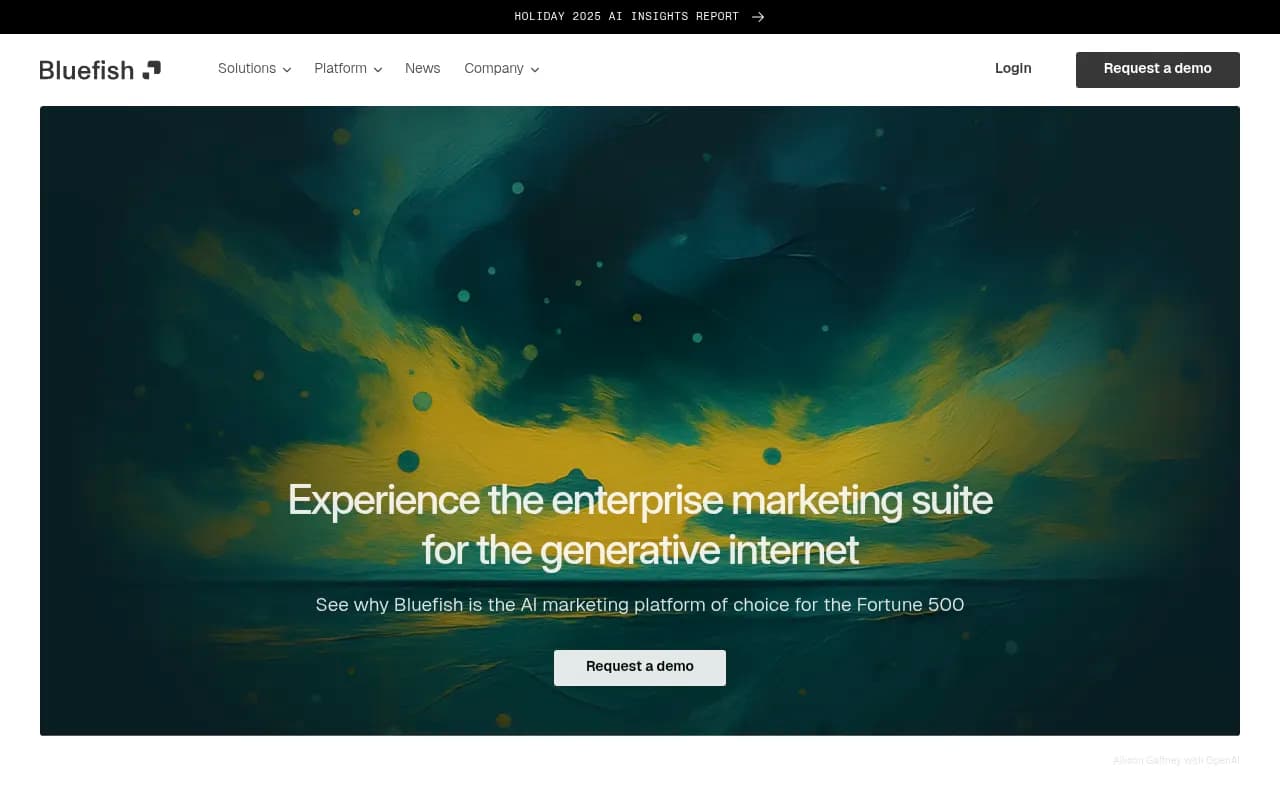
Bluefish positions itself as "the AI marketing platform of choice for the Fortune 500." It's an enterprise-grade system designed for large marketing teams that need visibility and control over brand presence across AI search engines and agentic commerce. The platform emphasizes going "beyond superficial metrics" with custom audiences, tailored prompts, and automated optimization workflows. Bluefish passes SOC 2 and enterprise infosec reviews, which matters if you're a regulated industry or public company. Pricing starts around $4,000/month with annual contracts and scales based on number of brands, markets, and features.
GetCito: Open-source tool + agency services
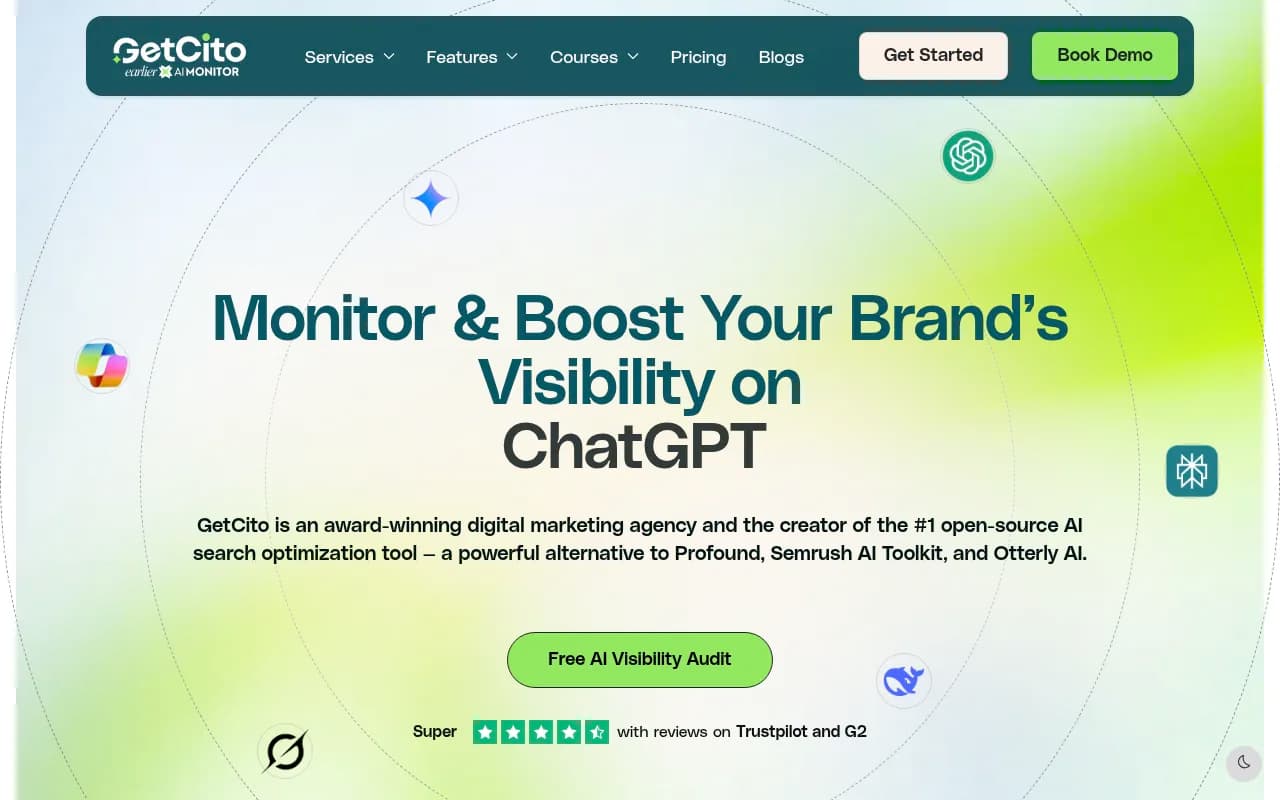
GetCito is a digital marketing agency that built an open-source AI visibility tracking tool. They describe it as "the #1 open-source AI search optimization tool" and position it as an alternative to Profound, Semrush AI Toolkit, and Otterly AI. The tool itself is free to self-host (you pay your own API costs to query ChatGPT, Perplexity, etc.), and paid plans start at $299/month bundled with agency services. GetCito's pitch is that you get both the tool and the expertise -- they handle strategy, content, and optimization while you get access to the data. The agency angle is central to their model.
Side-by-Side Comparison
| Feature | Bluefish | GetCito |
|---|---|---|
| Starting price | ~$4,000/month | $299/month (with agency services) |
| Free tier | No | Yes (self-hosted, API costs apply) |
| Open source | No | Yes |
| Target audience | Fortune 500, enterprise marketing teams | SMBs, agencies, startups |
| AI engines tracked | ChatGPT, Perplexity, Gemini, Copilot, others | ChatGPT, Perplexity, Gemini, Copilot, DeepSeek, Grok |
| Agency services included | No (software only) | Yes (bundled with paid plans) |
| Custom audiences | Yes | Not specified |
| Automated workflows | Yes | Not specified |
| SOC 2 / Enterprise compliance | Yes | Not specified |
| Self-hosting option | No | Yes |
| Contract terms | Annual contracts standard | Monthly billing available |
| Sentiment analysis | Not specified | Yes |
Pricing: A $3,700/month difference
The pricing gap is the first thing you'll notice.
Bluefish starts around $4,000/month with quote-based pricing. You're signing an annual contract, and the final number depends on how many brands you're tracking, which markets, and which features you need. This is enterprise software pricing -- expect a sales process, a demo, and negotiations. For a Fortune 500 company tracking multiple brands across global markets, this might be reasonable. For everyone else, it's a non-starter.
GetCito offers three tiers:
- Free self-hosted version (open source on GitHub, you pay API costs)
- Paid plans from $299/month bundled with agency services
- Custom enterprise pricing for larger clients
The free tier is genuinely free if you're technical enough to deploy it and willing to pay OpenAI, Anthropic, and Google for API access. The $299/month tier gets you the hosted tool plus agency support -- content strategy, optimization recommendations, and execution help.
| Plan Type | Bluefish | GetCito |
|---|---|---|
| Free | Not available | Self-hosted (API costs apply) |
| Starter | Not available | $299/month (with agency services) |
| Enterprise | ~$4,000/month+ (custom quote) | Custom pricing |
| Contract | Annual standard | Monthly available |
If you're a startup or SMB, GetCito is the only realistic option here. If you're a Fortune 500 brand with a seven-figure marketing budget, Bluefish's pricing won't scare you.
Feature depth: Enterprise control vs. agency-led optimization
Custom audiences and tailored prompts
Bluefish emphasizes "control and differentiation" with custom audiences and tailored prompts. In competitive markets, they argue, generic datasets aren't enough. You need to define exactly who you're targeting (e.g. "CMOs at B2B SaaS companies with 50-200 employees") and test prompts that match how those people actually query AI engines. Bluefish lets you build these custom segments and automate testing across them.
GetCito doesn't advertise this level of customization. Their focus is on benchmarking your brand against industry averages and competitors, then using agency expertise to close the gaps. You're not building custom audiences yourself -- you're working with their team to define strategy.
Verdict: If you need granular control and have the team to use it, Bluefish wins. If you want someone else to handle the strategy, GetCito's agency model fits better.
Automated optimization workflows
Bluefish highlights automated workflows that help teams "focus on metrics that matter." This likely means setting up rules like "alert me when competitor X gets cited more than us in category Y" or "auto-generate a report when our share-of-voice drops below Z%." For enterprise teams managing dozens of brands, automation is essential.
GetCito's automation isn't detailed on their site. The agency model suggests they're doing the heavy lifting manually -- analyzing data, making recommendations, executing changes. Less automation, more human involvement.
Verdict: Bluefish for teams that want to build their own workflows. GetCito for teams that want the agency to handle it.
AI commerce tracking
Bluefish explicitly mentions "agentic commerce" tracking. This likely refers to monitoring when your products show up in AI-powered shopping recommendations (e.g. ChatGPT's shopping features, Perplexity's product suggestions). As AI engines start recommending products directly, this becomes a critical channel.
GetCito doesn't mention commerce tracking specifically. Their focus is on brand visibility and sentiment in AI search results, not product recommendations.
Verdict: If you're an e-commerce brand or CPG company, Bluefish's commerce tracking is a differentiator.
Sentiment analysis
GetCito explicitly calls out sentiment analysis -- understanding whether AI engines are portraying your brand positively, negatively, or neutrally. This matters for reputation management and PR teams.
Bluefish doesn't highlight sentiment analysis on their site, though they emphasize understanding "how AI thinks," which could include sentiment. It's unclear if this is a core feature or something they'd build custom.
Verdict: GetCito makes sentiment analysis a clear selling point. If that's a priority, they're the safer bet.
Open source vs. closed: A philosophical divide
GetCito's tool is open source and available on GitHub. You can fork it, modify it, self-host it, and pay only for API costs. This appeals to technical teams, agencies that want to white-label the tool, and anyone who doesn't trust closed-source SaaS with their data.
Bluefish is closed-source enterprise SaaS. You're trusting them with your data, but you're also getting enterprise-grade security (SOC 2 compliance, infosec reviews) and a vendor that's accountable for uptime and support.
Verdict: Open source gives you control and transparency. Closed SaaS gives you reliability and compliance. Pick based on your priorities.
Agency services: The GetCito differentiator
GetCito's core pitch is that you're not just buying a tool -- you're hiring an agency that happens to have built a great tool. Their paid plans bundle monitoring with strategy, content creation, and optimization. They claim clients working with GetCito grow 47% faster, though it's unclear if that's because of the tool, the agency services, or both.
Bluefish is software-only. You're expected to have your own marketing team that knows how to use the platform. They provide the data and the workflows; you provide the strategy and execution.
Verdict: If you don't have an in-house team that can act on AI visibility data, GetCito's agency model is a huge advantage. If you have a strong internal team, Bluefish's software-only approach gives you more control.
Enterprise scale and compliance
Bluefish is "built for enterprise" and consistently passes infosec reviews. They mention SOC 2 compliance, custom data segmentation, and the ability to handle multiple brands across global markets. If you're a regulated industry (finance, healthcare, insurance) or a public company, these checkboxes matter.
GetCito doesn't mention enterprise compliance or security certifications. The open-source model means you can audit the code yourself, but there's no formal compliance framework.
Verdict: Bluefish for enterprises with strict security requirements. GetCito for everyone else.
Who should pick Bluefish
- Fortune 500 marketing teams with dedicated AI visibility budgets
- Brands managing multiple products or sub-brands across global markets
- Regulated industries that need SOC 2 compliance and formal security reviews
- Teams with internal resources to build custom audiences, workflows, and optimization strategies
- E-commerce and CPG brands that need AI commerce tracking
- Companies that value depth over simplicity and are willing to pay for it
Bluefish is overkill for most businesses. But if you're a category leader competing in a crowded market and AI visibility is a strategic priority, the depth and control are worth the price.
Who should pick GetCito
- SMBs and startups that can't afford $4,000/month for monitoring
- Agencies that want to offer AI visibility services to clients (white-label the open-source tool)
- Technical teams that prefer self-hosting and open-source transparency
- Brands without in-house AI expertise that need agency support to act on the data
- Companies prioritizing sentiment analysis and reputation management
- Anyone who wants to test AI visibility tracking without a financial commitment (free tier)
GetCito's agency model is its secret weapon. You're not just getting data -- you're getting a team that knows how to use it.
The AI visibility landscape in 2026
Both Bluefish and GetCito are betting on the same trend: AI search is eating traditional search traffic. Gartner predicts a 50% drop in organic search traffic by 2028, and we're already seeing it in 2025 data. If your brand isn't showing up in ChatGPT, Perplexity, and Google AI Overviews, you're invisible to a growing chunk of your audience.
The question is how you respond. Bluefish gives enterprise teams the tools to own the problem internally. GetCito gives smaller teams an affordable way to outsource it.
Worth noting: if you're looking for a middle ground that combines monitoring with content optimization and generation, Promptwatch offers a different approach -- it doesn't just show you where you're invisible, it helps you create content that gets cited by AI engines. Tools like Promptwatch can complement either Bluefish or GetCito by closing the loop from visibility tracking to content creation.

Pros and cons
Bluefish pros
- Deep customization with tailored audiences and prompts
- Automated workflows for enterprise-scale operations
- SOC 2 compliance and enterprise security
- AI commerce tracking for product recommendations
- Built for multi-brand, multi-market complexity
Bluefish cons
- Pricing starts at $4,000/month -- out of reach for most businesses
- Annual contracts required
- Software-only -- you need internal expertise to act on the data
- No free tier or trial to test before committing
GetCito pros
- Free self-hosted option (open source)
- Paid plans from $299/month with agency services included
- Open-source transparency and customization
- Sentiment analysis built in
- Agency expertise bundled with the tool
GetCito cons
- Less depth than Bluefish for custom audiences and workflows
- No mention of enterprise compliance or security certifications
- Self-hosted version requires technical setup and API cost management
- Agency model means less control if you prefer DIY
Final verdict
Bluefish and GetCito aren't really competitors -- they're serving completely different markets.
Bluefish is for Fortune 500 brands that need enterprise-grade AI visibility monitoring with deep customization, automated workflows, and compliance checkboxes. If you're managing multiple brands across global markets and have a seven-figure marketing budget, Bluefish gives you the control and depth to compete at the highest level. The $4,000/month starting price is a feature, not a bug -- it filters out everyone who isn't serious.
GetCito is for everyone else. SMBs, startups, and agencies get an affordable way to track AI visibility (free if you self-host, $299/month with agency support) without needing a dedicated team to interpret the data. The agency model is the key differentiator -- you're not just buying software, you're hiring a team that knows how to use it.
If you're a Fortune 500 CMO, pick Bluefish. If you're a startup founder or agency owner, pick GetCito. There's no overlap between the two.