Key takeaways
- Agentic GEO means AI agents don't just monitor your visibility in ChatGPT, Gemini, and Perplexity, they plan, write, and publish the fixes. Most teams in 2026 are still stuck at the monitoring stage.
- The six steps are: run a baseline visibility audit, check your AI crawler logs, fix technical foundations, close content gaps, set up an autonomous publishing pipeline with human review, and build a measurement feedback loop.
- A prompt tracker tells you "was my brand mentioned?" An agentic GEO platform tells you why you're invisible and then does something about it. That distinction is the whole game.
- Crawler logs are the most skipped step and the most valuable one. If ChatGPTBot hits errors on your key pages, no amount of content fixes that.
- Start with one agent, one audit, one site you know well. Compare the output to a manual audit before you trust it with publishing rights.
What "agentic GEO" actually means
Marie Haynes started using "agentic search" in late 2024 to describe a shift where users stop typing queries into a search box and start handing outcomes to AI agents. The agents visit your pages on the user's behalf, read, compare, and answer. The human never clicks.
Agentic GEO is the response to that shift. It's GEO (generative engine optimization, getting cited in AI answers) executed by AI agents that work multi-step: they crawl, analyze, plan, write, and publish, rather than answering a single prompt. The term "agentic" as a technical adjective predates the SEO conversation by years, but in 2026 it has a concrete working meaning for search teams.
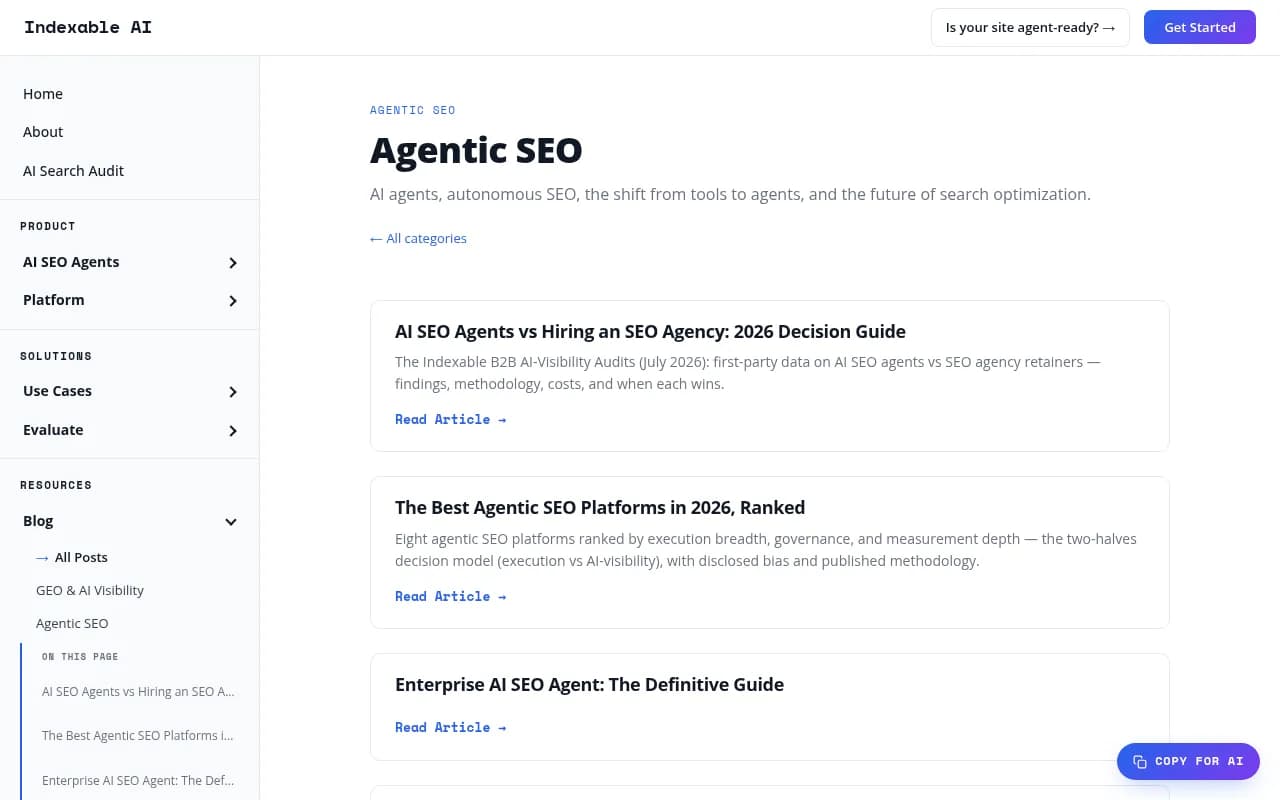
Indexable's framework for testing autonomous SEO claims is useful here, because a lot of vendors throw the word "agent" at what is really a report generator. They use a six-level scale:
| Level | What the system does | What it means for you |
|---|---|---|
| L0 | Reports data | A dashboard, nothing more |
| L1 | Makes recommendations | Still requires you to do everything |
| L2 | Assists with tasks | Drafts, but you drive |
| L3 | Supervises execution | Runs tasks, you approve |
| L4 | Executes autonomously | Plans, writes, publishes on a schedule |
| L5 | Embedded optimization | Continuously improves without prompting |
Most "AI visibility tools" on the market sit at L0 or L1. They tell you your share of voice and then email you a PDF. Agentic GEO means getting to L3 or L4: the system closes the loop from insight to published, indexed, cited content.
That's the gap this guide closes. Here's the six-step path from "we have no idea what ChatGPT says about us" to a publishing pipeline that runs itself.
Step 1: Run a baseline visibility audit (the right kind)
Every GEO effort starts with the same question: where are we visible, where are we invisible, and does it matter? The mistake most teams make is auditing too narrowly. They test 20 brand-name prompts in ChatGPT, see they're mentioned, and declare victory.
A real audit has more layers:
- Prompt coverage: not just "[brand] review" but the research prompts your buyers actually type, including the ones where you should appear and don't.
- Multi-model runs: ChatGPT, Gemini, Claude, Perplexity, and Google AI Overviews give different answers to the same prompt. Testing one model tells you about one model.
- Native vs. web testing: user-facing answers and citations can differ from API outputs, so you need to monitor actual interfaces, not just API responses.
- Business impact: mentions are nice, traffic and conversions from AI platforms are better.
The scoping matters as much as the tooling. Before you run anything, decide which personas, regions, and buying stages you care about. A B2B SaaS company selling in the US and Germany should not treat a German-language Perplexity answer as noise, and should not treat a consumer chatbot's opinion as signal.
For the audit itself, you have two routes. You can do it manually: design prompts, run them across models, log citations in a spreadsheet. That works once and stops working at scale. Or you can use a platform. Promptwatch runs the audit across ChatGPT, Gemini, Claude, Perplexity, Grok, Copilot, and Google AI Overviews using real UI data, with prompt volumes and difficulty scores so you can prioritize which prompts are worth fighting for.

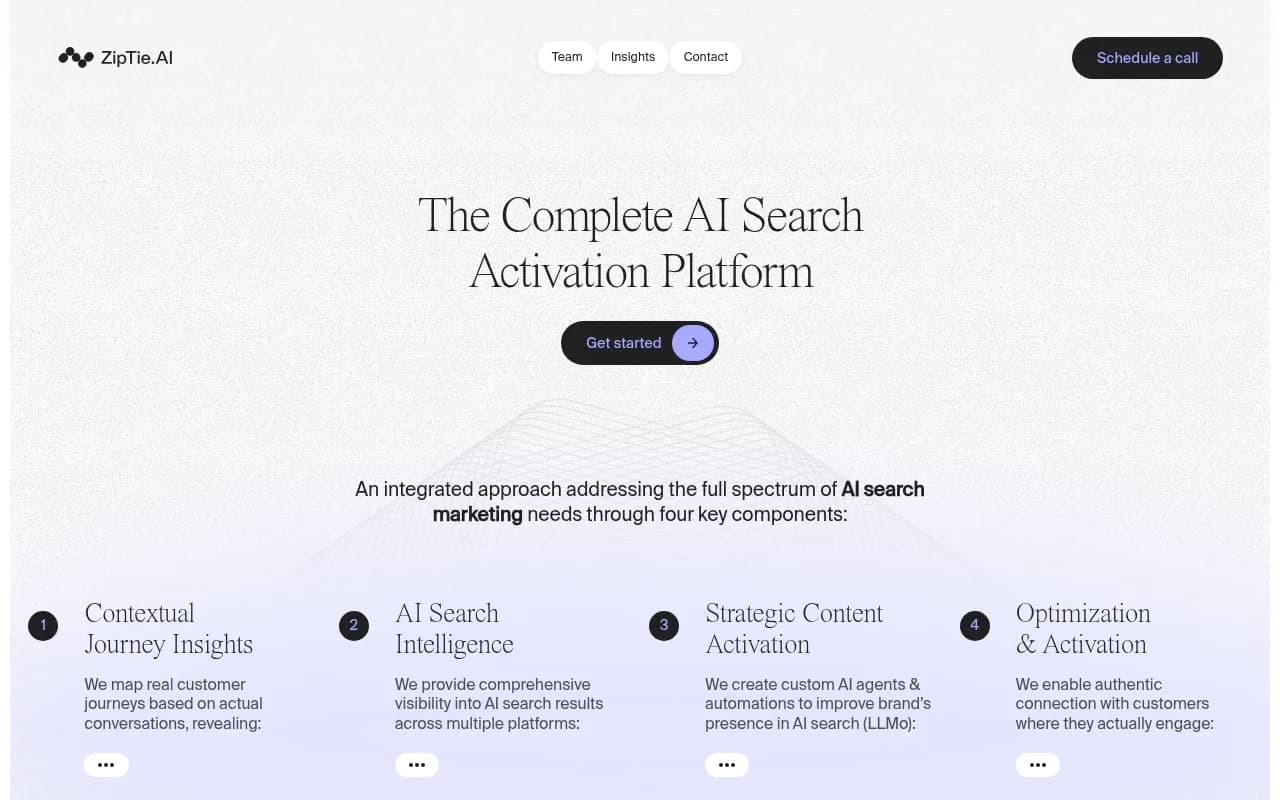
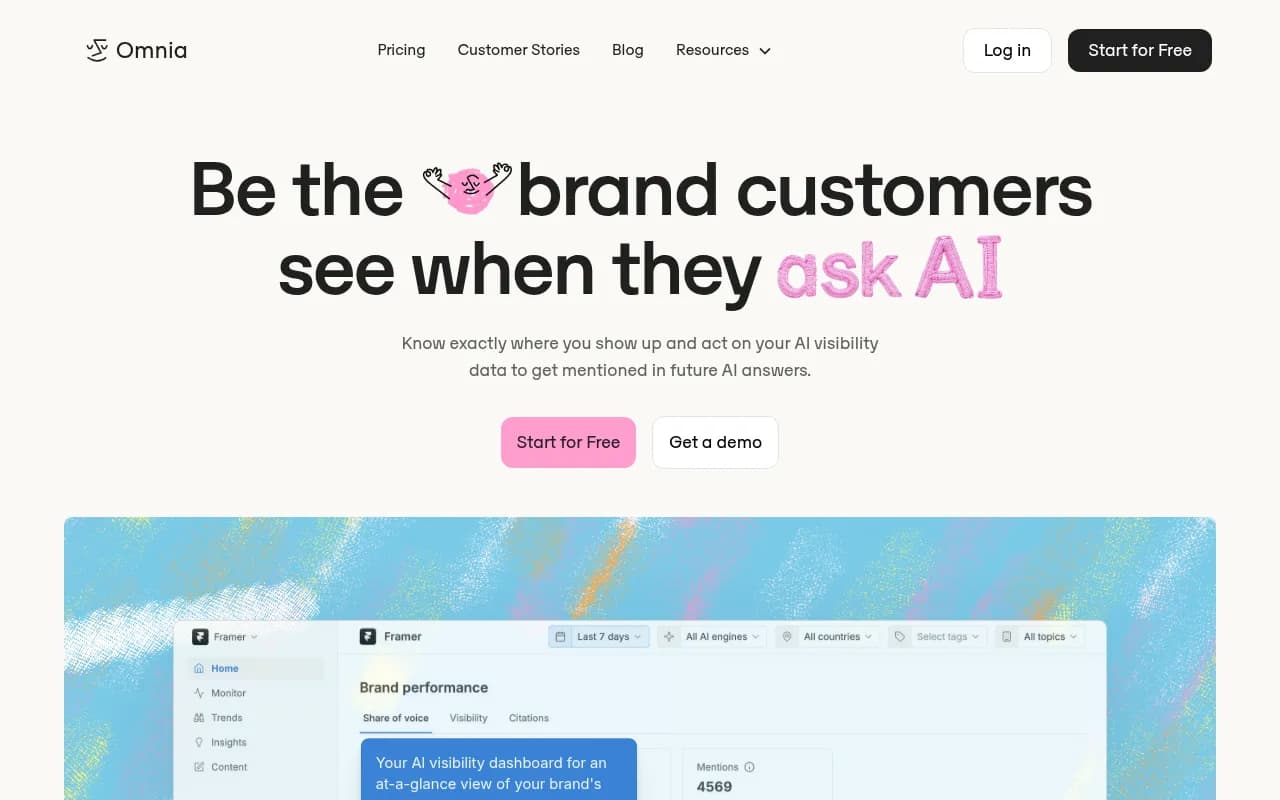
If you want a second opinion or a different angle, tools like ZipTie, Omnia, and Profound also run visibility audits, each with different strengths in depth and share-of-voice analytics.

The output of step 1 should be a short, honest document: our visibility score, our top 10 invisible prompts by business value, and which models we're weakest in. That document drives everything after this.
Step 2: Check your AI crawler logs before anything else
Here's the step almost everyone skips. Before you write a single new page, find out whether AI systems can actually read your site.
AI crawlers like ChatGPTBot, ClaudeBot, PerplexityBot, and GoogleOther visit your pages constantly. Most sites have never looked at what those crawlers read, which pages they hit, and whether they get errors. This is the technical foundation of GEO, and it's the equivalent of doing keyword research before your site is indexable.
What crawler logs tell you:
- Which of your pages AI systems actually read (and which they ignore)
- Whether they hit 403s, 429s, or redirect chains that block them
- The crawl-to-citation path: pages that get crawled a lot but never cited are a content problem, pages that never get crawled are a technical problem
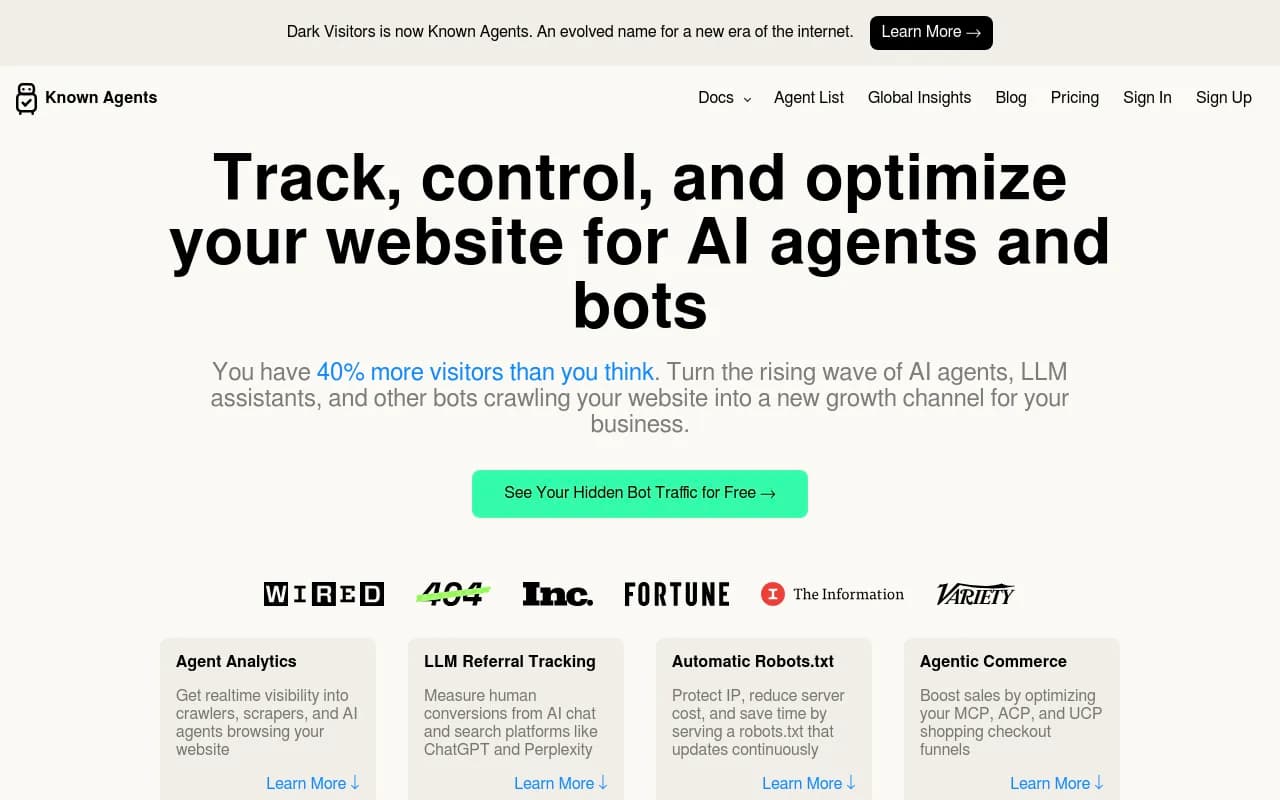
Promptwatch's Agent Analytics logs 400+ AI crawlers in real time, with a citation rate per page. If you'd rather piece it together yourself, DarkVisitors tracks which AI agents and bots visit your site, and you can pipe raw logs through Cloudflare or Vercel into your own analysis.
The fix list from this step is usually short and boring: update robots.txt to let known AI user agents through, expose content server-side (not behind client-side rendering AI crawlers can't execute), publish an llms.txt, and fix whatever errors the logs surface. Boring fixes, real impact.
Step 3: Fix the technical foundations
With logs in hand, work through the technical checklist. This is where agentic workflows start to earn their keep, because a technical audit agent can run a 50-point site audit in minutes instead of the 12-20 hours a manual audit takes.
The core items:
- Server-side rendering for content that matters. If your key pages are JavaScript-rendered, some AI crawlers will see empty shells.
- Schema.org markup: comprehensive structured data helps both classic search and AI systems parse what your content is and who published it.
- llms.txt: a plain-language map of your site for AI systems. It takes an hour to generate and costs nothing.
- Clean crawl paths: no orphaned money pages, no accidental noindex tags, no 10-hop redirect chains.
For the crawling and audit work, Screaming Frog remains the standard for technical SEO audits, and Sitebulb and Lumar both handle large-scale and enterprise crawling well.
If you're building your own audit agent rather than using a platform, the advice from practitioners who've done it is consistent: start with one agent, one audit, one site you know well. Run it, compare its output to a manual audit, and refine the prompts until the gap closes. That first audit becomes your proof of concept. Each run after that makes the agent better.
Step 4: Close the content gaps AI is exposing
Now, and only now, do you get to content. This is where the audit from step 1 pays off, because it tells you exactly which prompts you're invisible for and which pages competitors get cited on instead of you.
Content gap analysis for GEO is different from traditional keyword gap analysis. You're mapping your existing content against actual AI responses: what questions did the model answer, what sources did it cite, and what would you have needed on your site for it to cite you? Coverage scores per page, per topic, tell you where the holes are.
The workflow looks like this:
- Pull the prompts where you're invisible but should be visible (step 1 output).
- For each prompt, look at what the AI answer cited and what content types won (comparison pages, how-to guides, statistics roundups, Reddit threads, YouTube videos).
- Generate content briefs that fill the gap, with brand instructions, internal linking, and the actual search and news context baked in.
- Prioritize by prompt volume and difficulty, not by gut feel.
Promptwatch's content gap analysis does this against its dataset of 4.5 billion analyzed citations, and its briefs pull in search results, news, YouTube transcripts, and internal linking suggestions. It also classifies every citation by content type and source type, so you can see, for instance, that AI models in your niche love citing Reddit threads and YouTube, channels most teams ignore entirely.
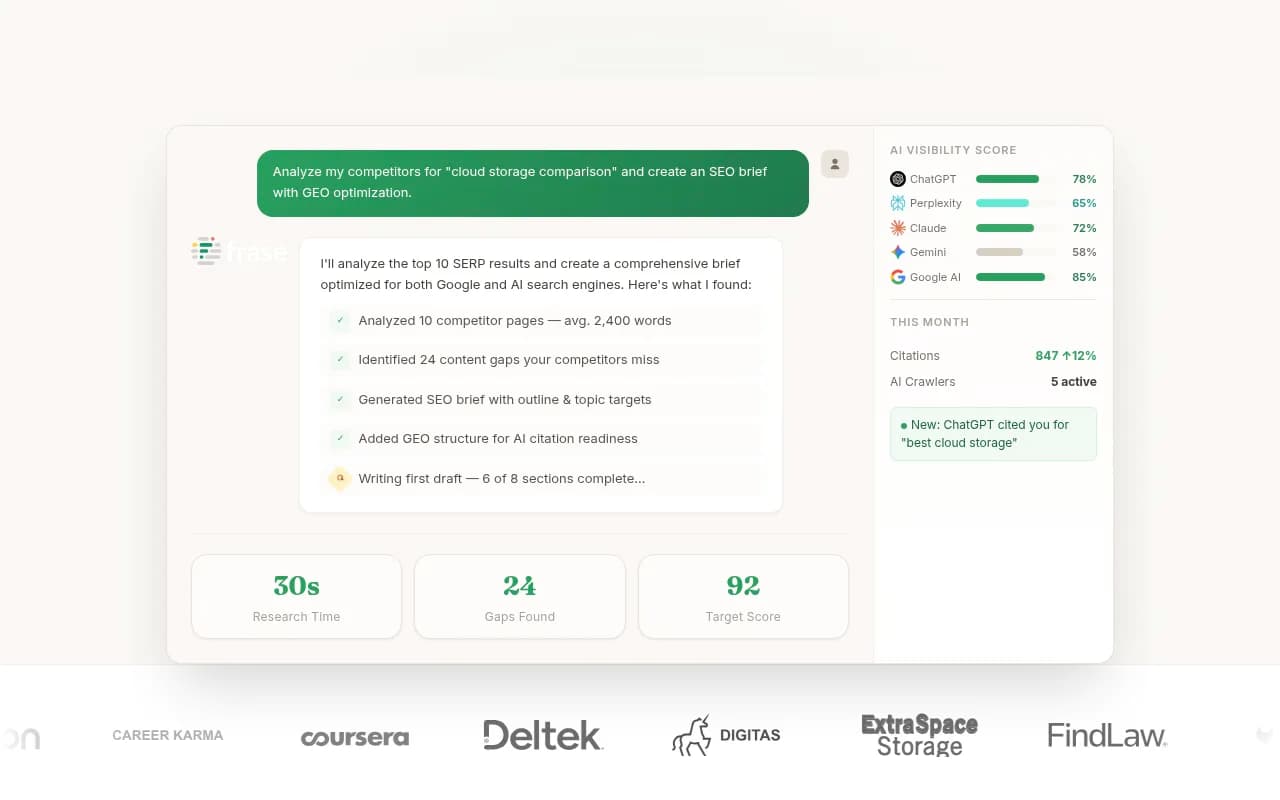
If you're running a more manual operation, Frase and MarketMuse both do content research and gap analysis, and Clearscope handles optimization scoring for both Google rankings and AI search.

One finding worth acting on even if you do nothing else in this step: Reddit and YouTube citations are heavily represented in AI answers, and most companies have zero strategy for either. If your buyers ask AI about your category and the model cites a two-year-old Reddit thread, that thread is your competition.
Step 5: Set up autonomous publishing with human review
This is the step that separates agentic GEO from GEO with extra steps. Instead of handing your content briefs to a writer (human or freelance), you hand them to an agent that drafts, and you publish on a schedule.
The honest way to do this, based on what's actually working in 2026:
Start at L3, not L4. Let the agent plan and draft, but keep a review inbox. Crisp, a customer support platform, scaled to 5-10 GEO-optimized articles per day this way and reported 2x higher conversion rates from AI traffic than from traditional channels. That only works because humans reviewed output early on and the prompts got better with each cycle. Full autopilot from day one produces generic content that neither Google nor AI models want to cite.
The pipeline:
- The agent takes a prioritized brief from step 4.
- It drafts with GEO scoring applied during writing, not after: answer-first structure, entity density, factual specificity.
- It publishes to your CMS (Webflow, Framer, and WordPress are the common ones) on a schedule you control.
- A human reviews, edits, approves or rejects. Rejections feed back into the prompts.
- Once quality is stable for a few weeks, loosen the schedule and let more through on autopilot.
Promptwatch's Content Agents run exactly this pipeline, with CMS publishing built in and a review inbox you can graduate from. If you'd rather assemble your own stack, Byword and Writesonic both generate and publish SEO content autonomously, and n8n or Zapier can wire the pieces together if you want full control over the workflow.

A word of caution. Autonomous publishing without the measurement loop in step 6 is just content farming with better branding. The teams getting results are the ones where the agent's output is grounded in citation data and crawler logs, not generated from a keyword list and vibes.
Step 6: Build the feedback loop and measure what matters
The last step closes the circle. Every published article should feed back into your visibility tracking: did citations increase for the target prompts? Did AI traffic to that page convert? Which models picked it up and which ignored it?
What to measure, in order of usefulness:
- Citation trends per prompt and per model, including ramp-up and decay. AI citations decay, and knowing your decay curve tells you when to refresh.
- AI-driven traffic and conversions, not just mentions. Visitor analytics that attribute actual sessions from ChatGPT, Perplexity, and AI Overviews to your site.
- Share of voice against named competitors across prompts and models.
- Sentiment: how positively or negatively the models discuss you, because being cited in a comparison answer that calls your product "dated" is not a win.
Promptwatch handles this loop natively: citation trends, visitor analytics, competitor heatmaps, sentiment analysis, and a weekly digest of prioritized actions (Unified Actions) that tells you what to fix next. Its Agent Chat also lets you ask questions about your live data in plain language, which is faster than building dashboards for every question.
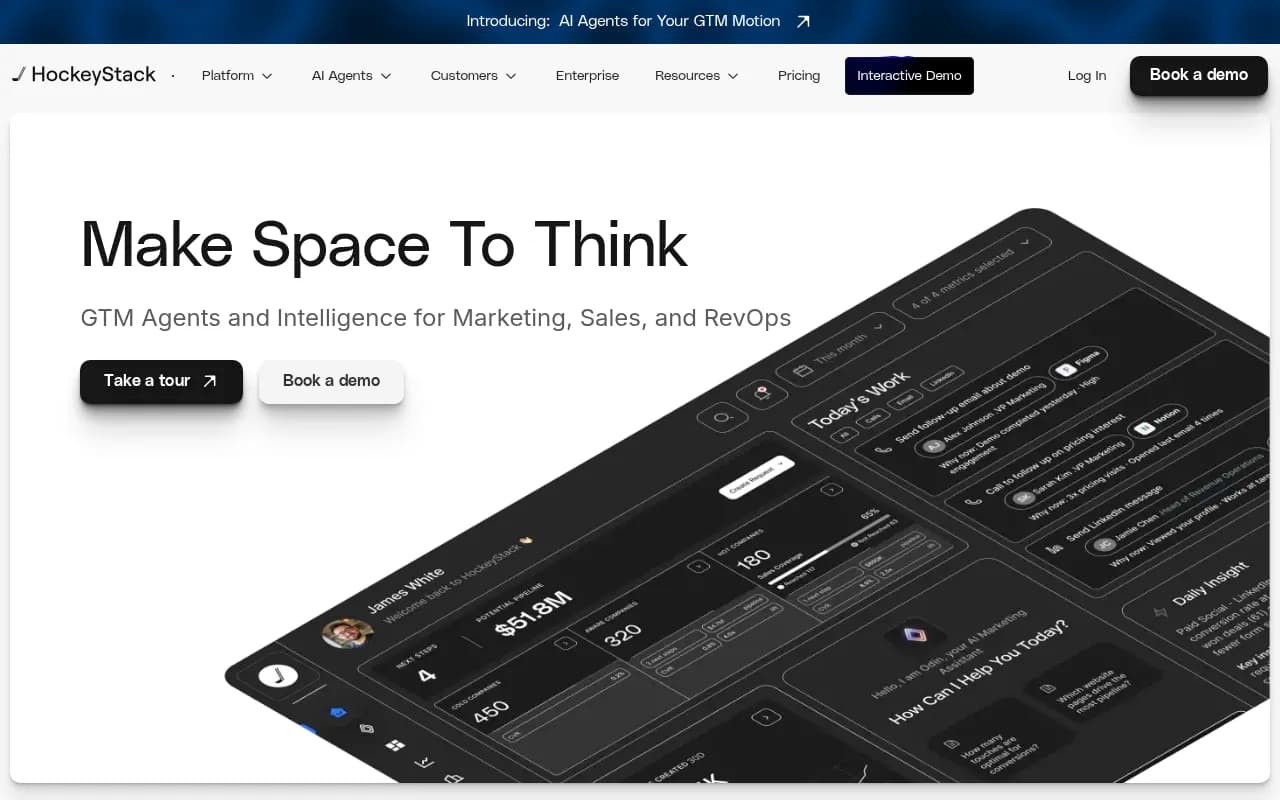
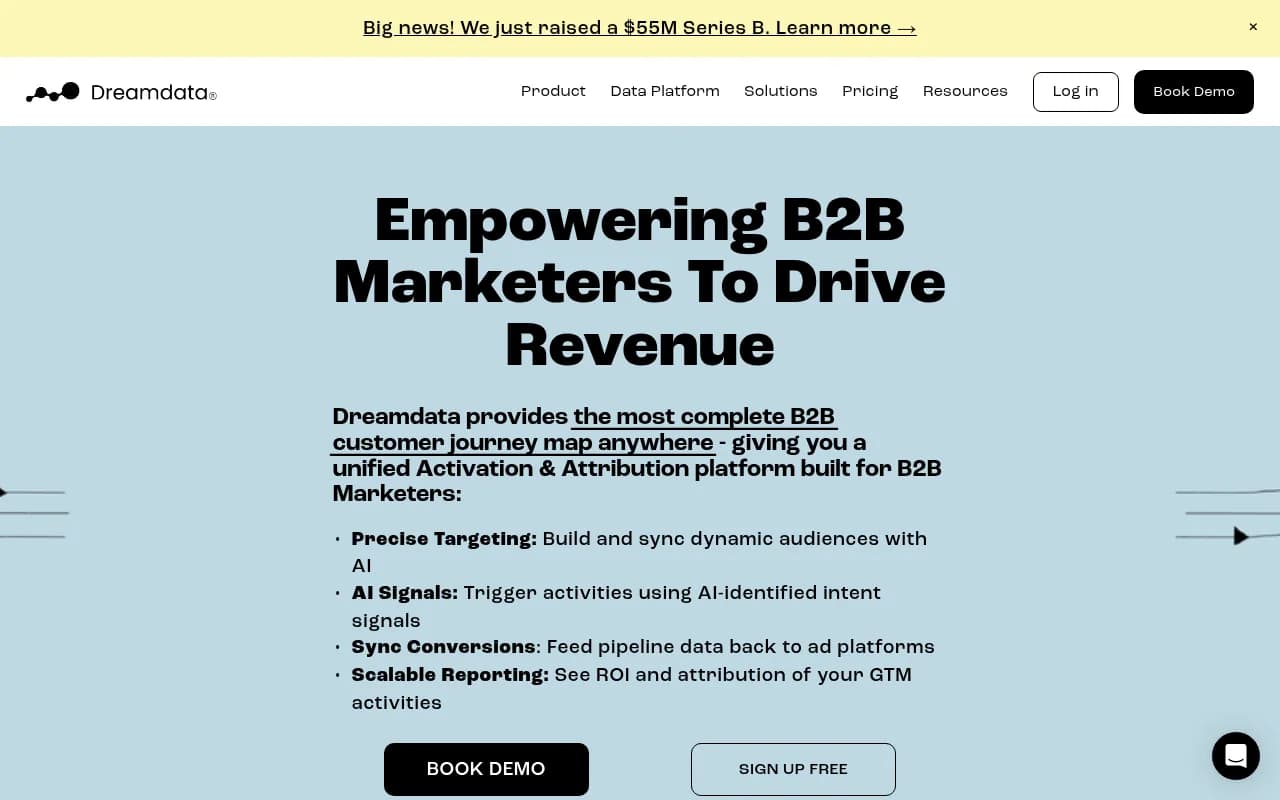
For attribution on the revenue side, HockeyStack and Dreamdata both connect AI-driven sessions to pipeline, which matters if you need to justify the program to a CFO.
The whole stack, compared
Because the steps above touch different tools, here's a quick map of what each category does and where it fits:
| Step | What you need | Example tools | Level of autonomy |
|---|---|---|---|
| 1. Visibility audit | Multi-model prompt tracking with volumes | Promptwatch, Profound, ZipTie | L0-L1 |
| 2. Crawler logs | AI bot hit logs with error tracking | Promptwatch Agent Analytics, DarkVisitors | L0 |
| 3. Technical foundations | Site crawling and audit | Screaming Frog, Sitebulb, Lumar | L1-L2 |
| 4. Content gaps | Gap analysis and briefs | Promptwatch, Frase, MarketMuse | L1-L2 |
| 5. Autonomous publishing | Agent drafting with CMS publishing | Promptwatch Content Agents, Byword, Writesonic | L3-L4 |
| 6. Feedback loop | Citation trends, traffic attribution, action digests | Promptwatch, HockeyStack, Dreamdata | L0-L1 |
The pattern worth noticing: most tools cover one or two steps. The platforms that cover the full loop, audit through publish through measure, are the ones that can actually run agentic GEO, because the agent needs the citation data and crawler logs to ground its decisions. A content generator without visibility data is flying blind.
Common mistakes
A few things I see teams get wrong consistently:
- Auditing once and never again. AI answers shift weekly. A January audit is stale by March.
- Blocking AI crawlers by default. Some security plugins and CDN settings block unknown bots, which quietly includes most AI crawlers. Check your logs before assuming you're visible.
- Treating mentions as the goal. A mention in an answer nobody acts on is a vanity metric. Track AI-driven traffic and conversions.
- Going full autopilot too early. The agencies reporting the best results from agentic workflows (65-75% gross margins versus 40-50% for traditional delivery, per Digital Applied's analysis) got there by refining agent prompts through dozens of supervised runs first.
- Ignoring Reddit and YouTube. If AI models cite them in your category and you have no presence there, you're conceding those citations to whoever shows up.
Where to start Monday morning
If you're doing this in-house: run a baseline audit this week (step 1), pull your AI crawler logs (step 2), and fix whatever the logs surface (step 3). That's a week of work and it's the foundation everything else depends on.
If you're evaluating platforms: test how far up the autonomy ladder each one actually goes. Ask the vendor to demo the full loop, from an invisible prompt to a published article to a measured citation lift. If they can only show you dashboards, they're a tracker, not an agentic platform.
And if you'd rather hand the whole program to a team that runs this stack daily, 1001 SEO Media builds and operates agentic GEO programs end to end, from the first visibility audit through autonomous publishing, with transparent monthly reporting and no long-term contracts.
The question, as one practitioner put it, is whether you build the agents or become the business that gets disrupted by them. Either way, the audit comes first. Start there.