Key takeaways
- ChatGPT-referred e-commerce traffic converts at a 31% higher rate than traditional organic search, making AI visibility a direct revenue lever.
- Paid click-through rates on queries with AI Overviews have dropped 68%, so organic AI citations are no longer optional.
- Most AEO tools only monitor -- they show you a score and stop there. The tools that actually move the needle help you find gaps, create content, and track results.
- E-commerce brands need to think beyond keywords: structured product data, review signals, and entity context are what AI models use to decide who to recommend.
- Agentic commerce (AI agents completing purchases autonomously) is coming fast. Brands that aren't visible in AI responses now will be invisible to those agents too.
Something shifted in late 2024 and accelerated hard through 2025: shoppers stopped Googling and started asking. Not just asking Google, but asking ChatGPT, Perplexity, Claude, Gemini. "What's the best running shoe for wide feet under $150?" "Which protein powder doesn't taste like chalk?" "Is [brand X] actually good or just well-marketed?"
These aren't informational queries anymore. They're buying signals. And the brands that show up in those AI-generated answers are capturing customers before they ever see a search results page.
According to Similarweb's 2025 Generative AI Landscape report, generative AI platforms now drive over two billion referrals to transactional sites each month. That number is only going up. If your e-commerce brand isn't optimizing for how AI engines answer product questions, you're leaving a growing slice of high-intent traffic on the table.
This guide covers what AEO actually means for e-commerce in 2026, what to look for in a tool, and which platforms are worth your time.
What AEO means for e-commerce specifically
Answer Engine Optimization (AEO) -- sometimes called Generative Engine Optimization (GEO) -- is the practice of making your brand, products, and content the source AI models reach for when answering user queries.
For e-commerce, this has a specific flavor. You're not just trying to rank for informational content. You need AI models to:
- Recommend your products when someone asks for the best option in a category
- Cite your product pages, reviews, and comparison content as authoritative sources
- Surface your brand name positively when someone asks "is [brand] good?"
- Include your products in shopping carousels and product recommendation responses (especially in ChatGPT's shopping features)
That's a different challenge than traditional SEO. Google's algorithm rewards links and on-page signals. AI models reward clarity, specificity, trustworthiness, and the quality of the sources they've been trained on or can retrieve. Reviews matter. Reddit threads matter. The way your product descriptions are structured matters.
What to look for in an AEO tool for e-commerce
Not all AEO tools are built with e-commerce in mind. Here's what actually matters when you're selling products:
Prompt-level visibility tracking. You need to know exactly which queries your brand appears in -- not just a vague "visibility score." When someone asks "best wireless earbuds for commuting," are you there? If not, why not, and who is?
Competitor comparison. E-commerce is inherently competitive. The best tools show you which competitors are being cited for the same prompts you want to own, and what's different about their content.
Review and sentiment signals. AI models pull from review aggregators, Reddit, and third-party sources to validate product claims. Tools that surface how your review sentiment appears in AI responses give you a real edge.
Content gap analysis. Knowing you're invisible is only useful if you know what to do about it. The best tools identify the specific topics, questions, and product angles you're missing.
ChatGPT Shopping tracking. ChatGPT now surfaces product recommendations and shopping carousels. For e-commerce brands, this is a whole new placement to track and optimize for.
Traffic attribution. Visibility scores are nice. Revenue is better. Tools that connect AI citations to actual site traffic and conversions tell you whether your AEO work is paying off.
The tools worth knowing about
For comprehensive AI visibility and optimization
Promptwatch is the platform I'd point most e-commerce teams toward first. It covers 10 AI models (ChatGPT, Perplexity, Claude, Gemini, Grok, DeepSeek, and more), tracks prompt-level visibility, and -- crucially -- goes beyond monitoring to help you actually fix what's broken.

The thing that separates it from most competitors is the action loop: you find the prompts where competitors are visible but you're not, generate content specifically engineered to get cited by AI models, then track whether your visibility improves. It also has crawler logs that show you which AI bots are hitting your site and what they're reading -- something most tools don't offer at all. For e-commerce brands, the ChatGPT Shopping tracking is particularly relevant.
For enterprise e-commerce teams
Profound is a solid choice for teams that need deep analytics and are willing to pay for it. It covers multiple AI platforms and has strong prompt tracking features.

BrightEdge has been in the enterprise SEO space for years and has added AI search tracking through its AI Catalyst product. If you're already on BrightEdge for traditional SEO, the AI visibility layer is worth exploring.
Azoma is specifically built for AI shopping optimization -- it focuses on ChatGPT's Rufus and other AI shopping surfaces, which makes it unusually relevant for product-focused brands.
For mid-market and growing brands
SE Ranking has added an AI Visibility Toolkit to its existing SEO platform. If you're already using SE Ranking for keyword tracking, this is a low-friction way to add AI monitoring.
AthenaHQ covers 8+ AI search engines and has clean reporting. It's monitoring-focused, so you'll need to bring your own content strategy, but the data quality is good.

Rankscale is worth a look for brands that want prompt-level tracking without enterprise pricing.
For tracking AI shopping specifically
GetCito focuses on AI citation tracking and is worth testing if you want to understand which pages are actually being cited in AI responses.
LLM Clicks tracks citations specifically in AI-powered search, which helps you connect visibility to actual traffic.
For content creation that targets AI visibility
Writesonic has built AI search visibility features into its content platform, which is useful if you want to create and optimize content in one place.
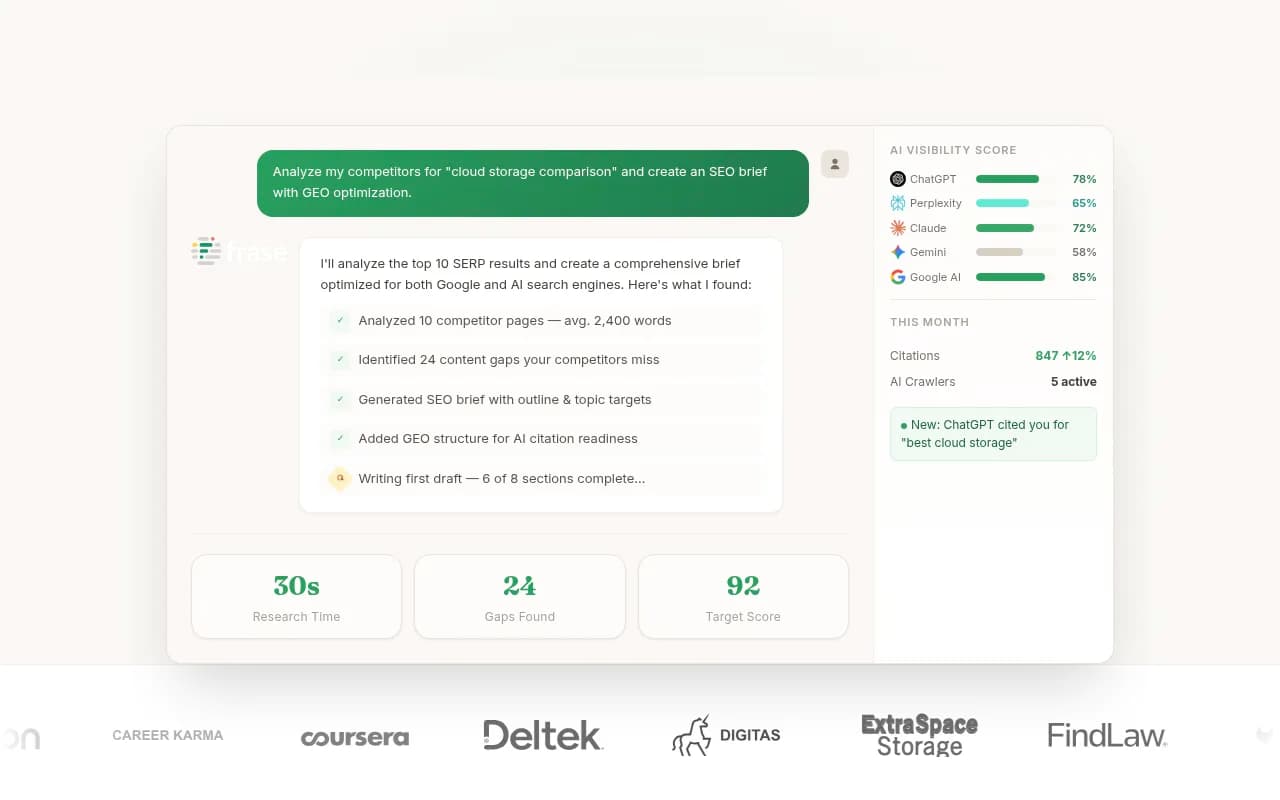
Frase combines SEO research with content generation and has been adding GEO-specific features.
Comparison: AEO tools for e-commerce brands
| Tool | AI models tracked | Content generation | ChatGPT Shopping | Traffic attribution | Best for |
|---|---|---|---|---|---|
| Promptwatch | 10+ | Yes (built-in AI writer) | Yes | Yes (GSC, logs, snippet) | Full-cycle optimization |
| Profound | 5+ | No | No | Limited | Enterprise analytics |
| AthenaHQ | 8+ | No | No | No | Monitoring-focused teams |
| SE Ranking | 4+ | Limited | No | No | Existing SE Ranking users |
| Azoma | 3 (shopping-focused) | No | Yes | Limited | AI shopping surfaces |
| Writesonic | 3+ | Yes | No | No | Content + basic tracking |
| Rankscale | 5+ | No | No | No | Mid-market monitoring |
The e-commerce AEO playbook
Tools are only useful if you know what to do with them. Here's how to think about AEO as an e-commerce brand in 2026.
Step 1: Map the prompts that matter to your category
Start with the questions your customers actually ask AI models. "Best [product category] for [use case]" queries are the obvious ones, but don't ignore comparison queries ("X vs Y"), problem-first queries ("how do I fix [problem]"), and brand validation queries ("is [your brand] legit?").
These are the prompts you need to be visible for. A good AEO tool will show you which ones you're already winning and which ones competitors own.
Step 2: Audit your content against what AI models want
AI models cite content that directly answers questions, has clear entity context, and is backed by credible signals. For e-commerce, that means:
- Product pages that answer "why should I buy this" clearly and specifically
- Comparison content that helps AI models understand where your product fits vs alternatives
- Review content that surfaces authentic customer sentiment (AI models pull from reviews heavily)
- FAQ and structured data that makes your product attributes machine-readable
Google's Universal Content Protocol (UCP), announced in 2026, is accelerating this by giving retailers a standardized way to feed structured product data into AI systems. If you haven't looked at UCP yet, it's worth understanding.
Step 3: Fix the gaps with content that's built to be cited
Generic blog posts won't cut it. The content that gets cited by ChatGPT, Perplexity, and Claude tends to be specific, authoritative, and directly responsive to the query. Think: "The 7 best [product type] for [specific use case] in 2026" with real comparisons, real specs, and real opinions.
This is where having a tool with built-in content generation (rather than just monitoring) saves significant time. Promptwatch's AI writing agent, for example, generates content grounded in citation data -- it knows what kinds of pages AI models actually cite, and writes accordingly.
Step 4: Track reviews and off-site sentiment
AI models don't just read your website. They read Reddit, review aggregators, YouTube comments, and third-party publications. If your brand has a reputation problem on Reddit, that will show up in AI responses whether you like it or not.
Monitoring what AI models say about your brand (not just whether they mention you) is important. Tools like Promptwatch surface the actual language AI models use when describing your brand, which tells you a lot about how your off-site reputation is being interpreted.
Step 5: Connect visibility to revenue
Visibility scores are a means to an end. The real question is: is AI search driving traffic and sales? Tools that integrate with Google Search Console, server logs, or use a tracking snippet to identify AI-referred visitors give you the attribution data you need to justify the investment.
The agentic commerce angle
Here's something most AEO guides skip: the next wave isn't just AI answering questions. It's AI completing purchases.
Agentic commerce -- where AI agents autonomously browse, compare, and buy on behalf of users -- is moving from experiment to reality. OpenAI's Operator, Perplexity's shopping features, and various browser-based AI agents are already doing this in limited ways.
For e-commerce brands, this means your AEO work today is also future-proofing for a world where the "customer" is an AI agent deciding which product to add to a cart. If your products aren't being recommended in AI responses now, they won't be in the agent's consideration set either.
Structured product data, clear pricing, availability signals, and strong review profiles are all things AI agents will use to make purchasing decisions. Getting those right now serves both current AEO and future agentic commerce readiness.
What most AEO tools get wrong for e-commerce
A quick honest note: the majority of AEO tools on the market in 2026 are monitoring dashboards. They'll show you a visibility score, maybe a list of prompts you appear in, and leave you to figure out what to do next.
That's fine for brand awareness tracking. It's not enough for e-commerce teams with revenue targets.
What e-commerce brands actually need is the full cycle: find the gaps, create content that fills them, and track whether it worked. Most tools handle step one. Few handle all three. When evaluating any tool, ask specifically: "After I see where I'm invisible, what does this tool help me do about it?"
Quick-reference tool list
For teams that want to explore the full landscape, here are additional tools worth evaluating:


The shift to AI-powered product discovery isn't slowing down. Brands that treat AEO as a core channel now -- not a side experiment -- will have a meaningful advantage as AI search matures and agentic commerce becomes mainstream. The tools exist. The playbook is clear enough. The question is whether your team moves on it before your competitors do.