SEOmonitor Review 2026
SEO platform built for agencies that includes ChatGPT rank tracking alongside traditional search analytics, forecasting, and client reporting tools.
Key takeaways
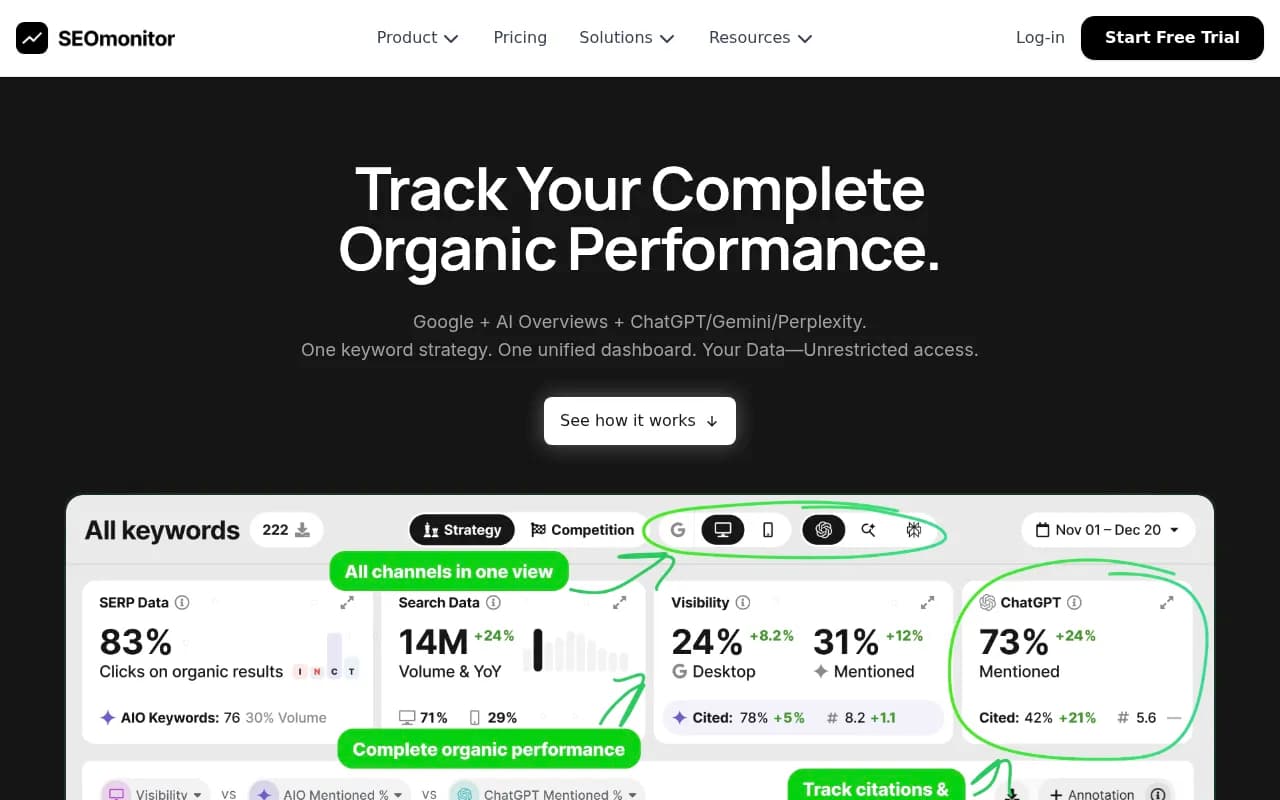
- SEOmonitor is a mature, agency-focused SEO platform that has expanded into AI search tracking, covering Google, AI Overviews, ChatGPT, Gemini, and Perplexity from a single keyword-based dashboard
- Rated 4.7/5 on G2 and trusted by agencies working with brands like Vodafone, Gymshark, Marks & Spencer, and TUI
- The keyword-based methodology (rather than prompt-based) is a genuine differentiator for agencies that want unified reporting across traditional and AI search channels
- Lacks the depth of a dedicated GEO platform: no AI crawler logs, no answer gap analysis, no prompt volume/difficulty scoring, no Reddit or YouTube citation tracking, no ChatGPT Shopping monitoring, and no AI traffic attribution -- capabilities that Promptwatch provides as core features
- Best suited for SEO agencies that want one tool for traditional SEO plus basic AI visibility, rather than teams that need deep AI search optimization
SEOmonitor has been around long enough to earn a real reputation in the agency SEO space. The Romanian-built platform started as a rank tracker and forecasting tool, then grew into a full agency workflow platform covering keyword research, content audits, client reporting, and business case generation. More recently, it added AI search tracking -- covering AI Overviews, ChatGPT, Gemini, and Perplexity -- making it one of the few traditional SEO tools to seriously attempt unified organic performance tracking.
The target audience is clear: SEO agencies managing multiple client accounts who are tired of juggling separate tools for rank tracking, reporting, forecasting, and now AI visibility. SEOmonitor's pitch is that you shouldn't need a different methodology or dashboard for each search channel. One keyword strategy, tracked everywhere. That's a compelling idea, and in practice it works reasonably well for agencies whose primary job is still traditional SEO with AI tracking as a secondary concern.
The platform has built a solid customer base that includes major agencies like Publicis, Performics, Brainlabs, and Wavemaker, alongside direct brands like Vodafone and Miro. That's not a small list. It suggests the tool has real staying power and has earned trust at scale.
Key features
Unified organic performance dashboard
The core idea here is that you track the same keywords across Google, AI Overviews, ChatGPT, Gemini, and Perplexity -- rather than maintaining separate keyword lists or prompt lists for each channel. In practice, this means when you add "running shoes" to your campaign, SEOmonitor automatically checks your Google ranking, whether you appear in AI Overviews for that query, and whether you're mentioned or cited in AI search responses from ChatGPT, Gemini, and Perplexity.
- Google rankings are tracked daily
- AI search visibility (ChatGPT, Gemini, Perplexity) is tracked weekly
- AI Overviews tracking is included with a dedicated methodology
- Competitor visibility is tracked automatically across all channels
The unified view is genuinely useful for agencies that need to show clients a complete picture of organic performance without building custom reports from multiple tools.
Keyword-based AI tracking methodology
SEOmonitor made a deliberate choice to track keywords rather than prompts for AI search. Their argument: one keyword like "running shoes" maps to thousands of long-tail prompts automatically, and keywords have verified search volume from Google while prompts don't. This means your AI visibility metrics are weighted by real demand, not arbitrary prompt selection.
This is a reasonable approach for agencies that want AI tracking to fit naturally into existing SEO workflows. The trade-off is that you lose granularity -- you can't see exactly which prompts your brand appears in, what the AI response says, or how your brand is framed. For agencies primarily doing traditional SEO, that's probably fine. For teams focused on GEO optimization, it's a significant limitation.
SEO forecasting
This is one of SEOmonitor's most mature features and the one that has earned the most industry recognition. The forecasting engine takes your keyword rankings and projects traffic outcomes, accounting for seasonality, CTR models (including zero-click adjustments for AI Overviews), and site authority. The output is a pitch-ready business case that agencies can use to win new clients.
- Month-by-month traffic projections
- AI Overview CTR impact calculations (accounts for zero-click behavior)
- Seasonality detection and adjustment
- Exportable business cases with executive summaries
- The "pitch for free, pay when you win" model means you can generate forecasts before committing to a paid campaign
The forecasting methodology is specific enough that SEOmonitor claims competitors have copied it -- which, whether or not you take that at face value, suggests it's been around long enough to be noticed.
AI content writer
SEOmonitor's content writer is positioned as a full content marketing agent, not just a text generator. The workflow covers topic discovery, editorial planning, writing, fact-checking, CMS publishing, and performance tracking.
- Strategic topic discovery based on site authority and ranking potential
- Built-in fact-checking before publishing (claimed to reduce hallucinations)
- Direct CMS publishing integration
- Automatic performance tracking after publication -- tracks how articles rank in Google, appear in AIO, and get cited in AI search
- A case study from AimUP agency claims 80% of articles rank within 30 days, 52% appear in AI Overviews, and 43% get cited in AI search
The content writer is a meaningful differentiator versus pure rank trackers. Whether the quality holds up at scale is harder to verify from the outside, but the workflow integration (from topic to tracking) is more complete than most SEO tools offer.
Keyword research and clustering
The research module generates a full keyword strategy from a URL. It handles automatic clustering, intent detection, and irrelevant keyword filtering. The pitch is "full keyword strategy in minutes" -- which is the standard claim for AI-assisted keyword tools, but SEOmonitor's integration with rank tracking and forecasting makes the output more actionable than standalone research tools.
Keyword Vault
A separate feature for tracking unlimited keywords with monthly updates, included in the plan. This is designed for monitoring a broader keyword universe without paying daily tracking prices for every keyword. Useful for agencies that want to keep an eye on thousands of keywords without the cost of daily tracking on all of them.
Content audit and cannibalization detection
Automatically identifies pages competing for the same keywords, intent mismatches, and content gaps. This is a standard feature in mature SEO platforms but SEOmonitor's integration with rank data and AI visibility makes it more useful than standalone audit tools.
Client reporting and dashboards
Agency-focused reporting with white-label client dashboards. The reporting pulls together Google rankings, AI visibility, traffic data from GA and GSC, and forecasting into a single view. Unlimited users are included at no extra cost, which is a genuine pricing advantage for agencies with large teams.
Competitive intelligence
Track competitors across all channels automatically. The competitive view shows Google visibility, AI Overview mentions, and AI search mentions side by side, with trend data over time. The example on the homepage (ASOS vs Next vs M&S vs H&M vs Debenhams in women's fashion) shows the kind of cross-channel competitive picture agencies can build.
Who is it for
SEOmonitor is built for SEO agencies managing multiple client accounts -- specifically agencies that do traditional SEO as their core service and want AI search tracking layered on top without switching tools or methodologies. An agency running 20-50 client campaigns, doing monthly reporting, and needing to pitch new business with data-backed forecasts will find the workflow fits naturally.
The "pitch for free, pay when you win" model is particularly well-suited to agencies that spend significant time on new business development. Being able to generate keyword research, traffic forecasts, and business cases before paying for a campaign is a real operational advantage.
Larger agencies working with enterprise brands (the Vodafone and Gymshark logos on the homepage suggest this is a real use case) will appreciate the unlimited users model and the API access for custom reporting. Teams that have built internal dashboards or client portals on top of SEO data will find the API useful.
Who should probably look elsewhere: teams whose primary goal is GEO optimization rather than traditional SEO. If you need to understand exactly which prompts your brand appears in, what the AI response says, why competitors are being cited, or how to close specific content gaps in AI search -- SEOmonitor's keyword-based approach gives you visibility scores but not the diagnostic depth to act on them. Similarly, brands that want to track AI crawler behavior on their site, monitor Reddit and YouTube as AI citation sources, or attribute AI search traffic to revenue will find SEOmonitor's AI tracking too surface-level.
Integrations and ecosystem
- Google Search Console: Direct integration for real traffic data alongside rank data
- Google Analytics: Connect GA to prove ROI with actual clicks
- CMS publishing: The content writer publishes directly to your CMS (specific CMS integrations not detailed on the homepage)
- Full API access: Included in all plans, no restrictions -- useful for agencies building custom reporting or automating workflows
- Data exports: No export limits mentioned as a pricing differentiator
The integration list is narrower than some competitors, but the GSC and GA integrations are the ones that matter most for agency reporting workflows. The API access without restrictions is a meaningful advantage for technical agencies.
No mention of Slack, Looker Studio, or other reporting tool integrations on the main site, though the API would enable these with custom work.
Pricing and value
SEOmonitor uses a configurable pricing model rather than fixed tiers. The pricing page mentions a Starter plan and a yearly discount of 17%, with pricing in both EUR and USD. Specific plan prices weren't available in the scraped content, but the platform emphasizes:
- No per-seat fees (unlimited users included)
- No data export limits
- Flexible plans adjustable anytime
- 14-day free trial, no credit card required
- "5x more keywords for the same budget as competitors" is their headline value claim
The "pay for data, not access" model is a genuine differentiator. Most SEO platforms charge per user or per export, which adds up quickly for agencies with large teams. SEOmonitor's model means the cost scales with data volume rather than team size.
For agencies comparing SEOmonitor to tools like Semrush or Ahrefs, the unlimited users model alone can justify the switch. For agencies comparing it to dedicated AI visibility platforms, the value calculation is different -- SEOmonitor covers more SEO ground but less AI search depth.
Strengths and limitations
What it does well:
- The unified keyword-based methodology genuinely solves the fragmented reporting problem for agencies doing traditional SEO plus AI tracking
- Forecasting and business case generation is mature, specific, and pitch-ready -- a real workflow advantage for agencies
- Unlimited users with no per-seat fees is a structural pricing advantage for larger agency teams
- The content writer's end-to-end workflow (topic to tracking) is more complete than most SEO tools
- Strong agency customer base (Publicis, Performics, Brainlabs) suggests real-world reliability at scale
Honest limitations:
- AI search tracking is visibility-level only -- you see whether you're mentioned, not what the AI says, why you're cited, or how to improve. There's no answer gap analysis, no prompt-level diagnostic data, and no content gap identification for AI search
- No AI crawler logs, so you can't see how AI engines are crawling your site, which pages they're reading, or what errors they're encountering
- No AI traffic attribution -- you can't connect AI search visibility to actual website visits or revenue
- No Reddit or YouTube tracking, which are significant citation sources for AI models
- No ChatGPT Shopping monitoring
- Prompt volume and difficulty scoring (to prioritize which AI queries to target) isn't part of the methodology
For teams that need to go beyond tracking and actually optimize for AI search, these gaps matter. Platforms like Promptwatch are built specifically around the optimization loop -- finding content gaps, generating content engineered for AI citation, and attributing the results to traffic and revenue. SEOmonitor's AI tracking is a useful addition to a traditional SEO workflow, but it's not a GEO optimization platform.
Bottom line
SEOmonitor is a strong choice for SEO agencies that want unified tracking across Google and AI search channels without abandoning their existing keyword-based workflow. The forecasting, client reporting, and unlimited-users pricing model make it particularly well-suited to agencies managing 10+ client accounts and spending significant time on pitching and reporting.
For teams whose primary need is AI search optimization -- understanding why competitors are cited, closing content gaps, tracking AI crawler behavior, or attributing AI visibility to revenue -- SEOmonitor's AI tracking layer is too shallow. That's a different job, and Promptwatch is built specifically for it.
Best use case: SEO agencies that want one platform for traditional SEO plus basic AI visibility monitoring, with strong forecasting and client reporting built in.
Frequently asked questions
What is SEOmonitor?
How does SEOmonitor track AI search visibility?
Is there a free trial for SEOmonitor?
How does SEOmonitor's pricing work?
Who is SEOmonitor best suited for?
How does SEOmonitor compare to dedicated GEO platforms like Promptwatch?
Similar and alternative tools to SEOmonitor