Key takeaways
- Google AI Overviews now appear on roughly 48-55% of all searches, a 58% increase year over year according to BrightEdge data tracking February 2025 through February 2026.
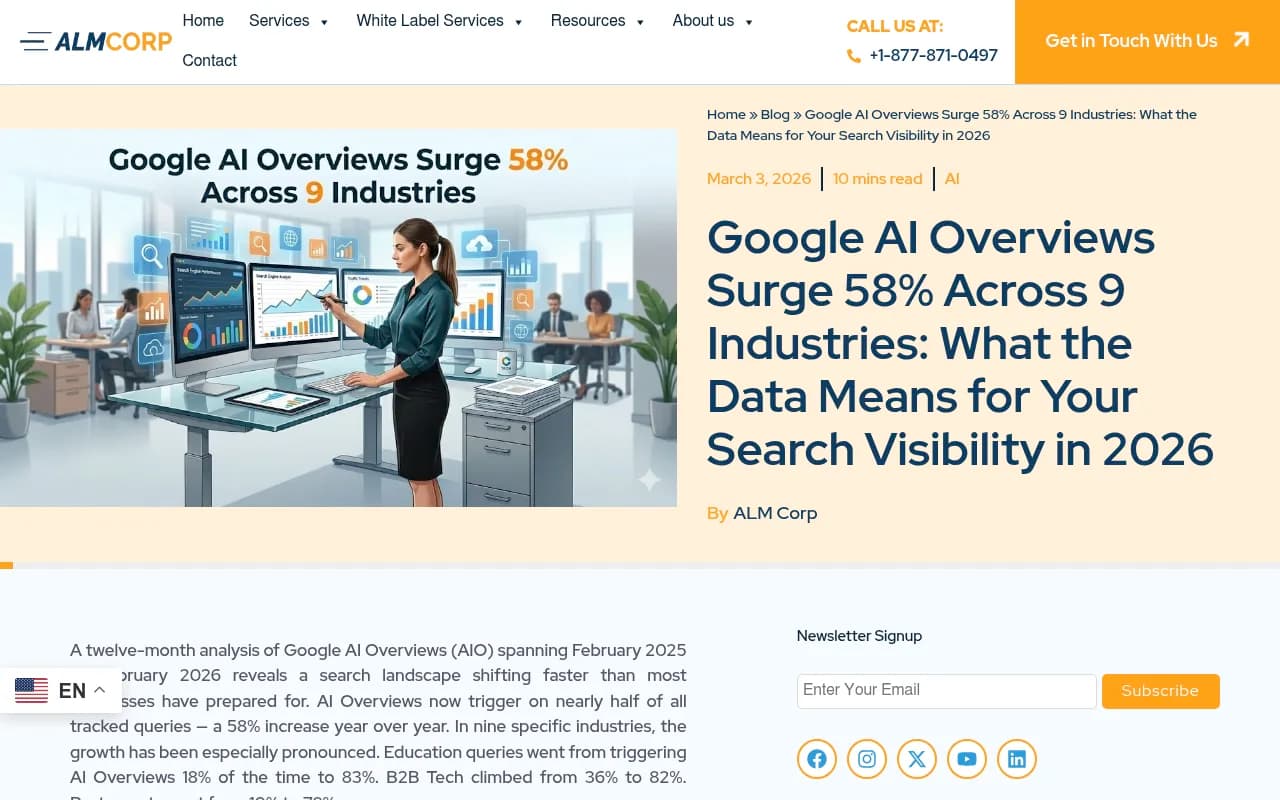
- The growth is extremely uneven by industry: Education jumped from 18% to 83% AI Overview trigger rate; B2B Tech from 36% to 82%; Restaurants from 10% to 78%.
- Long-tail, multi-word queries (8+ words) are 7x more likely to trigger an AI Overview than short queries.
- Local searches remain largely untouched, with AI Overviews appearing in only about 7% of local queries.
- Being cited in an AI Overview and ranking organically are two different things — your top-10 organic position doesn't guarantee you'll appear in the summary.
- Paid search is also affected: when AI Overviews push ads below the fold, CTR drops and cost-per-acquisition climbs.
The numbers coming out of 2026 are hard to ignore. Google AI Overviews, which many SEOs were treating as a curiosity or a minor nuisance just 18 months ago, have become a central feature of the search experience. BrightEdge tracked AI Overview presence across industry-specific keyword sets daily for a full year, and the results are striking: a 58% increase in AI Overview appearances, with the feature now triggering on roughly 48% of all tracked queries.
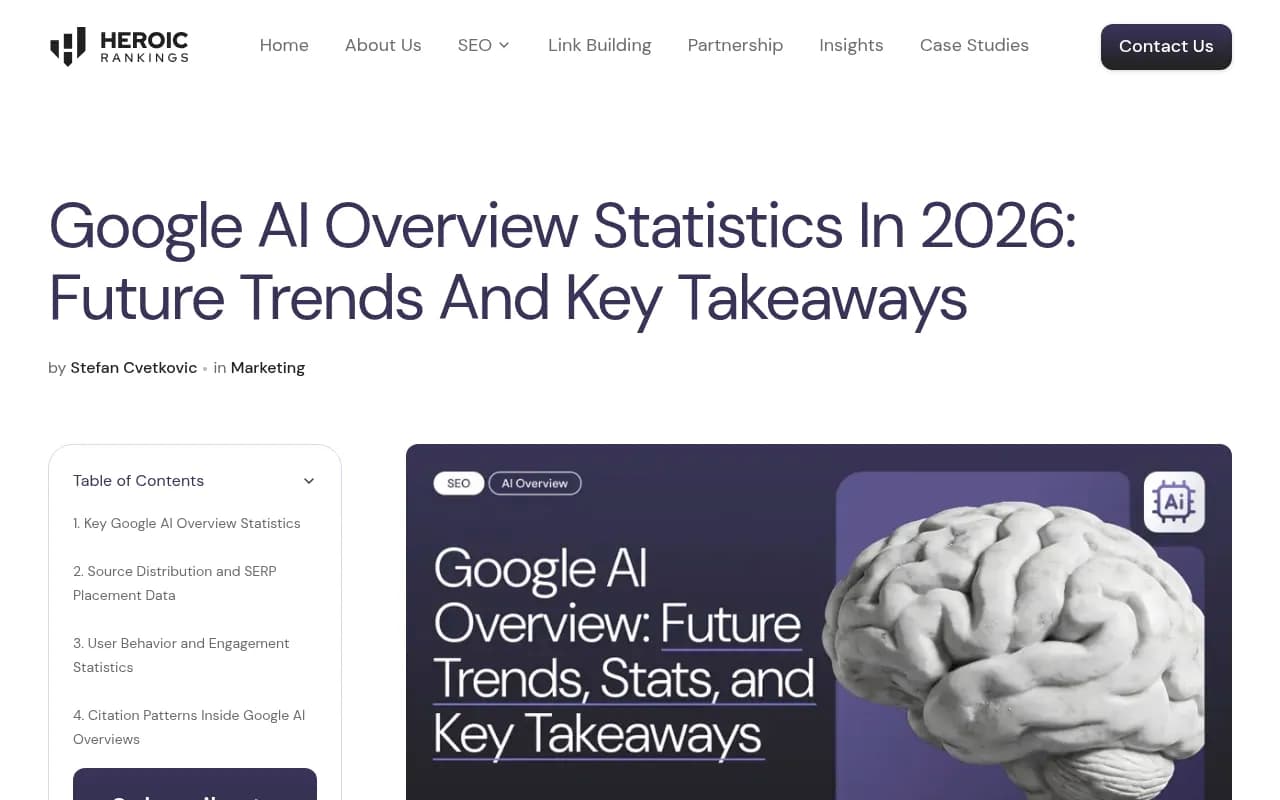
Other data puts the figure even higher. Heroic Rankings cites nearly 55% of all Google searches now generating an AI Overview. The exact number depends on the keyword set you're measuring, but the direction is clear regardless of which dataset you trust.
What's less discussed is the flip side: roughly half of searches still return no AI Overview at all. Traditional organic rankings still matter enormously. The challenge for most marketing teams right now is that they're operating in a split environment, where some of their target queries get an AI-generated summary at the top and others don't, and the rules governing which is which aren't always obvious.
This guide breaks down what the industry data actually shows, which sectors are seeing the biggest disruption, what Google seems to be filtering out, and what's actually changed in how you need to think about content and visibility.
How much has really changed since 2025
The short version: a lot, faster than most teams expected.
In February 2025, AI Overviews appeared on roughly 31% of tracked queries. By February 2026, that was 48%. The growth wasn't gradual — it accelerated through mid-2025, crossed the 40% threshold around June, and pushed toward 50% by year end. There were periods where more than half of all tracked queries triggered an AI Overview.
That pace matters because many SEO and content strategies were built on assumptions from 2024 or early 2025, when AI Overviews were still relatively rare. Teams that haven't revisited their keyword targeting, content structure, or traffic attribution since then are likely working with a model of search that no longer reflects reality.
The other thing that's changed is where AI Overviews appear on the page. When they trigger, they push organic results — and often paid ads — further down. Adthena analyzed data across six major industries from late 2025 into early 2026, tracking performance metrics from hundreds of thousands of advertisers. Their finding: when an AI Overview pushes paid ads below the fold, it triggers a chain reaction. Lower visibility leads to fewer clicks, fewer clicks mean fewer conversions, and the cost-per-acquisition climbs even as impression volume stays stable. This is not just an organic SEO problem.
Industry by industry: who's winning, who's getting squeezed
The aggregate 58% growth number obscures enormous variation by sector. Here's what the BrightEdge data shows for specific industries.
Education
Education went from AI Overviews triggering on 18% of queries to 83% in twelve months. That's the most dramatic shift in the dataset. It makes intuitive sense: educational queries are often definitional, explanatory, or procedural ("how does photosynthesis work," "what is the difference between X and Y"), which are exactly the kinds of questions AI Overviews are designed to answer directly.
For publishers and institutions in this space, the implications are significant. If you're a test prep company, an online learning platform, or a university with content-heavy pages, a large portion of your informational traffic is now competing for citation slots in an AI summary rather than clicks on a blue link.
B2B technology
B2B Tech climbed from 36% to 82%. This is another category where query intent aligns well with what AI Overviews do best: explaining concepts, comparing tools, and summarizing how things work. Queries like "what is a service mesh" or "how does zero-trust architecture work" are almost guaranteed to generate an AI Overview now.
The citation opportunity here is real. B2B tech content that's well-structured, authoritative, and answers specific technical questions has a genuine shot at being cited. The problem is that many B2B tech sites still write for traditional SEO — keyword-stuffed headers, thin explainer pages — rather than for the kind of clear, citable prose that AI models prefer.
Restaurants and food
Restaurants jumped from 10% to 78%, which is the most surprising figure in the dataset given how local the intent often is. The likely explanation: AI Overviews are triggering on the informational layer of restaurant queries ("best pizza styles," "what is omakase," "how to make a reservation at a high-end restaurant") rather than the transactional local layer ("pizza near me"). Local searches still show AI Overviews only about 7% of the time, so the "restaurants" category growth is probably being driven by food-related informational content rather than local business queries.
Healthcare and medical
Healthcare has historically been one of Google's most sensitive verticals, and AI Overviews here come with visible caveats and source citations. The trigger rate has grown substantially, but Google applies stricter quality filters in this space. Content needs to meet a higher bar for E-E-A-T (Experience, Expertise, Authoritativeness, Trustworthiness) to get cited. Sites without clear author credentials, medical review processes, or institutional backing are largely getting filtered out of AI Overview citations even when they rank organically.
Finance and legal
Similar story to healthcare. AI Overviews appear frequently for financial and legal queries, but the citation bar is high. Generic content farms and thin affiliate sites that might still rank on page one organically are not getting cited in AI summaries. Google appears to be pulling from a narrower set of authoritative sources in these verticals.
E-commerce and retail
This is where things get complicated. Product queries with clear transactional intent ("buy running shoes," "best laptop under $1000") still often return traditional results with shopping carousels rather than AI Overviews. But the informational layer around e-commerce ("how to choose a running shoe," "what specs matter in a laptop") is increasingly triggering AI Overviews. Retailers who've invested in educational content around their product categories are seeing citation opportunities; those who only have product pages are not.
What Google is filtering out
Not every query triggers an AI Overview, and the pattern of what gets filtered is worth understanding.
Local intent is the clearest filter. Only about 7% of local searches trigger an AI Overview. "Plumber near me" or "coffee shop downtown" still return map packs and local listings. This is probably intentional on Google's part — local queries need current, location-specific information that an AI summary can't reliably provide.
YMYL (Your Money Your Life) queries get filtered or heavily caveated. Medical, legal, and financial queries do trigger AI Overviews, but Google applies additional scrutiny. The summaries often include explicit disclaimers, and the sources cited tend to be institutional (Mayo Clinic, government sites, established financial publications) rather than independent blogs.
Highly contested or opinion-based queries also seem to trigger fewer AI Overviews. Questions where there's genuine disagreement, political sensitivity, or where a single "answer" would be misleading tend to return traditional results.
Short, ambiguous queries trigger AI Overviews less often. The data is clear: queries with eight or more words are 7x more likely to generate an AI Overview than short queries. Specificity signals that the user wants a real answer, not just a list of links.
The citation gap: organic rank ≠ AI Overview citation
This is the part that catches a lot of teams off guard. Ranking in the top 10 organically does not mean you'll be cited in the AI Overview for that query. The two systems use different signals.
AI Overviews pull from a broader set of sources than just the top organic results. They also weight content structure heavily — pages that answer questions directly, use clear headings, include structured data, and demonstrate topical depth get cited more often than pages that are optimized purely for keyword density.
The practical implication: you can be invisible in AI Overviews for queries where you rank on page one, and you can be cited in AI Overviews for queries where you don't rank in the top 10 organically. Tracking both separately is now necessary. Tools like Promptwatch are built specifically for this — monitoring where your brand and content appear in AI-generated responses across Google AI Overviews and other AI search engines, separate from traditional rank tracking.

For traditional rank tracking that also surfaces AI Overview presence, platforms like BrightEdge have built specific parsers for this.
What's actually working for AI Overview citations
Based on the available data and what's been reported across the SEO community in 2026, a few patterns are emerging for content that gets cited.
Answer-first structure
AI models prefer content that answers the question in the first paragraph, then expands. The old SEO practice of burying the answer to build engagement doesn't work here. If someone asks "what is X," your page should define X in the first two sentences, then go deeper.
Topical depth over keyword targeting
Pages that cover a topic comprehensively — addressing related questions, edge cases, and subtopics — get cited more often than pages that target a single keyword. This aligns with how AI models work: they're looking for sources that can provide a complete answer, not just a page that mentions the right words.
Schema markup and structured data
FAQ schema, HowTo schema, and Article schema all appear to improve citation rates. They give AI models a cleaner signal about what the page contains and how it's structured.
E-E-A-T signals
Author credentials, publication dates, citations to primary sources, and institutional affiliation all matter more for AI Overview citations than they do for traditional organic rankings. This is especially true in healthcare, finance, and legal verticals.
Page speed and technical health
Slow pages that AI crawlers can't access quickly get cited less. This is partly about crawl efficiency — if the page takes 8 seconds to load, the crawler may not wait. Technical SEO fundamentals still matter.
The paid search angle
It's worth spending a moment on the paid search impact because it's often left out of AI Overview discussions, which tend to focus on organic.
Adthena's analysis of more than 5 million ads across six industries found that AI Overviews are creating real revenue pressure for paid search campaigns. When an AI Overview appears, it pushes paid ads further down the page. The result is lower CTR, fewer conversions, and higher effective cost-per-acquisition — even when impression volume stays stable.
The industries hit hardest by this dynamic tend to be the same ones seeing the highest AI Overview trigger rates: education, B2B tech, and healthcare. If you're running paid campaigns in these verticals and haven't adjusted your bidding strategy or landing page approach to account for AI Overview presence, you're likely paying more for less.
Comparison: AI Overview trigger rates by industry (2025 vs 2026)
| Industry | Feb 2025 trigger rate | Feb 2026 trigger rate | Change |
|---|---|---|---|
| Education | 18% | 83% | +65 pts |
| B2B Technology | 36% | 82% | +46 pts |
| Restaurants/Food | 10% | 78% | +68 pts |
| Healthcare | ~30% | ~70% | ~+40 pts |
| Finance/Legal | ~25% | ~65% | ~+40 pts |
| E-commerce (informational) | ~20% | ~60% | ~+40 pts |
| Local searches | ~5% | ~7% | +2 pts |
| All queries (average) | ~31% | ~48% | +17 pts |
Note: Healthcare, Finance, E-commerce, and Local figures are approximate based on reported ranges. Education, B2B Tech, and Restaurant figures are from BrightEdge's Generative Parser data.
Tools worth knowing for AI Overview tracking
If you're trying to get a handle on your AI Overview visibility, a few tools have built specific capabilities for this.
For enterprise teams that need deep data on AI Overview citations alongside traditional SEO metrics:
For teams that want to track AI visibility across Google AI Overviews and other AI search engines (ChatGPT, Perplexity, Claude, etc.) in one place, with content gap analysis to identify what you're missing:
For agencies tracking multiple clients across AI search:
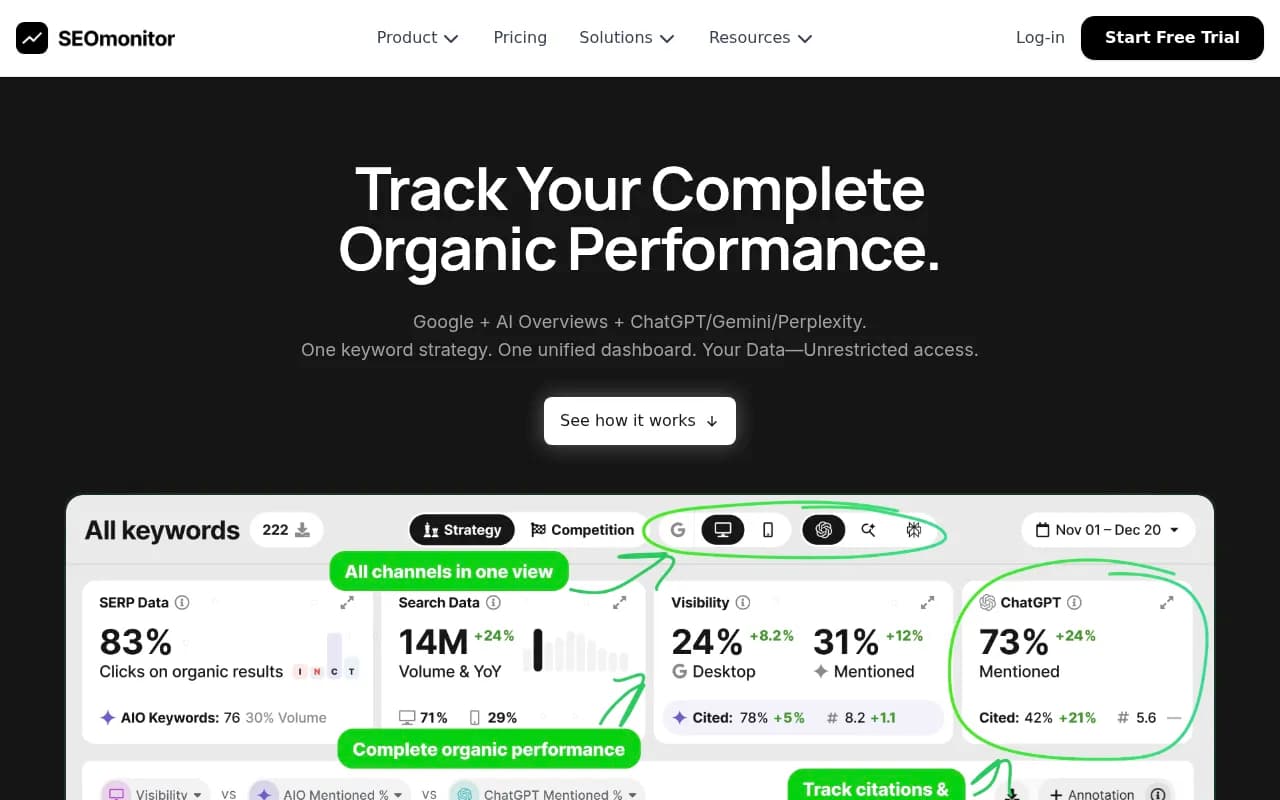
For teams that want to monitor AI Overview appearances alongside traditional rank tracking:
What this means for your strategy in 2026
A few concrete conclusions from all of this:
First, stop treating AI Overview optimization as separate from content strategy. The content that gets cited in AI Overviews is the same content that performs well for users: clear, authoritative, well-structured, and genuinely useful. There's no separate "AI Overview track" — it's just good content, built with a clearer understanding of how AI models read and cite pages.
Second, audit your query portfolio by AI Overview trigger rate. Not all your target queries are equally affected. Some of your highest-volume informational queries may now be generating AI Overviews 80% of the time; others may rarely trigger them. Knowing which is which lets you prioritize where to invest in citation optimization versus where traditional organic tactics still dominate.
Third, track citations separately from rankings. Your organic rank and your AI Overview citation rate are two different metrics now. A page can rank #1 and not be cited. A page can rank #8 and be the primary citation. You need visibility into both.
Fourth, don't abandon paid search — but do adjust. If you're in a high-trigger-rate industry like education or B2B tech, your paid campaigns are operating in a more crowded above-the-fold environment. That means bidding strategies, ad copy, and landing page quality all need to account for the fact that your ads may be appearing below an AI-generated summary that already answered the user's question.
The search landscape in 2026 is genuinely more complex than it was two years ago. But the underlying logic hasn't changed: be the most useful, credible source for the questions your audience is asking, and make sure Google's systems can actually find and understand what you've written. That's always been the job. The AI Overview era just makes it more measurable — and more urgent.