Key takeaways
- Traditional rank trackers can't measure AI Overview visibility -- you need purpose-built tools that actually execute prompts against Google's AI systems
- Semrush and Ahrefs both added AI Overview tracking, but their prompt sets are fixed and neither connects visibility data to content action
- SE Ranking's AI Visibility Toolkit covers Google AI Overviews and is the strongest all-in-one option if you're already paying for a full SEO suite
- Promptwatch is the only tool in this comparison that closes the loop: it finds gaps, generates content to fill them, and tracks whether that content gets cited
Why your rank tracker is lying to you about AI Overviews
Here's the uncomfortable truth: if you're still measuring your Google performance purely through position 1-10 rankings, you're missing a growing chunk of your search visibility.
Google AI Overviews now appear on a significant portion of informational queries. Users get a synthesized answer at the top of the page, often with cited sources, before they ever see the traditional blue links. If your brand is in that answer, great. If it's not, you may never know -- because your rank tracker is watching the wrong thing.
The problem is that AI Overview responses are dynamic. They change based on the query phrasing, the user's location, their search history, and what Google's models have decided is authoritative on any given day. A static rank check can't capture that. You need tools that run actual prompts, capture the AI-generated responses, and analyze what's inside them.
Four tools have become the main contenders for this job in 2026: Semrush, Ahrefs Brand Radar, SE Ranking, and Promptwatch. I tested all four. Here's what I found.
What to look for in a Google AI Overview tracker
Before the comparison, it's worth being clear about what actually matters. Not all "AI tracking" features are equal.
The key questions are:
- Does the tool run real prompts against Google AI Overviews, or does it scrape SERP data after the fact?
- Can you customize the prompts, or are you stuck with whatever the tool decides to track?
- Does it show you competitor visibility alongside yours?
- Does it connect visibility data to something actionable -- like content gaps or optimization suggestions?
- Can it track across other AI models (ChatGPT, Perplexity, Claude) or is it Google-only?
With those criteria in mind, let's get into the tools.
Semrush
Semrush added AI Overview tracking to its Position Tracking module, and for existing Semrush users it's a convenient add-on. You can see when your tracked keywords trigger an AI Overview and whether your domain appears as a cited source.
The limitation is significant though: Semrush uses fixed prompt sets. You can't define your own prompts or test the specific questions your customers are actually asking. You're tracking the keywords you already know about, not discovering new AI visibility opportunities. There's also no content gap analysis -- Semrush will tell you that you're not appearing in AI Overviews for a keyword, but it won't tell you why or what to do about it.
For teams that live inside Semrush and want a quick read on AI Overview presence without switching tools, it's useful. For teams that want to actually improve their AI visibility, it's a starting point at best.
Ahrefs Brand Radar
Ahrefs launched Brand Radar as its answer to the AI visibility tracking category. It monitors brand mentions across AI-generated search results, including Google AI Overviews, and gives you a share-of-voice view across competitors.
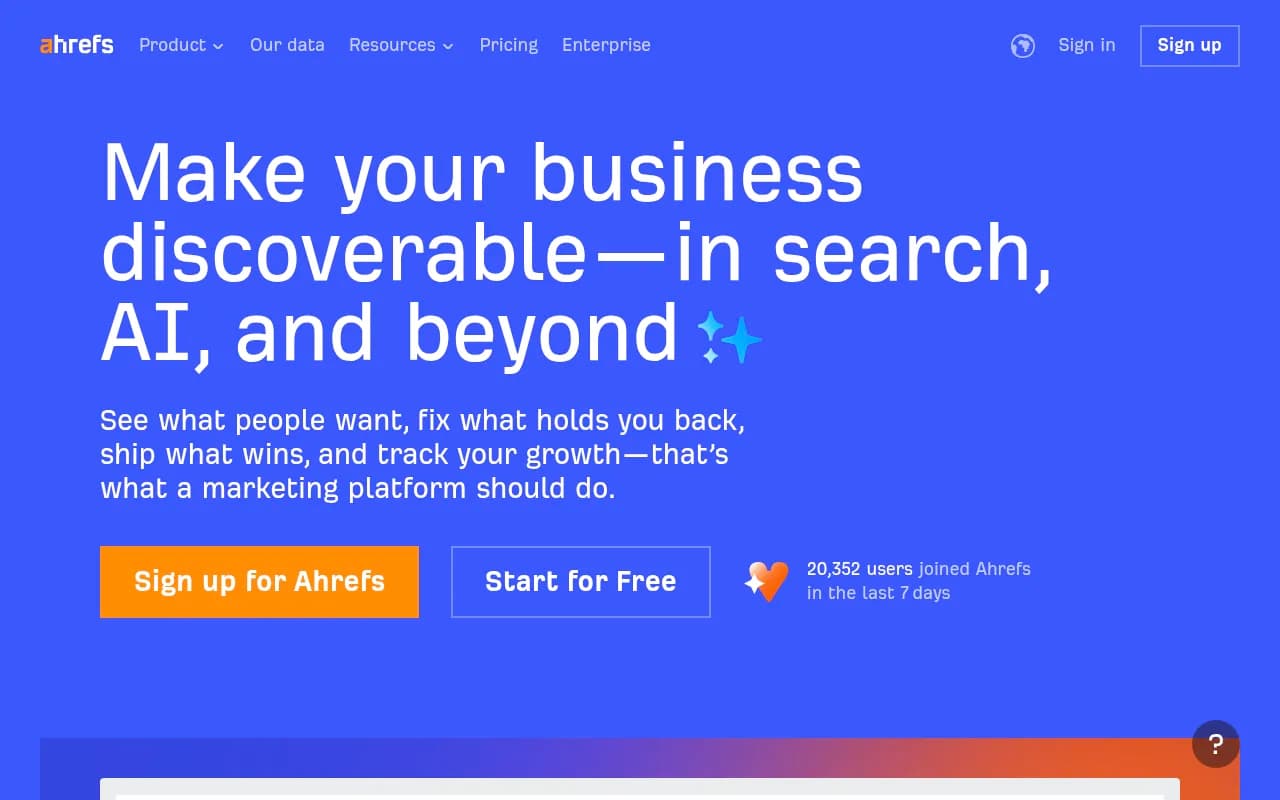
Like Semrush, Ahrefs uses fixed prompts. You can't customize the query set to match your specific market or customer personas. There's also no AI traffic attribution -- you can see that your brand appeared in an AI Overview, but you can't connect that to actual visits or conversions on your site.
Ahrefs Brand Radar is well-built for what it does, and the brand monitoring angle is genuinely useful for competitive intelligence. But it's still fundamentally a monitoring tool. It shows you the scoreboard; it doesn't help you win the game.
SE Ranking
SE Ranking has built one of the more complete AI visibility toolkits among traditional SEO platforms. Its AI Overviews tracker monitors keyword-level visibility, shows you which pages are being cited, and tracks changes over time. The interface is clean and the data is reliable.
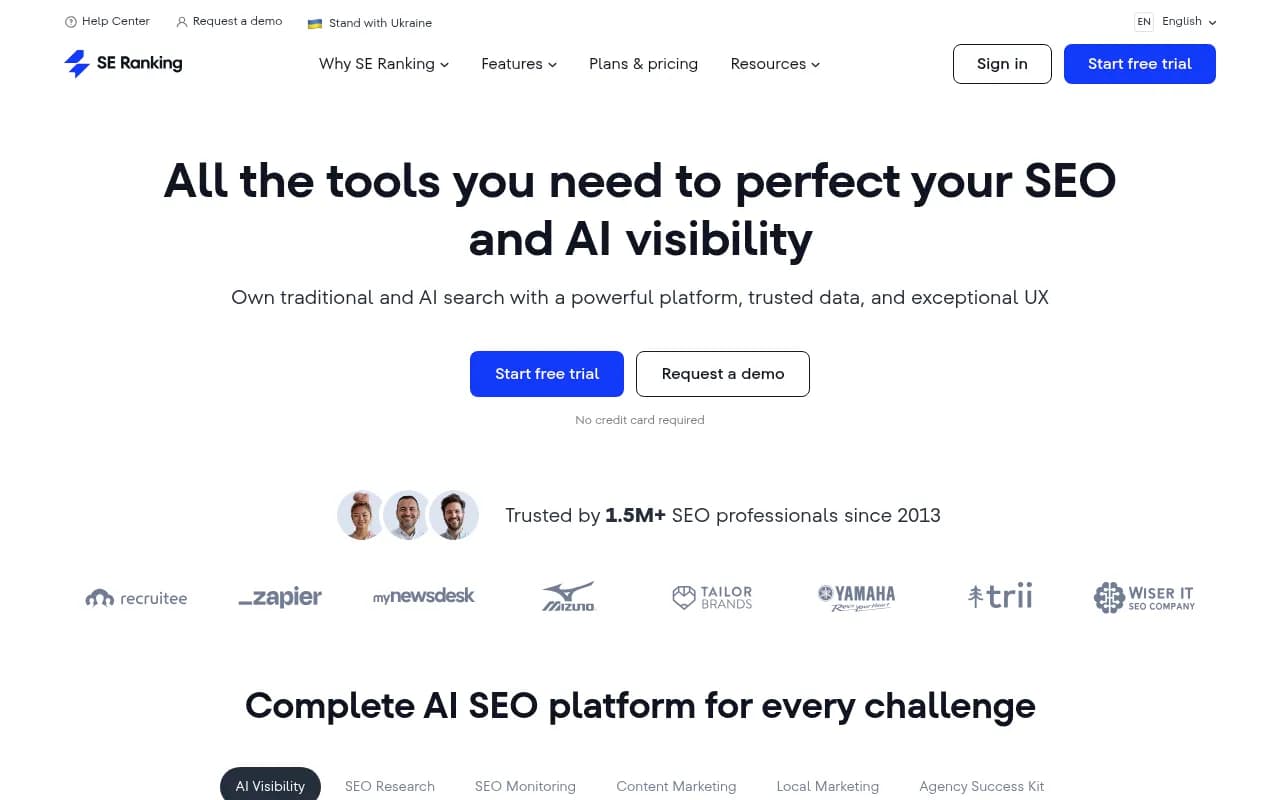
SE Ranking also covers a broader set of AI surfaces than most traditional SEO tools -- it tracks AI Overviews, AI Mode, and has been expanding its LLM coverage. For teams that want a single platform for both classic SEO and AI visibility, SE Ranking is probably the strongest option in this group.
The gap is on the action side. SE Ranking will show you where you're missing from AI Overviews, but it doesn't generate content to fill those gaps or help you understand which specific content changes would improve your citations. It's a solid monitoring platform that stops short of being an optimization platform.
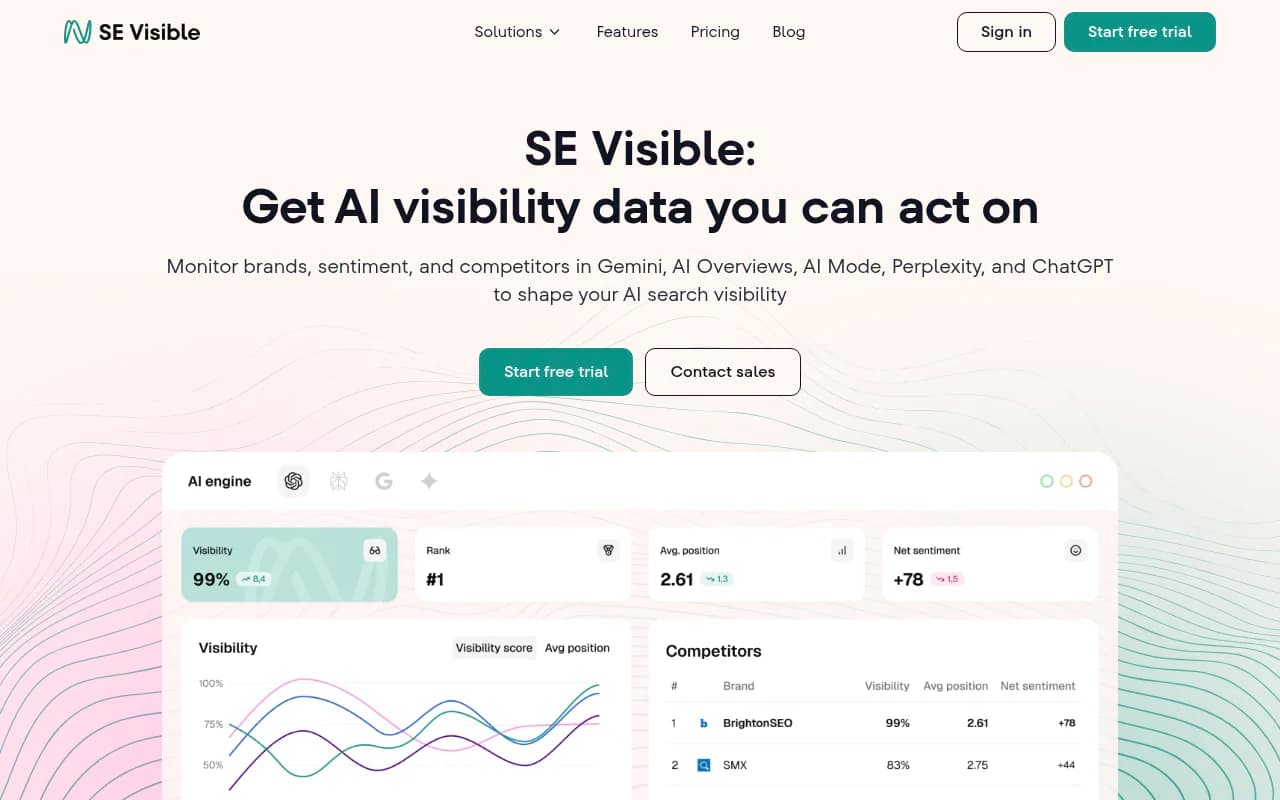
SE Ranking also has a dedicated AI visibility product called SE Visible:
Promptwatch
Promptwatch is built differently from the other three. It's not an SEO platform that added AI tracking -- it's an AI visibility platform built from the ground up around the problem of getting cited in AI-generated answers.
Promptwatch covers 10 AI models including Google AI Overviews, Google AI Mode, ChatGPT, Perplexity, Claude, Gemini, Grok, DeepSeek, Copilot, and Meta AI. That breadth matters because AI search isn't just Google anymore, and a tool that only watches one surface will miss a lot.

What separates Promptwatch from the other tools in this comparison is what happens after you see the data. The Answer Gap Analysis shows you exactly which prompts competitors are appearing for that you're not -- not just "you're missing from AI Overviews for this keyword" but the specific questions and topics where AI models want an answer they can't find on your site. Then the built-in AI writing agent generates content specifically engineered to get cited, grounded in 880M+ citations analyzed across all the major models.
The AI Crawler Logs feature is also worth calling out. You can see in real time which AI crawlers (ChatGPT, Claude, Perplexity, etc.) are visiting your site, which pages they're reading, and whether they're hitting errors. Most competitors don't offer this at all. It's the difference between guessing why you're not getting cited and actually diagnosing the problem.
Pricing starts at $99/month for the Essential plan (1 site, 50 prompts, 5 articles), $249/month for Professional (2 sites, 150 prompts, 15 articles, crawler logs), and $579/month for Business (5 sites, 350 prompts, 30 articles). A free trial is available.
Side-by-side comparison
| Feature | Semrush | Ahrefs Brand Radar | SE Ranking | Promptwatch |
|---|---|---|---|---|
| Google AI Overviews tracking | Yes | Yes | Yes | Yes |
| Google AI Mode tracking | Limited | No | Yes | Yes |
| Other LLMs (ChatGPT, Claude, etc.) | No | No | Limited | Yes (10 models) |
| Custom prompts | No (fixed) | No (fixed) | Limited | Yes |
| Competitor visibility comparison | Yes | Yes | Yes | Yes |
| Content gap analysis | No | No | No | Yes |
| AI content generation | No | No | No | Yes |
| AI crawler logs | No | No | No | Yes |
| Traffic attribution | No | No | No | Yes |
| Reddit/YouTube citation tracking | No | No | No | Yes |
| ChatGPT Shopping tracking | No | No | No | Yes |
| Starting price | ~$140/mo | Included in Ahrefs | ~$65/mo | $99/mo |
| Best for | Existing Semrush users | Brand monitoring | All-in-one SEO + AI | AI visibility optimization |
Which tool should you actually use?
The honest answer depends on what you're trying to do.
If you're already paying for Semrush or Ahrefs and just want a rough read on AI Overview presence without adding another tool to your stack, the built-in features are fine. They're not deep, but they're convenient and you're already paying for them.
If you want the best AI tracking inside a traditional SEO platform, SE Ranking is the strongest option. It's more complete than Semrush or Ahrefs on the AI side, and the pricing is reasonable for what you get.
If you actually want to improve your AI visibility -- not just measure it -- Promptwatch is in a different category. The gap analysis, content generation, and crawler logs turn it from a dashboard into a workflow. You find where you're invisible, create content that addresses the gap, and track whether it works. That loop is what most teams are actually trying to run, and none of the other tools in this comparison support it end to end.
There's also a meaningful difference in scope. Semrush and Ahrefs are watching Google. Promptwatch is watching 10 AI models. As ChatGPT, Perplexity, and Claude continue to grow as discovery surfaces, a Google-only view of AI visibility is going to feel increasingly incomplete.
A note on prompt customization
This is worth dwelling on because it's a bigger deal than it sounds.
Fixed prompts mean you're tracking what the tool vendor decided matters, not what your customers actually ask. If your product is in a niche where the common queries don't match Semrush's or Ahrefs' preset keyword sets, you'll have blind spots.
Custom prompts let you test the exact questions your buyers type into ChatGPT or Google AI Mode. "What's the best [your category] for [your use case]?" is often very different from the generic head terms a traditional SEO tool would track. Promptwatch and SE Ranking both support custom prompts; Semrush and Ahrefs don't.
What about other specialized trackers?
The four tools above aren't the only options. A few other platforms are worth knowing about depending on your specific needs.
For teams focused purely on Google AI Overviews within a content workflow, Thruuu has a lightweight tracker worth looking at:
For agencies managing multiple clients across AI surfaces, tools like Otterly.AI and Peec AI offer clean reporting at lower price points, though they're monitoring-only:


For enterprise teams that need deep competitive intelligence across AI models, Profound covers the enterprise end of the market:

The bottom line
Google AI Overviews aren't going away. If anything, AI Mode is pushing the conversational, AI-first search experience further into the mainstream. Tracking your visibility in these systems isn't optional anymore for brands that depend on search traffic.
The tools that will actually move the needle are the ones that don't stop at showing you a number. Monitoring is table stakes. The question is what you do with the data -- and right now, most tools leave you to figure that out yourself.
If you want a tracker that also helps you act on what it finds, Promptwatch is the clearest choice in this comparison. If you want AI tracking bolted onto an existing SEO platform, SE Ranking is the most complete option. And if you're just dipping a toe in, the Semrush or Ahrefs features you're already paying for are a reasonable place to start.