Key takeaways
- When a Google AI Overview appears, users click traditional results only 8% of the time, versus 15% without one -- a near 50% drop in available clicks.
- Seer Interactive's 2026 study (5.47 million tracked queries, 2.43 billion impressions) found organic CTR dropped 61% for queries where AI Overviews appear.
- Being cited inside an AI Overview can actually drive higher-quality traffic than a #1 organic result -- users who click through from an AIO are further along in their decision-making.
- The answer isn't "one or the other." The brands winning in 2026 are optimizing for both, because the queries that trigger AIOs and the ones that don't are fundamentally different.
- Tracking both channels requires different tooling -- traditional rank trackers miss AI visibility entirely.
There's a question a lot of SEOs are quietly asking right now: if Google is going to summarize everything at the top of the page anyway, does ranking #1 still matter?
It's a fair question. And the honest answer is: it depends on the query, the intent, and whether an AI Overview even shows up.
Let's get into what the data actually shows.
What's happening to click-through rates in 2026
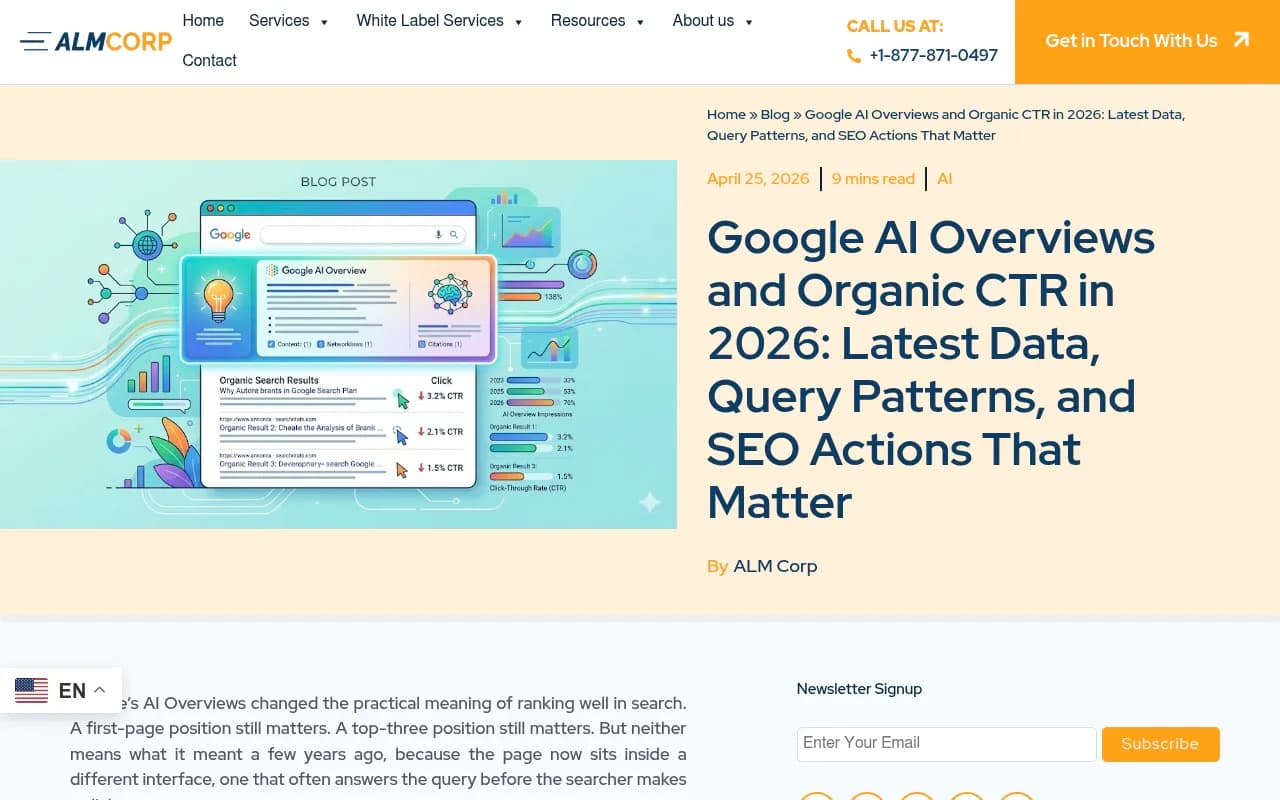
The most comprehensive recent study on this comes from Seer Interactive, which analyzed 53 brands, 5.47 million tracked queries, and 2.43 billion organic impressions from January 2025 through February 2026. Their finding: organic CTR dropped 61% for queries where AI Overviews appear -- from roughly 1.6% down to 0.64%.
That's not a rounding error. That's a structural change in how the search results page works.
Pew Research puts it differently: when a Google AI Overview is present, users click traditional results only 8% of the time. Without an AIO, that number is 15%. So the presence of an AI Overview roughly halves the number of clicks available to organic results -- regardless of where you rank.
This doesn't mean ranking #1 is worthless. It means ranking #1 for a query that triggers an AI Overview is worth considerably less than it used to be.
Which queries are most affected
Not every search triggers an AI Overview. Google tends to deploy them for informational and research-oriented queries -- "how does X work," "what's the difference between X and Y," "best practices for Z." Transactional queries ("buy running shoes size 10") and navigational queries ("Spotify login") are much less likely to get an AIO.
This matters enormously for how you think about the traffic question. If your top-ranking pages are answering informational questions, you're in the highest-risk category. If you're ranking for commercial or transactional terms, the impact is smaller -- for now.
What it means to be cited in an AI Overview
Here's where things get interesting. Being cited inside an AI Overview is not the same as ranking #1 below it. It's a different kind of visibility, and in some ways a more valuable one.
When Google's AI generates a summary and links to your page as a source, a few things happen:
- Your brand appears in the most prominent position on the page -- above all organic results
- The user has already read a summary that references you, so if they click through, they arrive with context and intent
- You get a form of "trust endorsement" from Google's own AI system
The traffic volume from AIO citations is lower than what a #1 ranking used to deliver. But the quality tends to be higher. Users who click through from an AI Overview have already been pre-qualified by the summary -- they're not clicking to find out what you do, they're clicking because the AI told them you're relevant to their specific question.
This mirrors a broader pattern in AI search. According to data from Exposure Ninja, AI search traffic converts at 14.2% compared to Google's 2.8% -- roughly five times more valuable per session. The mechanism is similar: AI-mediated discovery filters for intent before the click happens.
How to get cited in AI Overviews
Google's AI doesn't cite pages randomly. Based on what's been observed across large-scale studies, the pages that earn AIO citations tend to share a few characteristics:
- They answer specific questions directly and early in the content
- They use structured formats (clear headings, short paragraphs, lists where appropriate)
- They have strong E-E-A-T signals -- experience, expertise, authoritativeness, trustworthiness
- They're already ranking well organically (correlation, not necessarily causation)
- They cover the topic with enough depth that the AI can extract a useful answer
There's no guaranteed formula. But the content that earns AIO citations looks a lot like the content that was already winning in featured snippets -- clear, structured, authoritative, and directly responsive to the query.
Position 1 in 2026: still valuable, but for different reasons
Classic position 1 is not dead. It's just doing different work than it used to.
For queries without an AI Overview -- transactional searches, navigational searches, local searches, many branded queries -- position 1 still captures a disproportionate share of clicks. The traditional CTR curve still applies: position 1 gets roughly 25-30% of clicks, position 2 drops to 15%, and it falls off steeply from there.
For queries with an AI Overview, position 1 below the AIO still gets clicks -- just far fewer of them. And there's evidence that being cited inside the AIO matters more than your organic position for those queries.
One more nuance: pages cited in AI Overviews are often the same pages that rank in positions 1-3 organically. So chasing AIO citations and chasing position 1 aren't entirely separate strategies. Strong content that ranks well tends to get cited. But the reverse isn't always true -- you can rank #1 and not be cited, especially if your content isn't structured in a way the AI can easily parse.
The traffic math: a realistic comparison
Let's put some rough numbers to this. Assume a query gets 10,000 monthly searches and triggers an AI Overview.
- Without AIO: position 1 might capture ~28% of clicks = 2,800 visits/month
- With AIO present: total organic CTR drops ~61%, so position 1 might capture ~11% of clicks = 1,100 visits/month
- AIO citation (not position 1): the AIO itself captures a share of engagement, and the cited source might get 2-4% of total searches as direct clicks = 200-400 visits/month, but with higher conversion intent
So in raw volume, position 1 below an AIO still beats an AIO citation. But the AIO citation comes with brand visibility at the top of the page, higher-quality traffic, and a trust signal that organic position alone doesn't provide.
The real win is both: rank in position 1 AND get cited in the AIO. That's not impossible -- it's actually the most common outcome for pages that are genuinely authoritative on a topic.
The broader shift: AI search is eating into Google's share
This isn't just about AI Overviews within Google. The search landscape itself is fragmenting.
37% of consumers now start their searches with AI tools instead of Google, according to Search Engine Land. ChatGPT has crossed 900 million weekly active users. Perplexity processes 780 million queries per month. Google's AI Overviews reach 2 billion monthly users across 200+ countries.
Organic traffic from classic Google search is likely to decline by double-digit percentages over the next few years, according to multiple forecasts including Gartner and McKinsey. Gartner projects AI search experiences could rival traditional search as a source of website visits around 2028.
This doesn't mean Google becomes irrelevant. It means the definition of "search visibility" has expanded. Ranking #1 on Google is one piece of the puzzle. Being cited by ChatGPT, Perplexity, Gemini, and Claude is another. Brands that only track one of these are missing a growing share of how their customers actually find them.
How to track both channels
This is where most marketing teams are currently under-equipped. Traditional SEO tools -- rank trackers, GSC data, Ahrefs, Semrush -- measure Google organic performance well. They don't tell you whether you're being cited in AI Overviews, or whether ChatGPT recommends you when someone asks about your category.
For Google AI Overview tracking specifically, tools like Semrush and SE Ranking have added AIO monitoring to their platforms.
For broader AI search visibility -- across ChatGPT, Perplexity, Claude, Gemini, and others -- you need a dedicated GEO (Generative Engine Optimization) platform. Promptwatch tracks your brand's visibility across 10 AI models simultaneously, shows you which prompts competitors appear for that you don't, and includes a content generation layer to help you close those gaps. It's one of the few platforms that connects AI visibility to actual traffic attribution, so you can see whether your AIO citations and LLM mentions are translating into real visits and revenue.

For teams that want to track AI Overview appearances specifically alongside traditional rankings, Thruuu is built for content teams monitoring AIO presence, and Nightwatch has added AI search monitoring alongside its traditional rank tracking.
What this means for your content strategy
The practical implication of all this is that content strategy in 2026 needs to serve two masters simultaneously.
For traditional organic rankings, the fundamentals still apply: keyword research, on-page optimization, backlinks, technical SEO. Position 1 for transactional and commercial queries is still extremely valuable and worth fighting for.
For AI Overview citations, the focus shifts toward:
- Answering questions directly and specifically (not burying the answer in preamble)
- Structuring content so AI systems can extract clean, quotable answers
- Building topical authority across a subject area, not just optimizing individual pages
- Publishing original data, research, or expert perspectives that AI models want to cite
- Keeping content fresh and factually accurate (AI systems favor recency for many query types)
For AI search engines beyond Google, the approach overlaps with AIO optimization but adds distribution: publishing on platforms that AI models frequently cite (certain Reddit communities, YouTube, industry publications), building brand mentions across authoritative sources, and ensuring your own site is crawlable and parseable by AI bots.
Comparison: AI Overview citation vs position 1 organic
| Factor | Position 1 organic (no AIO) | Position 1 organic (AIO present) | AIO citation |
|---|---|---|---|
| Click volume | High (~25-30% CTR) | Reduced (~10-12% CTR) | Low-medium (2-5% CTR) |
| Traffic quality | Standard | Standard | Higher intent |
| Brand visibility | Below fold | Below AIO | Top of page |
| Conversion rate | Baseline | Baseline | ~5x higher (per Exposure Ninja) |
| Achievability | Traditional SEO | Traditional SEO + structure | Content quality + authority |
| Tracking tools | Any rank tracker | AIO-aware rank tracker | GEO platform required |
The table makes the trade-off clear. For queries without an AI Overview, position 1 is still the prize. For queries with an AIO, the math changes significantly -- and a citation inside the AIO may deliver better ROI even with lower raw traffic.
The practical recommendation
Stop treating these as competing priorities. The content that earns position 1 and the content that earns AIO citations are increasingly the same content -- authoritative, well-structured, directly responsive to user intent.
What you need to change is your measurement. If you're only tracking Google rankings and GSC clicks, you're measuring a shrinking share of your actual search visibility. Add AI Overview monitoring. Add LLM citation tracking. Understand which of your pages are being cited by AI systems and which aren't.
The brands that are winning right now aren't choosing between traditional SEO and AI visibility. They're doing both, measuring both, and using the data from each to inform the other.
That's the actual answer to the question. Not "AI Overviews vs position 1" -- but "how do I show up in both, and how do I know when I do?"