Key takeaways
- Google AI Overviews now appear in roughly 30–40% of search results, making citation tracking a real SEO priority, not a nice-to-have.
- Traditional rank trackers don't capture AI Overview mentions — you need purpose-built tools that parse the AI-generated text and extract cited sources.
- The tools in this guide vary enormously: some are lightweight monitors, others are full optimization platforms. Picking the wrong one means paying for data you can't act on.
- For teams that want to go beyond monitoring and actually fix their visibility gaps, platforms with built-in content tools (like Promptwatch) are worth the extra investment.
- Free trials are available on most platforms listed here — test on your actual keyword set before committing.
Why Google AI Overviews changed the tracking problem
When Google AI Overviews (formerly Search Generative Experience) started appearing at the top of results pages, the SEO community spent a few months debating whether they'd stick around. That debate is over. As of early 2026, AI Overviews trigger on somewhere between 30 and 40 percent of queries, and that number keeps climbing.
The problem for SEO teams is that traditional rank tracking tools were built for a different world. They tell you whether your page sits at position 3 or position 7. They don't tell you whether your brand is cited inside the AI-generated summary that appears above position 1. That's a completely different question, and it requires a different kind of tool.
What you actually need to know:
- Is your brand mentioned or cited in AI Overviews for your target keywords?
- Which specific URLs are being cited, and how often?
- Which competitors are getting cited when you're not?
- Is your visibility improving or declining over time?
The tools below answer those questions with varying degrees of depth. Some are dedicated AI visibility platforms. Others are traditional SEO suites that bolted on AI Overview tracking. A few are lightweight monitors that do one thing well. Here's how they stack up.
How these tools actually work
Before getting into the rankings, it helps to understand what's happening under the hood. Most tools in this space follow the same basic workflow:
- They query Google for your target keywords on a scheduled basis.
- They capture the full SERP, including the AI Overview block when one appears.
- They parse the AI Overview text to extract cited URLs and domains.
- They record whether your brand or pages appear, and track changes over time.
The differences between tools come down to how frequently they run queries, how accurately they parse citations, whether they track at the URL level or just the domain level, and what they let you do with that data beyond just viewing it.
Some tools also track Google AI Mode (the conversational search experience separate from standard AI Overviews) — these are different surfaces and shouldn't be conflated.
The 10 best Google AI Overview tracking tools in 2026
1. Promptwatch
Promptwatch is the most complete option if you want to track AI Overview visibility and then actually do something about it. Most tools in this space show you where you're invisible. Promptwatch shows you the same data, then gives you the tools to fix it.

The Answer Gap Analysis feature identifies which prompts and queries competitors are getting cited for but you're not. That's genuinely useful intelligence. The built-in AI writing agent then generates content grounded in citation data from over 880 million analyzed citations, targeting the specific topics and angles AI models want to reference. You can track whether that new content starts getting cited, and connect the whole loop to actual traffic through GSC integration or server log analysis.
For AI Overview tracking specifically, Promptwatch monitors Google AI Overviews and Google AI Mode alongside nine other AI platforms (ChatGPT, Perplexity, Claude, Gemini, Grok, DeepSeek, Copilot, Meta AI, Mistral). The AI crawler logs are a standout feature most competitors lack entirely — you can see exactly which pages Google's AI crawler is reading, how often, and what errors it encounters.
Pricing starts at $99/month for the Essential plan (1 site, 50 prompts). Professional is $249/month, Business $579/month.
2. SE Ranking
SE Ranking has built one of the more polished AI Overviews tracking modules inside a traditional SEO suite. It monitors when your target keywords trigger AI Overviews, detects brand mentions and links inside those overviews, and shows you historical trends. The advantage is that you get this alongside standard rank tracking, site auditing, and keyword research in one platform.
The downside is that it's still primarily a monitoring tool. You get good data on what's happening, but the path from "I'm not being cited" to "here's how to fix that" isn't built in.
3. Semrush
Semrush added AI Overview tracking to its existing platform, and for teams already paying for Semrush, it's a reasonable starting point. The data integrates with everything else in the platform, which makes reporting easier.
The limitation worth knowing: Semrush uses fixed prompts rather than letting you define custom queries, which means you're tracking what Semrush decides to track rather than the specific questions your customers are actually asking. For broad competitive intelligence it works. For precise brand monitoring it's less flexible.
4. Ahrefs Brand Radar
Ahrefs Brand Radar tracks brand mentions across AI-generated search results including Google AI Overviews. If you're already an Ahrefs user, it's worth exploring as an add-on.
Similar to Semrush, the prompts are fixed rather than customizable, and there's no AI traffic attribution to connect visibility data to actual site traffic. Good for awareness, limited for optimization.
5. Thruuu
Thruuu is specifically built for content teams who want to understand what's appearing in AI Overviews for their target keywords. It's lighter than the enterprise platforms, more focused, and honestly easier to use for teams that just need to monitor a specific set of keywords without a lot of setup overhead.
It's a solid choice for content strategists and smaller SEO teams. It doesn't have the breadth of a full GEO platform, but it does its core job well.
6. Omnia
Omnia focuses on AI visibility and share of voice analytics, including Google AI Overviews. It's built around helping teams understand their competitive position across AI search surfaces.
The tool has solid tracking capabilities and a clean interface. It's particularly useful for teams doing competitive benchmarking across multiple brands or clients.
7. LLM Pulse
LLM Pulse tracks AI Overview citations alongside mentions across ChatGPT, Perplexity, Gemini, and other platforms. It starts at €49/month with unlimited seats, which makes it one of the more accessible options for smaller teams or agencies managing multiple clients.
The multi-platform tracking is genuinely useful — if you care about AI Overview visibility, you probably also care about how you appear in ChatGPT and Perplexity, and having that in one dashboard saves a lot of time.
8. Peec AI
Peec AI is a monitoring-focused platform with solid multi-language support, which matters if you're tracking AI Overview visibility across different markets. It covers Google AI Overviews alongside other AI platforms.

It's a clean, functional tool. The main limitation is that it's monitoring-only — there's no content gap analysis or optimization tooling built in.
9. Otterly.AI
Otterly.AI is one of the more affordable options in this space and works well for teams that need basic AI visibility monitoring without a lot of complexity. It tracks brand mentions and citations across AI platforms including Google AI Overviews.

It's a good entry point. If you find yourself wanting more depth — crawler logs, content recommendations, traffic attribution — you'll likely outgrow it fairly quickly.
10. seoClarity
seoClarity is an enterprise SEO platform that has added AI search visibility tracking including Google AI Overviews. It's built for large organizations with complex reporting needs and integrates with existing enterprise data workflows.
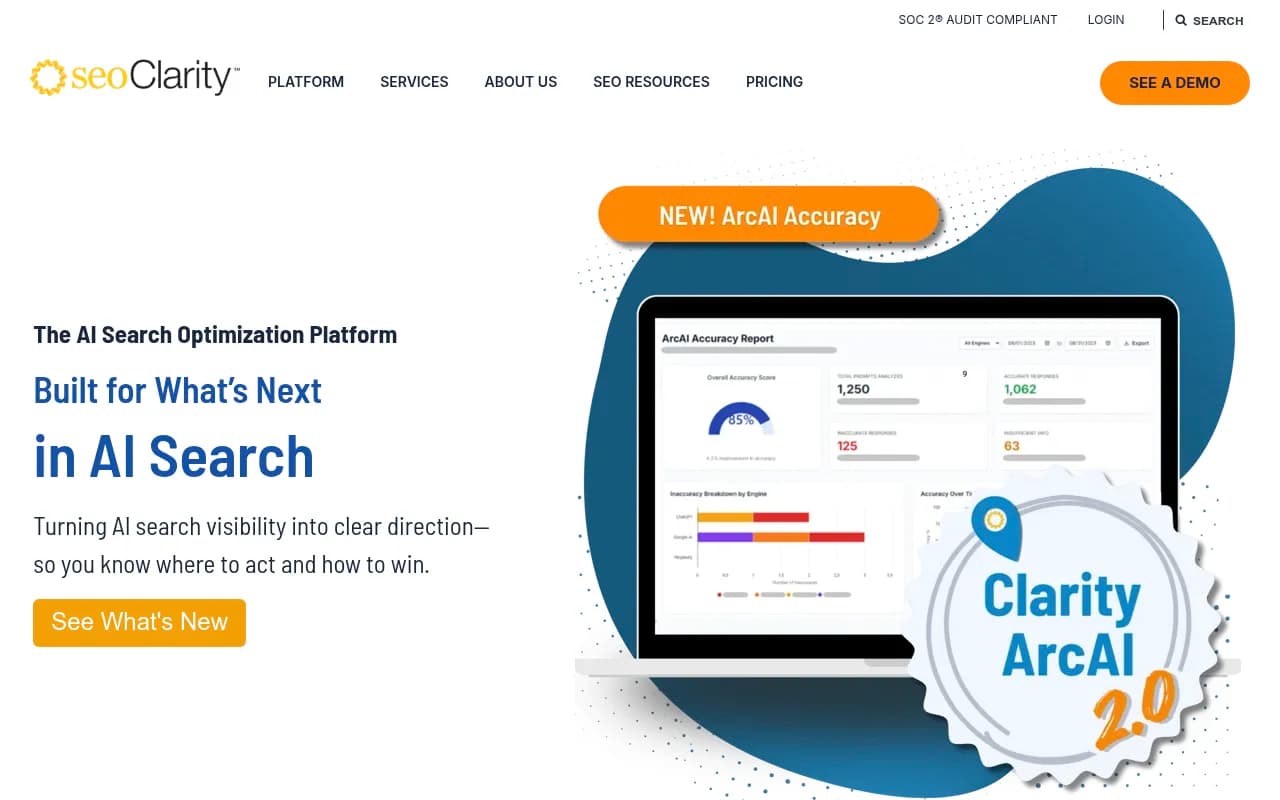
The depth is there for enterprise teams, but the price point and complexity make it overkill for most mid-market use cases.
Comparison table
| Tool | AI Overview tracking | Multi-LLM | Content gap analysis | AI content generation | Crawler logs | Starting price |
|---|---|---|---|---|---|---|
| Promptwatch | Yes | Yes (10 models) | Yes | Yes | Yes | $99/mo |
| SE Ranking | Yes | Limited | No | No | No | ~$52/mo |
| Semrush | Yes (fixed prompts) | Limited | No | No | No | ~$140/mo |
| Ahrefs Brand Radar | Yes (fixed prompts) | Limited | No | No | No | Add-on |
| Thruuu | Yes | No | No | No | No | Freemium |
| Omnia | Yes | Yes | No | No | No | Custom |
| LLM Pulse | Yes | Yes | No | No | No | €49/mo |
| Peec AI | Yes | Yes | No | No | No | Custom |
| Otterly.AI | Yes | Yes | No | No | No | ~$19/mo |
| seoClarity | Yes | Limited | No | No | No | Enterprise |
What to look for when choosing a tool
Citation tracking depth
There's a meaningful difference between a tool that tells you "your domain appeared in an AI Overview" and one that tells you exactly which URL was cited, in what context, for which query, and how that compares to last week. The former is barely useful. The latter is actionable.
Look for URL-level citation tracking, not just domain-level. And check whether the tool shows you the actual AI Overview text, not just a presence/absence flag.
Prompt customization
Several tools (Semrush, Ahrefs) use fixed prompt sets. That means you're tracking visibility for queries the tool decided are important, not the specific questions your actual customers type. For most teams, custom prompt tracking is worth the extra cost.
Frequency of data refresh
AI Overviews change. A tool that checks your keywords weekly will miss a lot of volatility. Daily refresh is the minimum for meaningful trend data. Some platforms offer near-real-time monitoring for high-priority keywords.
What you can do with the data
This is the biggest differentiator in the market right now. Most tools stop at showing you the data. They tell you that Competitor X is cited for "best project management software" and you're not. That's useful context, but it doesn't tell you what to write or how to fix it.
A smaller number of platforms have started building optimization tooling on top of the monitoring data. Content gap analysis, AI-assisted content generation grounded in citation patterns, and traffic attribution that connects visibility to revenue — these features separate tools that help you improve from tools that just report on your current situation.
Multi-platform coverage
Google AI Overviews is one surface. Your customers are also asking questions in ChatGPT, Perplexity, Gemini, and increasingly in AI Mode (Google's conversational search). A tool that only tracks AI Overviews gives you an incomplete picture. If budget allows, choose a platform that covers multiple AI surfaces so you're not managing four separate subscriptions.
A note on Google AI Mode vs. AI Overviews
These are different things and it's worth being clear about the distinction. Google AI Overviews appear in standard Google search results as a summarized block above the organic listings. Google AI Mode is a separate, conversational search experience (similar to ChatGPT) that Google has been rolling out more broadly in 2026.
Some tools track one, some track both, and some conflate them. When evaluating a platform, ask specifically which surface it's tracking. The citation mechanics are different, the query types are different, and the optimization strategies are different.
Bottom line
If you're just starting out and want to understand whether your brand appears in Google AI Overviews, any of the monitoring tools in this list will get you there. Otterly.AI and LLM Pulse are reasonable entry points at lower price points. Thruuu is worth trying if you're primarily a content team.
If you're serious about improving your AI Overview visibility rather than just measuring it, the gap between monitoring tools and optimization platforms is significant. Promptwatch is the only platform in this list that closes the full loop: find the gaps, generate content that addresses them, track whether it works, and connect that back to traffic and revenue.
The market for these tools is moving fast. Features that were enterprise-only six months ago are showing up in mid-market tools now. Whatever you choose, test it on your actual keyword set before committing to an annual plan — the variance in data quality between tools on the same queries can be surprising.