Key takeaways
- Promptwatch is a dedicated AI Search Visibility platform built around an action loop (find gaps, create content, track results). SEOmonitor is a traditional agency SEO platform that has added AI tracking as one component of a broader suite.
- For pure AI visibility depth, Promptwatch wins clearly: 10+ AI models monitored, AI crawler logs, ChatGPT Shopping tracking, Reddit/YouTube citation tracking, and a built-in content generation agent. SEOmonitor covers ChatGPT, Gemini, Perplexity, and Google AI Overviews but stops at monitoring.
- SEOmonitor is the stronger choice if you need unified Google + AI tracking in one place, with agency-grade forecasting, client reporting, and keyword-based strategy tools.
- Pricing is structured differently: Promptwatch has published flat-rate tiers starting at $99/mo. SEOmonitor uses configurable pricing (no per-seat fees) with a 14-day free trial, which can be more flexible for agencies with variable keyword volumes.
- Neither tool is a direct replacement for the other. They overlap on AI monitoring but diverge significantly on everything else.
- If AI search is your primary growth channel and you want to do more than just watch a dashboard, Promptwatch is the more actionable platform. If you're an agency that needs one tool for Google SEO plus basic AI tracking, SEOmonitor covers more ground.
Overview
Promptwatch

Promptwatch started as a prompt tracking tool and has grown into a full GEO (Generative Engine Optimization) platform. The core idea is that monitoring alone isn't enough. You need to know which prompts competitors are winning that you're not, generate content to close those gaps, and then verify the content actually gets cited. That three-step loop is what separates it from most AI monitoring tools, which are essentially dashboards that show you data and leave you to figure out what to do next.
It monitors 10+ AI models, including ChatGPT, Claude, Perplexity, Gemini, Grok, DeepSeek, Mistral, Copilot, and Meta AI. The AI crawler log feature is genuinely rare: you can see in real time when ChatGPT or Perplexity's crawlers visit your pages, which pages they read, and whether they hit errors. Rated 4.7/5 on G2, used by 8,000+ brands.
SEOmonitor
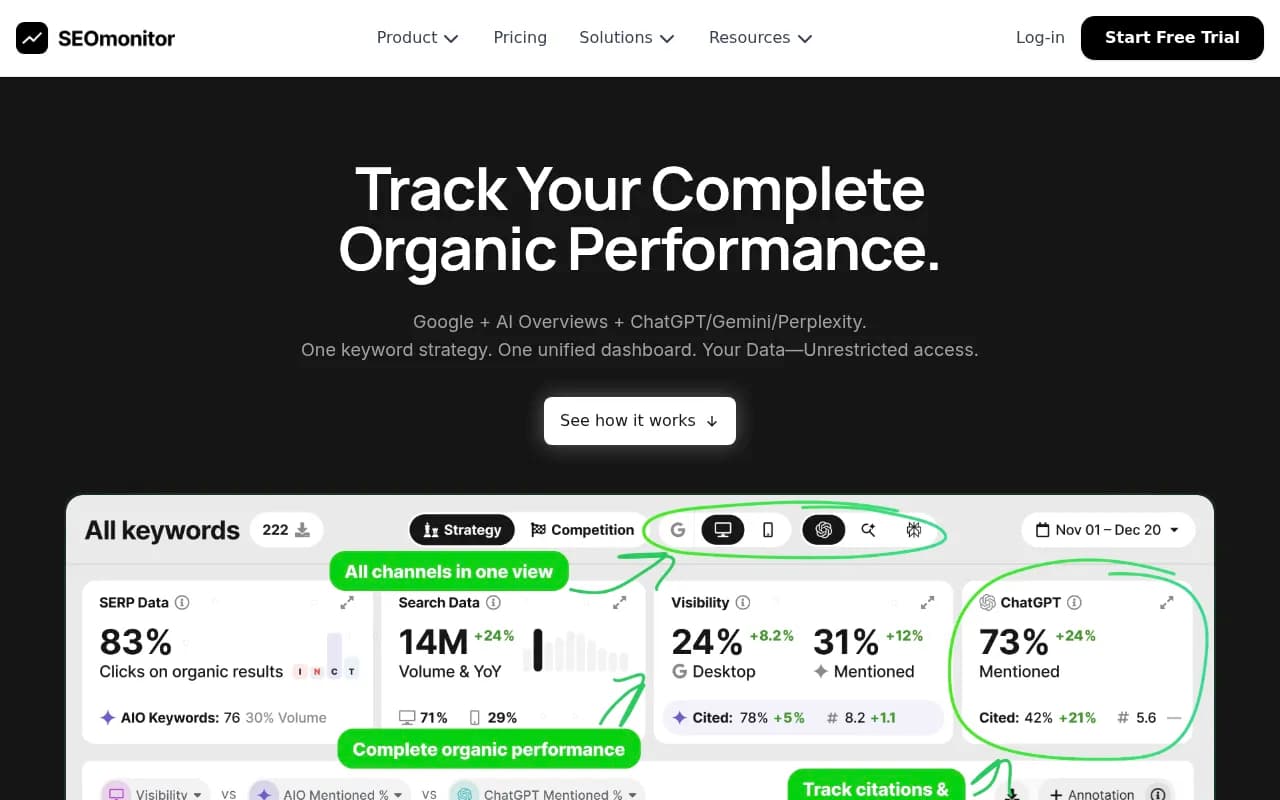
SEOmonitor is an agency-focused SEO platform that has been around for years as a Google rank tracking and forecasting tool. In 2024-2025 it expanded to include AI search tracking across ChatGPT, Gemini, Perplexity, and Google AI Overviews, positioning itself as a unified organic performance platform.
The pitch is straightforward: instead of running a separate AI tracking tool alongside your rank tracker, you get one dashboard that shows Google rankings, AI Overview appearances, and AI chatbot citations together. Clients like Vodafone, Gymshark, Publicis, and TUI use it. Also rated 4.7/5 on G2.
Side-by-side comparison
| Feature | Promptwatch | SEOmonitor |
|---|---|---|
| Primary focus | AI Search Visibility / GEO | Agency SEO + AI tracking |
| AI models monitored | 10+ (ChatGPT, Claude, Perplexity, Gemini, Grok, DeepSeek, Mistral, Copilot, Meta AI, Google AI Overviews) | 4 (ChatGPT, Gemini, Perplexity, Google AI Overviews) |
| Google rank tracking | No | Yes (core feature) |
| AI crawler logs | Yes (real-time) | No |
| Content gap analysis | Yes (Answer Gap Analysis) | No |
| AI content generation | Yes (Content Agent) | No |
| Citation & source analysis | Yes (880M+ citations) | Basic |
| Reddit / YouTube tracking | Yes | No |
| ChatGPT Shopping tracking | Yes | No |
| Prompt volume & difficulty scores | Yes | No (keyword-based) |
| Traffic attribution | Yes (GSC, code snippet, server logs) | Yes (GSC integration) |
| Forecasting | No | Yes |
| Client reporting / white-label | Agency plan available | Yes (core agency feature) |
| Free tier | No (7-day trial) | No (14-day trial) |
| Pricing model | Flat-rate tiers from $99/mo | Configurable, no per-seat fees |
| G2 rating | 4.7/5 | 4.7/5 |
| Best for | Marketing/SEO teams focused on AI search | Agencies managing Google + AI in one tool |
Head-to-head feature deep-dive
AI model coverage
Promptwatch monitors 10 AI platforms: OpenAI/ChatGPT, Perplexity, Google AI Overviews, Google AI Mode, Claude, Gemini, Meta/Llama, DeepSeek, Grok, Mistral, and Copilot. That's every major model your potential customers might be using.
SEOmonitor covers ChatGPT, Gemini, Perplexity, and Google AI Overviews. That's the four most common ones, which covers the majority of AI search traffic for most brands. But if you care about Claude, Grok, DeepSeek, or Copilot, SEOmonitor doesn't track them.
Verdict: Promptwatch covers more ground. For most brands, SEOmonitor's four models are sufficient, but if you're tracking a tech-savvy audience that uses Claude or Grok, the gap matters.
Tracking methodology: prompts vs keywords
This is one of the more interesting philosophical differences between the two tools.
SEOmonitor tracks keywords and maps them to AI responses. Their argument: one keyword like "running shoes" covers thousands of long-tail prompts automatically, so you get broader coverage without manually entering every possible question.
Promptwatch tracks actual prompts, the specific questions users ask AI engines. Their argument: keywords and prompts are fundamentally different things. A keyword is a search term; a prompt is a conversational question with intent, context, and nuance. Tracking "running shoes" doesn't tell you whether you're cited when someone asks "What are the best running shoes for flat feet under $150?"
Both approaches have merit. Keyword-based tracking is easier to manage at scale and maps naturally to existing SEO workflows. Prompt-based tracking is more precise for AI search but requires more upfront setup.
Verdict: Depends on your workflow. If you're an agency that already has keyword lists and wants to extend them to AI, SEOmonitor's approach is frictionless. If AI search is your primary focus and you want to track specific high-intent questions, Promptwatch's prompt-based approach gives you more control.
Content optimization and generation
This is where the tools diverge most sharply.
Promptwatch has a full Content Agent that generates articles, listicles, and comparison pages based on real citation data. It analyzes which content formats AI models cite most, what topics competitors are winning on, and what your site is missing. The output is content specifically engineered to get cited, not generic SEO filler.
The Answer Gap Analysis feature shows you exactly which prompts competitors appear for that you don't. You see the specific topics and questions AI models want to answer but can't find on your site. That's actionable in a way that most monitoring dashboards aren't.
SEOmonitor has no content generation features. It's a tracking and reporting tool. You see the data; you figure out what to do with it.
Verdict: Promptwatch wins this category outright. If you want to actually improve your AI visibility and not just measure it, the content tools are the difference.
AI crawler logs
Promptwatch shows you in real time when AI crawlers (ChatGPT, Claude, Perplexity, etc.) visit your website: which pages they read, how often they return, and whether they encounter errors. This is genuinely useful for diagnosing why certain pages aren't getting cited. If Perplexity's crawler keeps hitting a 404 on your pricing page, you'll see it immediately.
SEOmonitor doesn't have this feature. You can see whether your content is being cited in AI responses, but you can't see the crawl activity that precedes it.
Verdict: Promptwatch only. This is a meaningful gap for anyone doing serious AI SEO work.
Traditional SEO features
SEOmonitor is a full-featured rank tracker with keyword forecasting, organic traffic projections, cannibalization detection, and client reporting built for agencies. These are mature, well-developed features that have been refined over years.
Promptwatch doesn't do traditional Google rank tracking. It's focused entirely on AI search. If you need to track Google positions, you'd need a separate tool.
Verdict: SEOmonitor wins for traditional SEO. It's not even close. Promptwatch isn't trying to compete here.
Agency and client reporting
SEOmonitor is purpose-built for agencies. The reporting tools, white-label options, and multi-client management features are designed around agency workflows. The configurable pricing (no per-seat fees) also makes it easier to scale across a large client base.
Promptwatch has an agency tier with custom pricing, and the platform supports multiple sites. But the core product is oriented toward brand marketing and SEO teams, not agency account managers.
Verdict: SEOmonitor is the better fit for agencies managing multiple clients who need polished reporting.
Citation and source intelligence
Promptwatch has analyzed 880M+ citations across AI models. You can see which specific pages, Reddit threads, YouTube videos, and external domains AI models cite in their responses. That tells you where to publish content, which third-party sources to target, and what formats perform best.
The Reddit and YouTube tracking is particularly useful because AI models frequently pull from those sources, and most SEO tools ignore them entirely.
SEOmonitor shows citation data at a surface level but doesn't offer the same depth of source analysis or third-party platform tracking.
Verdict: Promptwatch goes deeper on citation intelligence.
Pricing comparison
| Plan | Promptwatch | SEOmonitor |
|---|---|---|
| Free tier | No | No |
| Trial | 7-day free trial | 14-day free trial |
| Entry plan | $99/mo (Essential: 1 site, 50 prompts, 5 articles) | Configurable (no published flat rate) |
| Mid plan | $249/mo (Professional: 2 sites, 150 prompts, 15 articles, crawler logs) | Configurable |
| Business plan | $579/mo (Business: 5 sites, 350 prompts, 30 articles) | Configurable |
| Agency/Enterprise | Custom pricing | Custom pricing |
| Per-seat fees | No | No |
| Annual discount | Yes | Yes |
SEOmonitor's configurable pricing is a double-edged thing. On one hand, you're not paying for a fixed tier that doesn't match your needs. On the other hand, you can't quickly compare costs without going through a demo or sales conversation. For agencies with large keyword volumes, SEOmonitor's model can be more cost-effective than Promptwatch's prompt-based tiers.
For smaller brands or individual marketing teams, Promptwatch's $99/mo entry point is clear and accessible.
Pros and cons
Promptwatch
Pros:
- Monitors 10+ AI models, the broadest coverage available
- Full action loop: gap analysis, content generation, tracking
- AI crawler logs give you visibility into how AI engines discover your content
- Citation analysis backed by 880M+ data points
- Reddit and YouTube tracking, which most tools ignore
- ChatGPT Shopping monitoring
- Prompt volume and difficulty scoring helps prioritize effort
- Traffic attribution connects AI visibility to actual revenue
Cons:
- No Google rank tracking. You'll need a separate tool for traditional SEO
- Prompt-based tracking requires more setup than keyword-based approaches
- Higher price points for larger sites and prompt volumes
- Newer platform compared to SEOmonitor's established agency toolset
- No white-label reporting out of the box on standard plans
SEOmonitor
Pros:
- Unified Google + AI tracking in one dashboard
- Mature, well-developed rank tracking and forecasting features
- Purpose-built for agencies with strong reporting and multi-client management
- Keyword-based AI tracking is easy to set up if you already have keyword lists
- Configurable pricing with no per-seat fees
- Longer free trial (14 days vs 7)
- Trusted by large brands: Vodafone, Gymshark, TUI, Marks & Spencer
Cons:
- Only covers 4 AI models (ChatGPT, Gemini, Perplexity, Google AI Overviews)
- No AI crawler logs
- No content gap analysis or content generation
- No Reddit or YouTube citation tracking
- No ChatGPT Shopping monitoring
- AI tracking feels like an add-on to the core Google SEO product, not a primary focus
- Less actionable for teams whose primary goal is improving AI visibility
Who should pick which tool
Pick Promptwatch if:
- AI search visibility is your primary focus, not a secondary metric
- You want to do more than monitor, you want to close content gaps and generate content that gets cited
- You need to track Claude, Grok, DeepSeek, Mistral, or Copilot alongside the big four
- You want AI crawler logs to diagnose indexing issues
- You're a brand marketing team, in-house SEO team, or agency that specializes in GEO/AEO
- You want to track ChatGPT Shopping appearances or Reddit/YouTube citations
Pick SEOmonitor if:
- You're an agency that needs one platform for Google rank tracking, forecasting, and AI monitoring
- Your team already works with keyword-based SEO workflows and wants AI tracking to fit naturally
- Client reporting and white-label features are important to your workflow
- You need organic traffic forecasting alongside AI visibility data
- You're managing a large number of clients and need flexible, scalable pricing
- AI tracking is one of several things you need, not the main thing
Final verdict
These two tools are solving different problems. Comparing them directly is a bit like comparing a specialist to a generalist: the specialist goes deeper, the generalist covers more ground.
If AI search visibility is the job you're hiring a tool to do, Promptwatch is the more capable platform. The content gap analysis, AI content generation, crawler logs, and 10-model coverage are features SEOmonitor simply doesn't have. You're not just watching a dashboard; you're getting a workflow for actually improving your AI visibility.
If you're an agency that needs Google rank tracking, forecasting, and client reporting, and you want AI monitoring included without running a second tool, SEOmonitor makes that easy. The AI tracking layer is solid for the four models it covers, and the unified dashboard is genuinely useful for showing clients their full organic picture.
The honest answer: many teams will end up using both. SEOmonitor for the Google SEO workflow, Promptwatch for the AI-specific work. They don't overlap enough to make one redundant.