Key takeaways
- Most AEO tools in 2026 are monitoring dashboards -- they show you citation data but stop there. Only a handful close the loop with content generation and gap analysis.
- The three features that separate useful platforms from expensive vanity dashboards are answer gap analysis, AI content generation, and citation tracking.
- Enterprise platforms (Profound, Bluefish, BrightEdge) have strong tracking but high price points and limited content generation built in.
- Mid-market tools like Promptwatch, Scrunch AI, and AthenaHQ cover more ground, but vary significantly on whether they help you act on what they find.
- If you're picking one platform to start with, prioritize answer gap analysis -- knowing which prompts competitors win that you don't is the highest-leverage starting point.
The AEO tool market has exploded. According to LLMrefs' directory, there are now over 200 platforms describing themselves as AEO, GEO, LLM visibility, or AI search optimization tools. That's a lot of noise to cut through, especially when many of them do essentially the same thing: run queries against AI models and show you whether your brand appeared.
What actually matters -- and what most buyers don't ask about until they're already locked into a contract -- is whether a tool helps you do anything about what it finds.
This matrix scores 15 platforms across the three capabilities that separate useful AEO tools from expensive dashboards: answer gap analysis, AI content generation, and citation tracking. Each is scored 1-5. I've also flagged which platforms cover the AI models that matter most in 2026.
What these three features actually mean
Before the scores, it's worth being precise about what each capability involves, because vendors use these terms loosely.
Answer gap analysis means the tool identifies specific prompts where competitors appear in AI responses but you don't. Not just "your visibility is low" -- but "here are 47 prompts where Competitor X is cited and you're invisible." That's actionable. A tool that just shows your share of voice without surfacing the specific gaps is only doing half the job.
AI content generation means the platform can produce content (articles, FAQs, comparisons) designed to get cited by AI models -- not generic SEO filler, but content grounded in what AI models actually cite. Some tools offer this natively; others integrate with third-party writers or leave it entirely to you.
Citation tracking means monitoring which of your pages are being cited, by which AI models, in response to which prompts. Page-level tracking matters here. A tool that tells you your brand appeared in 12% of responses is less useful than one that shows you exactly which URL was cited, how often, and in which model.
The feature matrix: 15 platforms scored
| Platform | Answer gap analysis | AI content generation | Citation tracking | AI models covered | Best for |
|---|---|---|---|---|---|
| Promptwatch | 5/5 | 5/5 | 5/5 | 10+ (ChatGPT, Claude, Gemini, Perplexity, Grok, DeepSeek, Copilot, Mistral, Meta AI, Google AI Overviews) | Teams that want to find gaps and fix them |
| Profound | 4/5 | 2/5 | 4/5 | ChatGPT, Perplexity, Gemini, Claude | Enterprise brand monitoring |
| Scrunch AI | 3/5 | 2/5 | 4/5 | ChatGPT, Perplexity, Gemini | Mid-market visibility tracking |
| AthenaHQ | 3/5 | 1/5 | 4/5 | 8+ AI engines | Monitoring-focused teams |
| Otterly.AI | 2/5 | 1/5 | 3/5 | ChatGPT, Perplexity, Gemini | Budget monitoring |
| Peec AI | 2/5 | 1/5 | 3/5 | ChatGPT, Perplexity, Gemini, Bing | Multi-language tracking |
| Search Party | 2/5 | 2/5 | 3/5 | ChatGPT, Perplexity, Gemini | Agencies |
| BrightEdge | 3/5 | 2/5 | 4/5 | ChatGPT, Google AI Overviews, Perplexity | Enterprise SEO teams |
| Semrush | 2/5 | 3/5 | 2/5 | Google AI Overviews (limited) | Existing Semrush users |
| Ahrefs Brand Radar | 1/5 | 1/5 | 3/5 | ChatGPT, Perplexity, Gemini | Ahrefs users adding AI tracking |
| Brandlight | 2/5 | 1/5 | 3/5 | ChatGPT, Perplexity, Claude | Brand reputation monitoring |
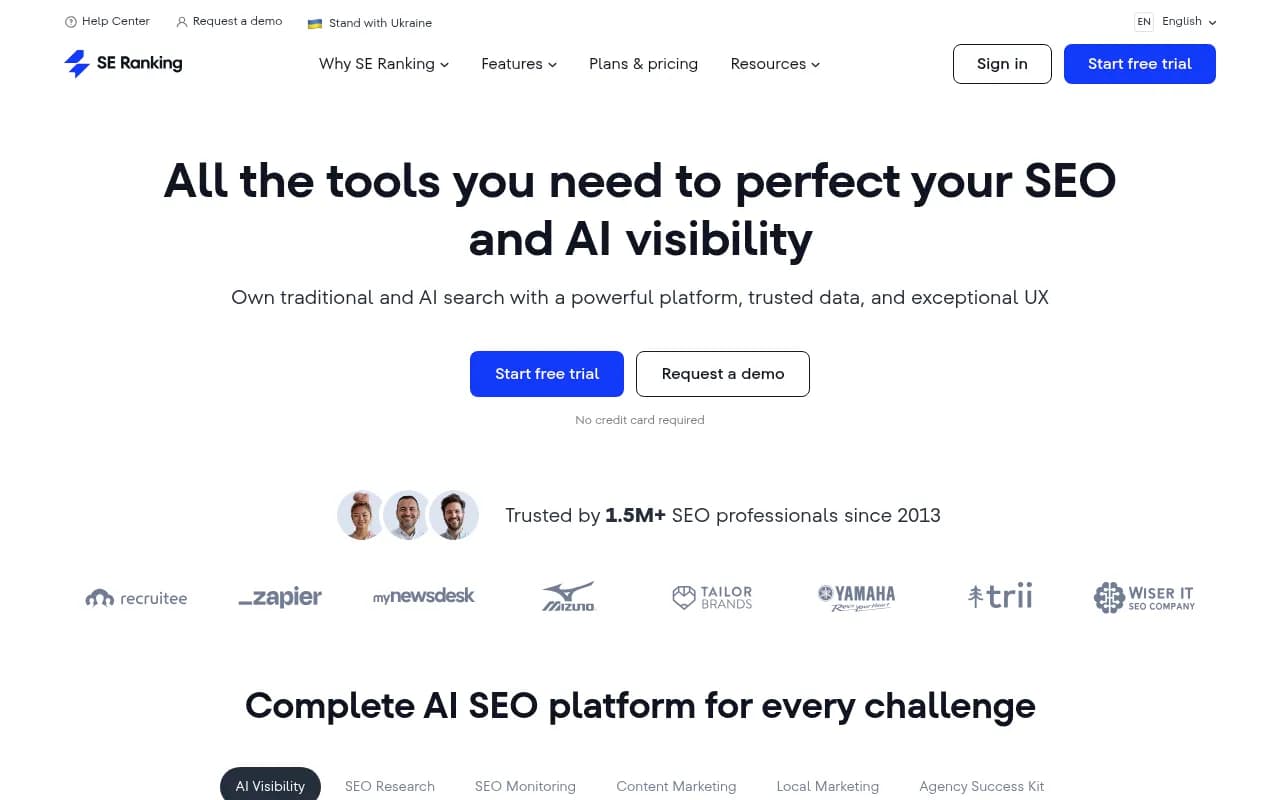
| SE Ranking | 2/5 | 2/5 | 3/5 | ChatGPT, Perplexity, Google AI Overviews | SMB SEO teams |
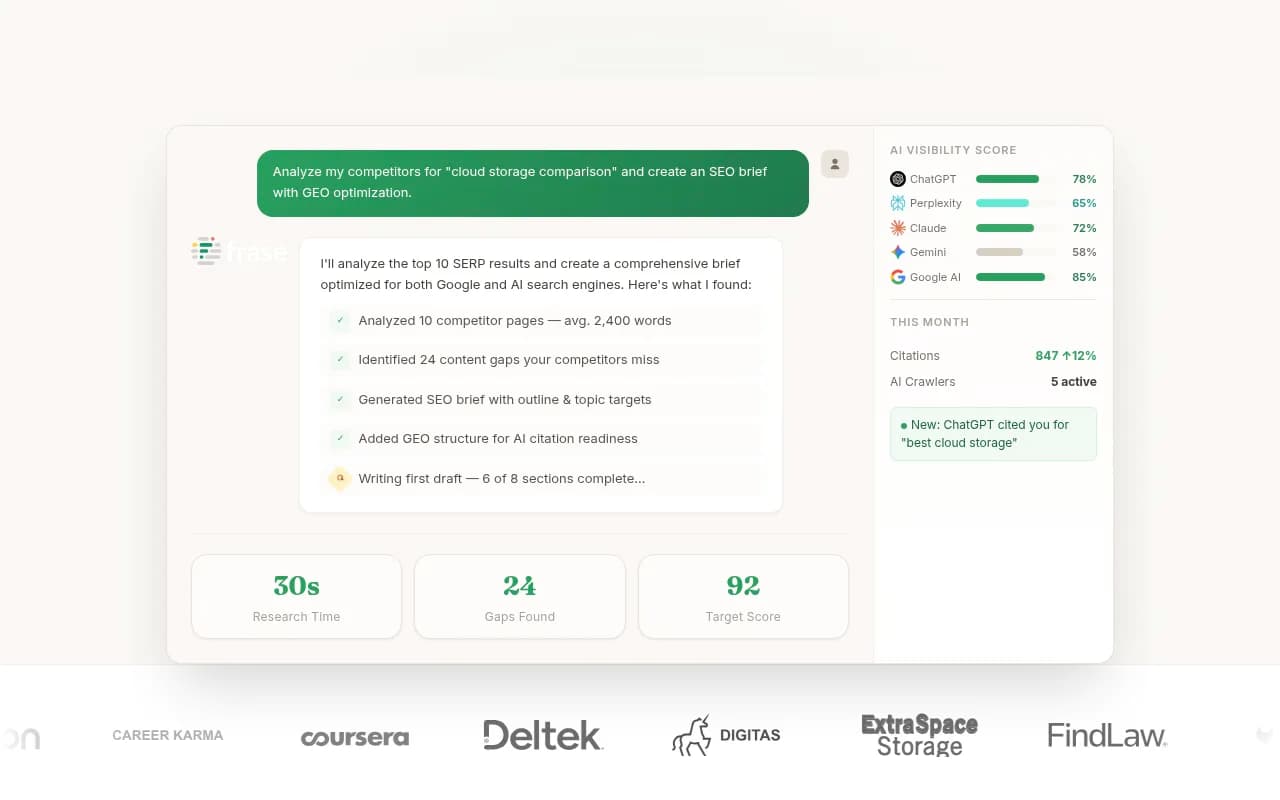
| Frase | 3/5 | 4/5 | 2/5 | Limited | Content-first teams |
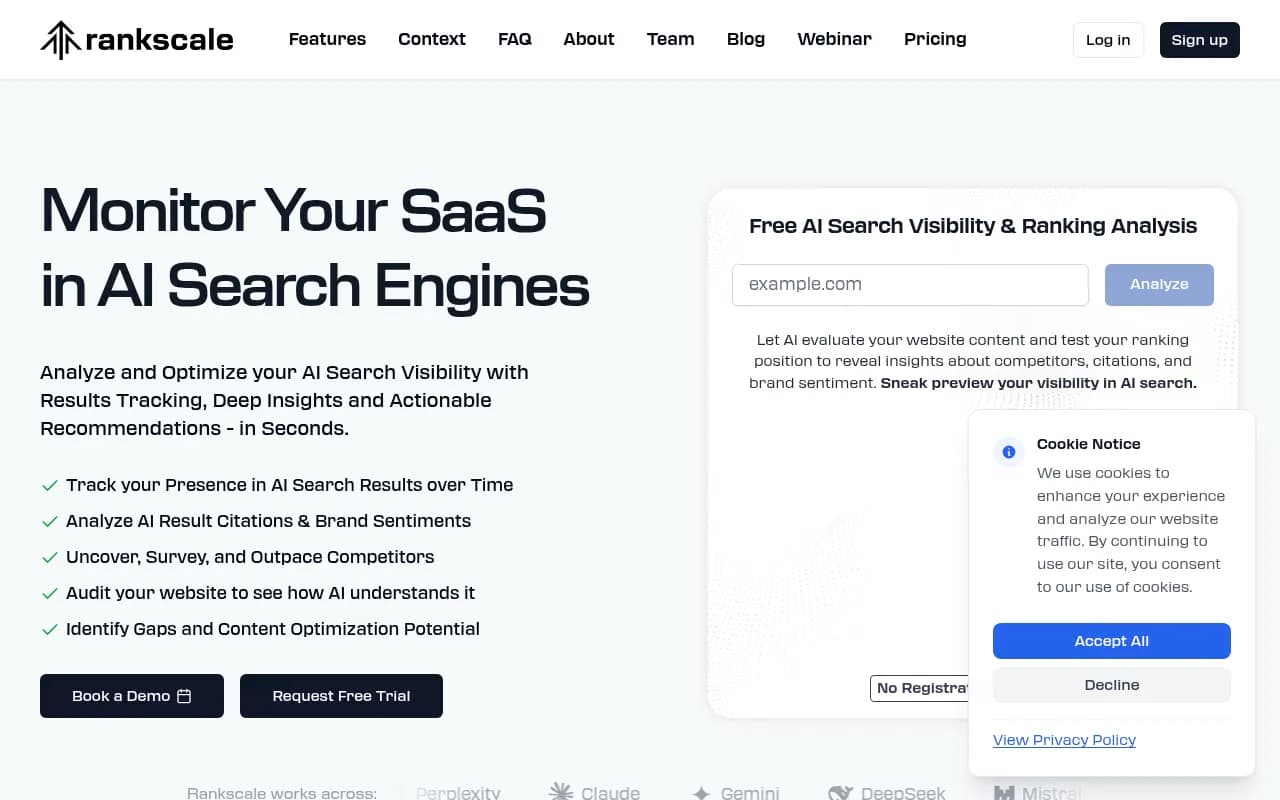
| Rankscale | 2/5 | 1/5 | 3/5 | ChatGPT, Perplexity, Gemini | Rank-focused tracking |
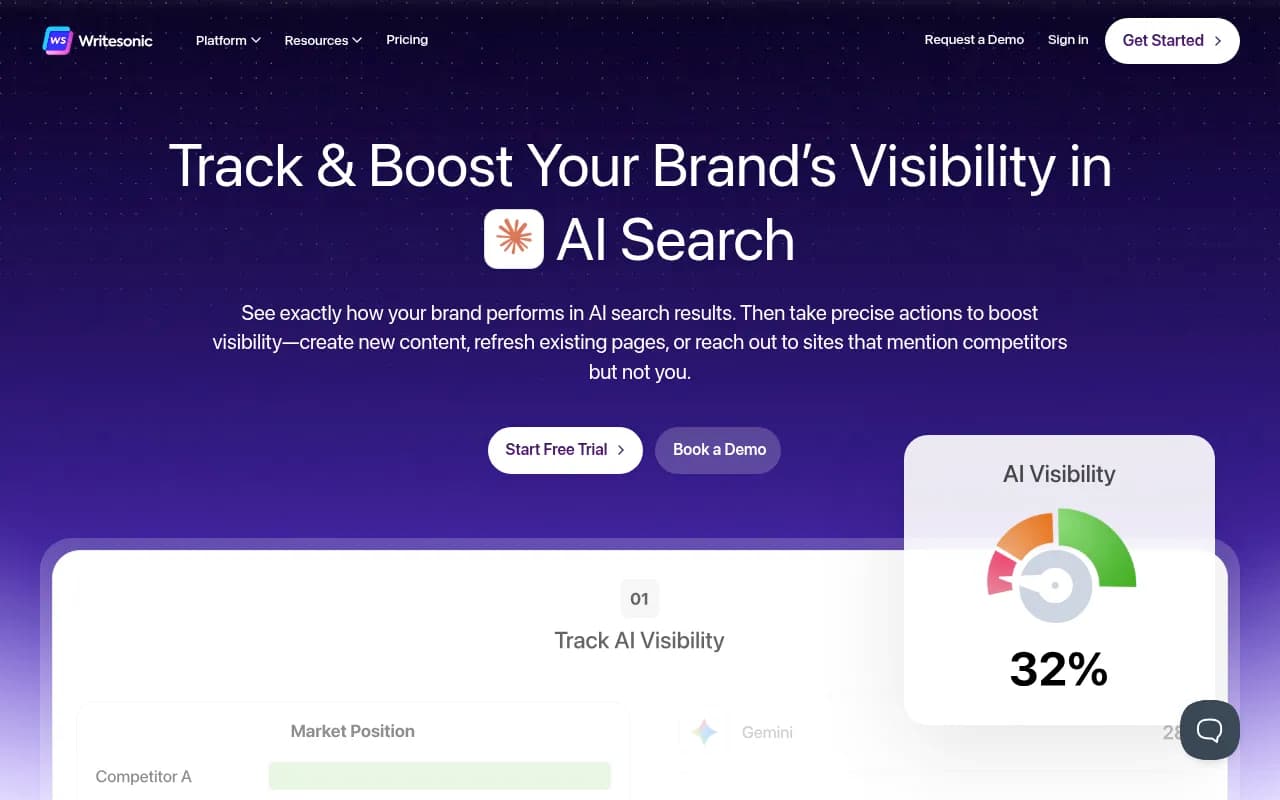
| Writesonic | 1/5 | 4/5 | 2/5 | Limited | Content generation with some AI SEO |
Platform-by-platform breakdown
Promptwatch
Promptwatch sits at the top of this matrix because it's the only platform in this comparison that scores well across all three dimensions. The answer gap analysis shows exactly which prompts competitors rank for that you don't -- down to the specific content your site is missing. The built-in content generation agent produces articles and comparisons grounded in 880M+ citations analyzed, not generic AI output. And citation tracking goes to the page level, showing which URLs are being cited, by which models, and how often.
Two features that don't fit neatly into the three-column matrix but matter a lot in practice: AI crawler logs (real-time visibility into when ChatGPT, Claude, and Perplexity crawl your site) and prompt intelligence with volume estimates and difficulty scores. Most competitors don't have either.

Profound
Profound is a well-funded platform ($55M across two raises from Kleiner Perkins and Sequoia) with strong citation tracking and a clean enterprise interface. Its gap analysis is solid but skews toward showing share-of-voice comparisons rather than surfacing specific actionable prompts. Content generation is minimal -- the platform is built around monitoring and reporting, not fixing. Good fit for enterprise teams that have a separate content operation and just need the data.

Scrunch AI
Scrunch AI covers the major AI models and has decent citation tracking. The gap analysis is present but fairly surface-level -- you get competitive comparisons but not the granular prompt-level breakdown that makes gap analysis genuinely useful. No native content generation. It works well as a monitoring layer for teams that already have a content workflow.
AthenaHQ
AthenaHQ covers 8+ AI engines and has built a reputation for clean dashboards and reliable tracking. The monitoring side is strong. But it's explicitly a monitoring platform -- there's no content generation, and the gap analysis stops at showing you where you're underperforming rather than telling you what to create. Teams that want to act on what they find will need to take the data elsewhere.

Otterly.AI
Otterly.AI is one of the more affordable options in this space and does basic citation monitoring competently. The gap analysis is limited to share-of-voice comparisons, and there's no content generation. Fine as a starting point for small teams that want to understand their AI visibility without a big budget commitment.

Peec AI
Peec AI's main differentiator is multi-language and multi-region support, which matters for international brands. The tracking is solid across its covered models. Like Otterly.AI, it's a monitoring tool -- no content generation, limited gap analysis depth. Worth considering if you're tracking AI visibility across multiple markets.

Search Party
Search Party is agency-oriented and has some content capabilities, but the gap analysis is limited and prompt-level metrics are thin. It works better as a client reporting layer than as an optimization platform. Agencies that need to show AI visibility data to clients will find it useful; agencies that want to actually improve that visibility will hit its ceiling quickly.
BrightEdge
BrightEdge is an established enterprise SEO platform that has added AI search tracking through its AI Catalyst product. The citation tracking is strong, particularly for Google AI Overviews. The gap analysis is better than most traditional SEO tools but still not as granular as purpose-built AEO platforms. Content generation exists but is more of an SEO writing assistant than an AI-citation-optimized content engine.
Semrush
Semrush has added AI Overviews tracking to its existing platform, which is useful if you're already a Semrush customer. The limitation is that it uses fixed prompts rather than letting you define your own, which means you're tracking what Semrush decides matters rather than what's relevant to your business. No AI traffic attribution. For teams already deep in the Semrush ecosystem, it's a reasonable add-on; as a standalone AEO solution, it's not enough.
Ahrefs Brand Radar
Similar situation to Semrush -- Ahrefs has added AI brand tracking as a feature within its existing platform. Fixed prompts, no AI traffic attribution, no content generation. The citation tracking is decent for the models it covers. Best suited for Ahrefs users who want a basic view of their AI brand presence without switching tools.
Brandlight
Brandlight focuses on brand reputation in AI responses -- tracking sentiment and how AI models describe your brand, not just whether they cite you. That's a useful angle, but the gap analysis and content generation capabilities are thin. Works well as a brand safety monitoring layer alongside a more optimization-focused platform.
SE Ranking
SE Ranking has built out a reasonable AI visibility toolkit within its all-in-one SEO platform. The tracking covers the main models, and the content tools are decent for SEO writing. The AI-specific gap analysis is limited. Good option for SMB teams that want to consolidate tools and don't need deep AEO capabilities.
Frase
Frase approaches this from the content side rather than the monitoring side. Its content generation and optimization capabilities are strong -- it's built for producing content that answers questions well. The citation tracking and gap analysis are limited compared to dedicated AEO platforms. Teams that prioritize content quality and are less focused on tracking AI model citations specifically will find it useful.
Rankscale
Rankscale is a focused rank-tracking tool for AI search. The citation tracking is solid for what it does. Gap analysis and content generation are minimal. It's a good supplementary tool but not a complete AEO platform on its own.
Writesonic
Writesonic has added AI search visibility features to its content generation platform. The content generation is strong -- that's the core product. The citation tracking and gap analysis are limited. If you're primarily a content team that wants to start thinking about AI search optimization, it's a reasonable starting point.
How to read this matrix for your situation
The scores above tell you what each platform can do. What they don't tell you is which capabilities matter most for where you are right now.
If you're just starting out and want to understand your current AI visibility, citation tracking is the first thing you need. Most tools on this list do this adequately. Otterly.AI, Peec AI, and SE Ranking are reasonable starting points at lower price points.
If you've been monitoring for a while and want to know why competitors are winning prompts you're not, answer gap analysis becomes the priority. This is where the field thins out considerably. Promptwatch and Profound are the strongest options here, with Promptwatch going further by connecting the gap analysis directly to content creation.
If you want to close the loop -- find gaps, generate content to fill them, and track whether that content gets cited -- you're looking at a very short list. Promptwatch is the only platform in this comparison that does all three natively. Frase and Writesonic have strong content generation but weak tracking. Everyone else is primarily a monitoring tool.
Features the matrix doesn't capture
Three capabilities didn't fit into the main matrix columns but are worth flagging when you're evaluating platforms:
AI crawler logs show you when AI bots (ChatGPT's crawler, Perplexity's crawler, etc.) visit your site, which pages they read, and any errors they encounter. This is how you diagnose indexing problems -- if Perplexity's crawler can't access your content, no amount of content optimization will help. Promptwatch has this; most competitors don't.
Prompt volume and difficulty scoring helps you prioritize. Not all prompts are worth chasing. A tool that shows you 200 gaps but can't tell you which ones have meaningful query volume is making you guess. Promptwatch's prompt intelligence includes volume estimates and difficulty scores; most monitoring-only tools don't have this data.
Reddit and YouTube tracking matters because AI models frequently cite Reddit threads and YouTube content in their responses. If you're not tracking which third-party content influences AI recommendations in your category, you're missing a significant optimization lever. This is a feature almost no competitor offers.
The market context
The AEO tool category has attracted serious capital. Profound raised $55M across two rounds (Kleiner Perkins and Sequoia). Bluefish raised $68M total. Evertune and Scrunch each raised $19M. That's over $200M in disclosed funding as of early 2026.
The investment makes sense given the underlying trend: generative AI referral traffic to websites was up 123% in the first half of 2025 according to Search Engine Land, and AI-sourced leads convert 2-4x better than conventional search traffic. Brands that establish citation equity now are building a durable advantage.
What the funding rounds don't tell you is whether the platforms are actually helping brands improve their AI visibility or just monitoring it. That's the question this matrix tries to answer -- and why the content generation and gap analysis scores matter as much as the citation tracking scores.
Bottom line
The honest summary: most AEO tools in 2026 are monitoring dashboards with good marketing copy. They'll show you that your AI visibility is lower than competitors. They won't tell you exactly why, and they won't help you fix it.
The platforms worth paying attention to are the ones that complete the loop: find the specific prompts you're losing, generate content designed to win those prompts, and track whether it works. That's a much shorter list than the 200+ tools currently competing for your attention.
For teams that want to start somewhere practical: pick a tool with strong citation tracking to establish a baseline, then evaluate whether its gap analysis is specific enough to act on. If you find yourself exporting data to a spreadsheet to figure out what to do next, that's a sign you need a platform that goes further.