Key takeaways
- SEO optimizes for traditional search engines like Google and Bing -- rankings, clicks, organic traffic. It's still relevant but no longer the whole picture.
- AEO (Answer Engine Optimization) focuses on getting your content pulled into direct answers -- featured snippets, voice search, and AI-powered Q&A interfaces.
- GEO (Generative Engine Optimization) is about getting cited by AI models like ChatGPT, Perplexity, Claude, and Gemini when they generate responses.
- These three disciplines overlap significantly, but they require different strategies, different metrics, and increasingly, different tools.
- Most brands need all three running in parallel -- the question is where to start and what to prioritize.
The problem with three acronyms that sound identical
If you've spent any time in marketing forums lately, you've probably seen SEO, AEO, and GEO used almost interchangeably -- sometimes by the same person in the same post. That's understandable. The lines between them are genuinely blurry, and the terminology is still settling.
But they're not the same thing. They target different systems, they measure success differently, and the tactics that work for one can actively fail for another. Getting them confused means misallocating budget, tracking the wrong metrics, and wondering why your visibility isn't improving even though you're "doing SEO."
Let's sort this out properly.
SEO: still the foundation, but not the ceiling
Search Engine Optimization has been around for 25+ years. The core idea hasn't changed: help Google (and Bing, and others) understand what your pages are about so they rank them for relevant queries.
In practice, SEO breaks into three areas:
- Technical SEO: crawlability, site speed, Core Web Vitals, structured data, XML sitemaps
- On-page SEO: keyword targeting, title tags, headers, content depth, internal linking
- Off-page SEO: backlinks, brand mentions, domain authority
Google still processes roughly 8.5 billion searches per day. Organic search still drives a huge share of web traffic for most businesses. SEO is not dead -- anyone telling you that is selling something.
What has changed is that SEO is now the floor, not the ceiling. People aren't only using Google anymore. They're asking ChatGPT, using Perplexity for research, getting AI Overviews at the top of Google results without ever clicking through, and querying voice assistants. Each of those touchpoints requires something different from your content.
For traditional SEO, tools like Semrush and Ahrefs remain the standard. They handle keyword research, rank tracking, backlink analysis, and site audits at scale.
If you're doing technical SEO at scale, Screaming Frog is still the go-to crawler for auditing large sites.
AEO: optimizing for the answer, not the ranking
Answer Engine Optimization emerged as a distinct concept when voice search and featured snippets became significant traffic drivers. The goal isn't just to rank -- it's to be the source that gets pulled into a direct answer.
Think about what happens when someone asks Google "what's the capital of France" or "how do I fix a 404 error." They don't see ten blue links. They see an answer box. AEO is about being that answer.
The tactics overlap heavily with good SEO practice:
- Structured data markup (FAQ schema, HowTo schema, Q&A schema)
- Clear, concise answers near the top of your content
- Question-based headings that match how people actually ask things
- Content that directly addresses specific queries rather than dancing around them
Where AEO diverges from traditional SEO is in measurement. You're not just tracking keyword rankings -- you're tracking featured snippet ownership, voice search appearance, and position zero results. The click-through rate on these is often lower (people get the answer without visiting your site), but the brand visibility and trust signals are real.
AEO also matters more for certain content types. FAQ pages, how-to guides, comparison articles, and definitional content ("what is X") are all high-AEO-value formats.
GEO: the newest layer, and the one most brands are ignoring
Generative Engine Optimization is what happens when you stop optimizing for search results pages and start optimizing for AI-generated responses.
When someone asks ChatGPT "what's the best project management tool for remote teams" or asks Perplexity "which CRM should I use for a B2B SaaS company," those AI models generate an answer. They cite sources. They recommend brands. They describe products. And right now, most brands have no idea whether they're showing up in those answers -- or why they're not.
That's the GEO problem.
GEO is different from SEO in a few important ways:
- You're not ranking on a results page -- you're being cited (or not) inside a synthesized response
- The "algorithm" isn't a ranking formula -- it's a language model's learned associations and real-time retrieval
- Success metrics aren't rankings and clicks -- they're citation frequency, sentiment in AI responses, and share of voice across models
- The content that gets cited tends to be authoritative, specific, and structured in ways that are easy for models to parse and quote
GEO is also different from AEO, despite the overlap. AEO is mostly about structured content for answer boxes and voice queries -- it's still within the Google ecosystem. GEO extends to ChatGPT, Claude, Perplexity, Gemini, Grok, DeepSeek, and every other AI model your customers might use. The audience is broader, the systems are more opaque, and the optimization levers are different.
How they compare side by side
| Dimension | SEO | AEO | GEO |
|---|---|---|---|
| Target system | Google, Bing | Google featured snippets, voice search | ChatGPT, Perplexity, Claude, Gemini, etc. |
| Primary goal | Rankings and organic traffic | Position zero / direct answers | Citations in AI-generated responses |
| Key tactics | Keywords, backlinks, technical health | Schema markup, Q&A content, concise answers | Authoritative content, citation-worthy sources, entity coverage |
| Success metrics | Rankings, clicks, organic sessions | Featured snippet ownership, voice appearances | Citation rate, share of voice, AI visibility score |
| Measurement tools | Semrush, Ahrefs, GSC | GSC, rank trackers with snippet tracking | GEO platforms (Promptwatch, Profound, etc.) |
| Overlap with others | High overlap with AEO | High overlap with SEO, moderate with GEO | Moderate overlap with AEO, lower with traditional SEO |
| Maturity | Mature, well-understood | Established but evolving | Emerging, fast-moving |
Where they overlap (and where they don't)
The good news is that strong SEO practice creates a solid foundation for both AEO and GEO. A well-structured, authoritative, technically sound website is more likely to earn featured snippets and more likely to be cited by AI models.
But the overlap isn't complete, and this is where brands get tripped up.
A page can rank #1 on Google and never appear in a ChatGPT response. Why? Because AI models don't just pull from whatever ranks highest -- they draw from their training data, from sources they've learned to trust, and from real-time retrieval that has its own logic. A brand that's dominated Google for years can be essentially invisible to AI models if it hasn't built the kind of web presence (citations, discussions, third-party mentions, structured entity data) that AI systems learn from.
Conversely, a brand that's heavily discussed on Reddit, cited in industry publications, and mentioned in YouTube reviews might show up frequently in AI responses even without exceptional Google rankings.
This is why GEO requires its own dedicated attention -- and its own tools.
Tools for each discipline
SEO tools
The traditional SEO stack is well-established. For most teams, it includes a keyword research and rank tracking platform, a technical crawler, and a content optimization tool.
For content optimization specifically, tools like Clearscope and MarketMuse help you build topical depth that satisfies both Google and, increasingly, AI models looking for comprehensive coverage.
AEO tools
AEO doesn't have its own dedicated tool category the way SEO does -- most AEO work happens inside standard SEO platforms. What you're looking for is featured snippet tracking, schema validation, and content scoring against question-based queries.
SE Ranking has built out solid AI visibility features alongside its traditional SEO toolkit, making it a reasonable choice if you want AEO and SEO coverage in one place.
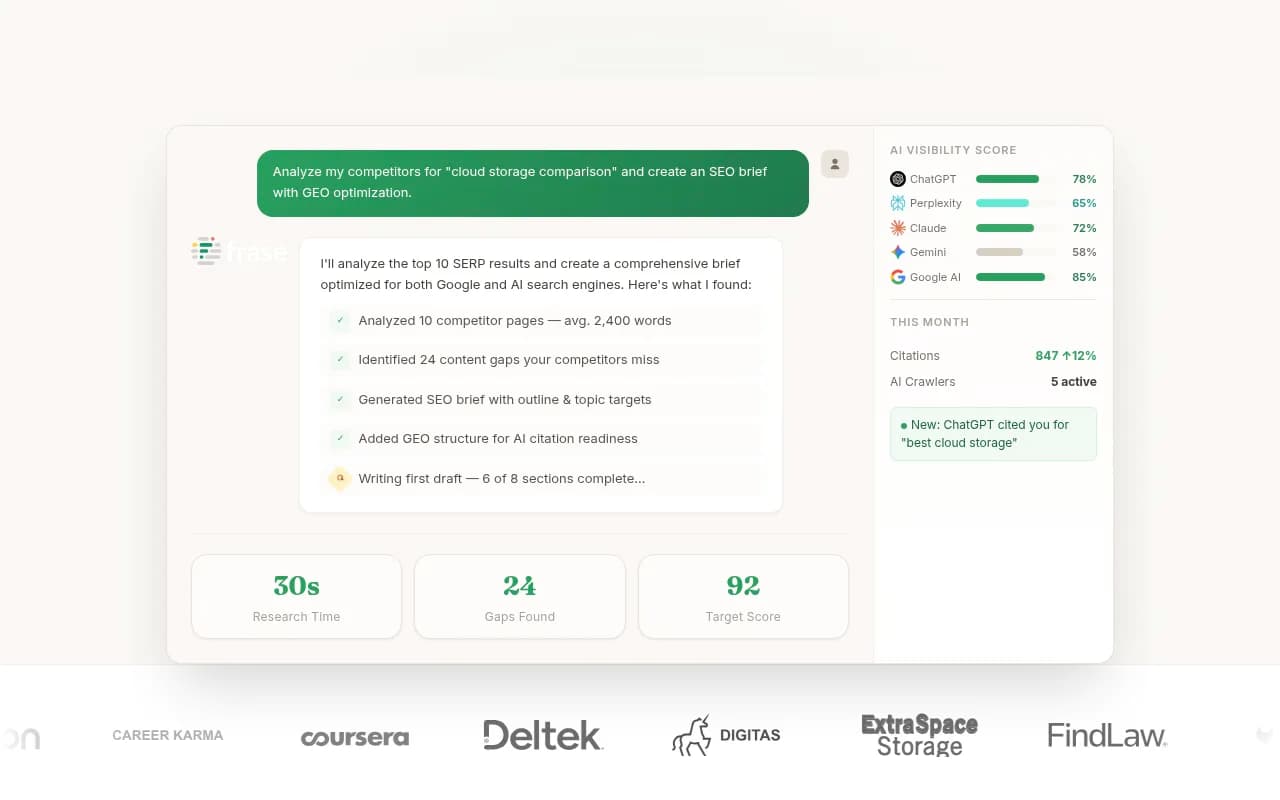
Frase is worth mentioning here too -- it's built around answering questions comprehensively, which maps directly to AEO content strategy.
GEO tools
This is where the tooling landscape is most active right now, and most interesting. A new category of platforms has emerged specifically to track and improve AI visibility -- how often you're cited, in which models, for which queries, and how your brand is described.
Promptwatch is the most complete platform in this space. It monitors 10 AI models (ChatGPT, Perplexity, Claude, Gemini, Grok, DeepSeek, Copilot, Meta AI, Google AI Overviews, and Mistral), tracks citation frequency and sentiment, and -- critically -- helps you do something about gaps. Its Answer Gap Analysis shows exactly which prompts competitors are visible for that you're not, and its built-in content generation tools create articles engineered to get cited. That's a different proposition from tools that just show you a dashboard.

Profound is another solid option for enterprise teams that want deep AI visibility data.

For teams that want a lighter-weight starting point, Otterly.AI and Peec AI offer monitoring at lower price points, though they're more limited on the action side.


AthenaHQ covers 8+ AI engines and is worth a look for teams focused on tracking.

Which one should you prioritize?
Honest answer: it depends on where your customers are in their journey and where you're currently weakest.
If you have almost no SEO foundation -- thin content, poor technical health, no backlinks -- start there. GEO and AEO won't save you if your site is a mess. AI models do pull from web content, and a poorly structured, low-authority site is going to struggle regardless of optimization layer.
If your SEO is solid but you're losing traffic to AI Overviews and zero-click results, AEO is the next logical step. Structured data, better Q&A content, and featured snippet optimization will help you reclaim some of that visibility within Google's own ecosystem.
If you're seeing good organic traffic but you're not showing up when people ask AI assistants about your category, GEO is where you need to focus. This is increasingly the case for B2B brands, where buyers are using ChatGPT and Perplexity for vendor research before they ever visit a website.
For most established brands in 2026, the honest answer is: all three, running in parallel, with GEO getting more attention than it currently does.
A practical starting point for GEO
If you're new to GEO, here's a simple way to start:
- Run a few prompts in ChatGPT, Perplexity, and Claude that a potential customer might use to find a brand like yours. Note who gets mentioned and who doesn't.
- Look at what those mentioned brands have in common -- are they cited in industry publications? Discussed on Reddit? Featured in comparison articles?
- Audit your own content for citation-worthiness: do you have clear, specific, authoritative pages that answer the questions AI models are being asked?
- Use a GEO platform to systematize this -- manual prompt testing doesn't scale, and you need consistent tracking across multiple models to see trends.
The brands that are winning in AI search right now aren't doing anything magical. They have comprehensive content that directly answers real questions, they're cited by credible third-party sources, and they've structured their information in ways that are easy for AI models to parse and quote. That's achievable for most brands -- it just requires treating GEO as a real discipline, not an afterthought.
The bottom line
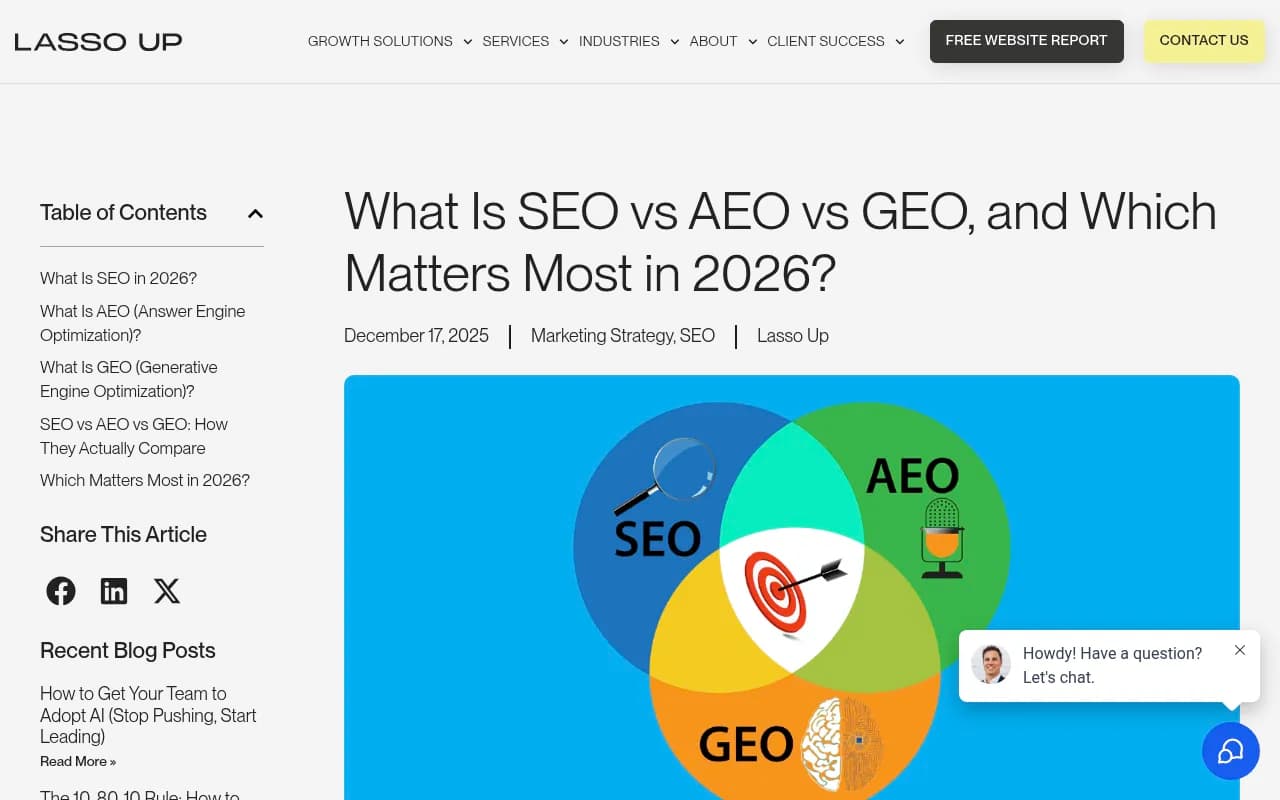
SEO, AEO, and GEO aren't competing frameworks -- they're layers of a complete visibility strategy. SEO gets you found on traditional search. AEO gets you into answer boxes and voice results. GEO gets you cited when AI models answer questions about your category.
The brands that treat these as separate silos will keep optimizing for a search landscape that's already changed. The ones that build a coherent strategy across all three will show up wherever their customers are looking -- whether that's a Google results page, a voice query, or a conversation with an AI assistant.
That last channel is growing faster than most marketing teams have adjusted for. The tools exist. The playbook is taking shape. The question is whether you start now or spend the next year watching competitors get cited while you're invisible.