Key takeaways
- Enterprise GEO is a cross-functional program, not a rebrand of the SEO team. The work touches content, product marketing, PR, engineering, analytics and brand.
- A workable core is 4 to 6 people for a mid-size enterprise, scaling to 10 to 15 with regional pods. Treat these as planning ranges based on my own judgment, not benchmarks. I found no verified public data on GEO headcount or salaries.
- Promptwatch Data shows the content mix AI cites (product and landing pages first) and how long pages stay cited. Both argue for product marketing and content maintenance seats, not just writers.
- Crawler access needs a named owner in engineering or technical SEO. Without one, a blocked bot quietly caps the whole program.
- Buy tools by seat: a monitoring and action platform for the program lead, crawler analytics for tech SEO, and CMS and workflow tools for content ops.
Why a GEO team needs its own structure
Most enterprises start GEO the same way. Someone in SEO notices the brand is missing from ChatGPT answers, runs a few prompts by hand, and builds a slide. Then leadership asks who owns the fix, and the honest answer is nobody. Fixing AI visibility needs pages rewritten (content), claims corrected (product marketing), third-party mentions earned (PR), bots allowed in (engineering), and results measured (analytics). No single SEO manager controls all of that.
So the question is not "do we hire a GEO specialist?" It is "who owns each of the five or six levers, and who coordinates them?" This guide answers that, with a staffing model you can adapt.
One caveat up front. Public data on GEO team sizes and salaries barely exists yet. The headcount numbers below are my planning heuristics from how the work divides, not survey results. Use them to start the conversation with finance, then adjust after your first 90 days.
What the data says the team has to cover
The shape of the team should follow the shape of what AI actually cites. Promptwatch publishes first-party research on this, and three findings drive the structure below.

Product and landing pages dominate citations
In Promptwatch Data's analysis of ChatGPT citations from Sep 28 to Oct 4, 2026, product pages were the most cited content type at 22.4%, and landing pages followed at 16.8%. That is roughly 39% of citations going to pages that describe what a company sells. For commercial prompts, product pages hit 26.0% and landing pages 20.6%.
That is a product marketing result, not a blog result. The people who own product pages, specs, pricing and positioning are GEO stakeholders whether or not they know it. Editorial formats combined (listicles, how-tos, comparisons, news, reviews) still make up about 43%, so you need both.
Content stays cited for a long time, or doesn't
Promptwatch tracked every page ChatGPT cited on July 6, 2026 for 90 days. Landing pages and docs held up best: 78% of landing pages and 76% of docs were still cited after 30 days, and 69% and 67% after 60 days. Product pages, reviews and how-tos had a half-life of roughly 74 to 77 days. News lost half its pages within 36 days, and almost a quarter were never cited again.
The staffing implication is that a refresh cadence matters more than raw publishing volume. A team that only ships new articles will watch its citations decay. You want someone whose job is keeping specs, prices and docs current.
Crawler access is its own problem
Promptwatch's AI crawler traffic report (IP-verified requests, Jun 8 to Sep 6, 2026) found OpenAI at 79.8% of verified requests in the week of Aug 31 to Sep 6, down from 94.8% in early June. The mix is shifting between OpenAI, Anthropic, Google, Perplexity and Mistral. If a provider is big in that mix but near zero in your logs, you are probably blocked by robots.txt, CDN or WAF rules. Someone has to own that check, and it is rarely the content team.
The core roles
Here is the cast. Not every role is a full-time hire at first. Several can be partial allocations from existing teams.
GEO program lead
This person owns the roadmap, the reporting to executives, and the cross-team prioritization. They need to be comfortable in both SEO and brand marketing, and they need enough standing to ask engineering for crawler fixes. Title varies: Head of AI Search, GEO Lead, Director of Organic. What matters is that they have a budget line and a regular slot in leadership reporting.
Their core metrics: Visibility Score, share of voice against named competitors, citation share, and AI-referred conversions. Their weekly question is "which three actions move those numbers?"
Technical SEO and crawler access owner
Owns robots.txt, CDN and WAF rules, rendering, structured data, llms.txt decisions, sitemaps and site audits. Also owns the monitoring of AI bot activity in server logs. In many enterprises this is an existing technical SEO manager with a new brief, working with a DevOps contact who can actually change the rules.
This role matters more than it looks. A content program built on pages AI bots cannot reach is wasted spend.
Content and GEO editor
Owns editorial formats: comparisons, listicles, how-tos, FAQs, and the refresh cycle. Maps content to prompt intent, using query fan-outs and the competitor pages AI already cites as inputs. In a mid-size team this is one editor plus freelance or agent-assisted writers.
Content operations and refresh owner
The half-life data justifies this seat. This person runs the refresh calendar, tracks which cited pages are decaying, and keeps docs, pricing and specs accurate. At smaller scale, fold it into the content editor's job. At enterprise scale with thousands of URLs, it is its own role.
Product marketing partner
Owns the facts AI repeats about your products: positioning, pricing language, feature claims, comparisons against competitors. When your monitoring shows AI saying something wrong about you, this person decides what the correct claim is and which page should state it. Usually a partial allocation, 10 to 20% of one person's time per product line.
Digital PR and reviews owner
AI answers lean on third-party sources: roundups, review sites, forums, directories. Someone has to get you listed in the roundups that get cited and collect reviews on trusted sites. For branded prompts, Promptwatch Data shows reviews at 5.6% of citations, more than three times their share across all prompts. This role often sits in comms or partner marketing.
Analyst or analytics engineer
Connects AI visibility data to traffic and revenue. Handles AI referral attribution, dashboards, and the reporting pipeline. Attribution is messier than it was: ChatGPT stopped sending a referrer on October 8, 2026, so teams now rely on UTM tagging and script-based detection. Someone has to own that logic. Without it, the program can't show revenue and the budget conversation gets hard.
Regional or market leads
Global brands need local monitoring, because AI answers differ by country and language. Add a regional owner per major market once the global program is stable, not before.
Headcount by company size
These are planning ranges, not benchmarks. The pattern: start with a lead and borrow the rest, then convert borrowed time into hires as the program proves itself.
| Stage | Dedicated GEO headcount | Borrowed or partial | Typical scope |
|---|---|---|---|
| Pilot (first 90 days) | 1 (program lead) | Tech SEO, content, product marketing, analyst at 10-25% each | One market, 1-2 monitors, top competitors, crawler audit |
| Mid-size enterprise | 4-6 | PR, product marketing, DevOps contact | Several product lines, weekly reporting, active refresh cadence |
| Large enterprise | 8-15 | Legal, brand, regional teams | Multiple markets, pods per business unit, agent-assisted content at volume |
| Global enterprise | 15+ | Centers of excellence | Hub-and-spoke model with local owners |
A few opinions on that table. First, do not hire writers before you have a crawler and measurement baseline. Second, the analyst seat gets cut first in budget meetings and regretted soonest. Third, an agency or agent-assisted workflow can stand in for content headcount while you prove the program, which is a reasonable bridge, not a permanent substitute for an owner.
Operating models: centralized, hub-and-spoke, or embedded
Centralized
One GEO team serves all business units. Fast to launch, consistent reporting, easy to staff. It struggles when product lines have very different buyers and prompts.
Hub-and-spoke
A central team owns tooling, methodology and reporting. Business units have a named GEO champion who owns their pages and prompts. This is where most large enterprises end up, because it matches how product marketing is already organized.
Embedded
GEO specialists sit inside each business unit. Works for very large companies with separate P&Ls, but standards drift fast. Needs a strong central playbook.
My default recommendation is to start centralized, then move to hub-and-spoke once you have three or more business units asking for support.
RACI: who owns what
| Activity | Program lead | Tech SEO | Content | Product marketing | PR | Analyst |
|---|---|---|---|---|---|---|
| Prompt and competitor set | A | C | R | C | I | C |
| Crawler access and site health | I | A/R | I | I | I | C |
| New content | A | C | R | C | I | I |
| Refresh of cited pages | A | C | R | C | I | I |
| Fact corrections about the brand | A | I | R | R | C | I |
| Third-party mentions and reviews | A | I | C | C | R | I |
| Attribution and reporting | A | C | I | I | I | R |
R is responsible, A is accountable, C is consulted, I is informed. The point of the exercise is that every row has exactly one accountable name.
The tool stack by seat
The tool question is easier once roles are clear. Buy for the seat, not for the feature list. There is also a real difference between tools that report a score and tools that help you fix what the score shows. Browse the full category at the GEO software directory if you want a wider view.
Program lead and shared platform
The core platform needs prompt tracking from real AI interfaces, competitor benchmarking, citation analysis, and some way to turn findings into work. Promptwatch covers this loop: it monitors ChatGPT, Gemini, Claude, Perplexity, Google AI Overviews and others, traces which pages and third-party sources get cited, and then provides an Action Board and a Content Agent for the fixes, with crawler logs and visitor analytics to check results. Pricing starts at $95/mo for Essential and $579/mo for Business, which is the first plan with the Content Agent, state and city tracking, and Fact Check. Confirm current numbers at promptwatch.com/pricing. Agencies running this for clients have separate plans from $199/mo.
Other platforms worth comparing for enterprise use:

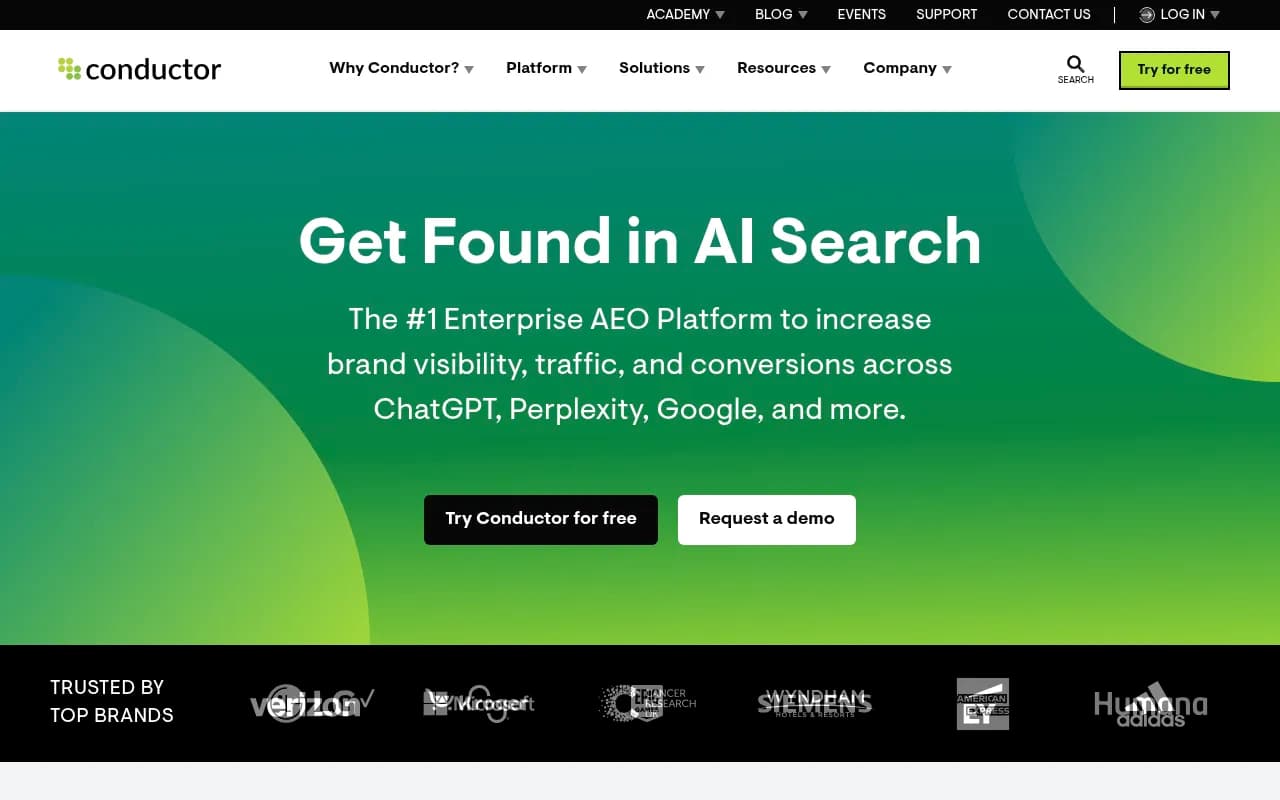
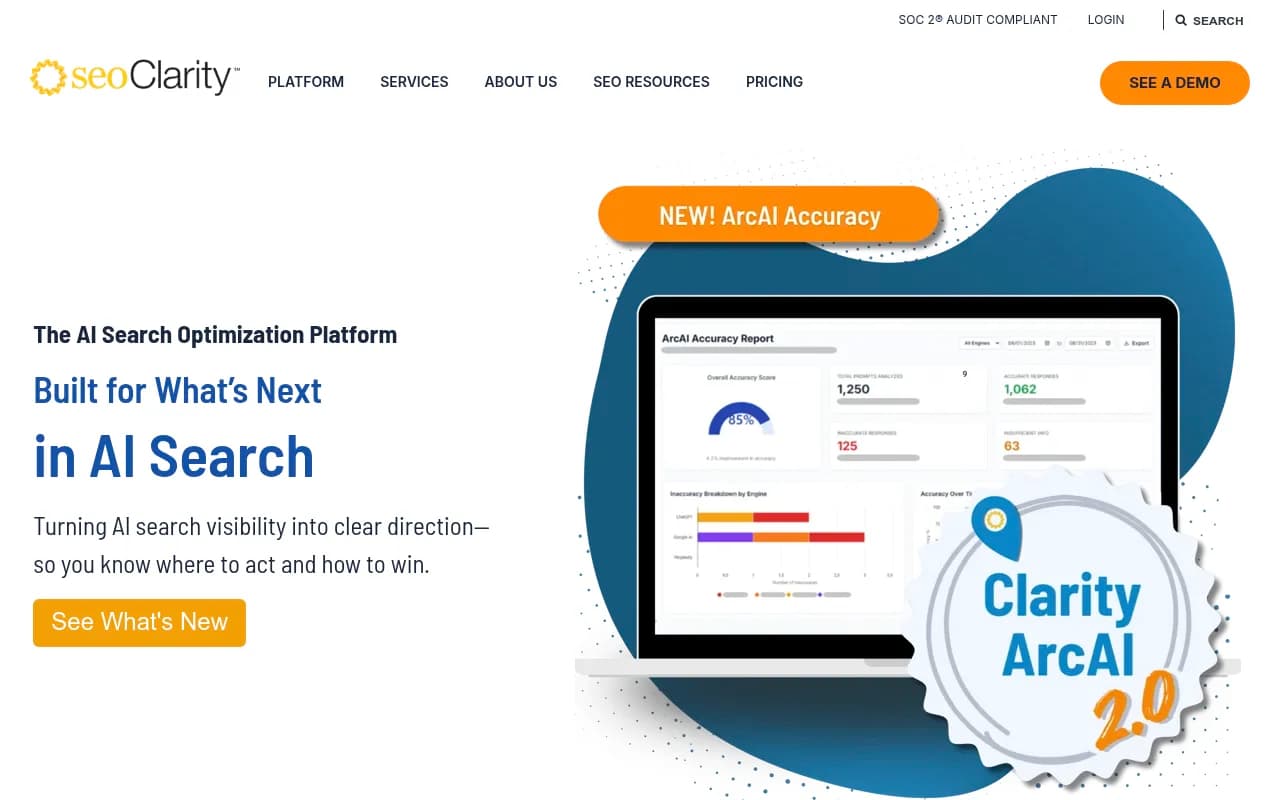
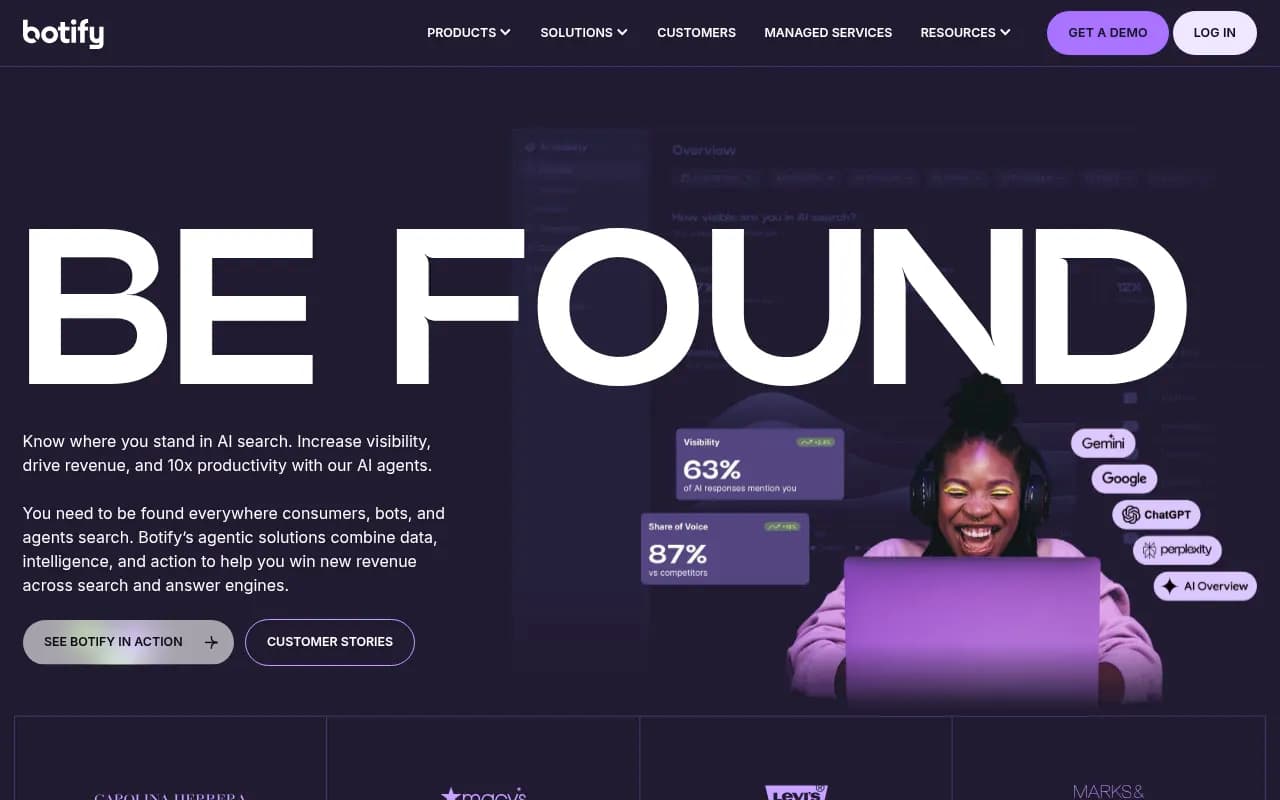
The traditional SEO suites (BrightEdge, Conductor, seoClarity, Botify) fit when your organization already runs its SEO program there and wants one vendor. The tradeoff is that AI tracking is often an add-on to a broader suite. Dedicated GEO platforms tend to go deeper on citations and content gaps.
Technical SEO and crawler owner
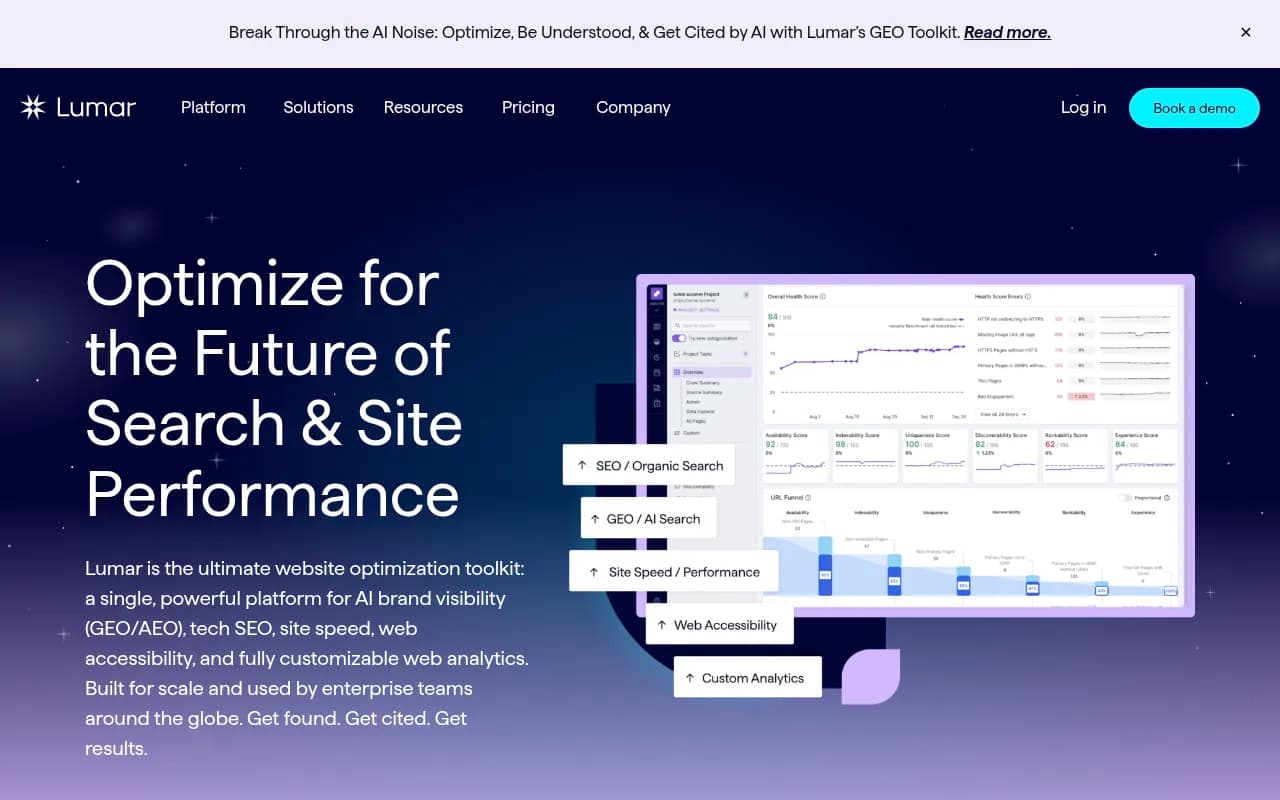
This seat needs IP-verified crawler logs, so the team can tell whether GPTBot, ClaudeBot, PerplexityBot and others reach key pages and what errors they hit. Promptwatch's AI crawler logs do this, and it also offers a free Agentic Readiness Check for a quick look at which bots can read your site. For traditional crawling and audits at enterprise scale:
A lightweight option for watching bot visits is DarkVisitors:
Content and refresh seats
Content teams need a way to see which prompts and pages matter, plus a drafting and publishing workflow. Content optimization tools like Clearscope, Surfer SEO and MarketMuse help with on-page quality. AirOps handles content engineering workflows. Promptwatch's Content Agent writes and publishes against visibility gaps to WordPress, Webflow or Framer, with a review inbox so editors keep control.


PR, reviews and brand monitoring
The PR seat needs to find third-party pages that name you (or competitors) and to track sentiment. Classic media monitoring still helps here:
Brandwatch Consumer Intelligence
For AI-specific offsite mentions, look for tools that find third-party pages AI cites, with or without a link back to you.
Analyst seat
The analyst needs API or warehouse access to visibility, crawler and visitor data, plus attribution. Promptwatch offers a REST API, MCP server and Looker Studio connector. Product analytics and attribution tools such as Amplitude or Dreamdata are common companions for revenue reporting.
Comparison of how each tool type maps to a role
| Role | What they need | Example tools |
|---|---|---|
| Program lead | Visibility, share of voice, action prioritization | Promptwatch, Profound, Conductor |
| Technical SEO | Crawler logs, site audits, rendering checks | Promptwatch, Lumar, Oncrawl, Screaming Frog |
| Content editor | Gap analysis, briefs, drafting, refresh | Promptwatch, AirOps, Clearscope, MarketMuse |
| PR and reviews | Offsite mentions, sentiment, media monitoring | Promptwatch, Meltwater, Brandwatch |
| Analyst | API access, attribution, dashboards | Promptwatch API, Amplitude, Dreamdata |
Budget thinking
I would split a GEO budget into three buckets: people, platform, and content production. People are the biggest line by far. A platform at the $95 to $579/mo level is small next to a single salary, which is why I'd rather underbuy headcount than overbuy tools, but also why skimping on the platform to save a few hundred dollars a month is a false economy.
Two rules of thumb. Keep tool spend tied to named owners, so every seat in the platform has a person whose weekly work depends on it. And fund refresh work explicitly, since the half-life data says unmaintained content decays.
A 90-day rollout
Days 1 to 30: baseline
Appoint the program lead. Audit crawler access and fix any blocked bots. Build the first prompt monitor around your real buyers' questions, plus 3 to 5 named competitors. Get a baseline Visibility Score and share of voice.
Days 31 to 60: fix the obvious
Assign owners from the RACI table. Correct inaccurate claims on key product pages. Publish or refresh content for your biggest gaps, favoring landing pages, docs, comparisons and FAQs. Start collecting reviews on the sites AI already cites for your category.
Days 61 to 90: measure and decide
Connect visitor analytics and attribution. Check which published pages got crawled, cited and clicked. Present results to leadership with a headcount request based on what worked. A 90-day GEO program guide is available in the Promptwatch Academy if you want a more detailed template.
Common mistakes
- Putting GEO under a single SEO manager with no authority over product pages or engineering.
- Hiring writers first and measurement last.
- Treating news-style content as a long-term asset when it loses half its cited pages in about 36 days.
- Reporting a visibility score with no link to traffic or revenue.
- Leaving crawler access unowned, so a firewall rule blocks a provider for months.
- Splitting tools by team so nobody sees the same data.
Build, buy or partner
Some enterprises build the whole team in-house. Others bring in an agency for the first six months while they hire. If you go the agency route, look for senior specialists, transparent reporting and no long-term lock-in. 1001 SEO Media is one option that offers GEO and AI search work alongside technical SEO and digital PR, and it runs its own GEO tracking on Promptwatch. Whichever route you take, keep the program lead in-house so the knowledge stays with you.
Final thoughts
A good enterprise GEO team is small at the center and wide at the edges. One accountable lead, a few dedicated specialists, and a set of partial seats in product marketing, PR, engineering and analytics. Start with the data on what AI cites, put a named owner on each lever, and let the first 90 days of results justify the next hire.