Key takeaways
- More than 50% of B2B software buyers now begin their vendor research inside an LLM, not Google -- and AI-referred traffic converts at 14.2% vs. Google organic's 2.8%
- Being cited in AI responses is a fundamentally different game than ranking on page one: it requires entity authority, third-party validation, and structured content -- not just keywords
- The playbook has three phases: audit your current AI visibility, build the content and authority signals AI models trust, then track and iterate
- Most B2B SaaS teams are still measuring success with Google Search Console alone, which is structurally blind to the channel where buyers are actually deciding
- Tools like Promptwatch close the loop by combining citation tracking, content gap analysis, and AI-native content generation in one platform
Why this matters right now
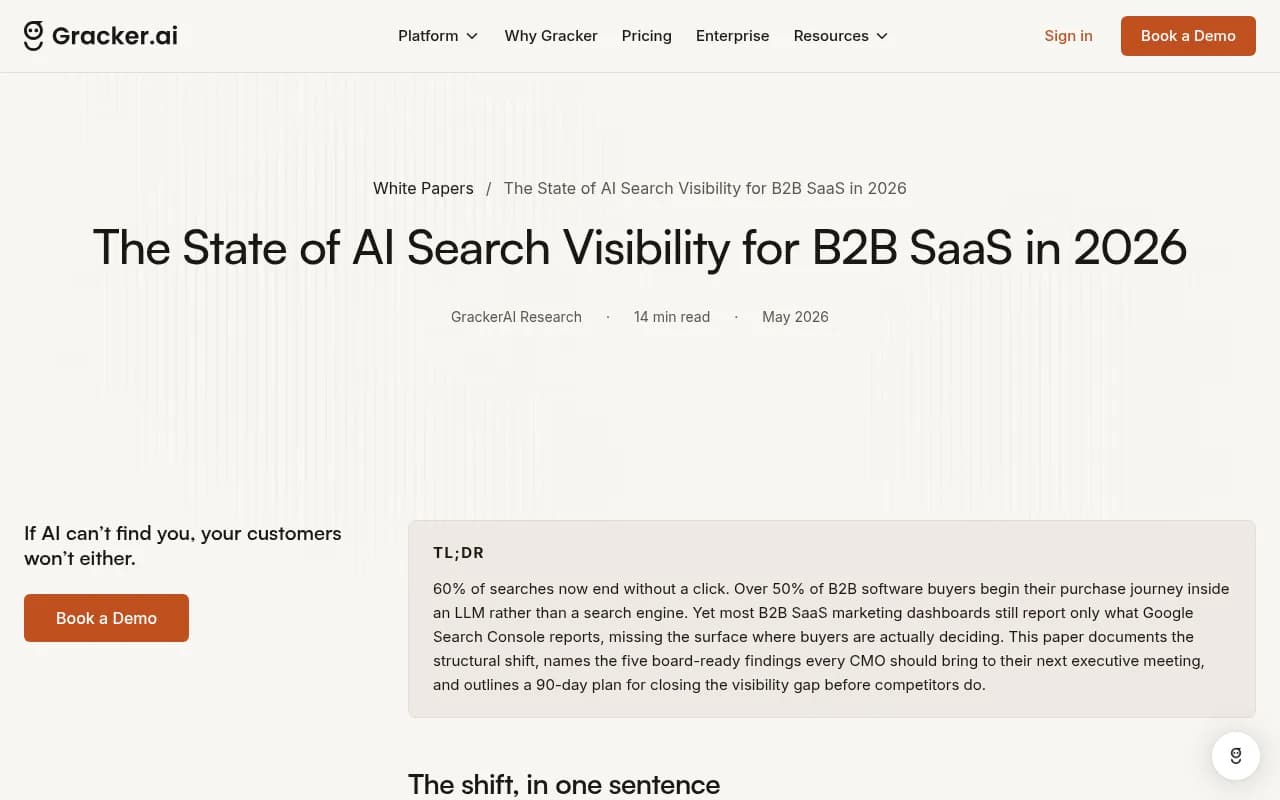
Let's start with a number that should make any SaaS marketer uncomfortable: according to Gracker AI's 2026 state-of-the-market research, 60% of searches now end without a click, and over half of B2B software buyers begin their purchase journey inside an LLM. Not Google. An LLM.
That shift has a very concrete consequence for SaaS marketing teams. When a VP of Operations asks ChatGPT "what's the best project management tool for a 50-person engineering team?", the model generates a paragraph that names two or three vendors. If your brand isn't in that paragraph, you're not on the shortlist. And your Google Search Console dashboard won't tell you that's happening.
Forrester estimates AI-generated traffic currently represents 2-6% of B2B organic traffic, growing at 40%+ month-over-month. The absolute numbers are still modest -- Cloudflare's April 2026 referral data showed all AI chatbots combined sending 0.27% of search referral traffic vs. Google's 87.52%. But the conversion quality is dramatically different. One widely cited 2026 study put AI traffic conversion at 14.2% versus Google organic's 2.8%. Discovered Labs research found 27% of visitors from AI engines become sales-qualified leads, compared to 2-5% from organic search.
Lower volume, much higher intent. That math changes your priorities.
This guide walks through the full playbook: how to audit where you stand today, what signals actually drive AI citations, how to build content that gets recommended, and how to measure whether it's working.
Phase 1: Audit your current AI visibility
Before you build anything, you need to know where you actually stand. Most SaaS teams skip this step and go straight to publishing content -- then wonder why nothing changes.
Run the "synthetic shortlist" test
Pick 10-15 prompts that your ideal buyers would realistically type into ChatGPT, Claude, or Perplexity. These should be:
- Category-level queries: "best [category] software for [use case]"
- Problem-first queries: "how do I solve [specific pain point]"
- Comparison queries: "[your brand] vs [competitor]"
- Persona-specific queries: "what [category] tool does a [job title] at a [company size] use"
Run each prompt across at least three AI models. Record which brands appear, how they're described, and whether your brand shows up at all. Do this manually first -- it gives you a feel for the landscape that no dashboard can fully replicate.
Check your entity footprint
AI models understand brands as "entities" -- a cluster of associations built from everything they've ingested: your website, G2 reviews, press mentions, Reddit discussions, LinkedIn posts, documentation, and competitor comparisons. A weak entity footprint means the model doesn't have enough signal to confidently recommend you.
Ask yourself:
- Does your brand appear on G2, Capterra, and Trustpilot with recent, detailed reviews?
- Have tier-1 publications (not just your own blog) written about your product?
- Are you mentioned in Reddit threads where your target buyers actually hang out?
- Does your documentation clearly explain what you do, who you serve, and what problems you solve?
If the answer to any of these is "not really," that's where you start.
Measure your baseline with a tracking tool
Manual testing gets you directional insight, but you need systematic tracking to measure progress. Several platforms now monitor AI citations at scale.
Promptwatch is worth looking at here -- it tracks citations across 10 AI models (ChatGPT, Claude, Perplexity, Gemini, Grok, DeepSeek, and more), shows you exactly which prompts competitors are being cited for that you're missing, and logs which pages AI crawlers are actually reading on your site.

For teams that want alternatives or want to compare options:




Here's a quick comparison of what these tools cover:
| Tool | Citation tracking | Content gap analysis | AI content generation | Crawler logs | Prompt volume data |
|---|---|---|---|---|---|
| Promptwatch | 10 models | Yes | Yes (built-in agent) | Yes | Yes |
| Profound | Multiple models | Partial | No | No | Limited |
| AthenaHQ | 8+ models | No | No | No | No |
| Otterly.AI | Multiple models | No | No | No | No |
| Peec AI | Multi-language | No | No | No | No |
The core difference: most tools show you data. Promptwatch is built around helping you act on it -- find the gap, generate the content, track the improvement.
Phase 2: Build the signals AI models trust
Once you know where you're invisible, the next question is why. AI models don't cite brands randomly. They cite brands that have strong, consistent signals across multiple authoritative sources. Here's what actually moves the needle.
Third-party validation is the foundation
Your own blog doesn't count for much. AI models are trained to trust the same sources humans trust: independent review platforms, editorial coverage, and community discussions. This means:
Review site presence: G2 and Capterra reviews are heavily weighted. Aim for 50+ reviews with detailed, specific language about your use cases. Generic "great tool!" reviews are less useful than reviews that mention specific features, integrations, and outcomes.
Editorial mentions: Getting written up in publications like TechCrunch, VentureBeat, or industry-specific outlets creates the kind of third-party signal that AI models weight heavily. A single well-placed editorial mention often does more for your AI citation rate than ten blog posts.
Reddit and community presence: This one surprises most teams, but Reddit threads are a significant citation source for AI models. When someone asks ChatGPT for a recommendation, it often surfaces content from relevant subreddits. Being mentioned positively in r/SaaS, r/entrepreneur, or niche subreddits relevant to your category matters.
Structured, answer-first content
AI models are looking for content that directly answers questions. The old SEO approach of burying the answer in paragraph seven doesn't work here. Structure your content so the key answer appears in the first 100-150 words, then support it with detail.
Specific content types that get cited frequently:
- Comparison pages ("X vs Y: which is better for [use case]")
- "Best of" listicles that include your brand alongside competitors
- Problem-specific guides that name your solution as an answer
- FAQ pages with structured schema markup
- Integration documentation that connects your product to other tools buyers use
Schema markup matters more than most teams realize. FAQ schema, HowTo schema, and Article schema all help AI models parse your content correctly and attribute it accurately.
Entity relationships and integrations
AI models build a mental map of your product based on what it connects to, who uses it, and what problems it solves. Explicitly publishing content about your integrations (Salesforce, HubSpot, Slack, etc.) creates entity relationships that help models understand your product's context.
If you integrate with 40 tools but only have documentation for 10 of them, you're leaving 30 entity relationships on the table.
Technical accessibility for AI crawlers
AI models can only cite content they can actually read. This means:
- Your robots.txt shouldn't block AI crawlers (GPTBot, ClaudeBot, PerplexityBot, etc.)
- Pages should load fast and render server-side where possible
- Core content shouldn't be hidden behind login walls or JavaScript that crawlers can't execute
Promptwatch's crawler log feature shows you exactly which pages AI bots are visiting, how often, and what errors they're encountering. Most teams are surprised to find that AI crawlers are hitting their site regularly but bouncing from pages with render issues.
Phase 3: Create content that gets cited
This is where most playbooks get vague. "Create great content" is not a strategy. Here's what actually works.
Map prompts to content gaps
Start with the prompts where competitors are being cited but you're not. These are your highest-priority targets because the demand is proven -- AI models are already answering these questions, just not with your brand.
For each gap prompt, ask: what content would a model need to see on my site to confidently recommend me for this query? Usually it's one of:
- A dedicated page that directly addresses the use case
- A comparison page that positions you against the competitor being cited
- A case study or testimonial from a customer in the relevant segment
- Updated documentation that mentions the relevant integration or workflow
Write for the model, not just the reader
This sounds counterintuitive, but AI-cited content has specific characteristics:
- Clear, direct sentences (models parse these more reliably)
- Specific claims with numbers or named sources (vague claims get filtered out)
- Explicit mention of your brand name, category, and key differentiators (don't make the model guess)
- Internal links to related pages (helps models understand your content structure)
One practical tip: read your content aloud and ask "if I were summarizing this for someone, what would I say?" That summary is what the AI model will extract. If the summary doesn't include your brand name and a clear value proposition, rewrite the opening.
Publish at the right velocity
SaaS brands that see meaningful AI visibility improvements typically publish 8-12 targeted pieces per month, not 2-3. The reason is coverage: you need content that addresses enough prompts to build a pattern of citations. One well-cited article doesn't make you visible; 30 does.
This is where AI writing tools become genuinely useful -- not for generating filler, but for scaling production of structured, on-brief content. The key is grounding the content in real citation data and prompt research rather than just asking an AI to "write about [topic]."
Research from AHOD's 2026 playbook found that SaaS brands executing a consistent content sprint see AI Visibility Score improvements from sub-30 to the 55-70 range within 90 days. That's a meaningful shift in a short timeframe, but it requires consistency -- not a single burst of publishing.
Phase 4: Track, attribute, and iterate
Getting cited is the goal, but you also need to know whether those citations are driving actual traffic and pipeline. This is where most teams fall short.
What to measure
Traditional SEO metrics (keyword rankings, organic sessions) don't capture AI visibility. You need a different measurement framework:
- Share of model: What percentage of relevant AI responses include your brand?
- Citation rate by prompt: Which specific prompts are driving citations?
- Page-level citation tracking: Which pages on your site are being cited, and by which models?
- AI referral traffic: Sessions arriving from ChatGPT, Perplexity, Claude, etc. (visible in GA4 as referral traffic from these domains)
- AI traffic conversion rate: Are AI-referred visitors converting at the rates the research suggests?
Connect visibility to revenue
The hardest part of AI visibility measurement is attribution. A buyer might ask ChatGPT for a recommendation, visit your site, then convert weeks later through a direct visit or paid ad. Standard attribution models miss the AI touchpoint entirely.
A few approaches that work:
- Tag AI referral sources in your CRM and track them through the funnel separately
- Use UTM parameters on any links that appear in AI responses (where possible)
- Survey new customers about where they first heard of you -- "an AI recommended it" is becoming a common answer
- Implement server log analysis to identify AI crawler visits and correlate them with subsequent traffic
Promptwatch handles this with a code snippet, Google Search Console integration, or server log analysis -- connecting AI visibility data to actual traffic and revenue. Most standalone monitoring tools stop at showing you citation counts, which is useful but incomplete.
The 90-day iteration cycle
AI visibility isn't a one-time project. The models update, competitors publish new content, and buyer prompts evolve. A sustainable cadence looks like:
Month 1: Audit baseline, identify top 20 gap prompts, publish first batch of targeted content
Month 2: Check citation rates for published content, identify what's working, double down on winning formats and topics
Month 3: Expand to secondary prompt clusters, build out third-party presence (reviews, editorial pitches, community engagement), review AI crawler logs for technical issues
Ongoing: Monthly citation tracking, quarterly content audits, continuous review generation
Tools worth knowing
Beyond the core tracking platforms, a few other tools are useful at different stages of this playbook.
For content creation and optimization:

For technical SEO and crawler analysis:
For brand mention monitoring (to catch third-party citations you're not aware of):
For B2B revenue attribution (connecting AI traffic to pipeline):
The honest picture
AI search visibility is real, it's growing, and the conversion quality is genuinely impressive. But it's not magic, and it's not fast. The brands seeing results in 2026 are the ones that started treating AI citations as a measurable marketing objective 6-12 months ago -- building review presence, publishing structured content, and tracking citations systematically.
If you're starting from zero today, 90 days of consistent execution will get you to a meaningful baseline. The brands that wait another six months will be playing catch-up against competitors who've already built citation authority across the prompts your buyers are typing.
The good news: most B2B SaaS companies are still not doing this seriously. The gap between where most brands are and where they could be is large, which means the opportunity is real for teams willing to move now.
Start with the audit. Know where you stand. Then build from there.