
Key takeaways
- The basics of AEO are the same everywhere, but the prompts, cited sources, and risks differ a lot by industry. Pick a platform that matches your sector's citation patterns, not the longest feature list.
- SaaS teams need G2, Capterra, and docs coverage plus a way to see whether docs are crawlable. Ecommerce teams need shopping surfaces and catalog-level visibility. Healthcare teams need accuracy checks. Local businesses need location-level tracking and listings.
- Whatever your industry, demand intent-level breakdowns, inspectable evidence, and a handoff from "gap found" to "page shipped."
- Run the same pilot on every shortlisted vendor and quote the same workload. Dashboards that only report a score leave all the work to you.
Why industry matters when you choose an AEO platform
Most AEO buyer's guides rank tools as if one winner fits everyone. It doesn't. The sources AI models cite for a software question look nothing like the sources they cite for a health question, and a platform tuned for one can be mediocre for the other.
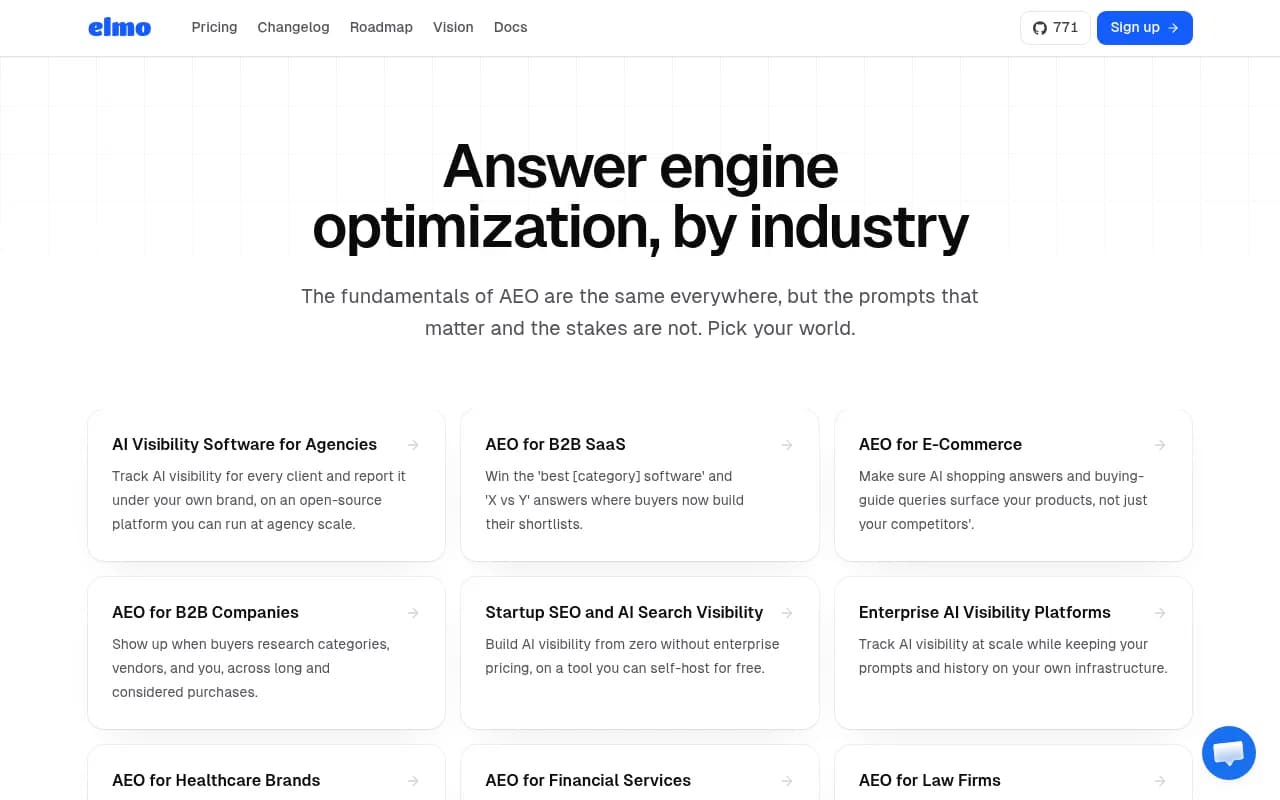
Elmo's AEO by industry pages put it well: the fundamentals are the same everywhere, but the prompts that matter and the stakes are not. A wrong answer about a CRM costs you a lead. A wrong answer about a medication is a different category of problem.
The data backs this up. Promptwatch Data shows that the most cited domains differ sharply by vertical. Below, I'll use those reports to turn each industry's citation pattern into concrete buying criteria.
What every AEO platform should do, regardless of industry
Before the industry-specific parts, here is the baseline. If a vendor fails these, the industry features don't matter.
- Real answer collection. Ask how responses are gathered. User-facing answers and citations can differ from API outputs, so a platform that monitors the actual interfaces of ChatGPT, Google AI Overviews, Gemini, and Perplexity gives you data closer to what buyers see.
- Intent breakdowns. One blended visibility score hides the problem. In Promptwatch's ChatGPT content type data (Sep 28 to Oct 4, 2026), product pages earned 26.0% of commercial-prompt citations but 19.1% of informational ones, and reviews rose to 5.6% for branded prompts. Your platform should split results by commercial, informational, and branded prompts.
- Citation evidence. You need to see which URLs were cited, in what position, and what snippet the model saw. "You were mentioned" is not enough.
- Crawler visibility. If AI bots can't read your pages, no amount of content helps. Look for IP-verified crawler logs, not just a robots.txt check.
- A handoff to action. Percepture's SaaS buyer's guide suggests a good test: ask the vendor to turn one observed gap into a specific task with a destination page, rationale, owner, and acceptance criteria. Vendors that can't do this are selling a report.
- Transparent commercial terms. Quote the same pilot workload across vendors and get inclusions, limits, overages, and exit terms in writing.
SaaS: win the shortlist questions
SaaS buyers ask AI things like "best [category] software" and "X vs Y." The answer decides who makes the shortlist before anyone visits your site.
What the citation data says
In Promptwatch's software citation report (Sep 28 to Oct 4, 2026), GitHub led ChatGPT citations at 1.2%, followed by Microsoft Learn at 0.98% and G2 at 0.73%. Gartner (0.34%) and Capterra (0.32%) also appeared. By source type, docs and help centers earned 2.64%, vendor sites 2.01%, and review sites and analysts 1.57%. Vendor pages plus docs together earned about three times what review sites and analysts did.
Two takeaways. Your own docs and product pages matter more than most SaaS marketers assume. And third-party review profiles still carry real weight.
What to look for
- Tracking for comparison and "best of" prompts, including competitor-comparison prompts.
- Citation reports that show G2, Capterra, and docs domains, not just your homepage.
- Crawler logs that tell you whether your docs and help center are being read or blocked.
- Questions that could disqualify you, not only ones that favor you. Percepture recommends including both when you build your test set.
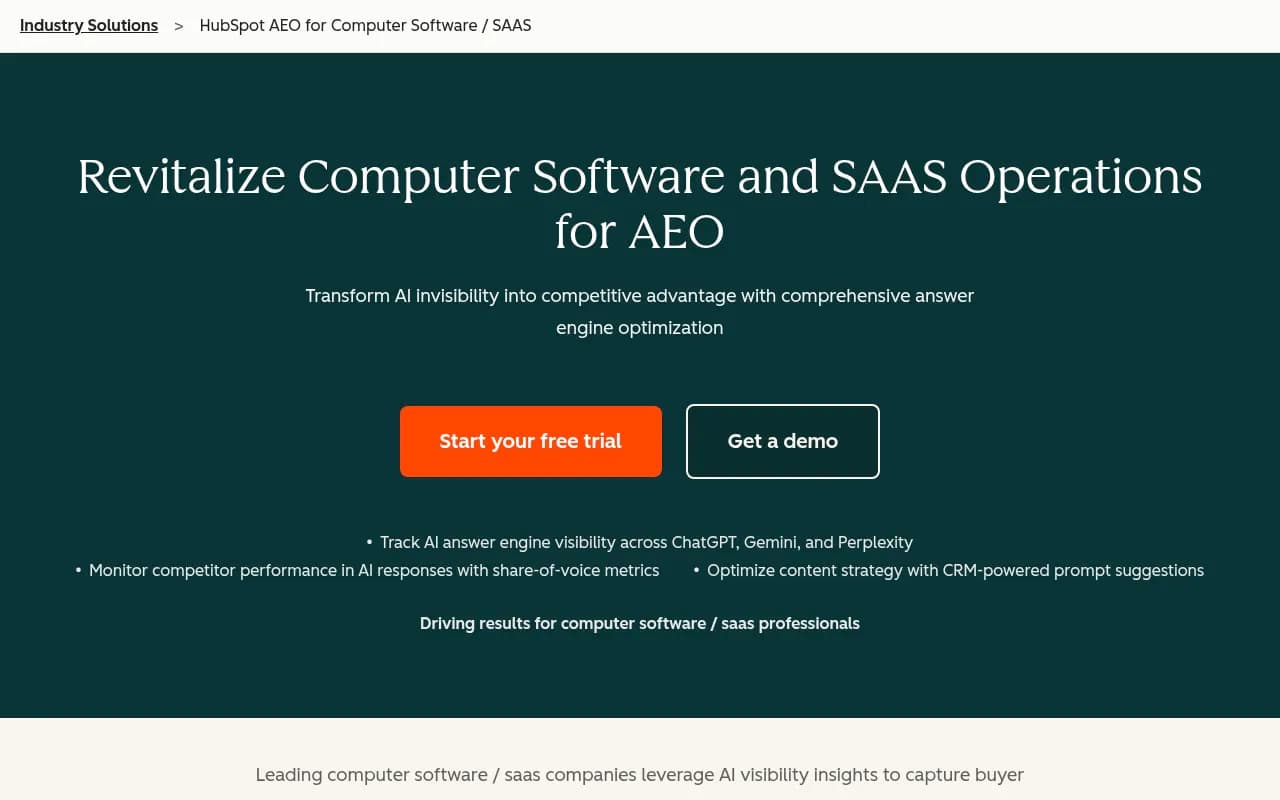
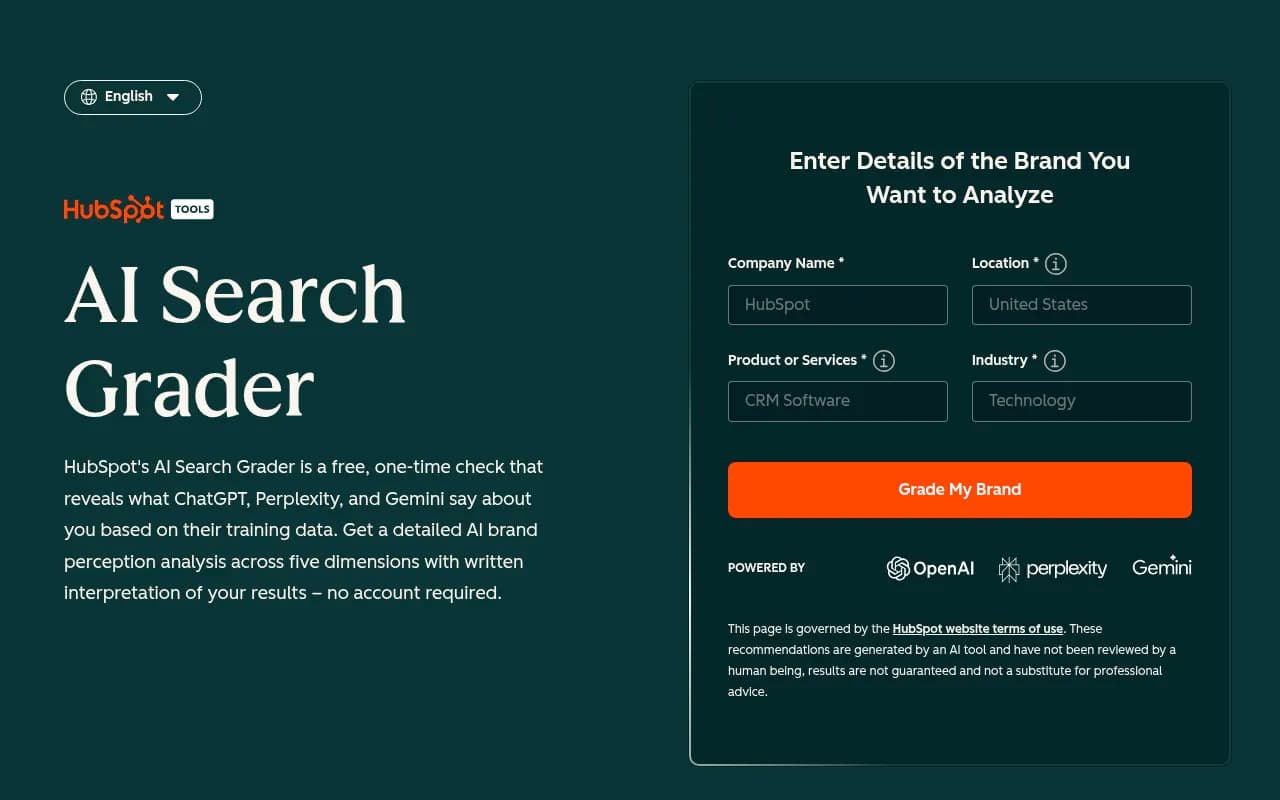
- A CRM or Search Console link to seed prompts from real customer language. HubSpot AEO does this through its CRM-powered prompt suggestions, which is a sensible angle if you already live in HubSpot.
For a platform that connects tracking to execution, Promptwatch tracks prompts by intent, shows which pages get cited, logs AI crawler visits, and its Content Agent writes and publishes the pages that fill the gaps. Its Crisp case study is a SaaS example: 2x higher conversion rates from AI traffic than traditional channels.

Other names worth a demo for SaaS include Profound, AthenaHQ, Peec AI, and HubSpot AEO.


Ecommerce: shopping surfaces and catalog complexity
Ecommerce AEO is less about being named in a paragraph and more about showing up in product recommendations, carousels, and buying-guide answers.
What to look for
- Visibility inside shopping features, not only text answers. Promptwatch tracks ChatGPT Shopping and Amazon Alexa product results, including which competitor products AI picks instead of yours. Promptwatch's shopping usage report tracks how often ChatGPT shows product cards.
- Catalog handling. If you have thousands of SKUs, ask how the tool groups products and whether pricing scales with prompts or SKU count. Yotpo's guide notes that tools typically price either by tracked prompt volume or by custom enterprise contract based on catalog size.
- Content-type awareness. Product pages were the most cited type in ChatGPT at 22.4% of citations, and for commercial prompts the top four types (product pages, landing pages, listicles, comparisons) made up almost 70%. Your platform should show which of your product and category pages are cited.
- Crawler access to the catalog. Ask how you can confirm AI bots reach product pages, feeds, and structured data.
- Review and marketplace tracking. Third-party listicles and marketplaces often outrank brand sites. In Promptwatch's automotive data, marketplaces like Autotrader and Cars.com outranked every car brand.
Candidates to evaluate: Promptwatch for the monitor-to-publish loop with shopping tracking, Yotpo Discover for catalog-heavy CPG, and Azoma or Goodie AI if shopping-surface optimization is the main job.
Healthcare: accuracy first
Healthcare is where I'd be most skeptical of a tool that only gives a visibility score. Being mentioned matters less than being described correctly.
What the citation data says
In Promptwatch's healthcare report (Sep 9 to Oct 8, 2026), NIH led at 5.46% of citations, with PubMed Central at 2.38% and PubMed at 2.33%. NIH alone earned more than the FDA, NHS, CMS, and SAMHSA combined. Government and public health sites made up 7.06% of the 15.54% captured by the top 20 sites, while hospitals and clinics earned 0.89%, medical associations 1.39%, and reviews and directories only 0.46%.
So for a clinic, device maker, or healthtech vendor, you are competing against institutions. Winning often means getting referenced by or consistent with authoritative sources, not outranking them.
What to look for
- Claim-level monitoring. You want to see the individual statements AI makes about your brand, grouped by theme, not a single sentiment number. Promptwatch's Brand Narrative does this on every plan, and Fact Check verifies each claim against your site and the most-cited third-party pages, then flags which page AI is learning the wrong thing from (Business plan and up).
- Citation source classification by type: government, research, associations, directories.
- Security and compliance. Ask for ISO/IEC 27001 and GDPR documentation and data-handling terms. Promptwatch is ISO/IEC 27001 certified and GDPR compliant.
- Audit logs and role-based access for regulated teams.
Cognizo's healthcare roundup lists starting prices: Cognizo $499/mo, Semrush AI Visibility $99/mo per domain, Profound $99/mo, Peec AI EUR 85/mo, Ahrefs Brand Radar $199/mo per platform, AthenaHQ $295/mo, HubSpot AEO $50/mo, and ZipTie $69/mo. Cognizo sells one of those tools, so treat the ranking as biased and confirm prices on each vendor's site.
Local: locations, listings, and reviews
Local AEO is the "best dentist near me" problem. The AI answer sits between a customer and a phone call, and the inputs are different: listings, reviews, and location context.
What to look for
- Location-aware tracking. Check whether the tool can run prompts as if asked from a specific place. Promptwatch lets you pin a monitor to exact coordinates for ChatGPT, Google AI Overviews, and Google AI Mode, and it supports state and city tracking on Business and above.
- Listings and reputation tooling. Thryv's small business guide says the best AEO services build on SEO, local listings, reviews, and other trust signals rather than replacing them. That matches my experience: no visibility tracker fixes inconsistent listings.
- Multi-location reporting for franchises and chains.
- Honest claims. Be wary of any provider guaranteeing placement in AI answers.
- Budget fit. HawkSEM, per Minuttia's roundup, lists a local GEO package from $1,550 a month and full GEO from $4,000. Software-only options start far lower.
Tools worth comparing: Yext, BrightLocal, Reputation.com, and SOCi for listings and reviews, plus Promptwatch for tracking and content on top. Small teams with limited budgets might look at MaxAEO, Snezzi, or Legible.
Industry comparison table
| Industry | What AI cites most | Must-have platform features | Watch out for |
|---|---|---|---|
| SaaS | Docs, vendor pages, G2, Capterra, GitHub | Comparison prompt tracking, docs crawl visibility, review-site citations | Tools that only score brand mentions |
| Ecommerce | Product pages, landing pages, listicles, marketplaces | Shopping surface tracking, catalog scale, product page citations | Per-SKU pricing surprises |
| Healthcare | NIH, PubMed, FDA, NHS, associations | Claim-level accuracy checks, source types, compliance | Unverified sentiment scores |
| Local | Listings, reviews, local directories | Coordinate-level tracking, multi-location reporting, listings tools | Guaranteed-placement promises |
Platform categories compared
| Category | Examples | Strength | Gap |
|---|---|---|---|
| End-to-end AEO platform | Promptwatch | Tracks, explains, writes, publishes, and measures | Fuller plans cost more than basic trackers |
| Prompt trackers | Otterly.AI, Peec AI | Cheap, quick setup | No crawler logs or content workflow |
| SEO suite add-ons | Semrush, Ahrefs Brand Radar, HubSpot AEO | Fits existing workflows | Shallower AI-specific data |
| Enterprise suites | Profound, BrightEdge, Conductor | Scale and governance | Price and complexity |
| Vertical tools | Yotpo Discover, Yext, BrightLocal | Industry depth | Narrow scope |
For broader category research, the GEO software directory at bestgeosoftware.com lists many more options.
A scorecard you can use in demos
Adapted from the scorecard approach in Percepture's guide, here is what to ask and what to keep.
| Criterion | Ask during the demo | Evidence to keep |
|---|---|---|
| Relevant coverage | Run your own agreed questions across the models and countries you need | Prompt list, collection method, settings |
| Intent split | Show results by commercial, informational, and branded prompts | Exported breakdown |
| Citation depth | Show cited URLs, positions, and snippets | CSV or API export |
| Crawler evidence | Show AI bot visits to your docs, products, or location pages | Log sample |
| Actionable handoff | Turn one gap into a task with a destination page and owner | The task itself |
| Commercial fit | Quote the same pilot workload and renewal scope | Written limits, overages, exit terms |
Run a 30-day pilot
- Write 30 to 50 prompts from real customer language: support tickets, sales calls, Search Console queries. Include some that could rule you out.
- Give every vendor the same list and the same markets. Don't let a vendor pick friendlier prompts.
- Ship at least three fixes during the trial, such as a refreshed product page, a missing comparison page, or a corrected claim.
- Check whether the fix worked. Did crawlers read the page? Was it cited? Did AI-referred visits arrive? Keep visibility reporting separate from business results.
- Compare effort. How many hours did your team spend moving from insight to published page?
Promptwatch's cost structure is worth checking against your pilot. Plans run from Essential at $95/mo to Business at $579/mo, with a 7-day free trial on monthly billing, and agency plans from $199/mo. Confirm current numbers at promptwatch.com/pricing. The Content Agent, faster-than-daily tracking, state and city tracking, Fact Check, and Shopping arrive at Business.
Do you need a platform, an agency, or both?
A platform tells you what is happening. Someone still has to ship the work. If your team lacks content or technical capacity, an agency can run the program on top of the software. Percepture's advice is to separate the platform agreement from the implementation scope and name who owns research, technical changes, content, and reporting. 1001 SEO Media works this way, pairing senior specialists with Promptwatch for AI visibility work. Whether you hire out or not, apply the same pilot discipline.
Final recommendation
Pick by sector, then verify by pilot. SaaS teams should favor docs and review-site visibility. Ecommerce teams should insist on shopping surface tracking. Healthcare teams should put claim accuracy and compliance ahead of price. Local businesses should combine location-level tracking with strong listings and reviews. In every case, choose the platform that closes the loop from gap to published page to measured result, because a score alone changes nothing.
FAQ
What is an AEO platform?
An AEO platform tracks how AI answer engines such as ChatGPT, Gemini, Perplexity, and Google AI Overviews mention, rank, and cite your brand. The better ones also explain why and help you fix gaps.
Is AEO the same as GEO?
In practice yes. AEO, GEO, AI SEO, and LLM SEO all describe optimizing for AI-generated answers. Vendors use the terms interchangeably.
How much does an AEO platform cost?
Starting prices range from about $50 to $600 per month for software, per the vendor pricing in the research above, while agencies run into the thousands. Always confirm on the vendor's own pricing page.
Which industry needs AEO the most?
Any industry where buyers ask AI for recommendations before visiting a site. SaaS and local services feel it first, while healthcare faces the highest accuracy risk.
Can I use one platform for several industries?
Yes, if it supports multiple monitors with separate languages and locations. Agencies managing clients in different sectors should look at agency plans with unlimited projects.