
Key takeaways
- We score every AEO platform on 10 criteria with stated weights that total 100, so you can rerun the math with your own priorities.
- Four criteria can be checked without talking to a vendor: engine coverage, real-interface data, citation and crawler evidence, and published research.
- Monitoring alone caps a platform's score. Platforms that help you fix gaps and prove the fix worked can score up to 100.
- This site's owner uses Promptwatch, so it is a conflict of interest. We say so up front and show the scoring so you can check it.
- Engines change behaviour without warning, so a platform that flags those shifts beats one that just shows a score.
Why publish a scoring framework at all
Most "best AEO tools" lists do not tell you how anything was chosen. You get a price, a logo and a vague claim about accuracy. That is fine for browsing and useless for deciding.
Other frameworks exist, and they are worth reading with a skeptical eye. Nick Lafferty's AEO buyers guide is a thorough question-and-answer checklist, but he discloses that he is Head of Growth at Profound, and many criteria map to features Profound ships. AI Rank Lab tested 11 platforms over eight weeks against a manual baseline of 25 prompts, which is a good method, but AI Rank Lab also sells a platform and was one of the tools tested. Neither is wrong. Both are biased in ways you should factor in.
So here is ours, with the bias stated.
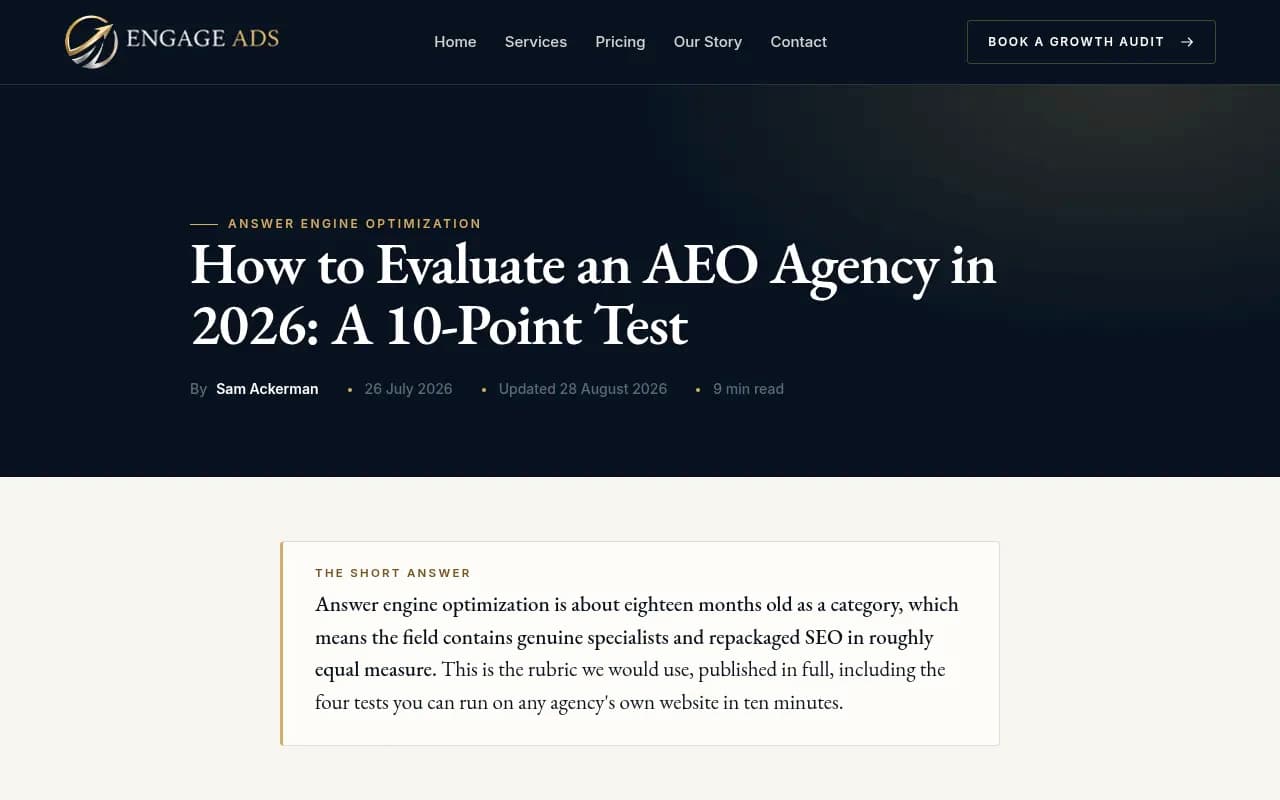
The structure borrows from an agency rubric published by Engage Ads: stated weights, criteria you can verify from outside, and a disclosure of the author's own incentives. That agency rubric is about hiring a firm, not buying software, so we adapted the idea rather than the criteria.
Our disclosure
1001 SEO Media publishes this site and uses Promptwatch as its own GEO and AI visibility platform. Promptwatch will score well on several criteria below. That is partly because the criteria reward end-to-end capability, which is what we think matters, and partly because we have used it. Weigh that accordingly, and run the same checks on any tool you are considering.

The rubric at a glance
| # | Criterion | Weight | Can you verify it yourself? |
|---|---|---|---|
| 1 | Real-interface data, not only API calls | 12 | Partly (trial and compare) |
| 2 | Engine coverage, tracked separately | 10 | Yes |
| 3 | Citation and source tracing | 12 | Yes (trial) |
| 4 | AI crawler visibility | 10 | Yes (trial) |
| 5 | Prompt intelligence and query fan-outs | 10 | Yes |
| 6 | Action and content execution | 14 | Partly |
| 7 | Traffic and conversion measurement | 10 | Yes (trial) |
| 8 | Handling of engine shifts and data stability | 8 | Partly |
| 9 | Published research and transparency | 7 | Yes |
| 10 | Pricing clarity and cost per response | 7 | Yes |
Weights total 100. The heaviest single item is execution (14), because a report that tells you where you are invisible and then leaves the work to you has solved the easy half of the problem.
Criterion 1: Real-interface data (12 points)
Answers from a model's API are not the answers a person sees. Citations, shopping carousels and source lists can differ between the two. A platform that only calls APIs is measuring something adjacent to what your buyers experience.
How to test it: pick five prompts. Ask each engine yourself, in a clean session. Then compare what the platform recorded for the same prompts. Note whether the platform tells you how it collects data. Perplexity is a good probe: if a tool does not say whether personalization and memory were switched off, earlier sessions may be shaping the recorded answers.
Full marks: collects from the actual interfaces, per country and language, and explains the method. Half marks: mixes interface and API data without labelling which is which. Zero: API only, no disclosure.
Criterion 2: Engine coverage, tracked separately (10 points)
Coverage means ChatGPT, Google AI Overviews, Google AI Mode, Gemini, Perplexity, Copilot and Claude at minimum. Newer surfaces like Meta AI and Amazon Alexa are a bonus.
But coverage is not the main point. Separation is. Promptwatch's data on average sources per response shows why. ChatGPT cites roughly 5 sources per web-search answer, while Google AI Overviews and Perplexity sit near 10. Microsoft Copilot swung from under 2 to nearly 17 sources per response within a few weeks before settling. A single blended visibility score hides all of that.
Pass condition: every metric can be split by engine, and the platform shows per-engine baselines so you know what a normal citation count looks like on each one.
Criterion 3: Citation and source tracing (12 points)
A mention tells you the brand came up. A citation tells you which page the model leaned on. The gap between the two is where most of the useful work lives. If your brand is mentioned but never cited from your own domain, that is a content or crawlability problem, and a tool that only counts mentions cannot tell you that.
What we look for:
- Cited URLs with their position in the source list
- Self-citation rate (share of citations pointing at your own domain)
- Source-type classification, so you can see whether directories, forums or publishers dominate
- Reddit, YouTube and LinkedIn citation reports, since social sources move fast
Promptwatch's social media citations report for November 2026 is a good illustration. From Oct 11 to Nov 9, 2026, ChatGPT got 0.64% of its citations from social platforms, Perplexity 1.94% and Google AI Overviews 13.16%. A platform that cannot break citations down by source type cannot tell you which of those numbers should change your plan.
Criterion 4: AI crawler visibility (10 points)
This is the criterion most tools skip, and it is the one that separates an access problem from a content problem. If GPTBot cannot fetch your pricing page, no amount of rewriting will get it cited.
IP-verified crawler logs are the standard to look for. Verified means the visit is checked against the operator's published IP ranges, so spoofed bots do not inflate your numbers. Good logs also show errors with a plain explanation and, ideally, a crawl-to-citation path per page.
Crawler behaviour shifts quickly. Promptwatch Data found Meta-WebIndexer growing from about 2% to nearly 38% of tracked AI crawler requests between mid-July and August 9, 2026. If your platform has no crawler view, you would not have noticed.
Tools that cover this at least partly include Promptwatch (through AI crawler logs) and DarkVisitors.
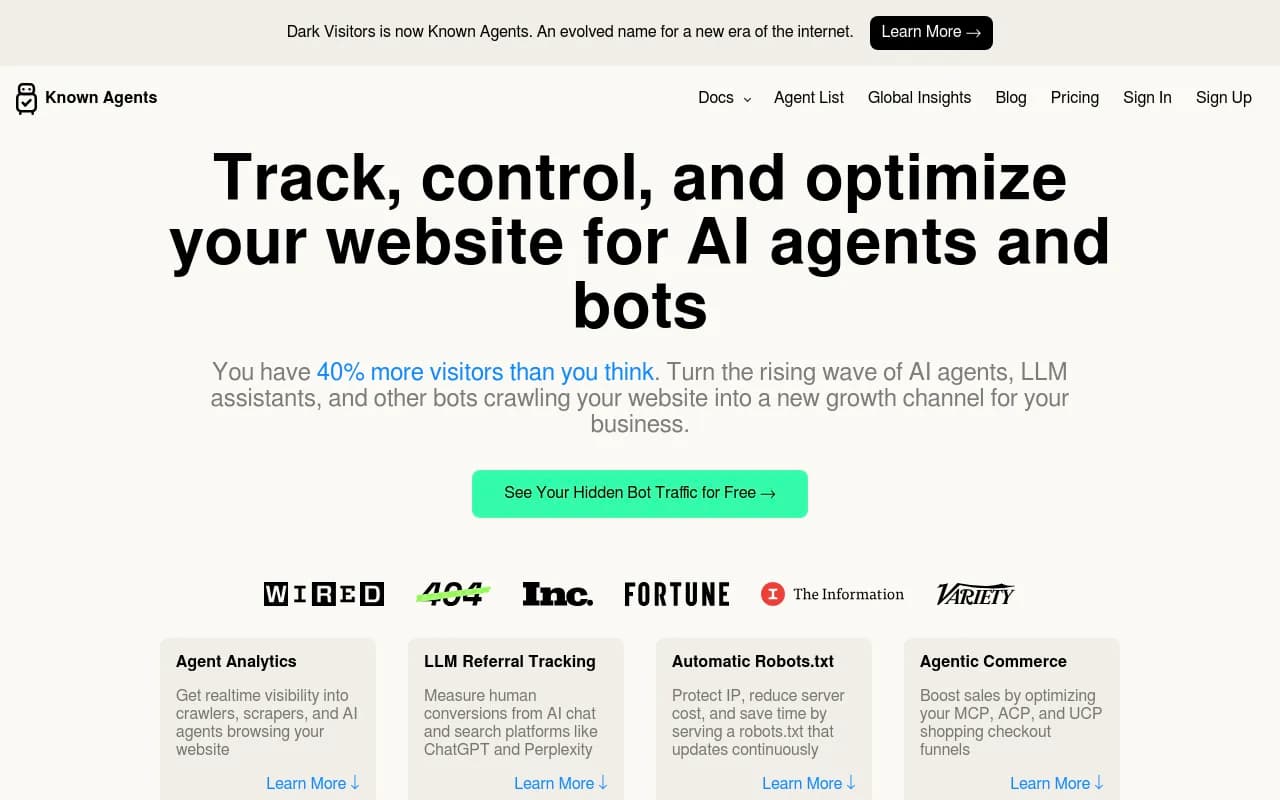
Profound also includes Agent Analytics for bot visits and human referrals.

Criterion 5: Prompt intelligence and query fan-outs (10 points)
Tracking the prompts you typed in is the floor. The better question is what the engine actually searches for when it answers.
Promptwatch Data on ChatGPT query fanouts says one prompt can trigger 3 to 8+ separate searches. Average fanouts per response were 2.15 in early December and about 1.84 by early March, and average query length fell from about 117 characters to the high 80s. Then in August, ChatGPT began using the site: operator at scale, which jumped from about 0.4% to about 17% of fanout queries overnight.
A platform that only shows your tracked prompts misses all of that movement. We award points for:
- Capturing fan-out queries per model
- Prompt volume and difficulty estimates
- Suggested prompts from Search Console, People Also Ask or your own pages
- Personas, so you can prompt the way different buyers would
You can poke at this yourself with the free ChatGPT query fan-out generator before you pay for anything.
Criterion 6: Action and content execution (14 points)
The heaviest weight, and the most divisive. Plenty of platforms report a score and stop. We think that is half a product.
What earns points here:
- A prioritized to-do list generated from your data
- Content gap analysis mapping your pages against the prompts AI answers
- Content creation grounded in citation data, with CMS publishing
- A check, after publishing, that the page got crawled and cited
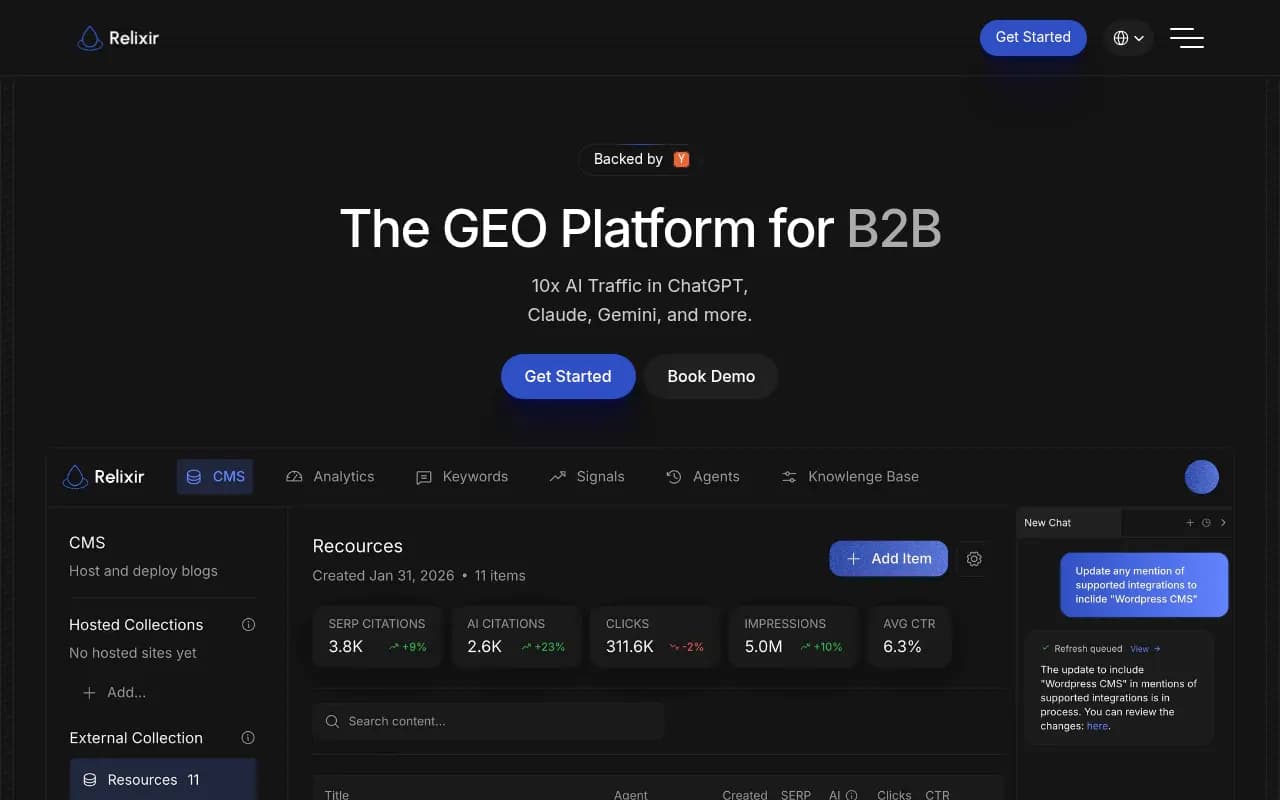
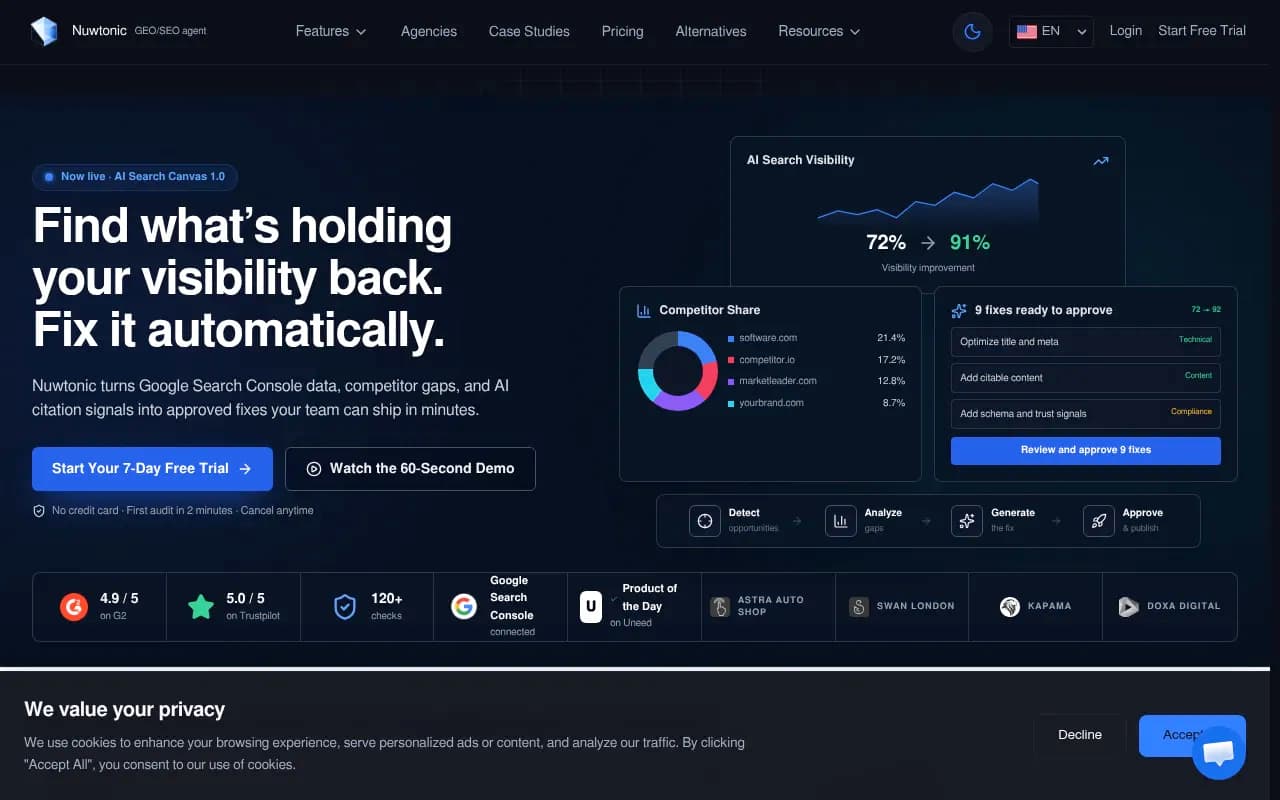
Promptwatch scores highest on this criterion among the tools we looked at, because its Content Agent plans, writes and publishes to WordPress, Webflow or Framer, and its Action Board and page tracking feed results back in. The Content Agent starts on the Business plan, so cheaper tiers do not get it. Profound has agentic workflows and a Projects feature that turns data into ranked tasks. Several smaller tools, including Relixir, Nuwtonic and GEOforge, pitch closed-loop fixes, though we have not scored them to the same depth.
Pure monitors lose most of these points. That is not a knock on them. A cheap tracker can be exactly right for a team that already has writers and a process.
Criterion 7: Traffic and conversion measurement (10 points)
Visibility without revenue evidence is a vanity metric. The platform should show AI-referred visits and conversions, or at least integrate with the analytics you already use.
One wrinkle worth checking: ChatGPT stopped sending a referrer on October 8, 2026, so referral reports undercount unless the tool can count visits tagged with utm_source=chatgpt.com. Ask the vendor how they handle it. Our guide to attributing AI traffic walks through the setup.
If you want to check your own baseline first, filter Google Analytics referrals for chatgpt.com, perplexity.ai and similar sources. It is crude, but it tells you whether the number is worth chasing.
Criterion 8: Handling engine shifts and data stability (8 points)
This one is new to our rubric this year, and I would argue it should be on everyone's. The targets move.
Promptwatch Data records several sudden shifts in 2026. Average citations per ChatGPT response dropped across GPT-5.3, GPT-5.4 and GPT-5-Mini around March 4. Reddit's share of ChatGPT citations fell from about 4% to 0.5% on August 14.
Imagine your visibility dips on August 14. Without an annotation, you might spend a month rewriting content that was never the problem. We give points when a platform flags known engine changes, lets you overlay events on trends, and avoids presenting a drop as your own failure.
Perplexity, incidentally, makes a decent test bench. It cites almost exactly 10 sources per answer every day, so movement in your citations there is more likely to reflect your content than engine noise.
Criterion 9: Published research and transparency (7 points)
A platform that analyzes citations at scale should be willing to show the work. Look for a public research hub, stated periods and sample sizes, and methodology pages.
Profound publishes research, including a Profound Index and citation analyses. Promptwatch Data publishes regularly updated reports on citations, crawler traffic and content types, built on 26.5B+ analyzed citations, clicks and prompts. Either way, check the dates. A report from last year about a system that changes monthly is closer to history than evidence.
This is also where we are suspicious of vendor-written buyer guides, ours included. The research is only as useful as your ability to see how it was gathered.
Criterion 10: Pricing clarity and cost per response (7 points)
Headline price is a poor comparison. Divide by what you actually get. Responses per month, number of prompts, projects, and whether engines are gated by plan all change the real cost.
As a reference, Promptwatch's published pricing at the time of writing is Essential at $95 per month (50 prompts, 6,000 responses), Professional at $245 (150 prompts, 18,000 responses) and Business at $579 (350 prompts, 42,000 responses). Every paid plan includes all supported AI models. Confirm current numbers at promptwatch.com/pricing, since plans change.
Points go to clear tiers, no engine paywalls, a real free trial, and no surprises on renewal.
How the scoring works
| Score | Reading |
|---|---|
| 80 to 100 | End-to-end platform. Monitors, explains and helps fix, with evidence it worked. |
| 60 to 79 | Strong monitor or strong executor, thin on the other half. Ask about the weak half. |
| 40 to 59 | A tracker. Fine if you have a content team, priced accordingly. |
| Below 40 | A dashboard with a score. Be careful. |
A note on how to use the weights. If you already have a strong content operation, drop criterion 6 to 5 points and redistribute them to criteria 1 and 3. If you run an agency, raise criterion 10 and add a check for white-label reporting. The point of publishing weights is that you can change them.
A quick comparison of rubric fit
| Platform type | Typical strengths | Typical gaps | Likely band |
|---|---|---|---|
| End-to-end platforms (Promptwatch, Profound) | Citations, crawlers, execution | Higher price tiers, learning curve | 70 to 90 |
| Budget trackers (Otterly.AI, Peec AI) | Price, simple setup | No crawler logs, limited execution | 35 to 55 |
| SEO suites with AI add-ons (Semrush, Ahrefs Brand Radar) | Familiar workflow, broad data | Fixed prompt sets, shallow AI data | 40 to 60 |
| Content tools (AirOps, Jasper) | Writing speed | Little visibility or citation data | 25 to 45 |
These bands are our judgment from published feature information, not a lab test. We have not run all of these tools through the 12-step test below, so treat the ranges as starting points.


The head-to-head pages at Promptwatch vs Profound and Promptwatch vs Peec apply a similar lens, though they are written by Promptwatch, so read them with the disclosure above in mind.
A 12-step test you can run in a week
- Choose 10 prompts your buyers really ask, across informational and commercial intent.
- Ask each one yourself in ChatGPT, Perplexity and Google AI Overviews. Screenshot the answers.
- Start trials on two or three platforms and load the same prompts.
- Compare recorded answers to your screenshots (criterion 1).
- Check whether metrics split by engine (criterion 2).
- Open the citation view. Can you see which of your pages were cited, and where in the source list? (criterion 3)
- Install crawler tracking. Does it flag errors on a page you know is blocked? (criterion 4)
- Look for fan-out queries on a commercial prompt (criterion 5).
- Ask the platform to produce a prioritized action. Is it specific enough to hand to a writer? (criterion 6)
- Check for AI traffic reporting and ask about the ChatGPT referrer change (criterion 7).
- Ask for annotations on the engine changes listed above (criterion 8).
- Divide plan price by monthly responses (criterion 10).
You can do steps 2 and 3 with no money at all. The free AI visibility report gives a no-login read on how ChatGPT, Gemini and Perplexity talk about your brand, and the Agentic Readiness Check shows which AI crawlers can read your site.
Where this rubric is weak
I would rather say it than have you find it.
The weights are judgment, not regression. We have no dataset showing that crawler logs predict revenue twice as well as sentiment tracking. Criteria 6 and 8 are the most arguable. Some teams will find execution features irrelevant, and criterion 8 depends on vendors being honest about their own gaps.
Also, a platform can look excellent on paper and still be wrong for you. A small local business with 20 prompts does not need 6 million daily executions, however impressive that number looks on an enterprise checklist.
Finally, we are not neutral. Run the 12-step test on Promptwatch exactly as you would on anything else. If it does not hold up on your prompts, trust your result over our rubric.
For wider browsing, the GEO software directory at bestgeosoftware.com lists tools across the category, and the AI rank tracking directory covers pure monitors.
FAQ
What is the difference between AEO and GEO platforms?
In practice, very little. AEO, GEO, AI SEO and LLM SEO all describe tools that measure and improve how AI engines mention and cite a brand. Score them on what they do, not on which acronym they use.
Which criterion matters most?
We weight execution highest at 14 points, followed by real-interface data and citation tracing at 12 each. If you already have a content team, citation tracing is probably your top priority.
Can I trust a vendor-written buyers guide?
Use it for the questions, not the answers. Vendor guides tend to favor features the vendor ships. Prefer ones that state weights, disclose the author's employer and let you run the checks yourself.
How often should I re-score a platform?
Every quarter, and after any major engine change. The data above shows citation behaviour shifting several times in 2026 alone.
Do I need a paid platform at all?
Not always. Start with free tools and a manual spot check. Pay when you need volume, history, crawler data or execution you cannot staff yourself.