
Key takeaways
- Promptwatch is an end-to-end AI visibility platform: it tracks ChatGPT, Gemini, Perplexity, Google AI Overviews and more, traces citations, writes content, and measures what happens on your own site.
- Plans run from $95/mo (Essential) to $579/mo (Business), plus agency plans from $199/mo. Response limits, not prompt counts, are what actually constrain you.
- Third-party reviews disagree on engine coverage per plan. Verify it in the trial before you commit.
- It is strongest for teams that will publish from the platform and use the crawler logs. It is a weaker deal if you only want a dashboard.
- A note on method: this review is built from vendor documentation, public pricing, and independent write-ups, not a claimed six-month hands-on test.
How this review was put together
The title says "after six months," so let me be straight about what that means here. I did not find independent evidence of a six-month test by any one reviewer, and I won't invent one. What follows pulls together Promptwatch's own documentation and pricing page, plus independent reviews from SE Visible, Geoptie, BestAEOTools, GreatCompany.ai and Radarkit. Where they conflict, I say so.
That approach is less romantic than a diary of daily use. It is also more useful, because the conflicts between reviews are where buyers get burned.
What Promptwatch is
Promptwatch is an AI search visibility and Generative Engine Optimization (GEO) platform. The category also goes by AEO, AI SEO and LLM SEO. The company is based in Amsterdam, with a US office in New York, and says more than 1,840 brands and agencies use it. It raised a EUR 1.2M pre-seed in September 2025 and a EUR 6M seed in July 2026.

The pitch is a loop. Monitor what AI says about you, trace where it gets its answers, act on the gaps, then measure the result on your own site. Most trackers stop after step one. Promptwatch's argument is that a score alone doesn't grow revenue, so it also writes and publishes content and then checks whether the pages got crawled, cited and clicked.
Monitoring: the part everyone reviews
Promptwatch collects answers from the real interfaces of ChatGPT, Google AI Overviews, Google AI Mode, Microsoft Copilot, Gemini, Perplexity, Amazon Alexa and Meta AI, in each country and language you pick. API models such as Claude, DeepSeek, Mistral and Grok are tracked alongside to show what models believe from training data. Coding agents (Codex, Claude Code, OpenCode) are covered too.
That real-UI point matters. User-facing answers and citations can differ from API output, so a tool that only calls APIs can report a visibility number that nobody actually sees. The how Promptwatch collects data guide explains the method.
The metrics are more granular than a single score:
- Visibility Score (0-100), scored on placement, share of attention and depth, with non-mentions counting as zero
- Share of Voice, Position, and a separate Sentiment score
- Citation rank and self-citation rate, so you can see whether you are a primary source
- Brand Narrative, which pulls out the individual claims AI makes about you ("affordable for small teams", "mobile app lacks features") and groups the repeated ones by theme
Read together, these locate the problem. Low Share of Voice is a coverage problem. Late Position is prominence. Mentions without self-citations point at content or crawlability. I like this framing because it stops you from staring at one number and guessing.
The engine coverage disagreement
Here is the first place reviews conflict, and you should know about it before paying.
- Promptwatch's pricing page lists all models as tracked on every plan.
- SE Visible and Geoptie say brand plans track only 4 of 9 engines, and that only agency plans include all.
- BestAEOTools says there is no hard model-count cap on paid plans and that four models is a quota recommendation, not a limit.
My read: the likely explanation is that tracking more engines burns your response allowance faster, so reviewers experienced it as a practical limit. But I can't confirm that, so treat it as unresolved. Ask during the trial, and test with the exact engines you need.
Claude has its own wrinkle. BestAEOTools notes that Claude is tracked through Anthropic's API at one response per run, and says Promptwatch's docs disagree on whether those runs use live web search. It is not the same as monitoring web-search citations, so don't treat Claude numbers like ChatGPT or Perplexity numbers.
Citations, crawlers and traffic: where it separates from trackers
This is the section that justifies the price for me.
Citation analysis
Every citation is classified into content types and source types, with URL positions over time. SE Visible rated this strong because the source-type split tells you whether a gap calls for PR or for content. Dedicated reports cover Reddit, YouTube, LinkedIn and Instagram, channels most competitors ignore.
That matters because what AI cites keeps moving. Promptwatch Data shows reddit.com's share of ChatGPT citations fell from roughly 4% to 0.5% on August 14, 2026, while YouTube was 6.71% of AI Overviews citations between Oct 11 and Nov 9, 2026. A static content plan built on last quarter's assumptions would already be stale.
AI crawler logs
Agent Analytics gives real-time, IP-verified logs of GPTBot, ChatGPT-User, ClaudeBot, PerplexityBot and other AI crawlers: which pages they read, errors they hit, and a crawl-to-citation path per page. That lets you tell an access problem from a content problem. It is the feature most competitors lack entirely. SE Visible called it useful, with the caveat that it sits on Professional and above. The AI crawler logs page covers setup, which runs through your CDN, host or the WordPress plugin.
Visitor analytics
A script tag, Google Tag Manager template or the WordPress plugin attributes visits and conversions from ChatGPT, Perplexity, Gemini, Claude, Copilot and others. One practical note: ChatGPT stopped sending a referrer on October 8, 2026, so there is an optional setting that counts visits tagged utm_source=chatgpt.com as ChatGPT traffic. Read the attributing AI traffic guide if your numbers look suspiciously low.
The proof points the company cites are specific: Crisp reported 2x higher conversion rates from AI traffic, and TreeHouse (Pararius) grew AI search to about 25% of organic conversions. Those are vendor-published case studies, so weigh them accordingly.
Acting on the gaps: Content Agent and the Action Board
The Action Board is an AI-generated, prioritized to-do list covering content gaps, sentiment, Reddit, offsite mentions, site health and more. A Discovery agent investigates your data weekly and suggests up to five evidence-backed actions per run, with a digest email on Mondays.
The Content Agent plans, writes and publishes against your visibility gaps, to WordPress, Webflow or Framer, with a review inbox or fully hands-off. Articles open with key takeaways, answer each heading in its first lines, and end with a FAQ, which is a structure AI assistants can quote. There is also Content Refresh, which proposes git-diff-style updates to existing pages.
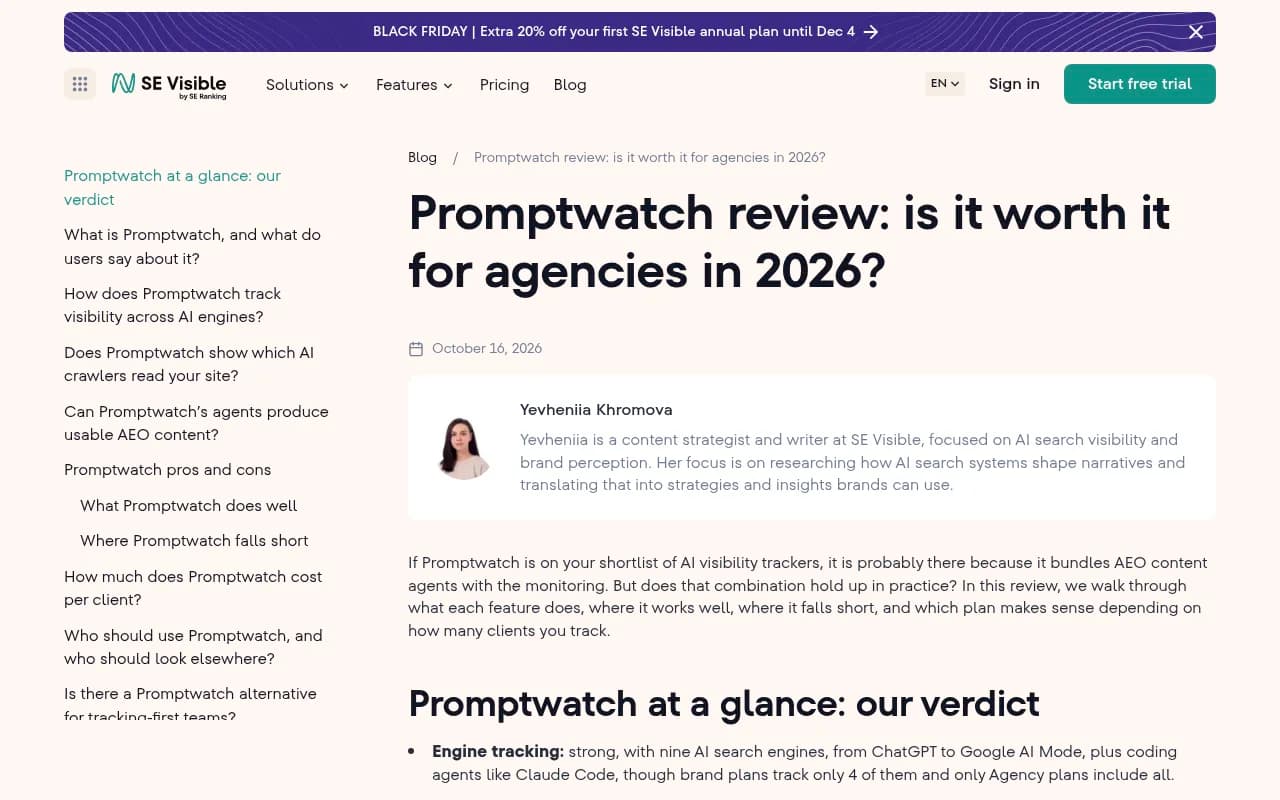
SE Visible's criticism is fair and worth repeating: the content agents are useful only if you publish from Promptwatch, articles start at Professional (5 per month, 10 on Business), and every draft leans on a knowledge base you have to keep current. If your CMS workflow is locked down or your team won't maintain a brand book, you will pay for a feature you barely use.
Pricing and the response-limit math
Always confirm on promptwatch.com/pricing. The page I saw was running a Black Friday promotion (30% off, ending Nov 30), so the displayed figures may not be the standard ones. Annual billing gives 12 months for the price of 10.
| Plan | Price/mo | Projects | Prompts | Responses/mo | Notable additions |
|---|---|---|---|---|---|
| Explore | Free | 1 | 10 | 310 | ChatGPT only, evaluation plan |
| Essential | $95 | 1 | 50 | 6,000 | Agent Chat, country tracking, MCP and API |
| Professional | $245 | 2 | 150 | 18,000 | Content writing and refresh, Knowledge Base, crawler logs |
| Business | $579 | 5 | 350 | 42,000 | Content Agent, hourly tracking, state/city, Fact Check, Shopping, Ads Radar |
| Agency Kick-off | $199 | Unlimited | Unlimited | 10,000 | AI Visibility Reports for pitches |
| Agency Growth | $399 | Unlimited | Unlimited | 25,000 | Larger response pool |
| Agency Scale | $799 | Unlimited | Unlimited | 65,000 | Faster tracking, local targeting, Fact Check |
Every plan includes unlimited team seats, Brand Narrative, and MCP and API access. There is a 7-day free trial on monthly billing for the paid plans.
Why responses matter more than prompts
Every prompt-model run consumes one response. So the prompt count on the pricing page is misleading until you multiply.
- 100 prompts x 5 models x 30 days = 15,000 responses
- That fits Professional's 18,000 but blows through Essential's 6,000
- At Essential's limit, monitoring can pause until the next cycle
Before you pick a plan, write down your prompts, your engines and your frequency, and do the multiplication. Most budget surprises in this category start there.
The agency question
SE Visible's verdict is blunt: a credible pick for one or two brands, a weaker deal for agencies. Unlimited projects and prompts sound generous, but all clients draw from one shared response pool, so each new client reduces coverage for the others. That is a fair criticism of the pool model, and I'd run the numbers for your client count before signing. On the other side, agency plans include AI Visibility Reports (a prospect PDF in about five minutes) and branded, read-only client access. The agencies page and the GEO for agencies guide are the places to start.
Independent opinions at a glance
| Source | Score or verdict | Main caveat |
|---|---|---|
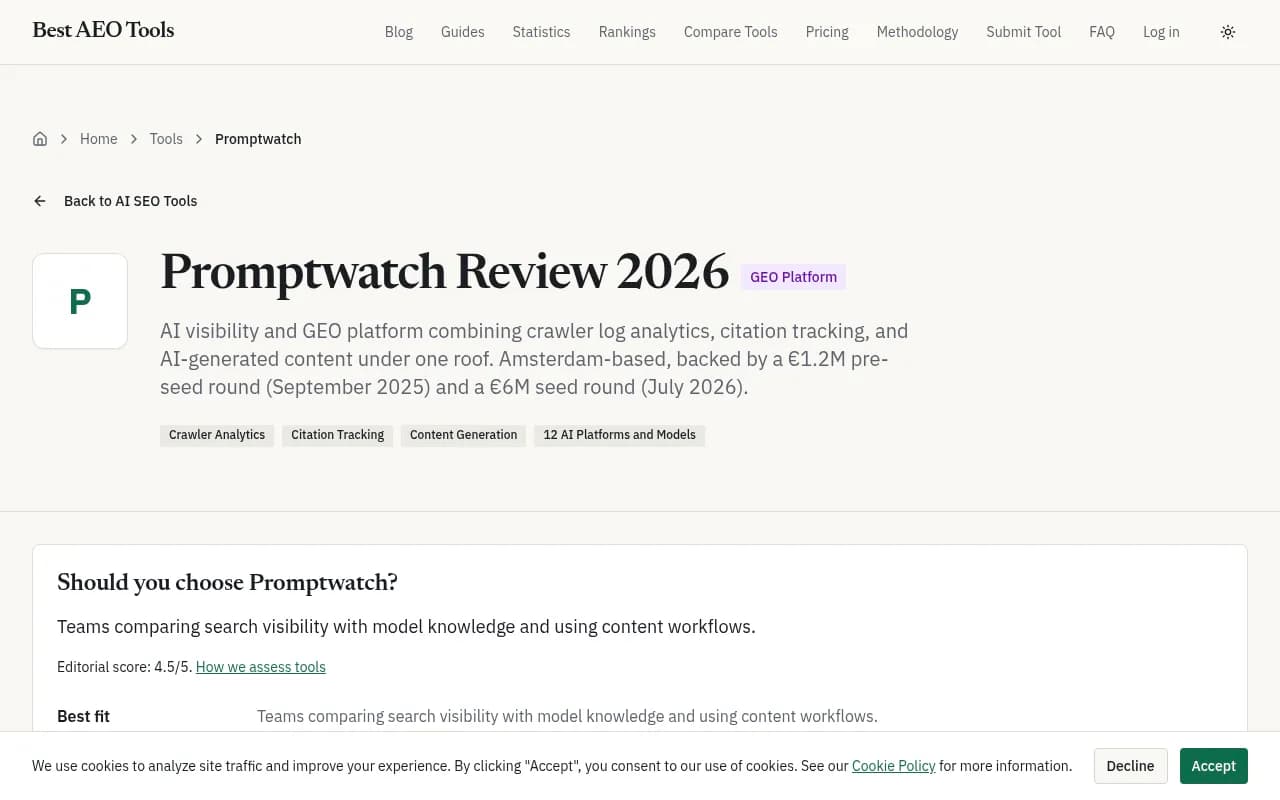
| BestAEOTools | 4.5/5 editorial score | Check that required engines and volume fit the plan; Claude via API |
| SE Visible | 4.6/5 on G2 (20 reviews) cited; good for one or two brands | Agency response pool; content agents need you to publish from the tool |
| Geoptie | Entry plan is $95/mo with daily refresh, MCP, API and AEO content | Says the Brands flow tracks 4 of 9 engines |
| Promptwatch pricing page | 4.7/5 on G2 | Self-reported |
The G2 discrepancy (4.6 versus 4.7) is probably timing, but a base of around 20 reviews is thin either way. Don't lean on the rating. Run a trial on one real account.
What I like and what bugs me
What holds up:
- The loop is real. Tracking, crawler logs, content and analytics live in one product, so a fix gets checked instead of forgotten.
- Real-UI collection and per-country monitors give numbers that resemble what buyers see.
- Agent Chat and the MCP server (110+ tools) let you query your data from Claude, ChatGPT or Cursor instead of clicking through dashboards.
- It is ISO/IEC 27001 certified and GDPR compliant, which shortens enterprise procurement.
What bugs me:
- The response-allowance model is easy to underestimate, and the engine-per-plan confusion in reviews suggests the documentation isn't as clear as it should be.
- The best features (crawler logs, content tools, Fact Check, hourly tracking) are spread across Professional and Business, so the $95 plan is closer to a tracker than the full product.
- Content value depends on discipline: a maintained knowledge base and an actual publishing habit.
Who should buy it
| Situation | Fit |
|---|---|
| One brand, wants tracking plus content and crawler data | Professional is the sensible starting point |
| Marketing team that wants hands-off publishing | Business, with the Content Agent |
| Developer-tool or API company | Strong, thanks to coding agent tracking |
| Local or multi-location business | Business, for local targeting at exact coordinates |
| Agency with many small clients | Run the shared-pool math first |
| Someone who just wants a cheap mention counter | Essential works, but a budget tracker may be enough |
If you are comparing, the best GEO and AI visibility platforms compared page and head-to-head pages such as Promptwatch vs Profound and Promptwatch vs Peec are the vendor's own take, so read them with that in mind. The GEO software directory at bestgeosoftware.com lists many other options.
How to test it properly in 7 days
- Pick one real brand and 30 to 50 prompts that mirror how buyers ask, not branded vanity queries.
- Choose exactly the engines you need and confirm they are all tracked on your plan.
- Connect crawler logs and visitor analytics on day one so data accumulates.
- Check the Action Board and Brand Narrative for something you didn't already know.
- Publish one piece through the Content Agent or editor and watch whether it gets crawled.
- Compute your monthly response burn and see whether your plan survives it.
If steps 4 and 5 produce nothing useful, the platform isn't for you. If they do, you have your answer faster than any review could give it.
You can also run the free AI visibility report first, or start the 7-day free trial.
Verdict
Promptwatch is one of the few platforms that goes past monitoring into fixing and measuring, and the crawler logs plus visitor analytics are the reason I'd pick it over a pure tracker. It is not cheap once you need the features that matter, and the response pool punishes sloppy planning. Buy Professional or Business if you will publish and measure. Skip it if all you want is a mention count.
FAQ
How much does Promptwatch cost in 2026?
Essential is $95/mo, Professional $245/mo, Business $579/mo, and agency plans run $199 to $799/mo. Enterprise is custom. Confirm current figures at promptwatch.com/pricing, since a Black Friday promotion was running.
Does Promptwatch track all AI engines on every plan?
Its pricing page says yes, while two independent reviews say brand plans track only 4 of 9. BestAEOTools describes four as a quota recommendation. Test it in the trial.
Is there a free plan?
Yes. Explore gives 1 project, 10 prompts and ChatGPT only. It is for evaluation, not a full plan. The 7-day trial on paid plans is the better test.
Does Promptwatch write content?
Yes, from Professional (5 AEO articles per month) and with the automated Content Agent on Business, publishing to WordPress, Webflow or Framer.
Is it good for agencies?
It has unlimited projects and prospect reports, but all clients share one response pool, so check your math against your client count.