
Key takeaways
- BrightEdge AI Catalyst suits global brands that need AI and organic results reported side by side for executives. Conductor has the broadest native AI tracking and an MCP server. Botify is a crawl and log-file specialist, and one 2026 ranking says it doesn't track AI citations or brand mentions at all.
- Adobe LLM Optimizer reads AI crawler traffic from CDN logs and can serve AI-optimized pages at the edge. It fits Adobe Experience Cloud shops, and it carries a cloaking risk you have to police.
- None of the four publish firm prices. Third parties report $75K to $500K+ a year for the suite vendors, and about $115,000 a year for Adobe. Treat all of those figures as unverified.
- Every vendor's engine list differs, so get it in writing along with prompt frequency and sample sizes per score.
- A platform finds the work. Somebody still has to write, build and ship it.
What enterprise AEO actually asks of a platform
Answer engine optimization at a small company is mostly a tracking problem. You pick 50 prompts, watch whether ChatGPT names you, and fix a few pages. At enterprise scale the problem changes. You have dozens of brands, a dozen markets, regional legal review, and a CFO who wants to know what any of it earns.
BrightEdge frames the extra requirements as four: governance, combined reporting, global tracking and audited security. That is a vendor's framing, but it matches what I'd expect procurement to ask about. If a tool can't give a regional team its own view while the global team sees everything, it will stall in rollout no matter how good the dashboards are.
Two things from Promptwatch Data are worth keeping in mind when you read vendor claims. First, engines behave differently. In Promptwatch's sources-per-response data, ChatGPT cites about 5 sources per web-search answer, while Google AI Overviews and Perplexity cite about 10. Copilot swung from under 2 to nearly 17 within a few weeks. A single blended "AI score" hides all of that, so ask each vendor how they report per engine.
Second, crawlers are not one group. In Promptwatch's AI crawler traffic report, OpenAI made up 79.8% of IP-verified AI crawler requests in the week of Aug 31 to Sept 6, 2026, down from 94.8% in mid-June. Any log-analysis feature should split out each bot rather than lump them together.
The four platforms at a glance
| Platform | Core strength | AI engines (vendor-stated) | Pricing model | Best fit |
|---|---|---|---|---|
| BrightEdge AI Catalyst | Executive reporting, AI and organic in one place | Google, AI Overviews, AI Mode, ChatGPT, Perplexity, Gemini | Contract by quote | Global brands with heavy reporting needs |
| Conductor | Content workflow, native AI tracking, MCP server | ChatGPT, Gemini, Copilot, Claude, Perplexity, AI Mode, Grok | Usage-based tiers, AI search credits | Content-led teams across many markets |
| Botify | Crawling, log analysis, JavaScript rendering | Not published as a list | Contract by quote | Sites with a million-plus pages and crawl trouble |
| Adobe LLM Optimizer | CDN-log agentic traffic, edge-deployed fixes | ChatGPT, Gemini, Copilot, Perplexity, AI Overviews | Prompts per year, annual contract only | Companies already on Adobe Experience Cloud |
Engine lists come from vendor pages and third-party summaries, so they will drift. Get the current list in your contract.
BrightEdge AI Catalyst
BrightEdge built its AEO product into the same platform its customers already use for SEO. AI Catalyst tracks mentions, citations and sentiment across AI engines and reports them next to organic results, which is the main reason an executive audience likes it.
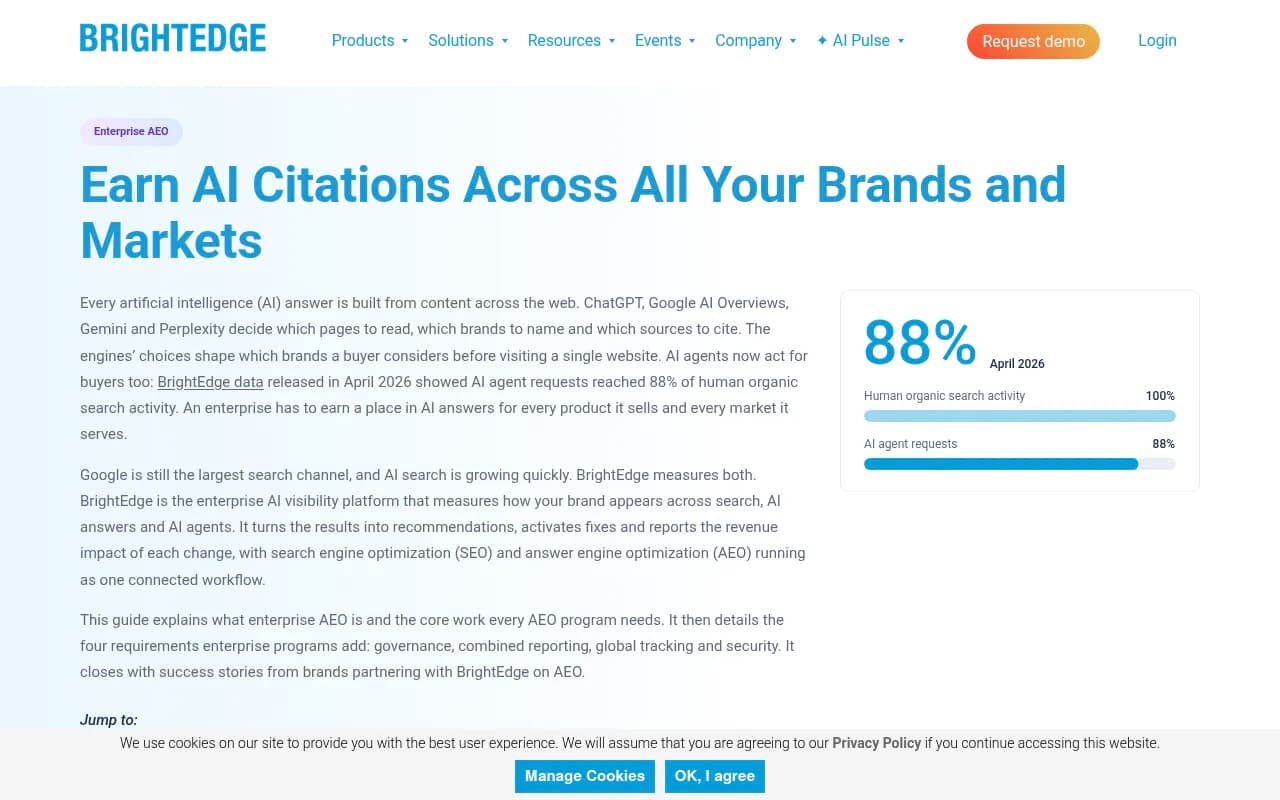
The pitch is a connected workflow: measure, recommend, activate fixes, report revenue impact. BrightEdge also cites its own April 2026 data showing AI agent requests reached 88% of human organic search activity. That is a vendor stat, so I'd treat it as directional rather than settled.
Where it is strong
Reporting and governance. One reviewer who has run BrightEdge in-house describes it as the automation incumbent, with AI Hyper Cube, AI Catalyst and Agent Edge sitting beside Autopilot, which the vendor says handles fully automated optimizations on your website. I couldn't verify Autopilot or Agent Edge details from primary sources, so ask for a live demo of both before you believe the automation story.
Where to push
A comparison from Vicious Marketing puts annual cost at $150K to $500K+ and calls out a steep learning curve and an older interface. Those are third-party numbers, not BrightEdge's. Ask who on your team will actually live in the tool, because a dashboard built for executives can frustrate the practitioners who have to act on it.
Conductor
Conductor is the one I'd shortlist first if your bottleneck is content teams working across markets. Its own ranking naturally puts it at number one, so discount that. Still, the product claims are specific: brand mentions, citations, share of voice and sentiment across ChatGPT, Perplexity, Google AI Overviews, AI Mode, Copilot, Grok and Claude.
The distinctive piece is the MCP server, which connects Conductor's data to your own AI workflows and agents. A reviewer notes AgentStack is now live, with apps inside ChatGPT, Claude and Copilot and turnkey agents for end-to-end workflows. I have no primary-source detail on AgentStack's depth, so test it on a real workflow rather than a canned demo.
Pricing and fit
Conductor doesn't publish prices. Plans are usage-based, with AI search credits attached to each tier. One comparison estimates $75K to $250K a year and describes the technical SEO side as weaker than Botify. If your site has crawl problems at scale, plan on pairing it with a crawler. Its data inputs include GA4, Search Console and Adobe Analytics, which helps if you're already in that ecosystem.
Botify
Botify is the odd one out in this group, and that is not an insult. It is a crawl and log-file platform first, built for marketplaces, large catalogues, publishers and manufacturers with deep product ranges.
The evidence on its AI features is mixed. A 2026 vendor-written ranking says flatly that Botify doesn't track AI citations or brand mentions. A pricing roundup lists it as tracking ChatGPT, Perplexity, AI Overviews, AI Mode and Gemini, with prompts drawn from your own search data. Another comparison marks AI support as "Partial." Those can't all be right, or they describe different moments in the product's life. Botify's own pitch is "AI Activation," described as automations that optimize, test and deploy content.
My read: buy Botify because your crawl budget, rendering and indexation are broken, not because you want an AEO dashboard. Ask them which AI crawlers their log analysis separates out and how often the crawl runs at your site size. Given the crawler mix above, a tool that only reports "AI bots" as one number isn't much use.
Estimated cost is $100K to $400K a year per one third-party comparison. Again, unverified.
Adobe LLM Optimizer
Adobe introduced Adobe LLM Optimizer in October 2025. It is now generally available and also marketed under the name Adobe Brand Visibility, so check which SKU a quote covers.
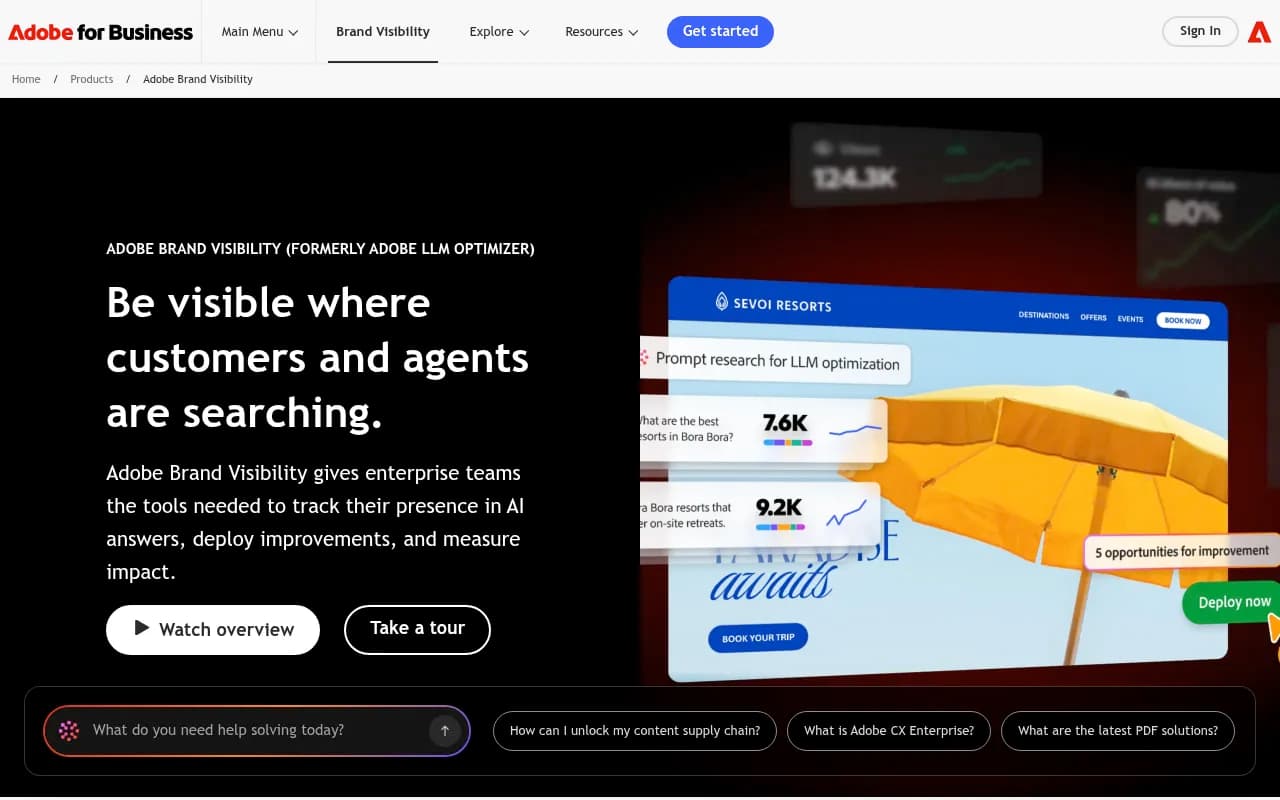
Adobe's own description says it shows how AI systems interact with your site and how your brand appears in LLM responses, with prescriptive recommendations and, in supported environments, fixes deployed without long development cycles. Its Agentic Traffic report asks a question many tools skip: can AI crawlers and agents reach and read your site at all, independent of whether they cite it?
What it does
Per a review from competing vendor GEOly (so read it with that in mind), it covers five engines: ChatGPT, Gemini, Copilot, Perplexity and AI Overviews. Not Grok, Claude, DeepSeek or regional engines. Features include GEO scoring, competitive share of voice, accuracy validation against your official content, and agentic traffic read from CDN logs. That last point matters. AI crawlers don't reliably run JavaScript, so tag-based analytics undercount them.
Limits from the official product description
- Licensed by prompts per year
- 40 included users, unlimited guests
- 150 projects
- Agent Analytics capped at 10 GB per day
- 800 AIO service credits per month
- Competitor and Benchmark Intelligence use Semrush Traffic Analytics data and are for included users only
The cloaking question
Optimize at Edge serves AI-optimized page versions to AI crawlers at the CDN layer. Reformatting is defensible: server-rendering JavaScript content, flattening tabs. It turns into cloaking if the machine version makes different claims or shows different prices. If you buy this, diff the human and machine versions on a schedule and give legal a seat at the table.
Pricing is quote-only and annual-only. Third parties report an entry point near $115,000 a year, which Adobe hasn't published. It is a good fit if you're on Experience Cloud and control your CDN and log pipeline. It is a poor fit if you need a pilot this quarter or sit outside the Adobe stack.
Head-to-head on the questions that matter
| Question | BrightEdge AI Catalyst | Conductor | Botify | Adobe LLM Optimizer |
|---|---|---|---|---|
| Tracks mentions, citations, sentiment | Yes | Yes, plus share of voice | Disputed in 2026 sources | Yes, plus accuracy validation |
| Crawler or log analysis | Site crawls via ContentIQ | Limited | Core strength | CDN-log agentic traffic |
| Executes fixes | Autopilot, Agent Edge (per vendor) | AgentStack, MCP server | AI Activation (per vendor) | Optimize at Edge |
| Third-party annual cost estimate | $150K to $500K+ | $75K to $250K | $100K to $400K | About $115K entry |
| Biggest risk | Learning curve, dated interface | Weaker technical SEO | Thin AEO measurement | Stack lock-in, cloaking if unmonitored |
Which one fits which company
| Your situation | Start with |
|---|---|
| Global brand, many country sites, executives want one report | BrightEdge, or Conductor |
| B2B SaaS with several markets and thin comparison or use-case content | Conductor |
| Marketplace or manufacturer with millions of URLs and indexation problems | Botify, plus a measurement layer |
| Already on Adobe Experience Cloud and in control of your CDN | Adobe LLM Optimizer |
| Need a pilot within a quarter, no six-figure commitment | None of the above, see below |
What to ask in every demo
- Which AI engines are covered today, in writing, and what is the cadence for adding new ones?
- Is the data collected from real user interfaces or from APIs? The answers can differ.
- How often does each prompt run, and how many runs sit behind a displayed score?
- Can regional teams get scoped access without seeing other markets?
- Which crawlers are separated in log analysis?
- What happens to a fix after it ships? Does the tool check whether the page got crawled, cited and clicked?
- How does billing convert to one annual figure? Credits, prompts, seats and keywords all appear, so normalize before comparing.
The last two matter most. Several of these tools find work and recommend it. Shipping and verifying it is where enterprise programs usually stall.
When an enterprise suite is the wrong buy
All four are annual, quote-only, six-figure commitments by most third-party estimates. If you want AEO measurement and execution without a procurement cycle, a dedicated AI visibility platform is a reasonable alternative or a companion to an SEO suite.
Promptwatch tracks ChatGPT, Gemini, Claude, Perplexity, Google AI Overviews, AI Mode, Copilot and others from the real interfaces, then goes further: IP-verified AI crawler logs, a Content Agent that writes and publishes to WordPress, Webflow or Framer, and visitor analytics to measure the traffic AI sends. It is ISO/IEC 27001 certified and GDPR compliant, which helps with security reviews. Pricing is published (Business is $579 a month, agencies start at $199 a month), and there is a 7-day free trial on monthly plans. Confirm current numbers at promptwatch.com/pricing.

Many teams run an SEO suite for governance and a platform like this for measurement and execution. If you are weighing options beyond these four, the GEO software directory at bestgeosoftware.com lists dozens more. Other enterprise-oriented names in the catalog include [tool:seoclarity], [tool:profound] and [tool:semrush-one], each worth a look depending on your bottleneck.
A note on sources
Most comparisons of these platforms are written by vendors or by competitors, including the Conductor ranking, GEOly's Adobe review, and an agency's list that recommends its own execution service. I found no neutral, primary-source pricing for BrightEdge, Conductor or Botify. The cost ranges above come from third-party roundups. Use them to set expectations, then get real quotes.
FAQ
Which enterprise platform has the broadest native AI tracking?
By vendor-stated engine lists, Conductor covers the most engines, including Claude and Grok. BrightEdge and Botify list Perplexity, AI Overviews, AI Mode and Gemini. Adobe covers five and omits Claude and Grok. Verify each list in your contract.
Does Botify track AI citations?
Sources disagree. One 2026 ranking says it doesn't track citations or brand mentions. Others list AI engines with prompts drawn from your own search data. Ask for a live demo using your domain.
Is Adobe LLM Optimizer the same as Adobe Brand Visibility?
They are marketed together. Adobe LLM Optimizer launched in October 2025 and is also sold as Adobe Brand Visibility, so confirm exactly which SKU and which features your quote includes.
How much do these platforms cost?
None publish enterprise prices. Third-party estimates range from about $75K to $500K+ per year, and about $115K a year for Adobe. All are unverified, so get written quotes.
Can I combine an enterprise suite with a dedicated AI visibility tool?
Yes, and it is common. The suite handles governance, crawling and organic reporting, while a dedicated platform handles per-engine measurement, crawler verification and content execution.