Adobe LLM Optimizer Review 2026
Adobe Experience Cloud app with AI visibility tracking, an opportunities dashboard and attribution tied to Adobe Analytics, built for Adobe-based enterprises.
Key takeaways
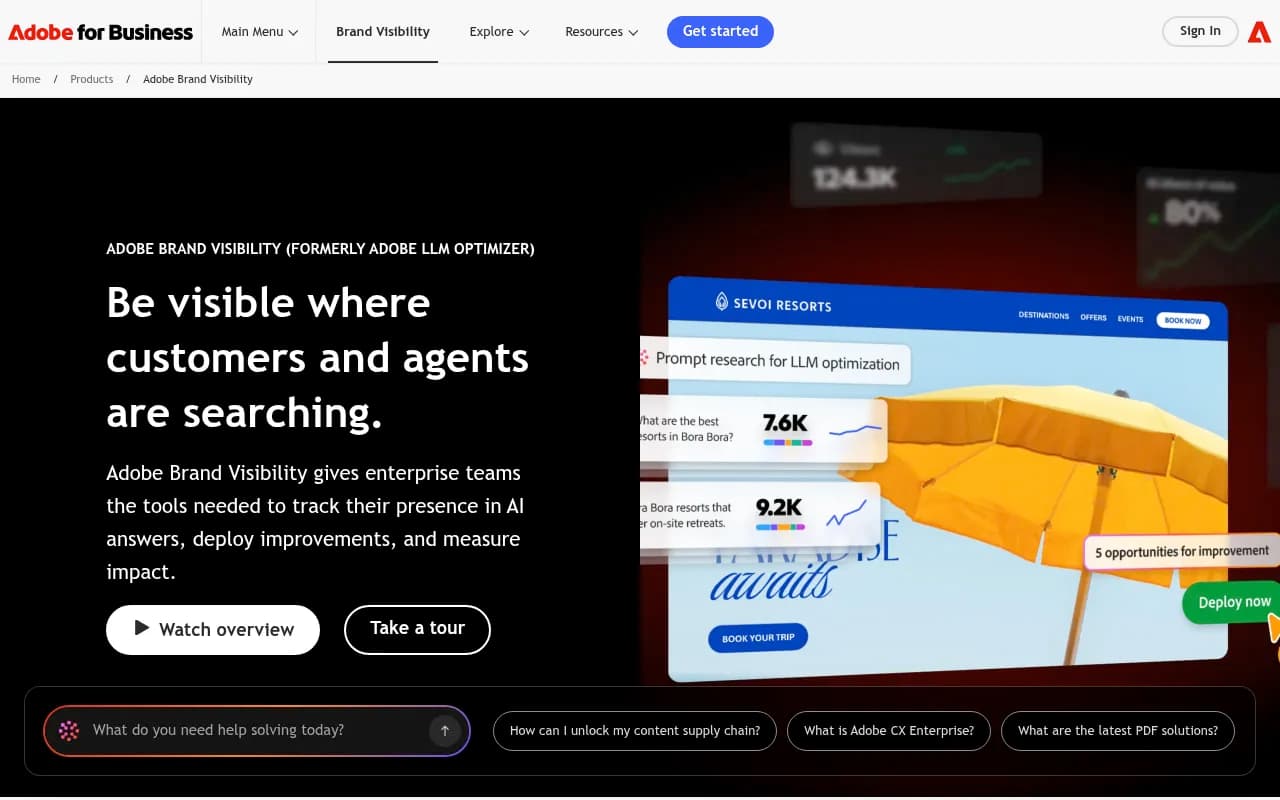
- Adobe Brand Visibility, formerly Adobe LLM Optimizer, is an enterprise GEO product that tracks AI answers, deploys fixes at the CDN edge, and reports results in Adobe Analytics and Customer Journey Analytics.
- Its best idea is edge deployment: marketers can fix blocked crawlers, missing structured data and 404s for AI agents without an engineering sprint, with rollback.
- Pricing is not public. Competitor-reported estimates range from roughly 60,000 EUR to about 115,000 USD per year, and none of it is verified. Expect annual contracts and a custom quote.
- It is a direct competitor to Promptwatch, and it lacks several things Promptwatch has: a self-serve free trial, an automated Content Agent with WordPress, Webflow and Framer publishing, Reddit, YouTube, LinkedIn and Instagram citation tracking, ChatGPT Shopping and Ads Radar, and Brand Narrative with Fact Check.
- Best for Adobe-centric enterprises that already live in Experience Manager and Adobe Analytics. Poor fit for small teams, agencies on tight budgets, or anyone who wants to start tomorrow with a credit card.
Adobe Brand Visibility is Adobe's generative engine optimization (GEO) application for enterprise marketing teams. It launched as Adobe LLM Optimizer and has been renamed, now positioned as a combination of Adobe's optimization tooling and market intelligence from Semrush, which Adobe owns. The pitch is simple: see how ChatGPT, Perplexity, Google AI Mode, Claude and Microsoft Copilot talk about your brand, fix what is wrong, and prove the effect in the analytics stack you already pay for.
The audience is clearly large organizations. The customer logos on the product page include Lovesac, Kellogg, Lumen and Heathrow Airport, and the whole experience, from the Get started button that leads to a consultation request to the documentation on Experience League, assumes an enterprise sales process. Adobe's docs are written for Admin, Leader and User roles, which tells you how it expects to be rolled out: governed, multi-team, and probably with a partner involved.
I have not seen verified G2 or Capterra reviews for this product, so a lot of what follows rests on Adobe's own documentation and on third-party comparisons, some of which come from competitors. I flag that where it matters.
Key features
AI visibility tracking. The core dashboard tracks mentions, citations, sentiment and share of voice across ten LLM families, including ChatGPT, Perplexity, Google AI Mode, Anthropic Claude and Microsoft Copilot. Share of voice benchmarking covers up to five direct competitors. Coverage spans more than 25 languages with state and city-level breakdowns. Adobe says its data comes from over 2.18B observed AI responses and clickstream data that reflects real browsing behavior, grouped into topics so you can see where you have gaps.
Semrush data fused with AI visibility. This is the differentiator that only Adobe can really offer. Semrush's keyword database (Adobe cites 28.9B keywords) is layered over AI citation data, so you can see where your search authority should be earning AI citations and is not. Because AI answers often draw on sources that also rank in search, this connection is useful for prioritization. It also keeps you focused on prompts with established demand instead of raw prompt counts.
Optimize at Edge. The feature most worth your attention. Brand Visibility detects AI agent requests at the CDN layer and serves optimized content to them without a CMS update. It works with Fastly, Akamai and Cloudflare, so it is not locked to Adobe Experience Manager. Typical fixes:
- Unblocking crawlers that robots rules or bot protection are turning away
- Adding missing structured data
- Resolving 404s for agent requests
- Adding FAQ formats, LLM-friendly summaries and simplified versions of complex pages
Adobe says optimizations target AI agents only, leave the human visitor experience alone, and can be rolled back. Anyone who has waited three sprints for a dev ticket will understand why this is attractive. It is also a place where I would want a careful governance review, because serving different content to bots than to people needs clear policy and legal sign-off in large companies.
Recommendations pushed to Adobe Experience Manager Sites. For teams on AEM, recommendations can go straight into Sites, where marketers review, approve and publish. Product details in Adobe Commerce and metadata in AEM Assets can feed AI agents accurate information. That is tight integration, and it is the main reason Adobe shops will find this appealing.
Off-site guidance. The product offers channel-by-channel guidance for Wikipedia, YouTube, Reddit and earned media. This is guidance on what to do, not a tracking suite for those channels. I could not confirm the depth of citation-level reporting for each one.
Traceability to prompts, answers and sources. Findings link back to the specific prompts, responses and cited sources, and connect to AI agent visits and traffic on your own site. CDN log verification gives server-level confirmation that AI bots fetched your updated content.
Impact measurement. You set a baseline before launching an optimization, then measure afterward. Results report into Adobe Customer Journey Analytics and Adobe Analytics next to paid, social and web results, and feed back into recommendations. Adobe is careful to say optimizations are associated with KPI changes, which is honest wording, since attribution from AI answers is hard. If your analytics already live in Adobe, this saves custom tagging and a separate reporting silo.
Collaboration. A shared workspace is meant to line up SEO teams, content strategists, web experience teams, analytics practitioners and brand leaders around a common set of opportunities.
Who is it for
The sweet spot is a global enterprise with an existing Adobe footprint: Experience Manager Sites, Adobe Analytics or Customer Journey Analytics, maybe Adobe Commerce. Think a retailer or telecom with a large digital team, a dedicated analytics group, and a procurement process that expects annual agreements. A head of digital who needs to explain AI search performance to the board in the same dashboards as paid and organic will get the most from it.
It also suits organizations where engineering capacity is the bottleneck. Edge deployment lets an SEO team ship technical fixes for AI crawlers without waiting in the queue.
Who should skip it? Startups, SMBs and small agencies. There is no public price, no self-serve signup and, according to a competitor, a 1,000-prompt minimum. Teams that want to monitor 50 to 300 prompts, or agencies running many client projects, will find the commitment out of proportion. Also skip it if your analytics stack is Google Analytics and your CMS is WordPress or Webflow. The edge deployment still works there, but the attribution story, which is the headline, assumes Adobe.
Integrations and ecosystem
The native ties are to Adobe Experience Manager Sites, Adobe Experience Manager Assets, Adobe Commerce, Adobe Analytics and Adobe Customer Journey Analytics. Semrush data is built in. For CDN deployment, Adobe lists Fastly, Akamai and Cloudflare.
Adobe has a dedicated integrations page, but I could not confirm the full list. I also could not verify a public REST API, MCP server or developer documentation for this product, so confirm that with Adobe if programmatic access matters. Documentation on Experience League includes release notes, dashboards guides, best-practice guides for topics and prompts, and a tutorial set called Brand Visibility University. Adobe also lists partners for implementation support.
Pricing and value
Adobe publishes no price. The pricing pages that come up in searches are for Acrobat and Creative Cloud, and they are unrelated to this product.
What third parties report, all unofficial:
- LLM Pulse, a competitor, says licenses are annual, by custom quote, with a 1,000-prompt minimum in 200-prompt increments, and tiers from 1K to 110K+ prompts. It cites teams quoted about 60 EUR per tracked prompt per year, which puts the minimum near 60,000 EUR annually.
- SEORCE, also a competitor, says it starts at about 115,000 USD per year on annual contracts with no free trial.
- Digital Applied reports a similar figure of around 115,000 USD from third-party listings.
These estimates do not match, and every source has a reason to make Adobe look expensive, so treat them as a range, not a quote. A trial reportedly exists only for certain eligible Adobe customers. Capterra lists "Prompt Packages" and a standalone application as options, and extra Experience Cloud licensing may be required for full value.
Compare that with Promptwatch, which publishes prices: Essential at $95/mo, Professional at $245/mo, Business at $579/mo, agency plans from $199/mo, a 7-day free trial on monthly billing, and a free AI visibility report. Check Promptwatch pricing for current numbers. The value argument for Adobe only works if you would otherwise buy the Adobe analytics integration and edge deployment as separate projects.
Strengths and limitations
Strengths
- CDN edge deployment lets marketers fix AI crawler problems without developers, with rollback.
- Semrush keyword data combined with AI citation data is a genuinely distinctive view of where authority should convert to citations.
- Native reporting in Adobe Analytics and Customer Journey Analytics keeps AI visibility next to every other channel.
- Broad language and location coverage, with 25+ languages and state and city breakdowns.
- Direct publishing path into Experience Manager Sites for approval workflows.
Limitations
- No public pricing, no self-serve signup, annual contracts, and a reported 1,000-prompt minimum (competitor-sourced).
- The best features assume Adobe infrastructure, and extra licenses may be needed.
- Competitor benchmarks cap at five direct competitors per tracking set.
What it lacks compared with Promptwatch
This is a direct competitor to Promptwatch, and the gaps are real. From what Adobe documents, Brand Visibility lacks or does not clearly show:
- A self-serve free trial. Promptwatch has a 7-day trial and a free AI visibility report.
- An automated Content Agent that plans, writes and publishes to WordPress, Webflow and Framer on a schedule, with Content Refresh for existing pages and a closed loop that follows each page through crawls, citations and traffic.
- Dedicated Reddit, YouTube, LinkedIn and Instagram citation reports. Adobe offers guidance for some of these channels, not tracking at the post level.
- ChatGPT Shopping, Amazon Alexa product visibility and Ads Radar for sponsored placements in AI search.
- Brand Narrative (the individual claims AI makes about you, by theme) and Fact Check against your own pages.
- Prompt volumes and difficulty scoring, query fan-outs, and page-level tracking with Offsite Mentions.
- Agent Chat, including in Slack, and a prioritized Action Board.
- Local GEO targeting at exact coordinates and up to hourly tracking.
- Real-UI collection across 20 engines and models, including Meta AI, Amazon Alexa and coding agents like Codex, Claude Code and OpenCode.
- Google Search Console and Bing data alongside AI data on a transparent plan.
To be fair to Adobe, it does have CDN-level verification and the Adobe Analytics integration, which most standalone tools cannot match for Adobe customers.
Bottom line
Adobe Brand Visibility makes sense if your company already runs on Adobe Experience Cloud, has a big technical backlog, and needs AI visibility reported in the same analytics environment as everything else. Edge deployment and the Semrush data are the real draws. The cost, contract terms and sales-led process make it a decision for enterprise procurement, not a quick test.
If you want optimization, not just monitoring, with transparent pricing and a trial, Promptwatch is the stronger alternative: it tracks, writes, publishes and then measures whether the fix worked. See Promptwatch vs Semrush for how it compares with Adobe's Semrush-powered data, or browse the GEO software directory at bestgeosoftware.com.
Best use case: a large Adobe-based enterprise that wants AI visibility fixes shipped at the CDN edge and reported next to its other marketing channels.
Frequently asked questions
What is Adobe LLM Optimizer?
How much does Adobe Brand Visibility cost?
Does it only work for Adobe Experience Manager customers?
Which AI platforms does it track?
Is there a free trial or a cheaper alternative?
Similar and alternative tools to Adobe LLM Optimizer