Key takeaways
- Scrunch, Searchable, and Relixir are three genuinely different products that happen to compete in the same GEO category -- their approaches to monitoring, content, and optimization vary significantly.
- Relixir is the most content-forward of the three, with an AI-native CMS built specifically for generating content that gets cited by LLMs.
- Scrunch has the strongest enterprise pedigree and compliance story, but its pricing and feature depth may be more than a growing mid-market team needs.
- Searchable sits somewhere in the middle -- a monitoring-plus-content tool that's accessible but less specialized than either competitor.
- If you want a platform that closes the full loop from gap analysis to content creation to traffic attribution, Promptwatch is worth a serious look alongside these three.
Why mid-market teams are shopping for GEO tools right now
A year ago, "GEO" was mostly a concern for enterprise SEO teams and early adopters. That's changed. According to a 2026 CMSCritic survey, 97% of digital leaders say AEO and GEO are delivering measurable results -- and the category has moved from experimental to expected.
The shift is real. ChatGPT, Perplexity, Claude, and Google AI Overviews are now meaningful traffic sources for many B2B and B2C brands. Marketing teams that used to track rankings in Google are now asking: "Does our brand show up when someone asks an AI chatbot for a recommendation in our category?"
That question is driving a wave of mid-market GEO tool purchases. And Scrunch, Searchable, and Relixir are three of the platforms showing up in those evaluations.
This guide breaks down what each one actually does -- not the marketing copy, but the real feature set, the tradeoffs, and who each tool is built for.
What "mid-market GEO" actually means in 2026
Before comparing platforms, it's worth being clear about the buyer profile. Mid-market here means:
- Marketing teams of 3-15 people, often without a dedicated SEO specialist
- Companies spending $5K-$50K/month on content and SEO
- Brands that are visible in traditional search but haven't yet figured out AI search
- Teams that need tools that don't require a six-month implementation or a dedicated analyst to interpret
Enterprise GEO tools (think Profound, Scrunch's enterprise tier, Adobe LLM Optimizer) are built for procurement processes, compliance reviews, and large-scale multi-brand deployments. That's not this buyer.
Mid-market teams want something they can set up in a day, start getting data from quickly, and actually act on without a consultant.
Scrunch

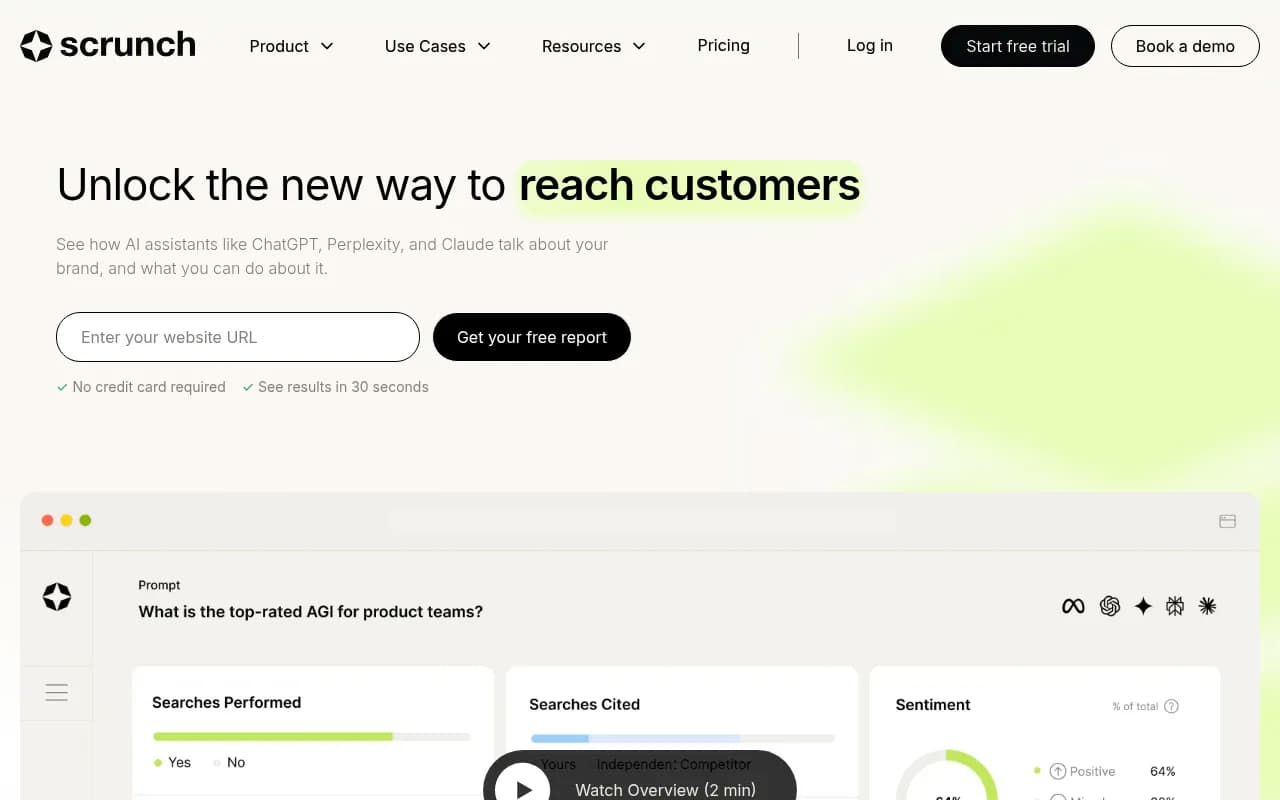
Scrunch started as an influencer marketing analytics platform and pivoted hard into GEO/AEO. That origin story matters -- it means Scrunch thinks about brand visibility differently than pure-play SEO tools. The platform tracks how AI models respond to prompts about your brand and category, surfaces competitor visibility data, and generates reports on where you're winning and losing in AI search.
What Scrunch does well
Scrunch has the most polished enterprise story of the three platforms here. SOC 2 Type II certification, SSO, RBAC -- the compliance boxes are checked. If you're at a company where IT security reviews vendor tools before procurement, Scrunch won't get blocked.
The platform also has a reasonably strong monitoring layer. You can track brand mentions across multiple LLMs, compare your visibility against named competitors, and see how AI responses change over time. The reporting is clean and presentable -- useful if you're regularly sharing AI visibility data with executives or clients.
Scrunch also positions itself as an enterprise-grade platform (their own blog lists it as one of the four best AEO/GEO platforms for enterprise companies in 2026, alongside Adobe LLM Optimizer, Bluefish, and Profound). That's a reasonable claim for their top tier.
Where Scrunch falls short for mid-market teams
The enterprise positioning is also the problem. Scrunch's pricing and feature depth are calibrated for larger organizations. Mid-market teams often find themselves paying for capabilities they don't need while missing the hands-on content optimization features that would actually move the needle.
The platform is primarily a monitoring and reporting tool. It shows you where you stand. It doesn't do much to help you change where you stand -- there's no built-in content generation, no answer gap analysis that tells you exactly what to write, and no direct integration with your CMS to push optimized content.
For a team that wants to understand their AI visibility position and report on it, Scrunch works. For a team that wants to improve their AI visibility position, it's a starting point, not a complete solution.
Searchable
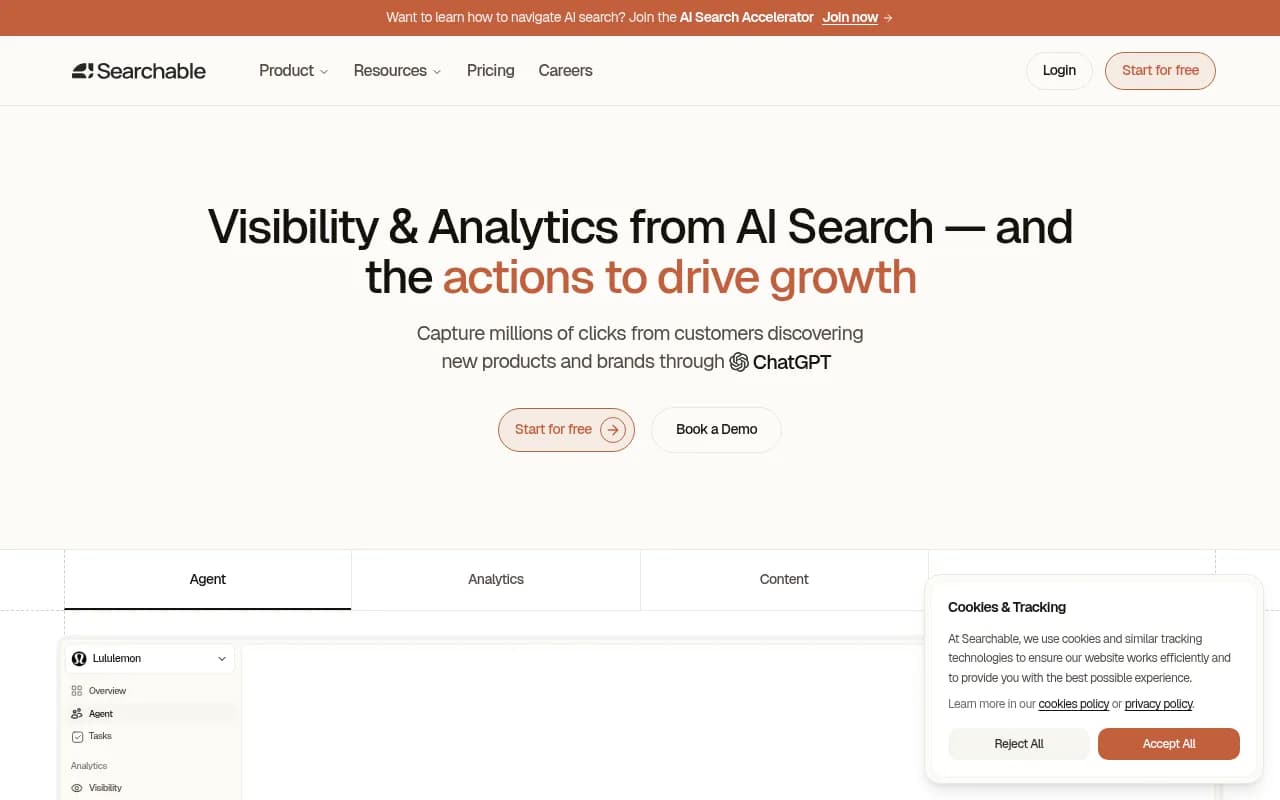
Searchable takes a more accessible approach to GEO. The platform is designed for marketing teams that are newer to AI search optimization and want a tool that doesn't require deep technical knowledge to use.
What Searchable does well
The onboarding experience is genuinely fast. You can connect your domain, set up a prompt set, and start seeing AI visibility data within a few hours -- not days. For teams that have been putting off GEO because it felt complicated, Searchable lowers that barrier.
The platform covers monitoring across the major AI models and gives you a visibility score you can track over time. It also includes some content guidance -- suggestions for topics and angles that could improve your AI visibility -- which puts it a step ahead of pure monitoring tools.
Searchable's pricing is accessible for mid-market teams. You're not looking at enterprise contract minimums or lengthy sales cycles.
Where Searchable falls short
The content tools are more advisory than actionable. Searchable will tell you that you should probably write about a particular topic, but it won't write it for you, and it won't tell you exactly which prompts that content needs to answer or how competitors are currently winning those prompts.
The depth of competitive intelligence is also limited compared to Scrunch or Relixir. If you're in a competitive category and want to understand precisely why a competitor is getting cited more than you, Searchable's data may not give you enough to work with.
It's a solid entry point. But teams that get serious about GEO tend to outgrow it.
Relixir
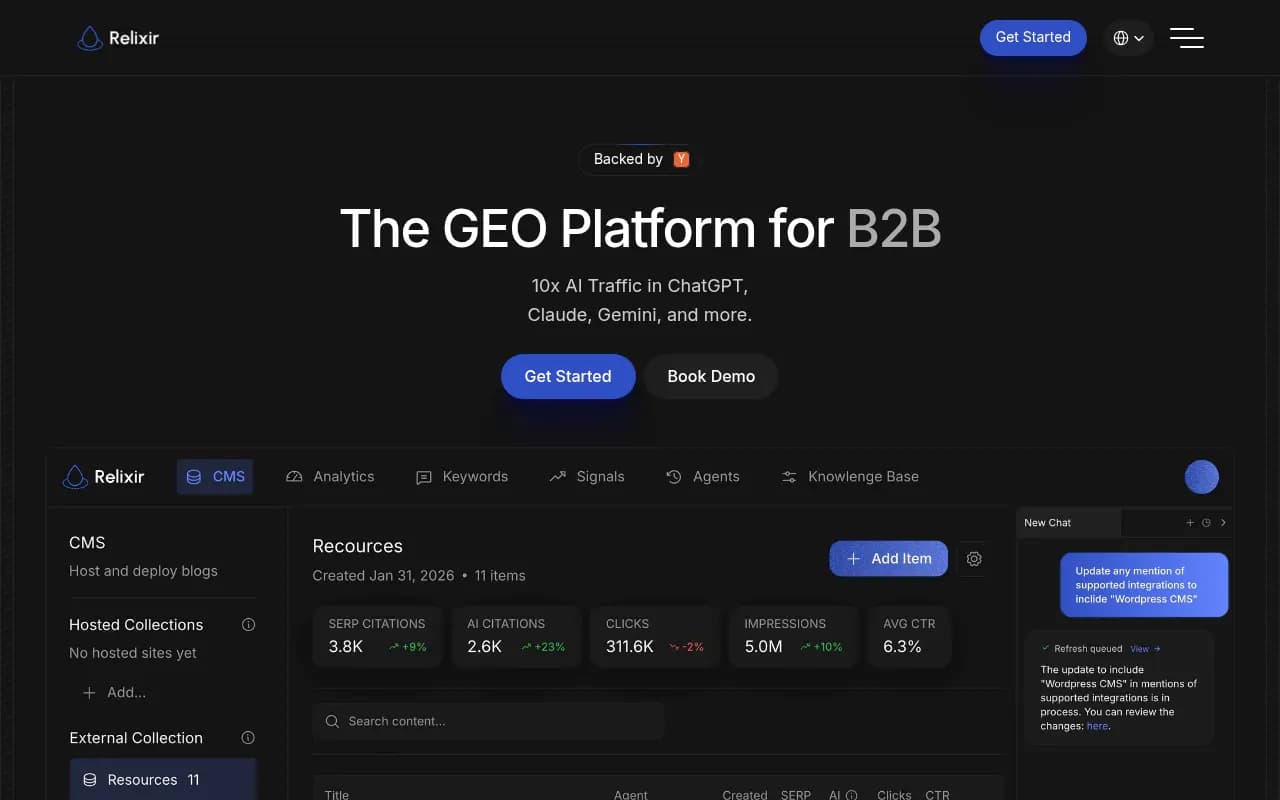
Relixir is the newest of the three -- founded in 2025, backed by Y Combinator -- and it takes the most opinionated approach to GEO. The platform is built around the idea that monitoring your AI visibility is only useful if you can actually improve it, and the product reflects that philosophy.
What Relixir does well
The standout feature is the AI-native CMS. Relixir doesn't just tell you that you're missing visibility for certain prompts -- it helps you create content specifically engineered to get cited by LLMs. The content generation is grounded in citation data and competitive analysis, not generic SEO best practices.
For growing marketing teams that are resource-constrained, this matters. You don't need a separate content team and a separate GEO analyst -- Relixir tries to collapse those into one workflow.
The platform also has a strong answer gap analysis layer. You can see which prompts your competitors are winning that you're not, understand why, and get specific recommendations for what to create.
Where Relixir falls short
Being new has real costs. Relixir's data coverage -- the number of prompts tracked, the breadth of AI models monitored, the depth of citation history -- is smaller than more established platforms. A tool that launched in 2025 simply hasn't had time to build the data infrastructure that platforms with years of operation have accumulated.
The platform is also still maturing in terms of integrations, reporting, and enterprise features. If your team needs SSO, detailed audit logs, or robust API access, Relixir may not be there yet.
Head-to-head comparison
| Feature | Scrunch | Searchable | Relixir |
|---|---|---|---|
| AI model coverage | Multiple LLMs | Major LLMs | Major LLMs |
| Monitoring depth | Strong | Moderate | Moderate |
| Competitor analysis | Strong | Limited | Strong |
| Answer gap analysis | Limited | Basic | Strong |
| Built-in content generation | No | No | Yes |
| AI-native CMS | No | No | Yes |
| Ease of setup | Moderate | Fast | Fast |
| Enterprise compliance (SOC 2, SSO) | Yes | Limited | Limited |
| Pricing accessibility | Enterprise-leaning | Mid-market | Mid-market |
| Best for | Enterprise/compliance-focused teams | GEO beginners | Content-driven growth teams |
The gap all three share
Here's the honest assessment: Scrunch, Searchable, and Relixir each solve part of the GEO problem. Scrunch monitors well. Searchable onboards fast. Relixir generates content.
But none of them close the full loop -- from identifying gaps, to creating content, to tracking whether that content is actually getting cited, to connecting AI visibility back to real traffic and revenue.
That's a meaningful gap for mid-market teams that need to justify GEO investment to leadership. "We're tracking our AI visibility" is a much weaker argument than "we can show you that our AI visibility work drove X sessions and Y conversions last quarter."
This is where Promptwatch is worth considering alongside these three. It's built specifically around that full cycle: find the gaps, create content that gets cited, track the results, and connect them to revenue.

Promptwatch monitors 10 AI models (including ChatGPT, Claude, Perplexity, Gemini, Grok, DeepSeek, and Google AI Overviews), has processed over 1.1 billion citations, and includes built-in content generation grounded in that citation data. The AI crawler logs feature -- which shows you exactly which pages AI bots are reading and which errors they're hitting -- is something none of the three platforms above offer. And the traffic attribution layer (via code snippet, Google Search Console integration, or server log analysis) closes the loop in a way that monitoring-only tools can't.
For a growing marketing team that needs to show ROI, that matters.
How to choose between these platforms
The right choice depends on where your team is in the GEO journey and what you actually need to do next.
Choose Scrunch if you're at a larger mid-market company with real compliance requirements, you need polished executive reporting, and your primary goal is understanding your AI visibility position rather than rapidly improving it. Scrunch is also worth considering if you're already using it for influencer analytics and want to add GEO monitoring without adding another vendor.
Choose Searchable if you're just getting started with GEO, you want to see data quickly without a complex setup, and you're not yet ready to invest heavily in content optimization. It's a reasonable first step.
Choose Relixir if your team is content-forward, you want to create AI-optimized content as fast as possible, and you're comfortable being an early adopter of a newer platform. The content generation capability is genuinely differentiated -- just go in with realistic expectations about data depth and enterprise features.
Consider Promptwatch if you want the full picture: monitoring across 10 AI models, answer gap analysis, AI-powered content creation grounded in real citation data, crawler logs, and traffic attribution. It's used by 6,700+ brands and agencies including Booking.com and Center Parcs, which gives it a data advantage that newer platforms are still building toward.
A note on evaluating any GEO platform
One thing Scrunch's own blog gets right: the best way to evaluate these tools is to actually use them. On paper, most GEO platforms look similar. They all track AI visibility, they all show competitor data, they all have dashboards.
The real differences show up in setup speed, data configurability, how actionable the insights actually are, and whether the platform helps you do something or just shows you things. Push vendors for a real trial, not just a demo. Run the same set of prompts across platforms and compare what you get. Ask specifically how the platform helps you improve your visibility, not just measure it.
The GEO category is moving fast. The platforms that will matter in 12 months are the ones that help teams take action, not just the ones with the nicest dashboards.