Key takeaways
- Both Profound and Promptwatch track brand visibility across major AI search engines, but their core philosophies differ: Profound is strong on data depth and enterprise analytics, while Promptwatch is built around a full action loop from gap detection to content creation to result tracking.
- Promptwatch includes AI crawler logs, content generation agents, Reddit/YouTube tracking, and ChatGPT Shopping monitoring -- features Profound either lacks or charges more to access.
- Profound starts at $399/mo for comparable breadth; Promptwatch's Professional plan is $249/mo.
- If your team needs to monitor and report, both work. If you need to actually fix your AI visibility gaps and create content that gets cited, Promptwatch has a clearer path to doing that.
- Neither tool is right for everyone -- the best choice depends on team size, budget, and whether you need a monitoring dashboard or an optimization platform.
Marketing teams evaluating AI visibility tools in 2026 are running into a familiar problem: the category has exploded, the terminology is fuzzy, and most tools look similar until you actually try to use them.
Profound and Promptwatch are two of the most-mentioned platforms in this space. Both track how your brand appears in AI-generated answers. Both cover multiple LLMs. Both have real customers and real data behind them.
But they're built around different ideas of what "AI visibility" actually means -- and that difference matters a lot when you're deciding where to spend $250-$400+ per month.
This guide goes feature by feature. No fluff, no vague comparisons. Just what each platform does, where it falls short, and which one makes more sense depending on what your team actually needs.
What each platform is trying to do
Before getting into features, it's worth understanding the design philosophy behind each tool.
Profound was built as a purpose-built AEO (Answer Engine Optimization) platform. Its pitch is data depth: a large corpus of prompt conversations, strong analytics, and reporting infrastructure that enterprise teams can plug into their existing workflows. It's well-funded, has G2 Leader status, and is genuinely comprehensive on the monitoring side.
Promptwatch takes a different angle. The core idea is that monitoring alone doesn't move the needle -- you need to close the loop between "where am I invisible" and "what do I do about it." So the platform is built around three steps: find the gaps, create content to fill them, track whether it worked. That's a meaningful distinction from a tool that shows you a dashboard and leaves the rest to you.


Feature-by-feature comparison
AI model coverage
Both platforms cover the major AI search engines. Promptwatch monitors 10 models: ChatGPT, Perplexity, Google AI Overviews, Google AI Mode, Claude, Gemini, Meta/Llama, DeepSeek, Grok, Mistral, and Copilot. Profound covers a similar set, with strong coverage of ChatGPT and Perplexity in particular.
One important distinction: Promptwatch tracks how AI search engines behave in real user interfaces, not just through API calls. This matters because what a user actually sees in ChatGPT or Perplexity can differ from what the API returns -- especially for shopping recommendations and citation carousels.
Prompt tracking and prompt intelligence
Both tools let you set up prompts and track your brand's visibility across AI responses. Where they diverge is in what they do with that data.
Promptwatch adds volume estimates and difficulty scores to each prompt, plus query fan-outs that show how one prompt branches into sub-queries. This helps teams prioritize -- instead of tracking 50 prompts with equal weight, you can focus on the high-volume, winnable ones first.
Profound's prompt data is strong, with a reported 400M+ prompt conversations in its corpus. But the emphasis is more on reporting what happened than on helping you decide what to do next.
Answer gap analysis
This is where the platforms diverge most clearly.
Promptwatch's Answer Gap Analysis shows you exactly which prompts your competitors are visible for that you're not. You see the specific topics, angles, and questions that AI models are already answering -- but not using your content. It's a prioritized list of content opportunities, not just a visibility score.
Profound has competitive analysis features, but the framing is more analytical than prescriptive. You can see where competitors appear, but the path from "they're winning here" to "here's what I should write" requires more manual interpretation.
Content creation
This is the biggest functional gap between the two platforms.
Promptwatch has Content Agents that generate articles, listicles, comparisons, and content briefs grounded in real prompt data, citation patterns, prompt volumes, persona targeting, and competitor analysis. The output is engineered to answer specific gaps AI models are exposing -- not generic SEO content. The Essential plan includes 5 articles/month; Professional includes 15; Business includes 30.
Profound includes AI agents that help marketing teams move from analysis to action faster, but content generation at the depth Promptwatch offers isn't a core part of the product. For teams that want to create content directly from their visibility data, this is a meaningful gap.
AI crawler logs
Promptwatch's crawler log feature is one of its most distinctive capabilities. It gives you real-time logs of AI crawlers (GPTBot, PerplexityBot, ClaudeBot, etc.) hitting your website -- which pages they read, errors they encounter, how often they return, and when pages move from crawl to citation. You can connect through Cloudflare, Fastly, Vercel, server logs, or a tracking snippet.
This matters because most teams have no idea which pages AI engines are actually reading. Crawler logs let you diagnose indexing issues before they become visibility problems.
Profound does not have an equivalent crawler log feature at the same depth. This is one area where Promptwatch has a clear technical advantage.
Citation and source analysis
Both platforms track which pages and domains AI models cite. Promptwatch goes further by tracking external citations too -- Reddit threads, YouTube videos, third-party listicles, and brand mentions outside your own site. Knowing that a Reddit thread is driving AI citations for your category is useful; knowing which one lets you actually do something about it.
Profound's citation analysis is solid for owned content but less focused on the offsite citation ecosystem.
Reddit and YouTube tracking
Promptwatch surfaces Reddit discussions and YouTube content that directly influence AI recommendations. This is a channel most platforms ignore entirely, and it's increasingly important as AI models pull heavily from Reddit in particular.
Profound doesn't have equivalent Reddit or YouTube tracking.
ChatGPT Shopping and entity tracking
Promptwatch monitors when your brand appears in ChatGPT's product recommendations, shopping carousels, and entity mentions. For e-commerce and consumer brands, this is a growing traffic source that most tools don't track at all.
Profound doesn't have documented ChatGPT Shopping tracking.
Multi-language and multi-region support
Both platforms support multi-language and multi-region monitoring. Promptwatch lets you monitor AI responses in any language, from any country, with customizable personas that match how your actual customers prompt. Profound has similar geographic coverage.
Integrations and reporting
Profound has strong integrations with enterprise analytics stacks, which is part of why it's popular with larger teams. Promptwatch offers Looker Studio integration, a full API, and website integrations through Cloudflare, Fastly, Vercel, server logs, and Google Search Console. For most marketing teams, that's sufficient. For enterprise teams with complex BI requirements, Profound may have an edge here.
Traffic attribution
Promptwatch connects AI visibility to actual revenue through traffic attribution -- so you can see which AI citations are driving sessions and conversions, not just impressions. This closes the loop between visibility data and business outcomes.
Pricing comparison
| Plan | Promptwatch | Profound |
|---|---|---|
| Entry-level | $99/mo (1 site, 50 prompts, 5 articles) | ~$99/mo (limited features) |
| Mid-tier | $249/mo (2 sites, 150 prompts, 15 articles, crawler logs) | ~$399/mo for comparable breadth |
| Business | $579/mo (5 sites, 350 prompts, 30 articles) | Custom/higher |
| Free trial | Yes | Yes |
| Content generation | Included | Limited |
| Crawler logs | Professional+ | Not available |
| Annual discount | Yes | Yes |
Profound's pricing has been reported at $399/mo for the tier that competes with Promptwatch's Professional plan. That's a meaningful difference, especially for smaller marketing teams or agencies managing multiple clients.
Full feature comparison table
| Feature | Promptwatch | Profound |
|---|---|---|
| AI model coverage | 10 models | ~10 models |
| Real UI tracking (not just API) | Yes | Partial |
| Prompt volume & difficulty scores | Yes | No |
| Query fan-outs | Yes | No |
| Answer gap analysis | Yes (prioritized) | Partial |
| Content generation agents | Yes (articles, briefs, listicles) | Limited |
| AI crawler logs | Yes | No |
| Reddit & YouTube tracking | Yes | No |
| ChatGPT Shopping tracking | Yes | No |
| Offsite citation analysis | Yes | Partial |
| Traffic attribution | Yes | Partial |
| Competitor heatmaps | Yes | Yes |
| Multi-language/region | Yes | Yes |
| Looker Studio / API | Yes | Yes |
| Enterprise analytics integrations | Moderate | Strong |
| Entry price | $99/mo | ~$99/mo |
| Mid-tier price | $249/mo | ~$399/mo |
Who should use Profound
Profound makes sense for enterprise marketing teams that are already embedded in a complex analytics stack and need a well-funded, established platform with strong reporting infrastructure. If your primary need is monitoring and reporting -- understanding where you stand across AI engines, building dashboards, and presenting visibility data to leadership -- Profound is a solid choice.
It's also worth considering if your team has dedicated analysts who can take raw visibility data and build their own action plans. Profound gives you the data; your team does the interpretation.
Who should use Promptwatch
Promptwatch is the better fit for marketing and SEO teams that need to actually move the needle, not just measure it. The combination of answer gap analysis, content agents, crawler logs, and traffic attribution means you can go from "we're invisible for this prompt" to "we published content, it got crawled, it's being cited" -- all within one platform.
It's also more accessible for mid-market teams. At $249/mo for the Professional plan (vs Profound's ~$399/mo for comparable breadth), the cost difference adds up quickly, especially for agencies running multiple client accounts.
The Reddit and YouTube tracking is genuinely useful and hard to find elsewhere. If your category has active Reddit communities -- and most B2B and consumer categories do -- knowing which discussions are shaping AI recommendations is valuable information.
A note on the broader landscape
Profound and Promptwatch are two of the stronger options in a crowded category. But they're not the only ones worth knowing about. Depending on your specific needs, tools like Peec AI (strong on multi-language, UI-accurate tracking) and AthenaHQ (good GA4/GSC integrations) are worth evaluating alongside these two.


For teams on tighter budgets, Otterly.AI and Airefs offer monitoring at lower price points, though neither has the content generation or crawler log capabilities of Promptwatch.

The bottom line
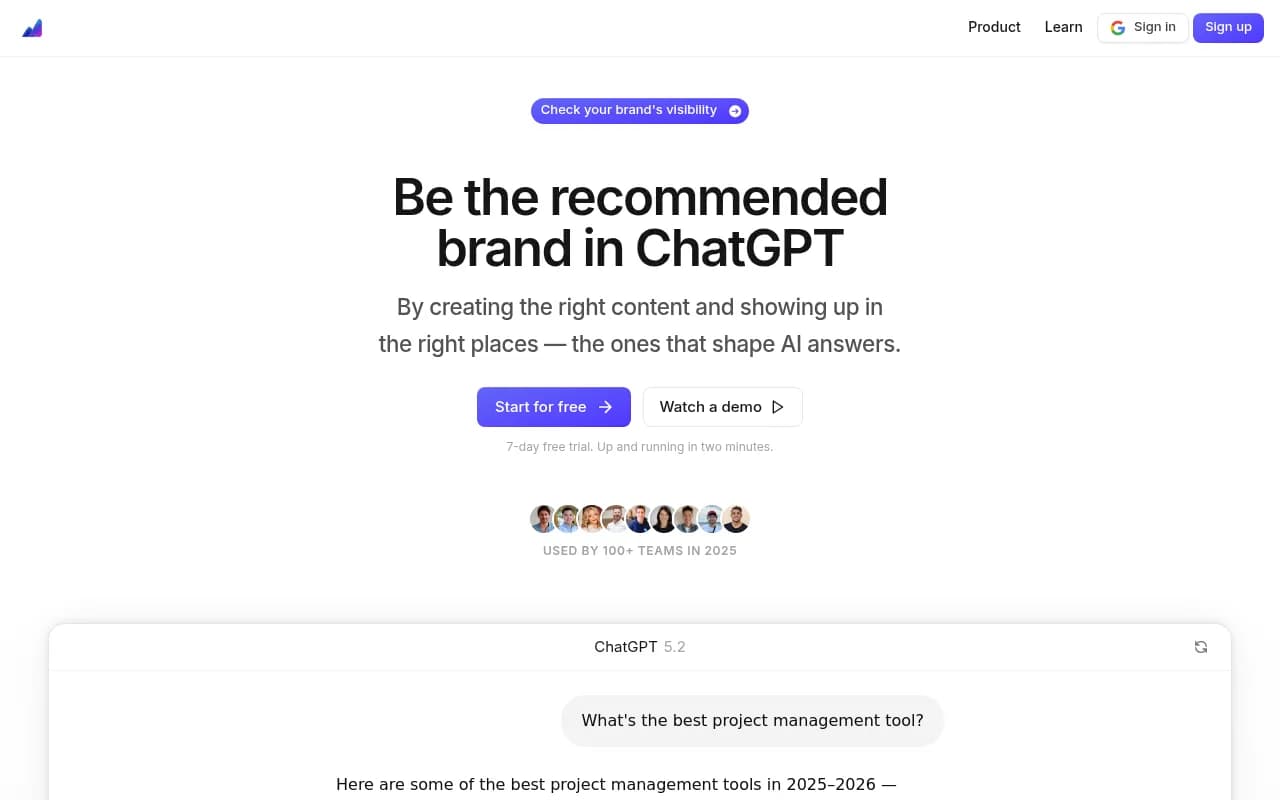
If you want a monitoring dashboard with strong enterprise reporting, Profound is a reasonable choice. If you want a platform that helps you find gaps, create content to fill them, and track whether it worked, Promptwatch is the more complete tool -- and at a lower price point for most tiers.
The honest version of this comparison: most AI visibility tools show you where you're losing. Promptwatch is one of the few that actually helps you stop losing.
Start with the free trial on either platform and run the same set of prompts through both. The difference in what you can do with the data will be obvious within the first week.