Key takeaways
- Profound's pricing (Starter at $99/month for ChatGPT only, Growth at $399/month) is hard to justify for most e-commerce teams when cheaper alternatives cover more AI engines
- E-commerce brands have specific needs that generic AI visibility tools miss: product-level tracking, ChatGPT Shopping carousels, category-level visibility, and SKU-specific citation data
- Most tools in this space are monitoring-only dashboards -- they show you where you're invisible but don't help you fix it
- The best alternatives for e-commerce in 2026 combine AI shopping tracking with content optimization, so you can close the gaps you find
- Promptwatch is the only platform in this comparison rated as a "Leader" across all categories in a 2026 review of 12 GEO tools, and it's one of the few that tracks ChatGPT Shopping alongside content gap analysis
Profound was an early mover in AI visibility tracking, and it deserves credit for that. But if you're running an e-commerce brand in 2026, you've probably noticed the same thing a lot of teams are noticing: the price climbs fast, the Starter plan only covers ChatGPT, and the platform tells you where you're invisible without giving you much to do about it.
Meanwhile, the category has exploded. There are now tools built specifically for product-level AI discovery, ChatGPT Shopping carousels, and the kind of category-level tracking that matters when someone asks "what's the best running shoe under $150" and your brand doesn't appear anywhere in the response.
This guide covers the best Profound alternatives for e-commerce brands in 2026 -- what each one actually does, where it falls short, and which use cases it fits best.
Why e-commerce brands need something different from standard AI visibility tools
Most AI visibility tools were built with B2B SaaS or publisher use cases in mind. They track brand mentions, citation counts, and share of voice across prompts like "what's the best project management tool" or "explain how X works."
That's useful. But e-commerce has a different problem.
When a shopper asks ChatGPT "what moisturizer should I buy for dry skin" or "best wireless headphones under $200," the AI doesn't just mention brands -- it often surfaces specific products, links to purchase pages, and in ChatGPT's case, displays a full shopping carousel with prices and images. That's a completely different visibility surface than a brand mention in a text response.
A few things e-commerce teams need that most tools don't cover well:
- Product-level tracking (not just brand-level)
- ChatGPT Shopping carousel monitoring
- Category and subcategory prompt coverage (not just branded queries)
- Competitor product comparisons inside AI responses
- Citation sources -- which review sites, Reddit threads, or YouTube videos are influencing AI recommendations for your category
If a tool can't tell you whether your specific SKUs are appearing in ChatGPT Shopping, or which competitor products are getting cited in "best of" responses, it's not really built for e-commerce.
The tools worth considering
Promptwatch -- best overall for e-commerce teams that want to act on data
Promptwatch is the platform I'd point most e-commerce teams toward first, and not just because it covers the most ground. The core difference from Profound and most other tools is that it's built around a loop: find gaps, create content, track results.

For e-commerce specifically, Promptwatch tracks ChatGPT Shopping carousels and entity mentions, which is rare. It also monitors 10 AI models (ChatGPT, Perplexity, Google AI Overviews, Google AI Mode, Claude, Gemini, Meta/Llama, DeepSeek, Grok, Mistral, Copilot) -- so you're not flying blind on any major platform.
The Answer Gap Analysis is where it gets genuinely useful for product discovery. It shows you the exact prompts your competitors appear in that you don't -- including category-level shopping queries. Then Content Agents help you generate the content that fills those gaps, grounded in real prompt data and citation analysis rather than generic SEO briefs.
The AI Crawler Logs are another feature most competitors skip entirely. You can see which pages AI crawlers are hitting, how often, and whether they're actually getting cited. For e-commerce brands with large catalogs, knowing which product pages are being read vs. ignored by AI crawlers is genuinely actionable.
Pricing starts at $99/month (Essential), $249/month (Professional), and $579/month (Business). Free trial available.
Profound -- the baseline you're moving away from
Worth understanding what you're comparing against.

Profound's strength is enterprise analytics depth. It has solid share-of-voice tracking, competitor benchmarking, and a reasonably clean interface. The agency mode is well-designed. But the pricing structure is the main friction point: the Starter plan at $99/month only tracks ChatGPT, and the Growth plan at $399/month is a significant jump. For e-commerce teams tracking dozens of product categories across multiple AI engines, the cost scales quickly.
The other issue is that Profound is primarily a monitoring tool. It shows you the data but doesn't have content generation or optimization built in. You're on your own to figure out what to do with what you find.
Ranketta -- best for product-level AI shopping tracking
Ranketta is purpose-built for e-commerce and D2C brands, and it's the most focused tool in this list on actual product discovery rather than brand-level visibility.
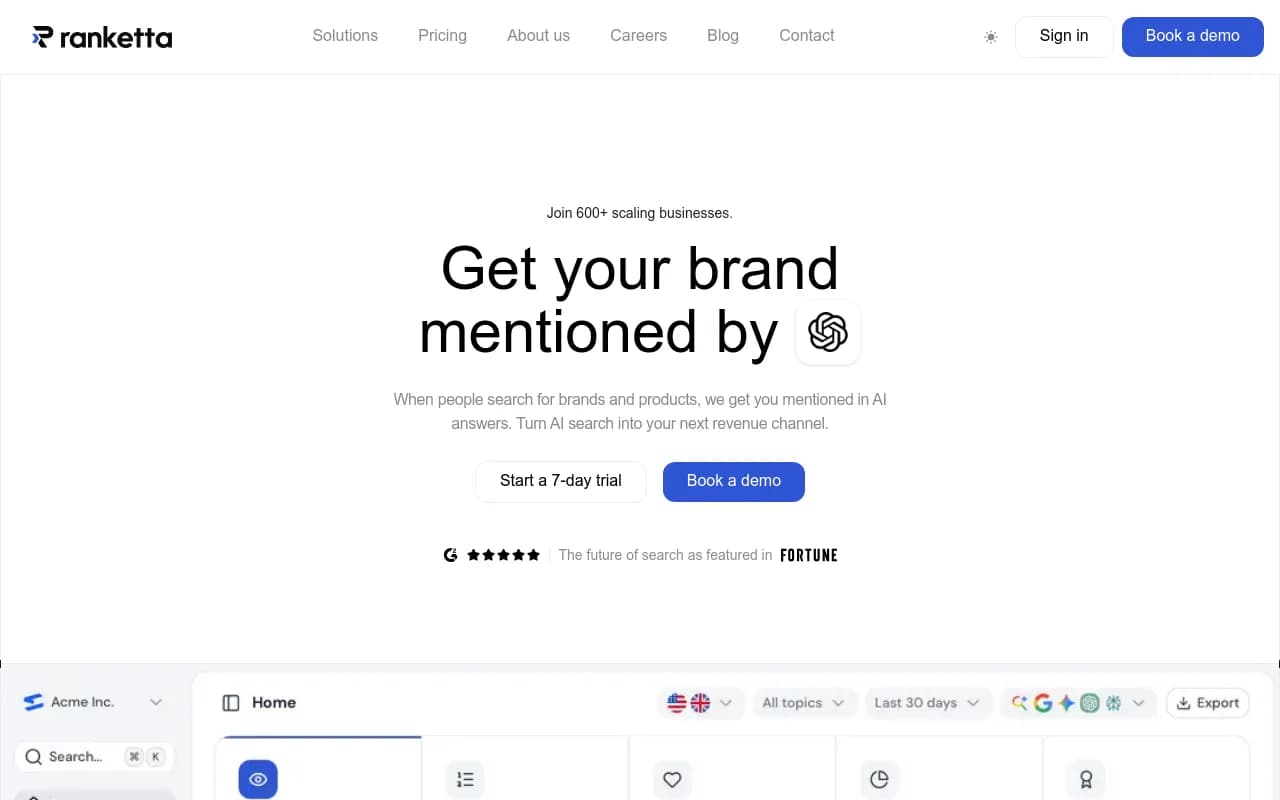
The standout feature is individual product tracking inside AI Shopping results. If you sell 50 SKUs, Ranketta can tell you which ones are appearing in ChatGPT Shopping, which are getting cited in Perplexity responses, and which competitor products are showing up instead of yours. That level of granularity is hard to find elsewhere.
AI engines covered on Starter and Pro plans: ChatGPT (including ChatGPT Shopping), Google AI Overviews, and Perplexity. Enterprise unlocks Gemini, Claude, Google AI Mode, and Microsoft Copilot. The 7-day free trial is a low-risk way to test it.
The limitation is that Ranketta is newer (founded 2025) and the content optimization side is less developed than Promptwatch. It's excellent for tracking but you'll need a separate workflow for acting on what you find.
Azoma -- best for brands selling through Amazon and retail AI
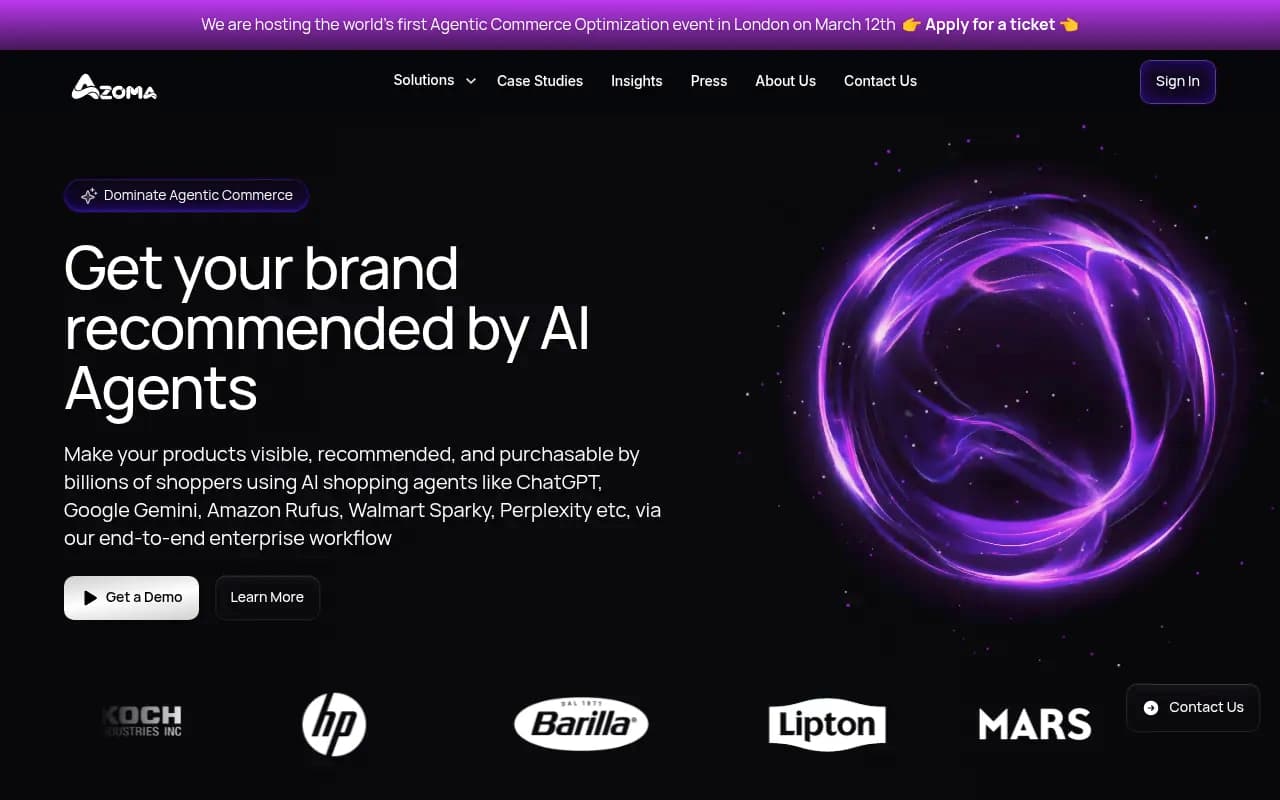
Azoma takes a different angle: it focuses on AI shopping agent visibility across platforms like ChatGPT, Amazon Rufus, and Google Shopping AI. If you're an e-commerce brand with significant Amazon presence, Azoma tracks how AI shopping agents surface your products when customers ask Rufus for recommendations.
This is a genuinely different use case from most tools here. Azoma isn't trying to be a general-purpose AI visibility platform -- it's specifically about the AI-mediated shopping journey across retail channels. Worth considering if Amazon is a major revenue channel.
AthenaHQ -- best for teams that want structured brand tracking

AthenaHQ covers 8+ AI search engines and has clean reporting for brand visibility tracking. It's a solid monitoring tool with good competitor benchmarking. The interface is well-designed and the data is reliable.
The gap for e-commerce teams is the same as Profound: it's monitoring-focused. There's no content generation, no ChatGPT Shopping tracking, and no Reddit/YouTube insights (which matter a lot for e-commerce categories where review content heavily influences AI recommendations). It's a good fit if you need clean dashboards for reporting to stakeholders but want to handle optimization separately.
Semrush -- best if you're already in the Semrush ecosystem
Semrush added AI visibility tracking to its platform, and if you're already paying for Semrush, it's worth exploring before adding another tool. The AI Visibility Toolkit connects your existing keyword and competitor data with AI search monitoring.
The honest limitation: Semrush uses fixed prompts for AI tracking rather than dynamic prompt discovery. For e-commerce brands with diverse product categories, fixed prompts mean you're only seeing visibility for the queries Semrush decided to track, not the full range of shopping queries your customers are actually using. It's a decent starting point but not a replacement for a dedicated AI visibility tool.
Otterly.AI -- best for budget-conscious teams starting out

Otterly.AI is the most affordable serious option in this space. It tracks brand citations across ChatGPT, Perplexity, Google AI Overviews, AI Mode, Gemini, and Microsoft Copilot. The interface is clean and setup is fast.
For e-commerce teams just starting to track AI visibility, Otterly is a reasonable entry point. It won't give you product-level tracking or ChatGPT Shopping data, and there's no content optimization built in. But if you want to understand whether your brand is appearing in AI responses at all before committing to a more expensive platform, Otterly is a sensible first step.
Scrunch AI -- best for understanding how AI crawlers see your site
Scrunch AI focuses on the technical side of AI visibility: how AI crawlers read and interpret your website. It's particularly useful for e-commerce brands with complex site structures, where product pages, category pages, and faceted navigation can confuse AI crawlers.
If your products aren't appearing in AI responses despite being well-known, the problem might be crawlability rather than content. Scrunch helps diagnose that. It's more of a technical complement to a visibility tracking tool than a standalone solution.
Peec AI -- best for multi-language e-commerce

Peec AI has strong multi-language support, which matters if you're an e-commerce brand operating across European or global markets. It tracks AI visibility in multiple languages and regions, which most tools handle poorly or not at all.
The feature set is monitoring-focused (no content generation), but the language coverage is genuinely better than most competitors. If you're tracking AI visibility in German, French, Spanish, or other languages, Peec AI is worth evaluating.
Feature comparison
| Tool | ChatGPT Shopping | Product-level tracking | Content generation | AI engines covered | Starting price |
|---|---|---|---|---|---|
| Promptwatch | Yes | Brand + entity | Yes (Content Agents) | 10 | $99/mo |
| Profound | Partial | Brand-level | No | 5+ | $99/mo (ChatGPT only) |
| Ranketta | Yes | Individual SKUs | Limited | 3-7 | Custom (trial available) |
| Azoma | Yes (retail AI) | Product-level | No | ChatGPT, Rufus, Google | Enterprise |
| AthenaHQ | No | Brand-level | No | 8+ | Custom |
| Semrush | No | Brand-level | Via ContentShake | Multiple | Bundled |
| Otterly.AI | No | Brand-level | No | 6 | ~$19/mo |
| Scrunch AI | No | Technical/crawl | No | Multiple | Custom |
| Peec AI | No | Brand-level | No | Multiple | Custom |
What the research says about this market
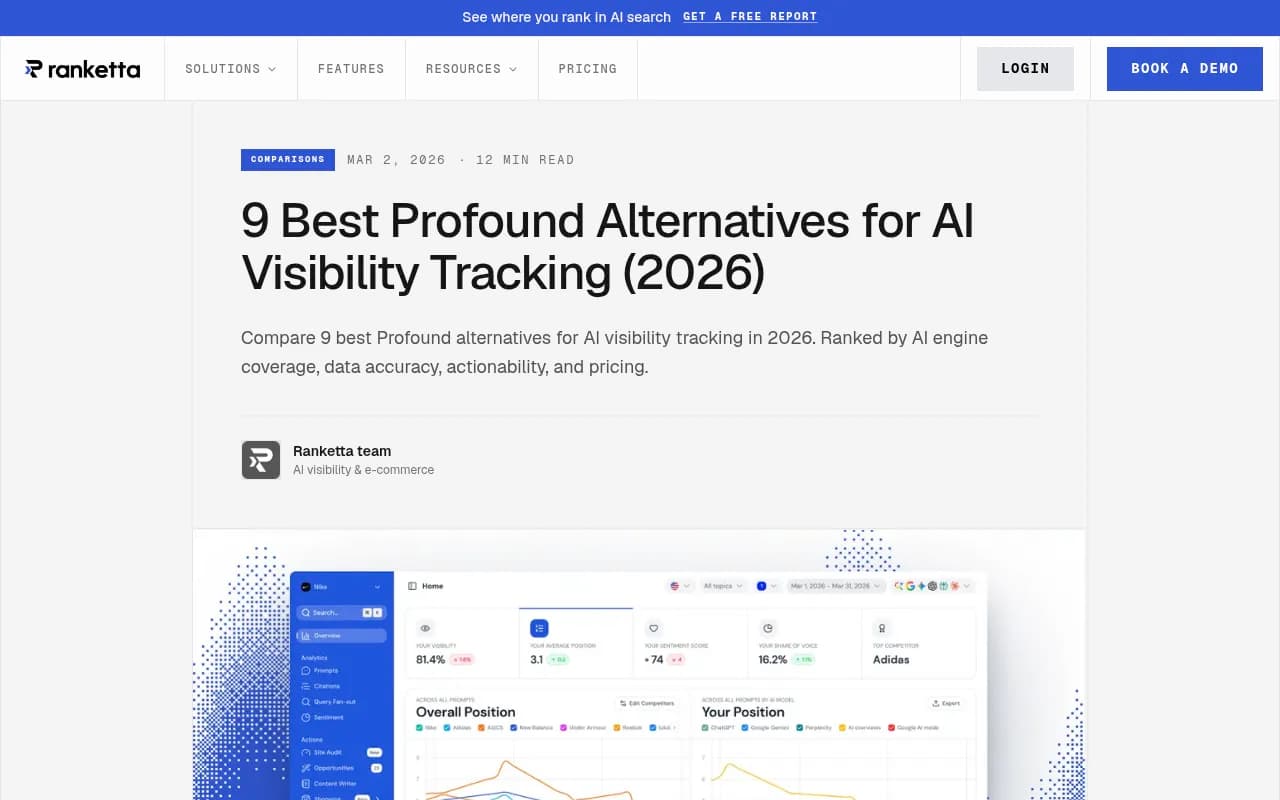
The research from multiple 2026 comparisons points to the same pattern: the tools that launched as "monitoring dashboards" are struggling to differentiate as the category matures. Profound, AthenaHQ, and Peec AI all have solid tracking but limited action layers. The tools gaining ground are the ones that close the loop between finding a gap and fixing it.
For e-commerce specifically, the ChatGPT Shopping surface is becoming a genuine revenue channel. Generative AI traffic to retail sites is up significantly year-over-year, and AI-driven shoppers convert at roughly 4x the rate of traditional search visitors (around 12% vs 3%). That conversion rate difference means AI visibility isn't just a branding metric anymore -- it's directly tied to revenue.
The implication: if your AI visibility tool can't tell you whether your products are appearing in ChatGPT Shopping carousels, you're missing the highest-intent surface in the channel.
How to choose the right tool for your situation
A few questions worth answering before you commit:
Do you sell through Amazon or major retail channels? If yes, Azoma is worth evaluating alongside a general-purpose tool. The retail AI shopping agent tracking is unique.
Do you have a large product catalog? Product-level tracking matters more as your catalog grows. Ranketta is the most granular option here. Promptwatch's entity tracking and ChatGPT Shopping monitoring also help at scale.
Do you need to act on what you find, not just monitor? If your team needs to produce content to close visibility gaps, you need a tool with content generation built in. Promptwatch is the clearest option here. Most others will leave you with data and no workflow for using it.
Are you operating in multiple languages? Peec AI has the best multi-language support. Promptwatch also supports multi-language and multi-region monitoring.
What's your budget? Otterly.AI is the entry point. Promptwatch's Essential plan at $99/month covers one site with 50 prompts and 5 articles -- comparable to Profound's Starter but with more AI engines and content generation included. Profound's Growth plan at $399/month is hard to justify unless you specifically need its enterprise reporting features.
Are you already in a major SEO platform? If you're a heavy Semrush user, start with their AI toolkit before adding another subscription. The fixed-prompt limitation is real but the integration value is also real.
The honest summary
Profound is a well-built tool that made sense when AI visibility tracking was new and options were limited. In 2026, the category has matured enough that the monitoring-only approach is a real constraint, especially for e-commerce teams who need to track product discovery, not just brand mentions.
For most e-commerce brands, Promptwatch covers the most ground: 10 AI engines, ChatGPT Shopping tracking, content gap analysis, and content generation in one platform. Ranketta is the better choice if product-level SKU tracking is your primary need. Azoma is worth adding if Amazon Rufus is a significant channel for you.
The tools that just show you a dashboard and leave you to figure out the rest are going to get harder to justify as the platforms that close the loop get better. That's the direction this market is moving.