
Key takeaways
- All three products bolt AEO (answer engine optimization) tracking onto an SEO suite. None of them writes and publishes fixes for you; they report, and your team acts.
- They sell in different units. Semrush charges per prompt and per domain, Ahrefs sells check packs and per-index access, SE Ranking bundles prompts into plan tiers. Normalize to one workload before you compare sticker prices.
- Ahrefs Brand Radar has the widest engine and prompt-index coverage, but full coverage pushes the realistic all-in bill past $800/mo. SE Ranking is the cheapest way to get daily rank tracking, audits and AI tracking in one login. Semrush One is the safest default if your team already lives in Semrush.
- Claude coverage is patchy across all three: Ahrefs has it for custom prompts only, Semrush on Enterprise only, and SE Visible lists it as coming soon.
- Prices and plan packaging in this category move constantly. Treat every number below as a November 2026 snapshot and confirm on the vendor page.
Why SEO teams are comparing these three
Most SEO teams in 2026 already pay for one of Semrush, Ahrefs or SE Ranking. When AI answers started eating clicks, all three shipped some form of AI visibility tracking, and the question became whether to extend the suite you have or buy a dedicated platform.
That is a reasonable first move. Extending a suite you already pay for is usually cheaper than adding a new vendor, and your team already knows the interface. But the three products are not interchangeable, and the pricing models are different enough that a quick glance at the entry price will mislead you.
One caveat before we start. The research behind this guide comes from vendor pages and third-party reviews, several of them published by competing AEO vendors. Where two sources disagree, I say so rather than pick a winner.
The quick comparison
| Semrush One / AI Visibility Toolkit | SE Ranking (SE Visible / AI Search add-on) | Ahrefs Brand Radar | |
|---|---|---|---|
| Entry AI price | $99/mo per domain (25 prompts, 1 user); Semrush One from $199/mo | SE Visible roughly $89 to $99/mo depending on source; AI Search add-on from about $71/mo | From $199/mo per AI index; $699/mo for all indexes |
| Pricing unit | Prompts, domains and users | Prompts per plan | Prompt index access plus check packs |
| Engines | AI Overviews, AI Mode, ChatGPT, Perplexity, Gemini | ChatGPT, Perplexity, AI Overviews, AI Mode (Gemini on some tiers) | AI Overviews, AI Mode, ChatGPT, Perplexity, Gemini, Copilot |
| Claude | Enterprise AIO plan only | Listed as coming soon | Custom prompts only, 8 checks per update |
| Recommendations / execution | Data only | Data only | Data only |
| Best fit | Existing Semrush teams | Agencies and SMBs on a budget | Authority-led SEO teams on Ahrefs |
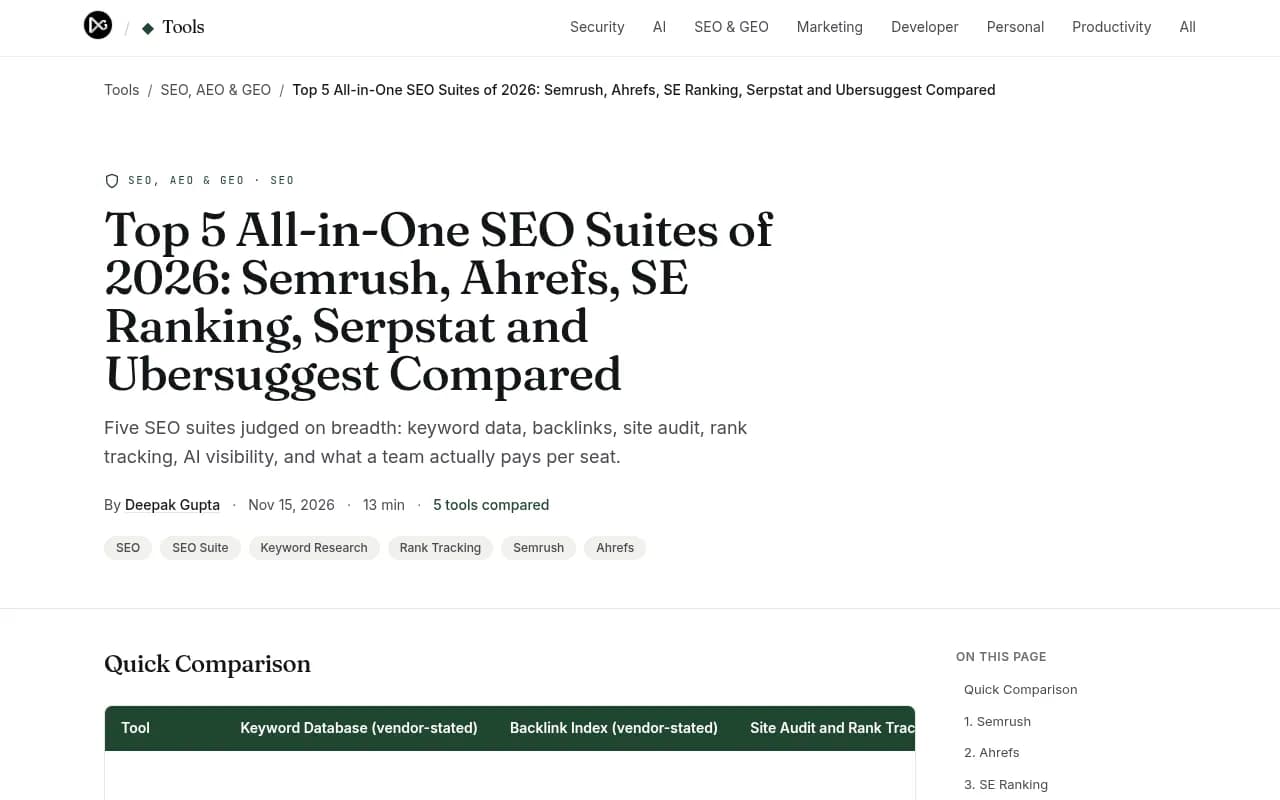
The suite-level comparison above, from Deepak Gupta's November 2026 review, is useful context: AI visibility is only one slice of what you are paying for.
Semrush One
Semrush is the broadest suite of the three. Its own data page lists 28.8 billion keywords across 142 geographic databases and more than 43 trillion backlinks. Adobe completed its acquisition of Semrush on April 28, 2026, and Semrush says existing contracts are not changing immediately. Packaging may shift under Adobe, so check the pricing page before you commit to a long term.
How the AEO side is packaged
The AI Visibility Toolkit costs $99/mo per domain and covers 1 domain, 1 user and 25 prompts. Extra prompts cost $60/mo per 50, and each extra domain or user license is $99. There is no free trial. Semrush One, which bundles SEO and AI search, starts at $199/mo.
The toolkit is sold standalone, so you do not need the $139.95 SEO plan to buy it. That plan, by the way, has no AI visibility features of its own in at least one third-party read, while Gupta's suite review says AI search tracking is on every paid plan (50 prompts daily on Starter, 100 on Pro+). The two descriptions conflict, which tells you how much the packaging changes. Read the November 2026 price page line by line.
Where it works
- One login and one contract for keyword research, audits, position tracking and AI visibility.
- Sentiment reporting that covers more than 68,000 location and language combinations.
- Existing customers pay the same $99 as new ones, so there is no loyalty discount but also no surprise.
- A Semrush MCP server and white-label reporting on the broader suite.
Where it hurts
- 25 prompts is a small question set. Geoptie estimated a workload of 100 prompts per day at about $219 for one brand and $657 for three brands.
- Add-ons are per seat and per domain, so cost compounds fast on agency accounts.
- Mavlers calls its citation depth weaker than purpose-built trackers, and I think that is fair. It is a research layer, not a system of record for AI citations.
- Claude is Enterprise only.
SE Ranking and SE Visible
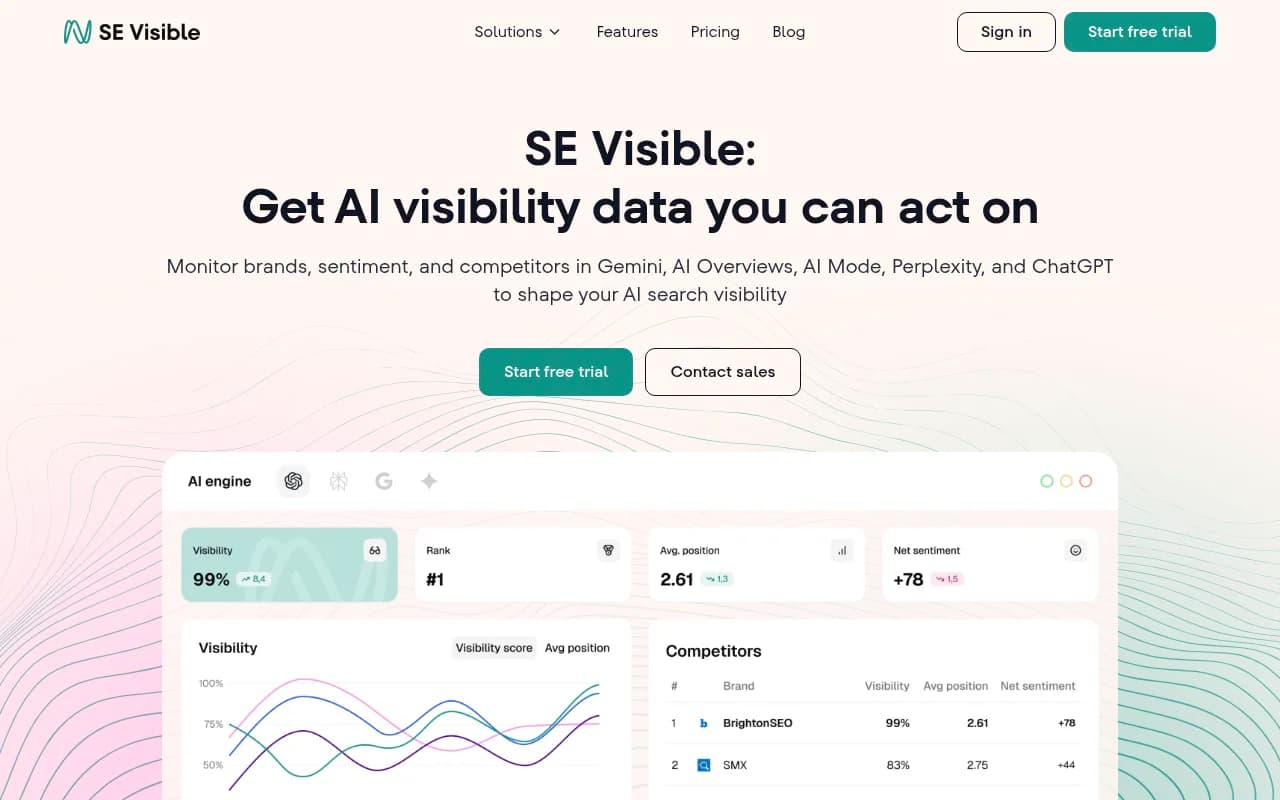
SE Ranking is the value pick. Its Core plan is $129/mo, or $103.20 a month billed annually, and includes 2,000 keywords tracked daily, 250,000 audit pages a month and 25 AI prompts daily across five LLMs. Growth at $279/mo includes three manager seats, and extra seats start at $16. Its keyword and backlink databases are smaller than Semrush's and Ahrefs' (2.9 trillion backlinks, 428 million domains).
The pricing disagreement
SE Visible is also sold as a standalone product, and the sources do not agree on what it costs. SolCrys lists Basic at $99 for 200 prompts, Core at $189 and Plus at $355, with a 10-day trial. Geoptie lists it from $89/mo for 75 prompts. Maya describes an AI Search add-on at $89 for 200 prompts, and Mavlers quotes $71.20/mo. Those can all be true on different dates or billing terms, but I would not budget from any of them. Open the vendor page.
Where it works
- Prompts per dollar. At the $99 tier, 200 prompts beats what Semrush gives you for the same money.
- Agency economics: multiple projects, white-label reports on the main SEO product, and a 14-day free trial on the suite.
- Rated 4.8/5 on G2 across 1,400+ reviews, according to Mavlers.
Where it hurts
- Four or five engines, and no Claude, Copilot or Grok.
- SolCrys notes that white-label reporting is not yet available for SE Visible itself, though SolCrys is a competitor so verify that claim.
- Power users hit depth ceilings on dataset size and refresh cadence.
- Seats are limited: one manager on Core, three on Growth.
Ahrefs Brand Radar
Brand Radar is the odd one out because it works from a large pre-built prompt index rather than only your own tracked prompts. Sources quote the index at roughly 481 million to 578 million prompts, and Mavlers cites a 199M+ database figure; the number depends on when and how it is counted. What matters is that you can look up any brand, including a competitor, and get AI share of voice immediately.
How it is priced
The AI Visibility Index starts at $199/mo per platform index, or $699/mo for all of them, covering AI Overviews, AI Mode, ChatGPT, Perplexity, Gemini and Copilot. Custom prompt tracking is a separate meter:
| Check pack | Price |
|---|---|
| 2,500 checks | $50 |
| 7,000 checks | $100 |
| 25,000 checks | $250 |
Overage runs $0.010 to $0.020 per check. Claude costs 8 checks per update, which is why including it raises a bill so sharply. Geoptie estimated 100 prompts/day on four engines at about $175 for one brand and $360 for three; with Claude it becomes $330 and $990.
A small allowance is included on paid Ahrefs plans (Lite $129, Standard $249, Advanced $449). Ahrefs Brand Radar is effectively cheaper for existing Ahrefs customers, since the base subscription is a cost you already carry. A Reddit thread on SE Visible versus Brand Radar claims full add-on setups can exceed $800 to $1,000 a month. That is anecdotal, but it matches Maya's math of $828 to $1,148/mo all-in for new customers.
Where it works
- The broadest engine and prompt coverage here, plus social surfaces such as YouTube, TikTok and Reddit.
- You can cross-reference AI visibility with backlink profiles, keyword rankings and content data inside one product.
- API and MCP access to Brand Radar data.
Where it hurts
- No recommendations or action items. It is an observation tool.
- Mavlers says testers flagged accuracy gaps in mention counts, so cross-check numbers before they go into a client deck.
- Full coverage is the most expensive option of the three.
Normalizing the cost
The single biggest trap is comparing three different pricing units. Semrush sells prompts per domain, Ahrefs sells checks, SE Ranking sells prompts per plan. Before you shortlist, write down your real workload: how many brands, how many prompts, how many engines, how many seats.
Here is what the Geoptie-style workload math looks like for 100 prompts a day:
| Scenario | Semrush | Ahrefs (4 engines) | SE Ranking |
|---|---|---|---|
| 1 brand | About $219/mo | About $175/mo (plus base plan) | Core plus add-on, roughly $200 to $230 |
| 3 brands | About $657/mo | About $360/mo (plus base plan) | About $399/mo on an agency-style plan |
Treat those as ballpark. The Geoptie numbers are from a vendor of a competing budget toolkit, and the SE Ranking row is my rough sum of published list prices rather than a quote.
What none of the three does
All three answer the question "Are we mentioned?" reasonably well. None of them answers "What do we do about it?" in a structured way.
- No AI crawler logs, so you cannot tell whether GPTBot or ClaudeBot can actually read your pages.
- No AI traffic attribution to conversions.
- No content agents that write and publish pages AI engines cite.
- Fixed or capped prompt sets, which matters because ChatGPT has few citation slots (about five sources per web-search answer, per Promptwatch's sources-per-response data) and tracking has to be prompt-specific.
Citation share is also very fragmented. In Promptwatch's ChatGPT citation share data for November 1 to 25, 2026, the top 20 popular sites together earned under 2% of citations, with the rest spread across hundreds of thousands of domains. A tool that only tells you about a handful of big domains is not telling you much. You need prompt-level tracking and a way to see which of your own pages get cited.
If your team wants the loop closed, a platform like Promptwatch covers the monitoring plus the part the suites skip: IP-verified AI crawler logs, visitor analytics for AI-referred traffic, and a Content Agent that writes and publishes pages to WordPress, Webflow or Framer. Its prompt tracking runs against the real interfaces of ChatGPT, AI Overviews, AI Mode, Gemini, Perplexity and Copilot rather than only APIs. Paid plans start at $95/mo for Essential, with the Content Agent arriving on Business ($579/mo); confirm on promptwatch.com/pricing.

The honest framing: it is a different category of product, not a drop-in replacement for the SEO suite. Many teams run both, which is what SolCrys's FAQ also notes for AEO platforms in general.
Which one should you pick
Pick Semrush One if
- Your team already runs keyword research, audits and position tracking in Semrush.
- You want a single vendor and are comfortable with a small, curated prompt set.
- You track one or two domains and few seats.
Pick SE Ranking if
- You are an agency or small team whose daily work is audits and rank tracking.
- Prompts per dollar matters more to you than engine breadth.
- You can live without Claude, Copilot and Grok for now.
Pick Ahrefs Brand Radar if
- Backlinks and authority are the core of your SEO program and you already pay for Ahrefs.
- You want competitor AI visibility on demand across the widest index.
- You have budget for per-index pricing and will verify the numbers before reporting them.
Consider a dedicated AEO platform if
- AI search is a headline channel, not a side metric.
- You need crawler logs, AI traffic attribution or automated content.
- You manage many brands and the per-domain add-ons would compound.
There are plenty of other options; the GEO software directory at bestgeosoftware.com lists dozens, and Peec AI, Otterly.AI and Profound come up most often as dedicated alternatives.


A practical way to test
- List 50 to 100 prompts your buyers actually use, grouped by topic and by funnel stage.
- Check the engines each vendor covers against where your audience actually asks. If Claude matters, rule out two of the three immediately.
- Run the same workload through each trial. Semrush has no free trial, SE Ranking has 10 to 14 days depending on the product, so negotiate or use a month-to-month plan.
- Compare mention counts across tools for the same prompts. If they diverge sharply, find out why before trusting either.
- Price the real seat and domain count, not the entry tier.
- Check how the data reaches your reporting: API, MCP, exports or white-label PDFs.
Bottom line
Semrush One is the convenient default, SE Ranking is the budget pick with the best prompts per dollar, and Ahrefs Brand Radar is the research powerhouse with the highest all-in cost. All three are monitoring products. If the question your boss asks is "how do we get cited more," budget separately for whatever turns the data into published pages.
FAQ
Is Semrush One cheaper than buying the AI Visibility Toolkit alone?
Semrush One starts at $199/mo and bundles SEO and AI search. The toolkit alone is $99/mo per domain. If you need both SEO tools and AI tracking, the bundle is usually the better deal; if you only need AI tracking, the standalone toolkit is cheaper.
Does Ahrefs Brand Radar track Claude?
Only for custom prompts, and each Claude update costs 8 checks, so it raises your bill quickly. The standard index covers AI Overviews, AI Mode, ChatGPT, Perplexity, Gemini and Copilot.
Which tool is best for agencies?
SE Ranking, on price and multi-project structure. Semrush works if you accept per-domain add-ons, and Ahrefs suits agencies already built around its link data.
Can I run an AEO platform next to my SEO suite?
Yes, and most teams do. The suite handles keywords, links and audits, while a dedicated AEO platform measures mentions, citations and crawler activity.
How current are the prices here?
They reflect vendor and third-party pages read in November 2026. Semrush's packaging may change further under Adobe, so confirm before buying.