Key takeaways
- Most GEO/AEO platforms are monitoring dashboards first -- integrations are often an afterthought, which creates real friction when you need to connect data to your existing stack.
- Platforms built on top of established SEO tools (Semrush, Ahrefs, SE Ranking) have a natural integration advantage because they inherit years of connector work.
- For teams that need to close the loop between AI visibility and revenue, traffic attribution integrations (GSC, GA4, server logs) matter more than social or CRM connections.
- A handful of platforms -- including Promptwatch -- go beyond monitoring and offer content generation plus attribution, which changes what "integration" even means for your workflow.
- If your stack is heavily agency-oriented or built around Looker Studio, API access and white-label export capabilities should be a primary filter when choosing a platform.
The GEO platform market has exploded. There are now well over a dozen tools claiming to track your brand's visibility in ChatGPT, Perplexity, Gemini, and the rest. Most of them do a reasonable job of showing you a dashboard.
But here's the question nobody asks until it's too late: does this tool actually connect to anything else I use?
Integrations sound boring. They're not. A GEO platform that lives in isolation -- that you have to log into separately, manually export CSVs from, and reconcile against your GA4 data by hand -- is a platform you'll stop using within three months. The tools that stick are the ones that plug into Looker Studio, push alerts to Slack, sync with Google Search Console, or at minimum offer an API you can build on.
This guide breaks down how the major GEO platforms handle integrations in 2026, what categories of connection actually matter, and which platforms are worth your time if you care about workflow fit.
Why integrations matter more than they used to
A year ago, most marketing teams were just trying to figure out whether AI search was real. Now it's real, and the question has shifted: how do I operationalize this?
That means connecting AI visibility data to the tools where decisions get made. Your SEO team lives in Google Search Console. Your analytics team lives in Looker Studio or Tableau. Your content team works in a CMS. Your agency clients want white-labeled reports, not another login.
If your GEO platform can't talk to any of those systems, you've got a data silo. And data silos don't change behavior -- they just create more meetings.
There are roughly five categories of integration that matter for GEO platforms:
- Analytics and attribution -- connecting AI visibility to actual traffic and revenue (GSC, GA4, server logs)
- Reporting and BI -- pushing data into dashboards your stakeholders already use (Looker Studio, Data Studio, Tableau)
- Workflow and automation -- triggering actions based on visibility changes (Slack alerts, Zapier, n8n)
- SEO ecosystem -- living alongside or inside your existing SEO tools (Semrush, Ahrefs, SE Ranking)
- Content and CMS -- connecting visibility gaps to content creation and publishing workflows
Let's look at how the main platforms stack up across these.
The integration landscape by platform
Platforms built inside existing SEO tools
The easiest integration story belongs to platforms that are extensions of tools you already use.
Semrush added AI visibility tracking to its existing suite, which means if you're already a Semrush customer, your GEO data lives alongside your keyword rankings, backlink data, and site audits. That's genuinely useful -- you don't need to reconcile two separate datasets. The catch is that Semrush's AI tracking uses fixed prompts, which limits how customizable your monitoring can be.
Ahrefs Brand Radar follows a similar logic. If your team already runs Ahrefs for backlinks and keyword research, having brand monitoring in the same interface reduces friction. But like Semrush, it uses fixed prompts and lacks AI traffic attribution -- so you can see where you appear in AI responses, but you can't connect that to actual clicks or revenue.
SE Ranking has built out an AI visibility toolkit that sits inside its broader SEO platform. For smaller teams that want one tool for everything, this is a reasonable option.
The pattern here: if you're already paying for one of these platforms, the GEO features are worth exploring. If you're not, they're not a strong enough reason to switch your entire SEO stack.
Platforms with native analytics integrations
This is where things get more interesting for teams that care about attribution.
Bluefish has made GA4 and Slack integrations a core part of its pitch. If you need AI visibility data to flow automatically into your analytics setup and alert your team when something changes, that's a real differentiator. The platform targets enterprise and Fortune 500 brands, so the integration depth reflects that audience.
Promptwatch takes a different approach to attribution. Rather than just pushing data to GA4, it offers three methods for connecting AI visibility to actual revenue: a JavaScript snippet you add to your site, Google Search Console integration, and server log analysis. The idea is to close the loop -- not just show you that Perplexity cited your page, but show you whether that citation drove a visit and what happened after.

That server log approach is worth pausing on. Most platforms can tell you which AI crawlers visited your site in theory. Promptwatch's AI Crawler Logs feature shows you in real time which pages ChatGPT, Claude, Perplexity, and others are actually reading, how often they return, and what errors they encounter. That's the kind of data that lives in your server logs, not in a third-party dashboard -- and having it surfaced automatically changes how you think about technical optimization for AI.
For agencies and teams that report in Looker Studio, Promptwatch also offers a Looker Studio integration and an API, which means you can build AI visibility into client dashboards without asking clients to log into yet another tool.
Platforms with workflow automation
A few platforms have started thinking about GEO data as a trigger for action, not just a reporting metric.
Zapier and n8n aren't GEO platforms themselves, but they're worth mentioning here because several GEO tools expose webhooks or API endpoints that let you build automations on top of them. If a competitor's AI visibility score spikes, you could trigger a Slack message, create a task in Asana, or kick off a content brief in your CMS.
AthenaHQ has taken an interesting angle by integrating LinkedIn outreach into its platform. The idea is that if AI models are citing certain sources, you can reach out to those source authors directly. It's a niche use case, but it shows how some platforms are thinking about GEO data as an input to broader marketing workflows, not just a reporting endpoint.

Profound is another platform with solid monitoring depth. It's strong on tracking and competitive analysis, but like most dedicated GEO tools, its integration story is primarily API-based rather than native connectors.

Platforms with content workflow integrations
This is the category most GEO platforms ignore entirely, and it's arguably the most important one.
Knowing you're invisible in AI search is only useful if you can do something about it. The platforms that connect visibility gaps to content creation -- and then track whether that new content gets cited -- are operating at a different level than pure monitoring tools.
Promptwatch's built-in AI writing agent generates articles, listicles, and comparisons based on real citation data. The content isn't generic -- it's grounded in which prompts competitors are winning, what topics AI models want answers to, and what's missing from your site. That output can then be tracked at the page level to see whether the new content starts getting cited. It's a workflow loop, not just a feature.
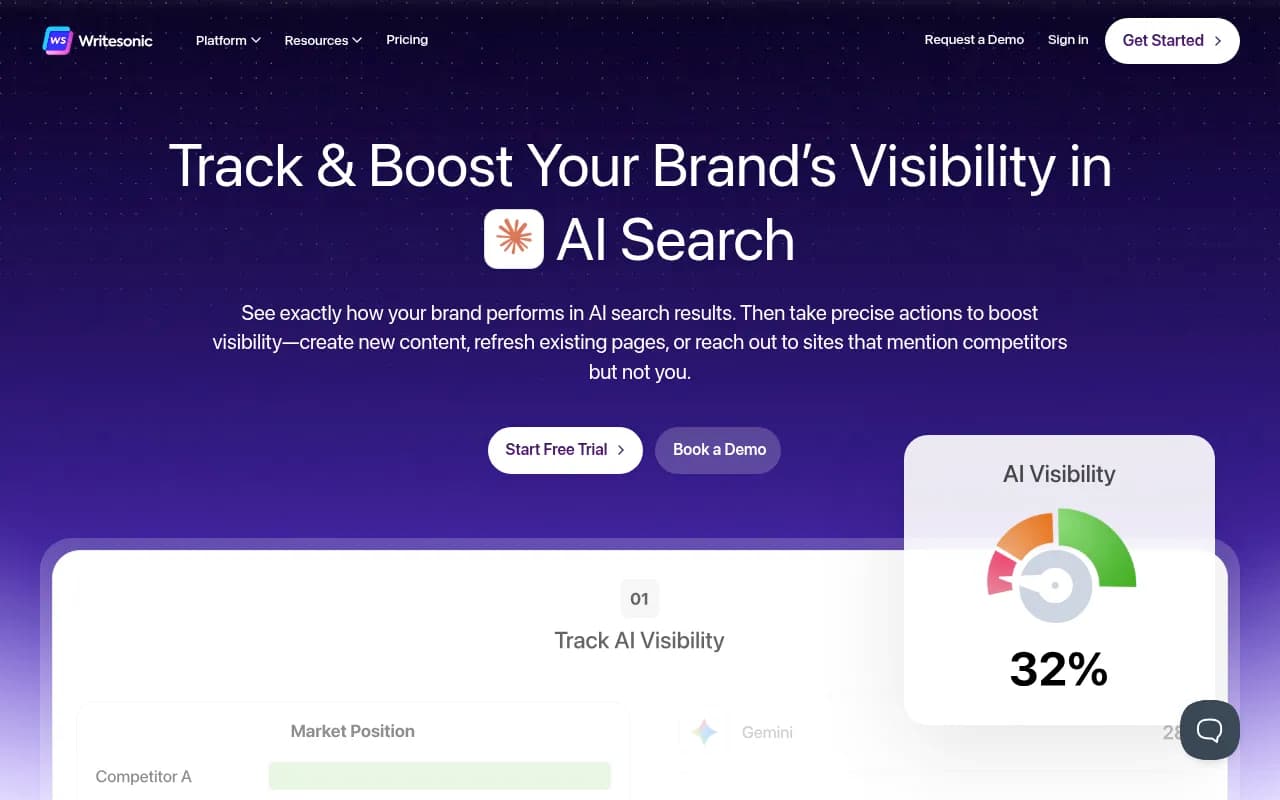
For teams that want content generation but prefer to keep their existing CMS workflow, Writesonic offers GEO features integrated into its broader writing platform. If you're already using Writesonic for content, the GEO visibility layer is a natural add-on.
Scrunch AI focuses on monitoring and has some content recommendation features, though it's primarily a tracking tool rather than a content generation platform.
Integration comparison table
Here's a direct comparison of how major GEO platforms handle the five integration categories:
| Platform | GSC / GA4 | Looker Studio / BI | Slack / Alerts | API access | Content generation |
|---|---|---|---|---|---|
| Promptwatch | Yes (GSC + server logs) | Yes (Looker Studio) | Via API/webhook | Yes | Yes (built-in AI writer) |
| Semrush | Partial (within Semrush) | Via Semrush exports | No native | Limited | Via ContentShake |
| Ahrefs Brand Radar | No | No | No | Limited | No |
| Bluefish | Yes (GA4) | No | Yes (Slack) | Yes | No |
| AthenaHQ | No | No | No | Yes | No |
| Profound | No | No | No | Yes | No |
| SE Ranking | Partial | Via SE Ranking | No | Yes | No |
| Otterly.AI | No | No | No | Limited | No |
| Peec AI | No | No | No | Yes | No |
| Scrunch AI | No | No | No | Yes | No |
A few things stand out from this table. First, most platforms have no native analytics integration -- they're dashboards that you check manually. Second, content generation is rare. Third, the platforms that do offer API access vary significantly in what that API actually exposes.
What "API access" actually means in practice
Almost every GEO platform claims to have an API. What that means varies a lot.
Some APIs let you pull your visibility scores and citation counts into a spreadsheet or BI tool. That's useful for reporting but doesn't enable much automation.
A more capable API lets you query prompt results programmatically, trigger monitoring runs, pull citation source data, and push that data into custom workflows. If you're an agency building client dashboards, or a larger brand that wants to integrate AI visibility into a broader data warehouse, you need the latter.
Promptwatch's API falls into the more capable category -- it's designed for teams that want to build on top of the data, not just export it. Combined with the Looker Studio integration, it covers most agency reporting needs without requiring custom engineering work.
For teams that want to go further with automation, pairing any GEO platform's API with a workflow tool like n8n or Make can unlock a lot. You can build flows that alert your content team when a competitor gains visibility for a high-value prompt, or automatically create content briefs when the Answer Gap Analysis surfaces a new opportunity.
Choosing based on your stack
The right integration story depends on what you're already using. Here's a practical breakdown:
If your team lives in Google's ecosystem
GSC integration and Looker Studio compatibility should be your primary filters. Promptwatch covers both. SE Ranking has partial GSC integration. Most other dedicated GEO platforms don't touch either.
If you're an agency managing multiple clients
You need white-label reporting, multi-site management, and ideally an API or Looker Studio connector so you can build client dashboards without giving everyone a separate login. Promptwatch's agency tier is built for this. Search Party is another option worth evaluating for agency workflows.
If you're already deep in the Semrush or Ahrefs ecosystem
Start with the native AI visibility features in your existing tool. They're not the most powerful GEO platforms available, but the integration overhead is zero. If you outgrow them -- which you likely will if AI search becomes a significant channel -- then evaluate dedicated platforms.
If content production is your bottleneck
A monitoring-only tool won't solve your problem. You need a platform that connects visibility gaps to content creation. Promptwatch's Answer Gap Analysis plus built-in AI writer is the most complete version of this workflow currently available. Writesonic's GEO features are worth considering if you're already in that ecosystem.
If you need real-time alerts
Bluefish's Slack integration is the most mature native alerting setup among dedicated GEO platforms. For other platforms, you can approximate this with API polling and a Zapier or n8n workflow, but it requires more setup.
The crawler log angle most teams miss
One integration category that almost nobody talks about: AI crawler logs.
When ChatGPT or Perplexity crawls your site, that shows up in your server logs. Most teams never look at those logs for AI-specific signals -- they're focused on Googlebot. But understanding which pages AI crawlers are reading (and which they're ignoring, or hitting errors on) is foundational to technical GEO optimization.
Promptwatch surfaces this automatically. You can see in real time which AI crawlers visited your site, which pages they read, how often they return, and what errors they encountered. That data connects directly to your content and technical SEO workflows in a way that pure visibility monitoring can't.
Most GEO platforms -- including Otterly.AI, Peec.ai, AthenaHQ, and Search Party -- don't offer this at all. It's one of the more meaningful capability gaps in the market right now.


Bottom line
The GEO platform market is maturing fast, but integrations are still an afterthought for most tools. The majority of platforms are dashboards you check manually, with limited ability to connect AI visibility data to the systems where your team actually works.
If integrations matter to your workflow -- and for most teams beyond the "just curious" stage, they should -- the shortlist gets short quickly. Platforms built inside existing SEO tools (Semrush, Ahrefs) offer the easiest integration story but the least powerful GEO features. Dedicated platforms with strong API access and attribution (Promptwatch, Bluefish) offer more capability but require more intentional setup.
The question to ask before you commit to any platform: "Where does this data need to go, and can this tool get it there?" If the answer is a shrug, keep looking.