Key takeaways
- Most AI visibility tools are still trackers. Only a handful close the loop: find the gap, write the content, publish it, and check whether it got cited.
- Agentic features vary wildly. Ask what the agent actually does without you: draft, publish, or just suggest.
- Promptwatch, Profound, and a few newer tools (Whitebox, Nuwtonic, GEOforge, Relixir) are the ones built around execution rather than reporting.
- Most "best of" lists online are written by vendors who rank themselves first. Treat them as feature checklists, not verdicts.
- Content type matters. ChatGPT cites product and landing pages most, so agents that only crank out blog posts are aiming at the wrong target.
Why "agentic" is the question now
A year or two ago, the question was "does this tool show me whether ChatGPT mentions my brand?" Nearly every tool answers yes. The harder question in 2026 is what happens after you see the answer is no.
If your team is already stretched, another dashboard is a liability. Somebody has to read it, figure out what to write, brief it, publish it, and then go back and check. That is the work most marketing teams never get to. The tools worth paying for now try to take some or all of that off your plate.
I went through the vendor roundups from Yotpo, Profound, KIME, Zapier, and Nick Lafferty's agent ranking, plus the tool catalog here, to sort the field. A warning up front: the Yotpo, Profound, and KIME lists each rank their own product first. That does not make them useless, but read them like you would read a restaurant's own review of itself.
What counts as an agent, and what is just a chatbot with a button
Before comparing tools, it helps to have a rough scale. I use four levels.
- Monitor only. Tracks prompts, shows mentions and share of voice. No action layer.
- Recommend. Tells you what to fix, often as a to-do list. You do the work.
- Draft. Writes content or fixes for you to approve and publish yourself.
- Execute. Plans, writes, publishes to your CMS, and measures whether the result got crawled and cited. You review or stay hands-off.
Most tools sit at level 1 or 2. A smaller group reaches level 3. Very few reach level 4 with a real measurement loop behind it. That last part matters. An agent that publishes 30 articles but cannot tell you whether any were cited is a content mill with extra steps.
The shortlist
Promptwatch
Promptwatch is the one I would start with if the goal is genuinely hands-off optimization. Its Content Agent plans, writes, and publishes against visibility gaps, pushing to WordPress, Webflow, or Framer on a schedule you set. You can run it through a review inbox (approve, edit, decline) or fully hands-off. Agent Chat works as an analyst over your live data, and the Action Board gives you a prioritized GEO to-do list, with a Discovery agent that investigates weekly and suggests up to five evidence-backed actions per run.
The measurement side is what separates it from a content generator. IP-verified AI crawler logs show whether GPTBot, ClaudeBot, PerplexityBot and others actually reached the pages, visitor analytics tie AI referrals to conversions, and published pages come back as actions if they underperform. Crisp reported 2x higher conversion from AI traffic and scaled to 5-10 articles a day using it.

The catch: the automated Content Agent starts on the Business plan ($579/month), and agency plans do not include it. Essential at $95/month is a fair entry point for monitoring plus Agent Chat, but if autonomous publishing is the point, budget for Business. Confirm current numbers at promptwatch.com/pricing.
Profound
Profound is the most credible enterprise alternative. Profound Agents can start from visibility, citation, and prompt-volume data, research what answer engines cite, create or refresh content, route it through human approval, publish to a CMS, and measure citations. Its Context Manager keeps brand knowledge in one place, and Agency Mode suits shops with many clients.

It is a serious product. It is also priced for larger teams, and its own roundup (naturally) says it is the best. Run a trial against your own prompts before believing anyone's ranking, including mine.
Whitebox, Nuwtonic, and GEOforge
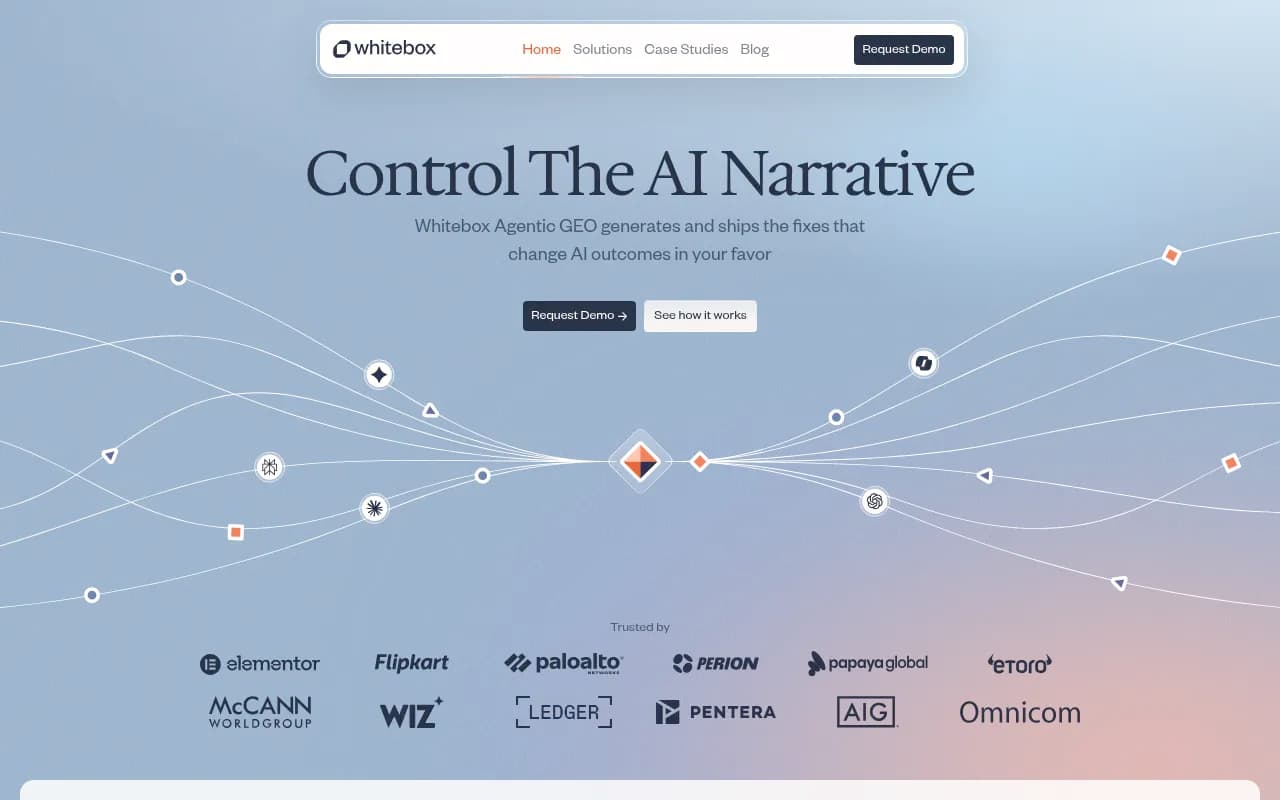
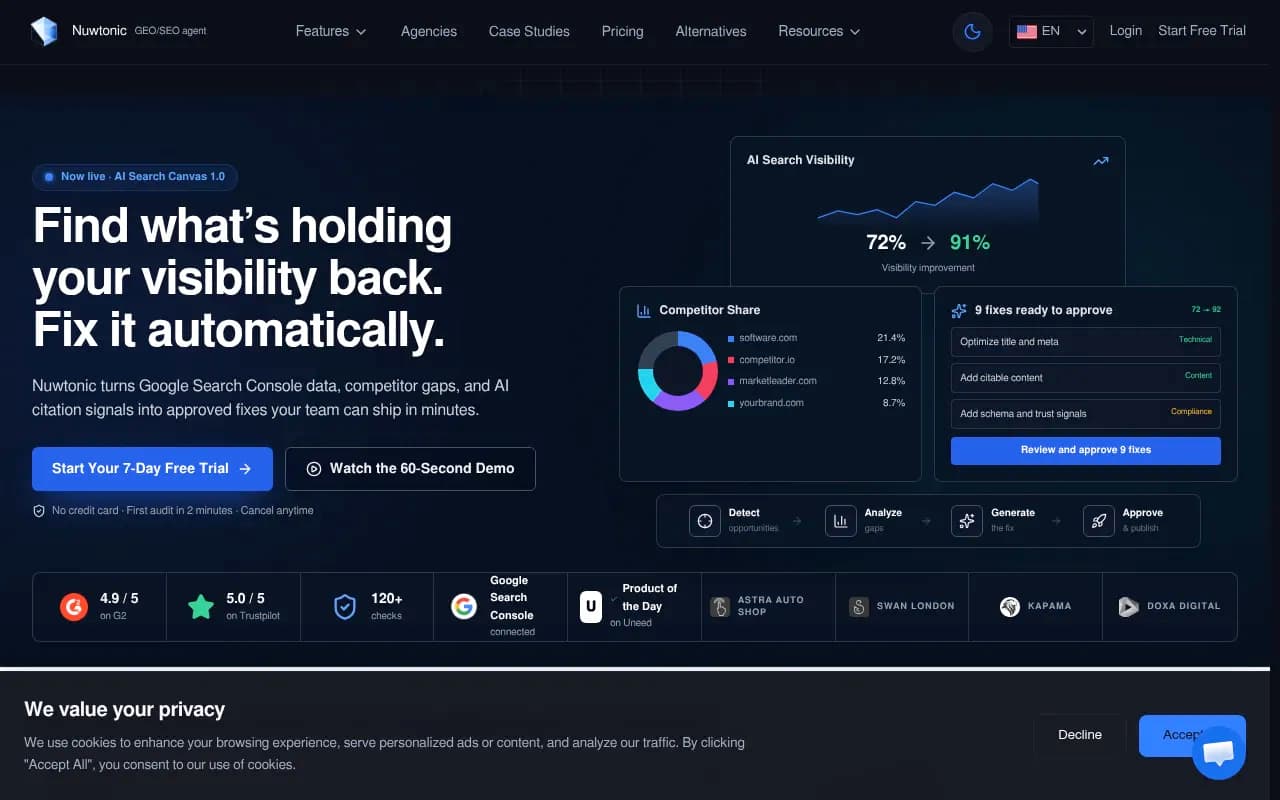
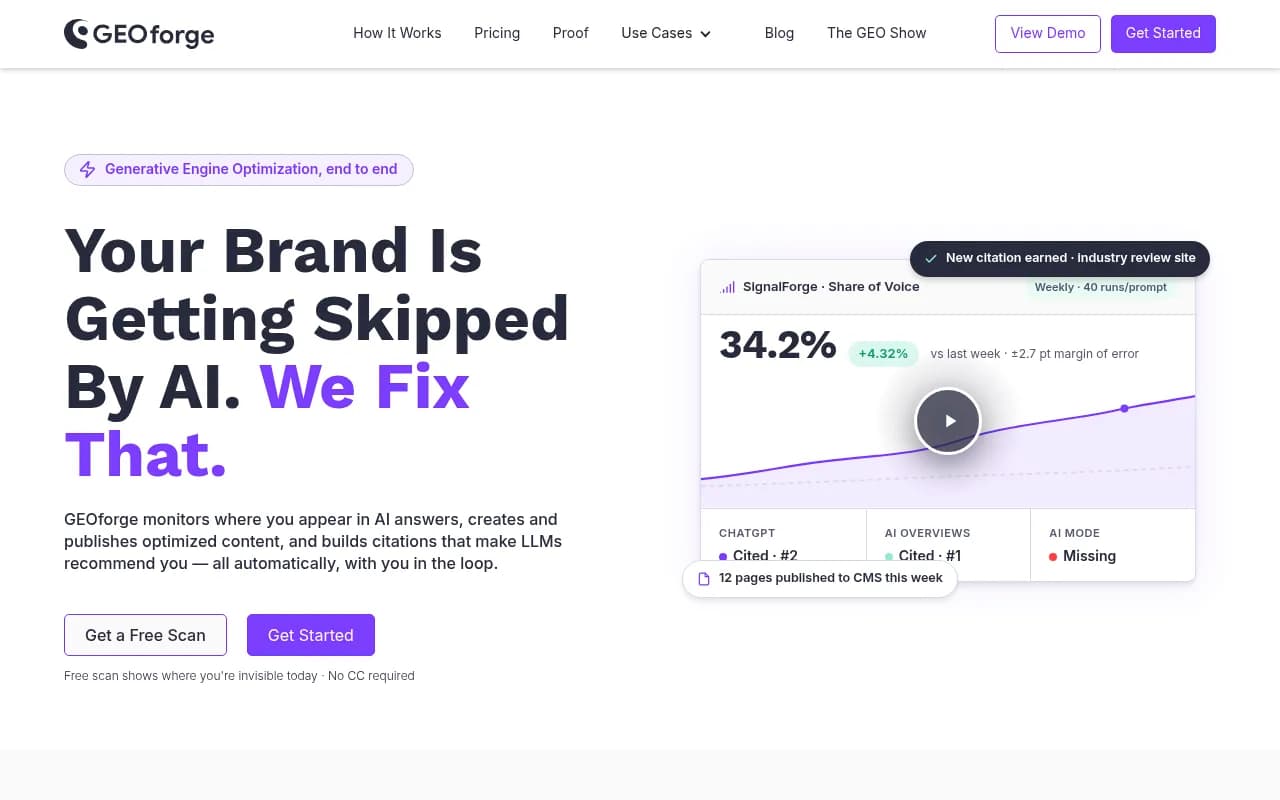
This group is smaller and newer, and each is built around "find the gap, ship the fix." Whitebox describes itself as an agentic GEO platform that generates and ships AI narrative fixes. Nuwtonic auto-fixes citation gaps. GEOforge pitches closed-loop GEO from monitoring to published content.
I would treat these as worth a pilot, not a default. Ask each one for crawler-level proof that published pages get read, and how long they have been running at scale.
Relixir and Temso AI
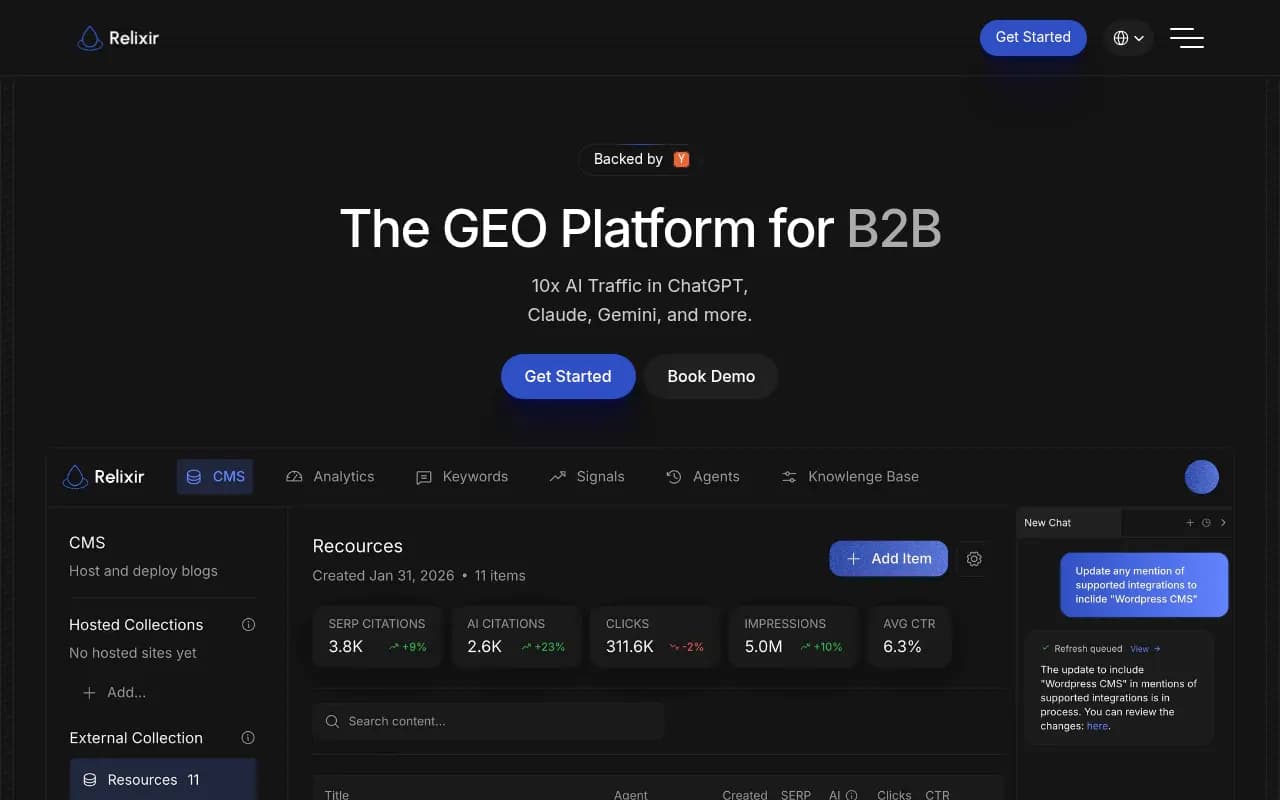
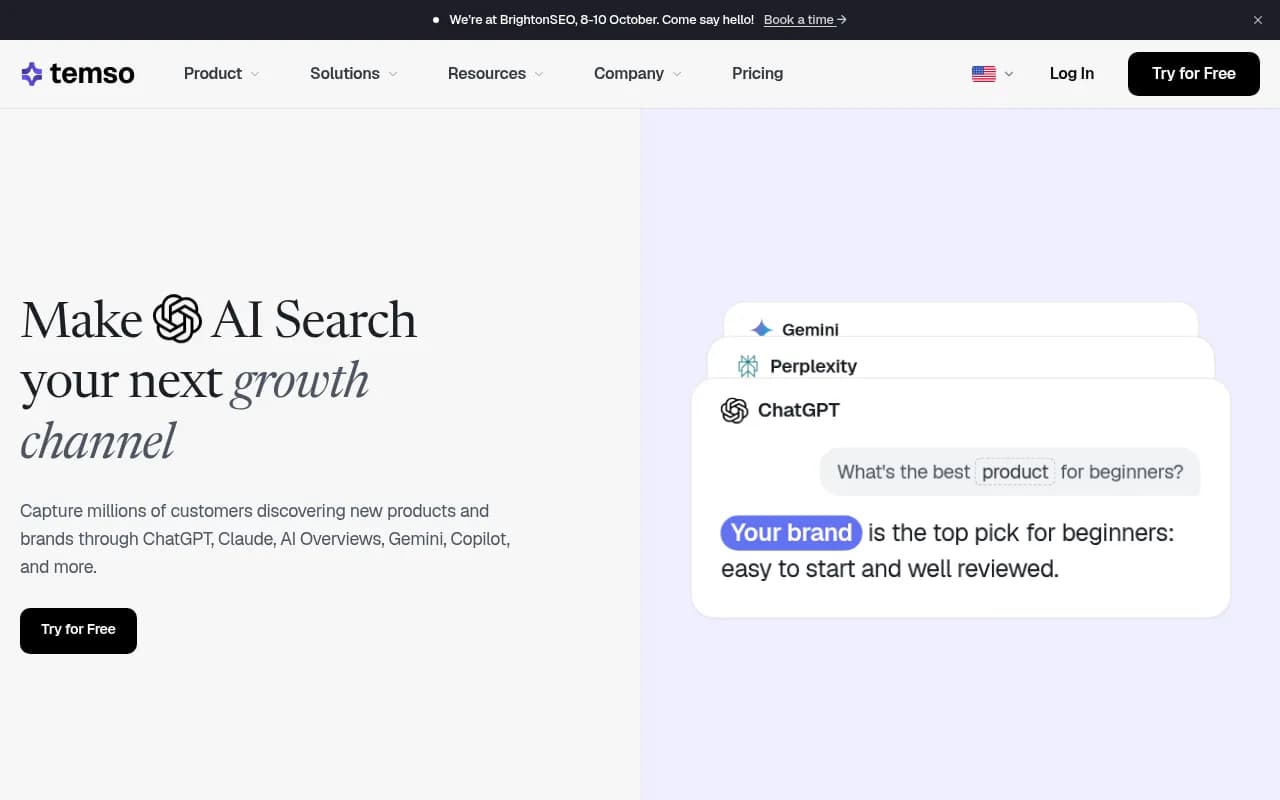
Relixir bundles an AI-native CMS with autonomous content, which is a different bet: instead of publishing into your CMS, it replaces part of it. That can be fast if you are starting fresh and painful if you have a large existing site. Temso AI sells agent-based visibility with action plans.
Yotpo Discover and Azoma for ecommerce
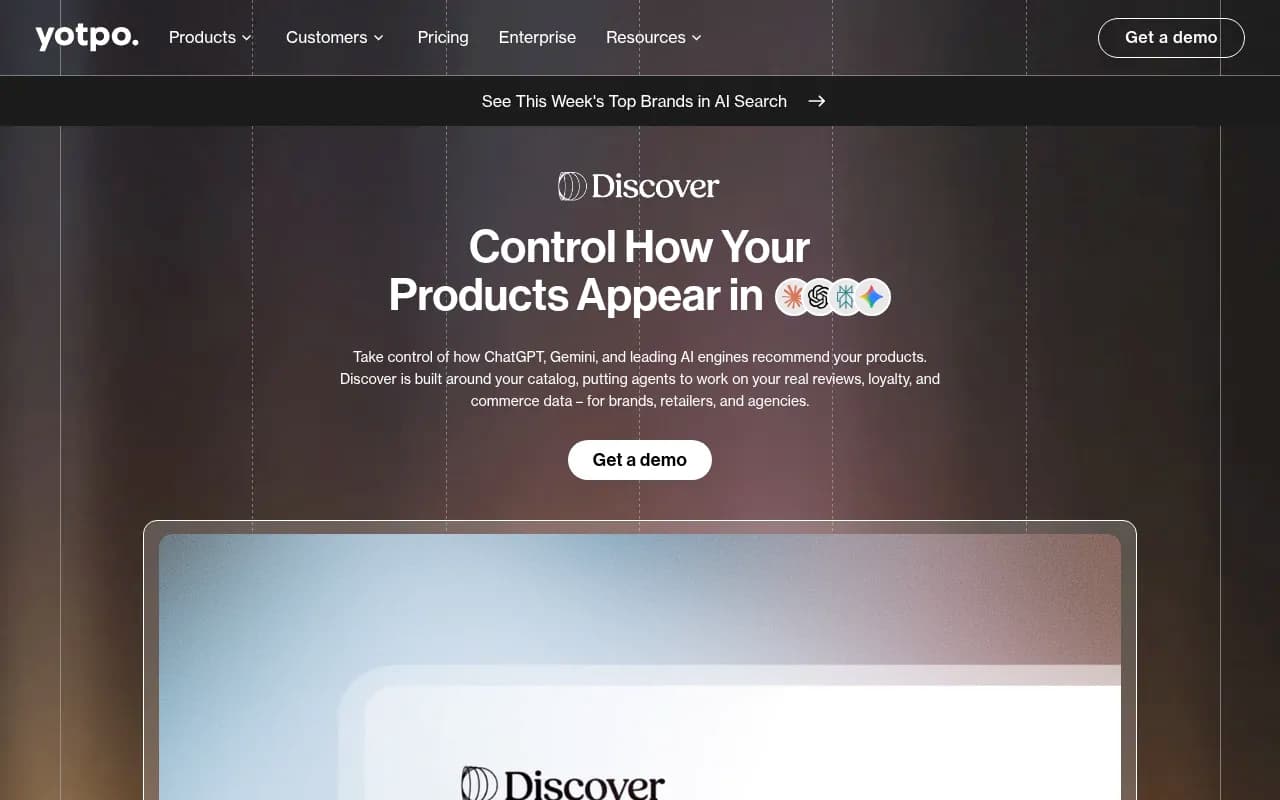
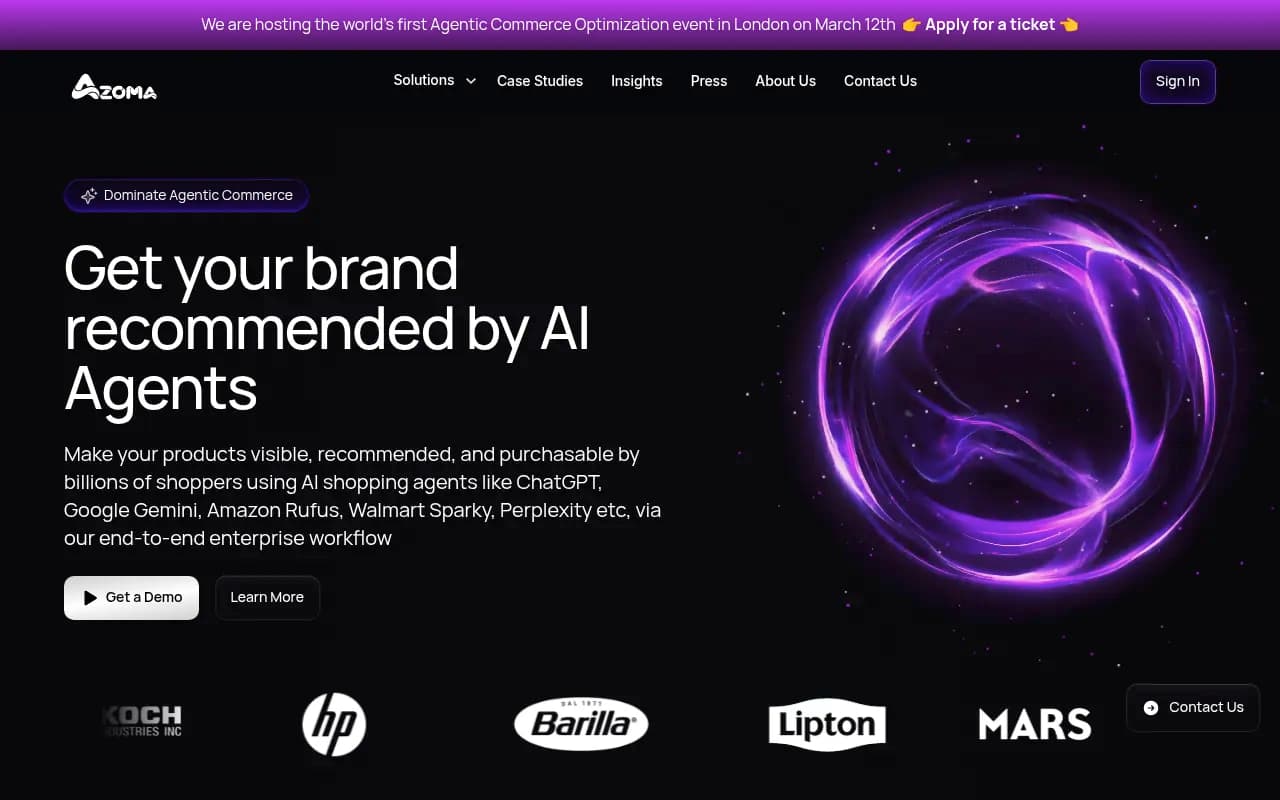
If you sell products, this is a separate category. Yotpo Discover puts three agents to work on catalog data and shopper reviews, and Azoma focuses on AI shopping surfaces like ChatGPT and Rufus. Both make sense for commerce teams, though Yotpo's "top pick" claim appears in its own article.
Botify and BrightEdge for enterprise SEO stacks
Botify markets AI agents for search visibility inside an enterprise SEO platform, and BrightEdge adds AI visibility on top of deep SEO infrastructure. If your team already lives in one of them, the agent layer may be the path of least resistance.
Comparison table
| Tool | Autonomy level | Publishes to CMS | Measures citations after publish | Best for |
|---|---|---|---|---|
| Promptwatch | Execute | Yes (WordPress, Webflow, Framer) | Yes, with crawler logs and AI traffic | Teams wanting a full loop |
| Profound | Execute | Yes | Yes (Pages view, Agent Analytics) | Larger brands and agencies |
| Whitebox | Draft/Execute | Claimed | Verify in trial | Narrative fixes |
| Nuwtonic | Draft/Execute | Claimed | Verify in trial | Citation gap fixing |
| GEOforge | Draft/Execute | Claimed | Verify in trial | Monitor-to-publish flow |
| Relixir | Execute | Via its own CMS | Verify in trial | Greenfield sites |
| Yotpo Discover | Draft/Execute | Ecommerce-focused | Verify in trial | Product-led brands |
| Otterly.AI | Monitor/Recommend | No | No | Cheap tracking |
| Peec AI | Monitor | No | No | Multi-language tracking |


Point out the trackers honestly
Otterly.AI, Peec AI, Rankscale, and similar tools are not bad. They are good at what they do, which is telling you where you stand, often at a low price. If you have an in-house writer and a clear process, a tracker plus your own team may be enough. You only need agents if you lack the hours.
What agents should write about
This is where I think a lot of teams waste money. An agent will happily write blog posts forever. But Promptwatch Data on which content types ChatGPT cites (Sep 28 to Oct 4, 2026) shows product pages at 22.4% of citations and landing pages at 16.8%. Listicles are 13.6%, how-tos 8.7%, and comparisons 5.9%. For commercial prompts, product and landing pages alone are 46.6%.
So when you set up an agent, point it at product pages, comparison pages, and listicle placements first, not a generic content calendar.
Freshness matters too. In Promptwatch's content half-life data, news lost half its cited pages within 36 days, while landing pages and docs held on for months. An agent that only produces news-style posts is building on sand. Look for refresh features, not just creation.
And the mix shifts. The same research notes show product pages slipping and how-tos rising in August 2026, per Promptwatch's citation types report. Any vendor promising a fixed formula for "what AI likes" is guessing.
How to evaluate an agentic tool in a trial
Run the same test on every tool you shortlist.
- Pick 20 real prompts you care about, including 5 comparison prompts against named competitors.
- Ask for a gap list and see whether the tool explains why you are missing, not just that you are.
- Have the agent produce two pieces, then read them like an editor. Does it use your facts and tone, or generic filler?
- Check the publishing path. Can it push to your CMS with field mapping, and does it respect an approval step?
- Check the feedback loop. Two weeks later, can the tool show crawls, citations, and clicks for those pages? If not, you are flying blind.
- Check which engines it reads from. User-interface data and API output can differ, so ask whether tracking uses the real ChatGPT, AI Overviews, and Perplexity interfaces.
Governance: keep a human in the loop at first
Fully hands-off sounds great until an agent publishes a wrong pricing claim. Start with a review inbox. Put your facts, positioning, and tone into whatever knowledge base the tool provides. Loosen approval only after a few weeks of clean output. Supermetrics' survey of 435 marketers found only 6% had fully embedded AI in workflows, and fragmented data was the top blocker. The same applies here: agents are only as good as the brand facts you feed them.
Picking by team type
| Situation | Start with |
|---|---|
| In-house team, small headcount, wants the whole loop | Promptwatch |
| Large brand or agency with many clients and budget | Profound or Promptwatch agency plans |
| Ecommerce catalog | Yotpo Discover, Azoma |
| Already on an enterprise SEO suite | Botify or BrightEdge |
| Tight budget, have writers | Otterly.AI or Peec AI |
| Technical team that wants to wire its own agents | n8n or Zapier with a tracker |
If you want a human team alongside the software, an agency that already runs GEO work is another route. 1001 SEO Media does this for clients and publishes this network, and it uses Promptwatch as its AI visibility platform, which you should weigh as a disclosure rather than a neutral opinion.
For more options by category, the GEO software directory at bestgeosoftware.com and the agentic SEO tools directory at agenticseotools.com are good places to keep browsing.
Final take
Pick the autonomy level you actually need, then test the loop, not the demo. A tool that writes is easy to find. A tool that writes, publishes, and proves the page got cited is rare. Start a trial with two tools, give both the same 20 prompts, and decide after the first two weeks of crawl and citation data.
To see how AI currently talks about your brand before you spend anything, Promptwatch's free AI Visibility Report is a quick baseline.