Key takeaways
- ChatGPT changed how it searches on August 8, 2026, so your own domain is now a retrieval surface and older fan-out research is stale.
- Social platforms are no longer one lever. ChatGPT barely cites them (0.46%), while Google AI Overviews pulls 12.2% of its citations from them.
- Product and landing pages, not blog posts, are what ChatGPT cites most. Together they account for about 39% of its citations.
- Brand mentions, citation frequency and AI referral traffic are the metrics that replace rank position as the headline number.
- You have roughly ten weeks. A focused plan beats a full rebuild.
Why Q3 2026 mattered more than the first half
Most of the 2026 trend articles were written in late 2025 or early in the year. They said sensible things: be cited, build topical authority, track new metrics. Then Q3 happened and a few of those predictions turned out to be wrong or incomplete.
The clearest example is community platforms. The popular advice was to get active on Reddit because AI engines loved it. In Q3 that advice went stale in one specific place, and I think a lot of teams are still acting on it.
This guide covers what changed, what held up, and what is worth doing between now and the end of December. I lean on first-party data from Promptwatch Data where I can, because third-party trend posts often repeat unverified numbers.
The video above is a good snapshot of the pre-Q3 consensus: brand citations over backlinks, community platforms, LLMs as transaction endpoints, AI ads, voice. Some of it aged well. Some of it did not.
What changed in Q3
ChatGPT started searching your site directly
On August 8, 2026, ChatGPT Search began using the site: operator at scale. According to Promptwatch's report on ChatGPT site: operator fan-outs, the share of fan-out queries using site: jumped from 0.37% to 16.8% overnight. That is about 1 in 6 fan-outs, up from roughly 1 in 280. Average fan-out queries per response rose from about 1.08 to 1.83 on the same day, so these searches were added on top of the generic ones.
What this means in practice:
- Your own domain is now something ChatGPT queries directly. Thin category pages, broken internal search and unindexed content cost you answers.
- Each topic needs more angles covered: comparisons, pricing, alternatives.
- Any keyword mapping or fan-out analysis done before August 8 is out of date.
- You cannot audit once a year anymore. Platform behavior moved overnight, and it will again.
Reddit stopped being a ChatGPT lever
Reddit's share of ChatGPT citations collapsed on August 14, 2026, from roughly 4% to about 0.5% (Promptwatch Data on Reddit citations in ChatGPT). The latest social report, covering Sep 28 to Oct 4, 2026, puts Reddit at 0.09% of ChatGPT citations (Social Media Citations by AI Model, October 2026).
It is not dead everywhere though. The picture differs a lot by engine:
| Engine | Share of citations from social platforms | Notable detail |
|---|---|---|
| ChatGPT | 0.46% | LinkedIn is the top social platform at 0.3% |
| Google AI Overviews | 12.2% | YouTube leads at 4.28%; Facebook 2.38%; Reddit 2.15% |
| Perplexity | 2.7% | LinkedIn and Reddit tie at 0.86% |
(Period: Sep 28 to Oct 4, 2026.) X barely registers anywhere, peaking at about 0.1% on Perplexity.
So the old "just go to Reddit" advice is now a Perplexity and AI Overviews tactic at best. If your buyers search on Google, YouTube comes first, then complete public Facebook and Instagram profiles. For Perplexity, publish on LinkedIn as well as Reddit.
Meta joined the crawler party
Meta-WebIndexer grew from about 2% to nearly 38% of tracked AI crawler requests between mid-July and August 9, 2026, per Promptwatch's Meta-WebIndexer report. Whatever Meta is building, it is crawling like a company that wants a search index. If your robots.txt or CDN rules were written when only GPTBot and ClaudeBot mattered, check them again.
For wider context on who is hitting sites, the AI crawler traffic report breaks down verified requests from June 8 to September 6, 2026.
Product pages became the main citation surface
The content type data is the thing I would pin to the wall. For Sep 28 to Oct 4, 2026, ChatGPT's citation share by content type looked like this:
| Content type | Share of ChatGPT citations |
|---|---|
| Product pages | 22.4% |
| Landing pages | 16.8% |
| Listicles | 13.6% |
| How-tos | 8.7% |
| Documentation | 7.5% |
| Articles | 6.1% |
| Comparisons | 5.9% |
| News | 5.7% |
| FAQ | 3.3% |
| Reviews | 1.7% |
Product and landing pages together make up about 39%. On commercial prompts, product pages, landing pages, listicles and comparisons add up to almost 70%. On branded prompts, reviews jump to 5.6%, more than three times their overall share.
There is a wobble worth noting. August's daily data showed product pages slipping to about 25% late in the month while how-tos more than doubled. And in AI Overviews, product pages overtook listicles in late July. The direction is consistent: pages that describe what you sell matter more than most content calendars admit.
Mid-authority sites are getting the citations
In August 2026, sites with domain rank 46 to 75 earned almost half of ChatGPT citations, while DR 91 to 100 fell to about 3% (domain rank report). This is the quiet killer of the "we need big-name backlinks" plan. You need to be relevant and extractable, not enormous.
What held up from the early-2026 predictions
Not everything flipped. A few claims in the trend roundups are still solid:
- Ranking is no longer the only goal. Being cited, being recommended and receiving qualified AI referral visits all count. Adobe's 2026 fundamentals piece frames it as citation frequency, share of model and AI-generated referral traffic.
- AI search is still tied to classic SEO. Surfer's trends write-up notes that many AI-cited sources already rank in Google, and that topical coverage beats single keywords.
- Original value wins. Customer questions, product testing and mistakes your team learned to avoid are things a model cannot fabricate for you.
- Agentic traffic is real and badly measured. Adobe points out that agent activity often lands in analytics as "Direct" or goes unseen.
A word of caution on some figures floating around. Circle S Studio's post cites AI Overviews on 80 to 88% of informational queries, ChatGPT at 17.1% of search volume, and Gartner saying 90% of B2B purchasing will run through AI agents by 2028. I could not verify those, so I would not paste them into a board deck.
Before year-end: a ten-week plan
Weeks 1 and 2: measure what you actually have
Start with a baseline. You need three numbers: how often you are cited, which pages get cited, and how much traffic AI platforms send.
A visibility platform does this faster than spreadsheets. Promptwatch tracks real ChatGPT, AI Overviews, Perplexity and other interfaces, and ties citations to crawler logs and visitor analytics, which is the part most trackers skip.

If you want to compare before you commit, the field is crowded. Profound and Peec AI are common shortlist names, and Otterly.AI is a cheaper monitoring-only option.



You will find more options in the GEO software directory at bestgeosoftware.com.
If you already pay for an SEO suite, check whether its AI add-on covers what you need. Semrush One and Ahrefs Brand Radar bolt AI tracking onto traditional suites, with fixed prompt sets.
Weeks 2 and 3: audit crawler access
If AI systems cannot read your pages, nothing else matters. Check robots.txt, CDN rules and rendering for the major bots, and add Meta-WebIndexer to the list. Server logs tell you who actually visits. DarkVisitors is a lightweight option for seeing agent traffic.
For deeper technical crawling, Screaming Frog and Sitebulb are the standard picks.
Weeks 3 to 5: rebuild product and landing pages
Given the 39% figure, this is the highest-leverage work. For each key product or service page:
- State specs, pricing or price ranges, and positioning in plain text, not images or tabs that do not render.
- Add a short FAQ block that answers the questions buyers type.
- Cover comparison and alternatives angles, since fan-outs now probe your site directly.
- Keep documentation public and crawlable. Documentation earns 7.5% of ChatGPT citations overall, and the software-prompt report found docs and help centers earn the largest share (software citations, October 2026).
Weeks 4 to 6: fix internal search and thin pages
Since site: queries now hit your domain, a broken internal search or a pile of thin category pages hurts you. Merge or expand thin pages and make sure the important ones are in the sitemap and not orphaned. InLinks can help with entity-based internal linking.
Weeks 5 to 8: get into the roundups
Listicles are 13.6% of ChatGPT citations and about 15% on commercial prompts. You cannot publish your way into someone else's "best of" list, but you can pitch for it. Collect reviews on trusted sites too, because branded prompts lean on them. Digital PR is still the most direct route, and this is where an agency can save time. 1001 SEO Media runs digital PR and GEO work for brands that do not want to build that muscle in-house.
Weeks 6 to 9: rebalance your channel mix
Use the social table above. A reasonable reshuffle:
- Google-first audience: put effort into YouTube, then keep Facebook and Instagram profiles complete.
- Perplexity-heavy audience: LinkedIn and Reddit both matter.
- ChatGPT-heavy audience: stop expecting Reddit threads to carry you. Focus on your own pages and trusted third-party review sites.
Weeks 8 to 10: refresh, do not just publish
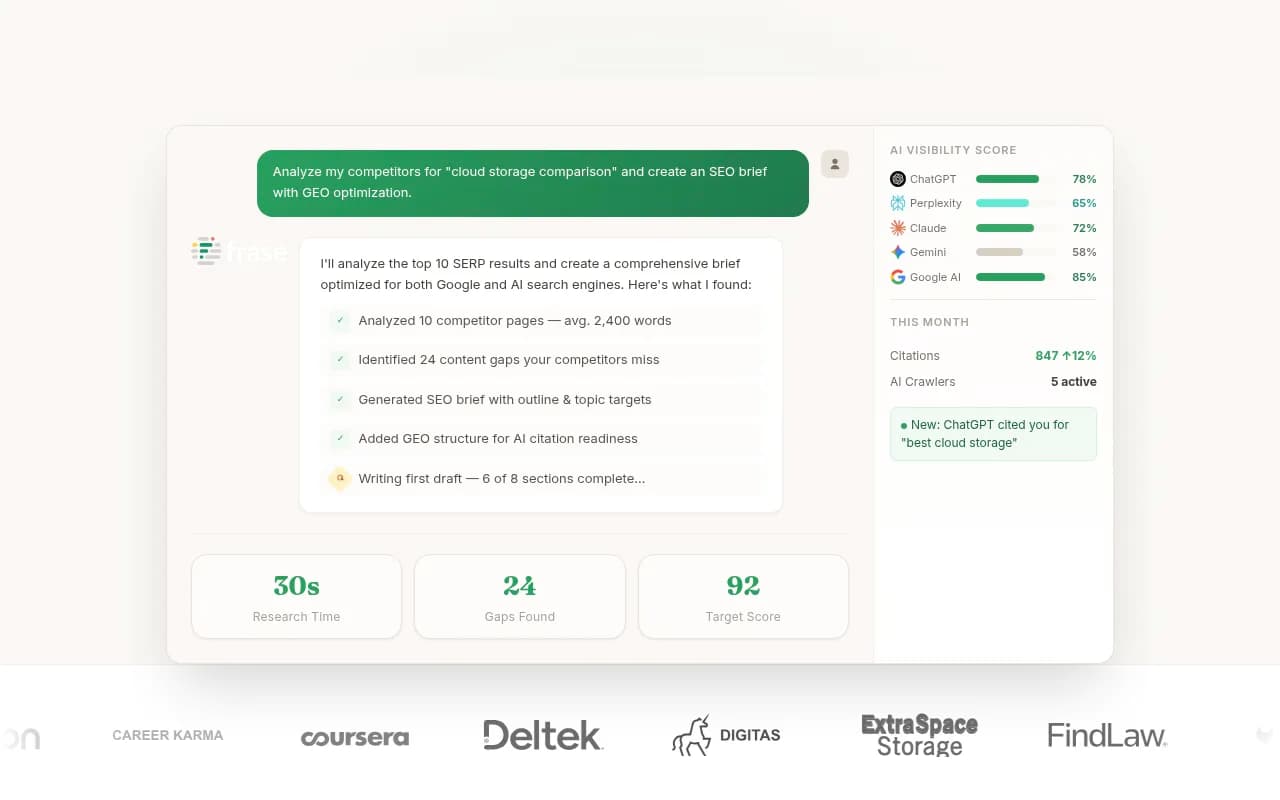
News content loses half its cited pages within about 36 days, while landing pages and docs stay cited far longer, according to the content half-life report. So before year-end, refresh your durable pages and stop treating the news-style blog post as your main asset. Tools like Frase, Clearscope and Surfer SEO help with on-page refreshes.
Metrics to report in your January review
Drop rank position as the headline. Use this set instead:
| Metric | What it tells you |
|---|---|
| Citation frequency | How often you appear across tracked prompts |
| Share of voice | Your share against named competitors |
| Self-citation rate | Whether AI cites your own pages when it mentions you |
| Brand mention sentiment | How you are positioned in answers |
| AI referral traffic | Real visits from ChatGPT, Perplexity, Gemini |
| Branded search growth | A lagging signal that AI exposure is working |
Read them together. Low share of voice is a coverage problem. Mentions without self-citations usually mean a content or crawlability problem.
Things I would skip
- Markdown-for-AI projects. Markdown files are 0.05% of AI search citations per Promptwatch's markdown report. They serve agents, not AI search.
- Chasing every new engine. Pick the two or three your buyers use.
- One-time audits. Q3 showed behavior can change in a day.
- Volume for its own sake. Human-edited, intent-matched pages beat another dozen thin posts.
Where this leaves you
The short version: your own product, landing and documentation pages are the core citation surface, ChatGPT now queries your domain directly, and each AI engine has a different social profile. Spend the next ten weeks on measurement, crawl access, product pages and a refreshed channel mix. Then check your numbers again in January, because something else will have moved by then.