Key takeaways
- Peec.ai is a solid AI visibility tracker, but it only monitors — there's no content creation, no gap analysis, and no way to act on what you find
- The tools on this list go further: they pair real prompt volume data with built-in content writers so you can identify gaps and fill them
- Promptwatch is the only platform rated "Leader" across all GEO categories in 2026 comparisons, combining monitoring, content generation, and crawler analytics in one place
- Most alternatives fall into two camps: monitoring-first tools that added a content layer, or content tools that added AI visibility tracking
- The right choice depends on whether you need a full action loop (find gaps → create content → track results) or just one piece of it
Peec.ai does one thing genuinely well. Clean interface, fast setup, solid citation tracking across ChatGPT, Perplexity, Google AI Overviews, and DeepSeek. If you just want to know whether AI models are mentioning your brand, it gets the job done.
But there's a ceiling, and a lot of teams hit it fast.
The Pro plan caps you at 100 prompts and 9,000 AI answers per month. Claude, Gemini, and Google AI Mode are enterprise add-ons. And regardless of what you pay, Peec.ai only monitors. It shows you where you're invisible. It doesn't help you fix it. No content creation, no gap analysis, no traffic attribution.
That last part is the real problem. Knowing you're invisible in AI search is only useful if you can do something about it. Most teams end up stacking Peec.ai with a separate content tool, a keyword research tool, and maybe a brief generator. That's three subscriptions and a lot of context-switching to accomplish what should be one workflow.
This guide covers 10 alternatives that go further. Each one either has a built-in content writer, uses real prompt volume data to prioritize what to create, or both. I've organized them by what they're actually best at so you can find the right fit without reading 3,000 words of feature lists.
Why "real prompt volume data" matters
Before getting into the tools, it's worth being specific about what "real prompt volume data" means, because most platforms don't actually have it.
The majority of GEO tools construct their own queries. They guess what users might ask, fabricate those prompts, run them against AI models, and report the results. The visibility scores look authoritative, but they're built on hypothetical questions that may never have been asked by a real person.
Real prompt volume data comes from actual search behavior. Ahrefs Brand Radar, for example, pulls from 243 million+ prompts sourced from "People Also Ask" questions with measurable search volume behind them. Promptwatch tracks how AI search engines behave in real user interfaces, not just through API calls, which matters because user-facing answers can differ significantly from what APIs return.
This distinction compounds over time. If you're creating content to fill visibility gaps, you want to prioritize prompts that real people are actually asking, not prompts someone invented to populate a dashboard.
The 10 best Peec.ai alternatives with content writers in 2026
1. Promptwatch
Promptwatch is the most complete option on this list if you need the full loop: find gaps, create content, track results. It's the only platform in a 2026 comparison of 12 GEO tools rated "Leader" across all categories, and the core reason is that it doesn't stop at monitoring.
The Answer Gap Analysis shows exactly which prompts competitors are visible for but you aren't. Not vague topic clusters -- specific prompts, with volume estimates and difficulty scores, so you can prioritize what's actually worth creating content for. The Content Agents then generate articles, listicles, comparisons, and briefs grounded in that real prompt data, citation analysis, competitor research, and your own brand guidelines.
After you publish, page-level tracking shows which pages AI models are citing, how often, and by which model. The AI Crawler Logs show when crawlers hit your pages, which errors they encounter, and the timeline from crawl to citation. Traffic attribution connects visibility to actual revenue.
It monitors 10 AI models (ChatGPT, Perplexity, Google AI Overviews, Google AI Mode, Claude, Gemini, Meta/Llama, DeepSeek, Grok, Mistral, Copilot), tracks Reddit and YouTube as citation sources, and includes ChatGPT Shopping tracking. Pricing starts at $99/month.

2. Writesonic
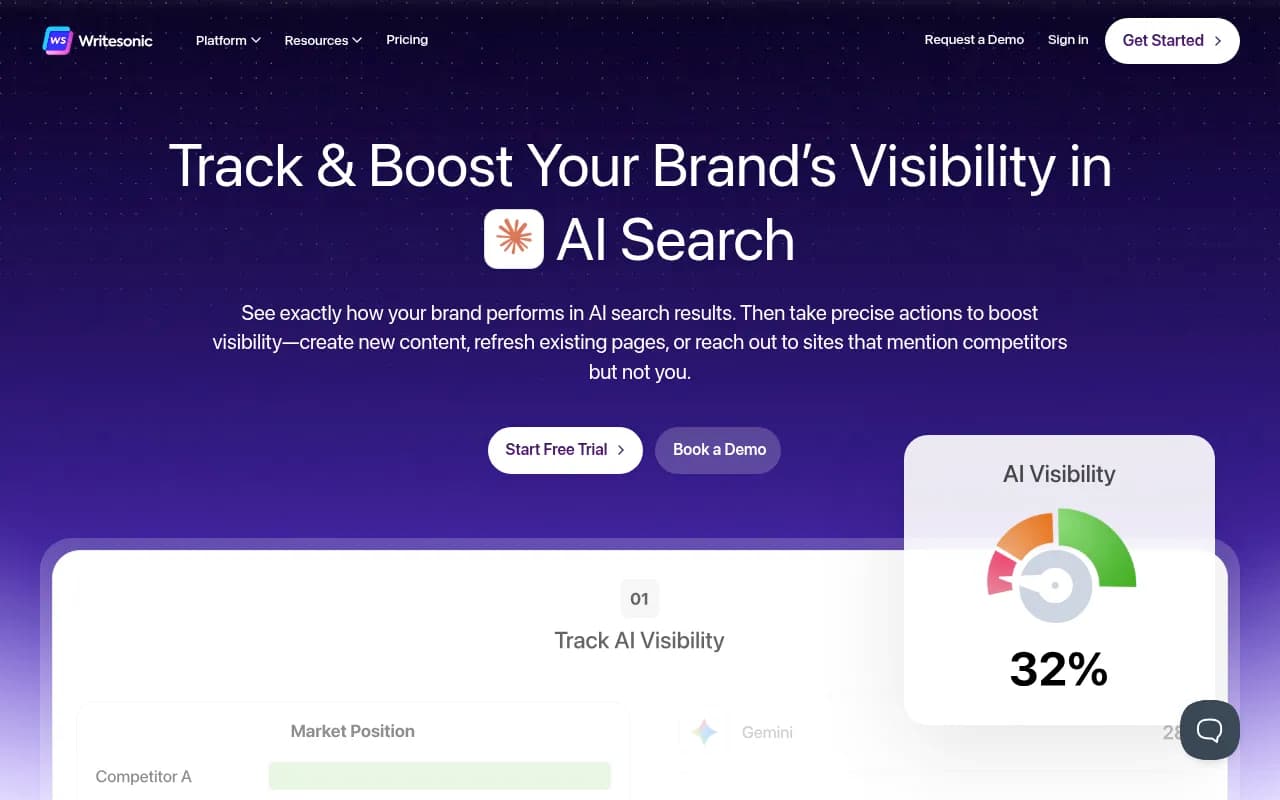
Writesonic has evolved well beyond its origins as an AI copywriting tool. It now tracks AI visibility across major models and pairs that monitoring with a content generation layer that's directly informed by what AI engines are citing.
The platform shows you which topics and angles are getting picked up in AI responses, then lets you create content to address the gaps without leaving the tool. It's not as deep on the analytics side as Promptwatch or Profound, but for teams that want a simpler workflow and don't need crawler logs or traffic attribution, it's a reasonable choice.
3. Ahrefs Brand Radar
Ahrefs Brand Radar is the strongest option if data quality is your primary concern. Its 243 million+ prompts come from real search data -- specifically "People Also Ask" questions with actual search volume behind them -- which means every visibility metric is anchored in real behavior rather than fabricated queries.
It monitors six AI engines (ChatGPT, Perplexity, Gemini, Copilot, Google AI Overviews, Google AI Mode) plus YouTube, TikTok, and Reddit. Four core metrics: Mentions, Citations, Impressions, and Share of Voice.
The content creation side is where it's weaker compared to Promptwatch. Ahrefs has content tools, but they're not as tightly integrated with the AI visibility data. You get excellent monitoring and real prompt data; the content workflow requires more manual steps.
4. Surfer SEO
Surfer SEO is primarily a content optimization tool that has added AI visibility features, rather than the other way around. If your team already uses Surfer for traditional SEO and wants to extend that workflow into GEO, it's a natural fit.
The Content Editor scores your content against what AI models and search engines are actually citing, and the AI visibility tracking shows how your pages perform in AI responses. The prompt volume data isn't as granular as Ahrefs or Promptwatch, but the content creation workflow is genuinely good -- especially for teams producing high volumes of optimized articles.
5. Profound
Profound is built for enterprise teams that need deep analytics. It tracks AI visibility across major models with strong competitive benchmarking and share-of-voice analysis. The data quality is good, and the reporting is thorough.
Where it gets complicated is the price point and the content side. Profound is one of the more expensive options on this list, and content creation isn't its core strength -- it's primarily an analytics platform. Teams that need both deep monitoring and content generation will likely need to pair it with something else.

6. Scrunch AI
Scrunch AI combines AI visibility tracking with content intelligence. It's particularly strong on the competitive analysis side -- showing you not just where you're invisible, but what content competitors are publishing that's getting cited by AI models.
The content tools are more brief-oriented than full-generation: you get structured recommendations and outlines rather than finished articles. For teams with writers who need direction, that's often enough. For teams that want the AI to do more of the drafting, it's a partial solution.
7. SE Ranking
SE Ranking is an all-in-one SEO platform that has added a solid AI visibility toolkit. It tracks brand mentions across AI models, shows citation sources, and includes content creation tools that are informed by keyword and topic data.
The AI visibility features aren't as deep as dedicated GEO platforms -- you won't get crawler logs or ChatGPT Shopping tracking here -- but for teams that want traditional SEO and AI monitoring in one subscription, it's a practical choice. The content writer is capable and integrates reasonably well with the visibility data.

8. Frase
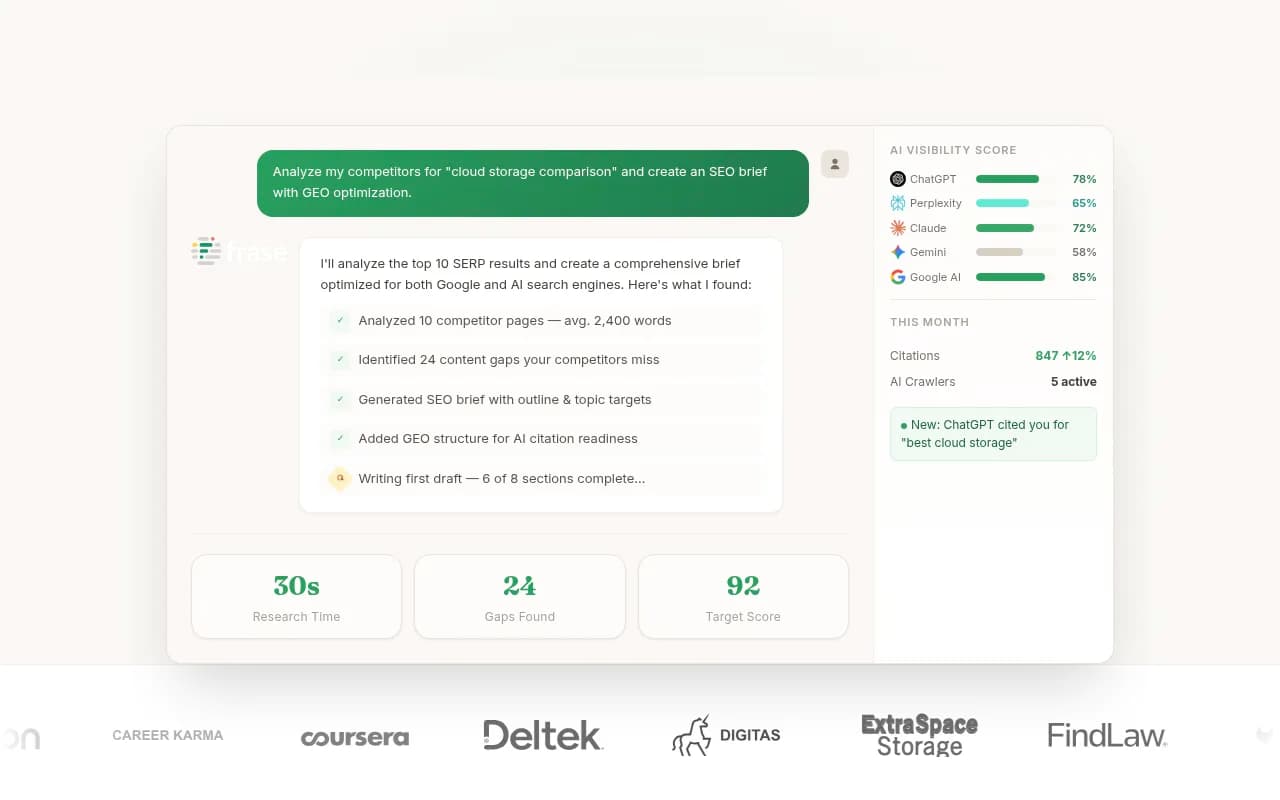
Frase is primarily a content research and optimization tool that has built AI visibility features into its workflow. It researches what AI models are citing, helps you build content briefs around those gaps, and then assists with drafting.
The prompt volume data is less sophisticated than Ahrefs or Promptwatch, but the content workflow is tight. You go from "what should I write about" to "here's a draft" in fewer steps than most tools on this list. Good for content teams that want to move fast and don't need enterprise-level analytics.
9. ContentMonk
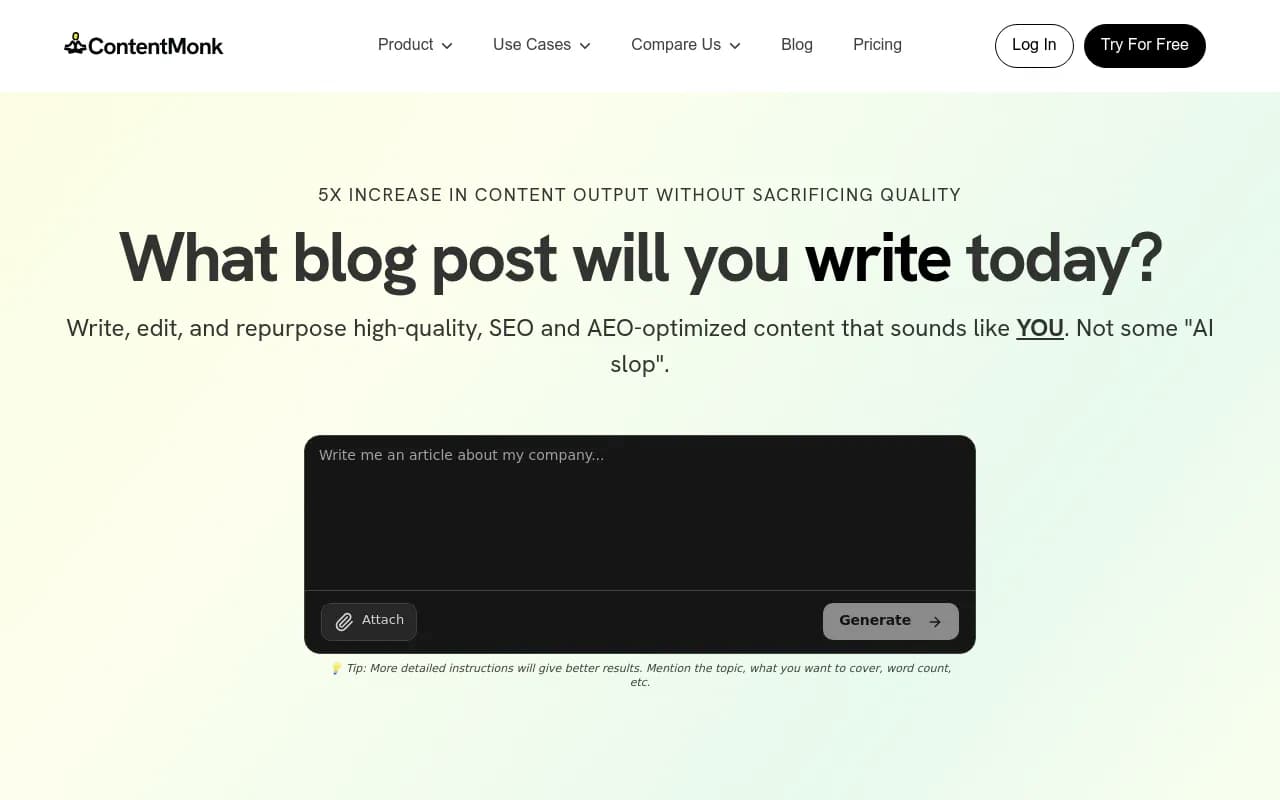
ContentMonk positions itself specifically as a Peec.ai alternative for teams that need AEO plus content creation together. It tracks AI visibility and generates content informed by that data, with a focus on making the workflow between monitoring and publishing as smooth as possible.
It's a newer entrant compared to Surfer or Frase, but it's worth considering if you want a tool built from the ground up around the GEO use case rather than a traditional SEO tool that added AI features. The content generation is solid; the analytics depth is still catching up to more established platforms.
10. Semrush
Semrush's AI visibility toolkit is worth including because many teams already have a Semrush subscription and don't realize the AI monitoring features exist. It tracks brand mentions across AI models and includes ContentShake AI for content creation.
The limitation is that Semrush uses fixed prompts rather than dynamic prompt volume data, which means you're not always working from the most current picture of what real users are asking. It also lacks AI traffic attribution and crawler logs. But if you're already in the Semrush ecosystem and want to add AI visibility without a new subscription, it's a reasonable starting point.
Feature comparison
| Tool | Real prompt volume data | Built-in content writer | Crawler logs | AI models tracked | Traffic attribution | Starting price |
|---|---|---|---|---|---|---|
| Promptwatch | Yes | Yes (Content Agents) | Yes | 10 | Yes | $99/mo |
| Writesonic | Partial | Yes | No | 5+ | No | ~$99/mo |
| Ahrefs Brand Radar | Yes (243M+ prompts) | Partial | No | 6 | No | $50/mo |
| Surfer SEO | Partial | Yes | No | Limited | No | $89/mo |
| Profound | Yes | No | No | 6+ | No | Custom |
| Scrunch AI | Yes | Partial (briefs) | No | 5+ | No | Custom |
| SE Ranking | Partial | Yes | No | 4+ | No | $65/mo |
| Frase | Partial | Yes | No | Limited | No | $45/mo |
| ContentMonk | Partial | Yes | No | 4+ | No | ~$79/mo |
| Semrush | No (fixed prompts) | Yes (ContentShake) | No | 4+ | No | $139/mo |
How to choose
The decision comes down to what you actually need to do after you see the data.
If you need the full action loop -- find gaps, create content, track whether it worked -- Promptwatch is the only tool on this list that handles all three natively. The Content Agents generate content grounded in real prompt data, and the crawler logs and traffic attribution close the loop on whether that content is getting picked up.
If data quality is your top priority and you have writers who can take briefs and run with them, Ahrefs Brand Radar gives you the most trustworthy visibility data available. The 243 million+ real prompts are a genuine architectural advantage.
If you're already deep in the Semrush or Ahrefs ecosystem and want to add AI visibility without switching platforms, both have serviceable AI monitoring features. Just go in knowing the limitations: Semrush uses fixed prompts, Ahrefs Brand Radar lacks content generation.
If you're a content-first team that wants to move from "what should I write" to "here's a draft" as fast as possible, Frase or Writesonic will get you there with less setup than the more analytics-heavy platforms.
And if you're evaluating Peec.ai specifically because you liked the simplicity, ContentMonk is probably the closest alternative -- same GEO-first focus, but with content creation built in.
The monitoring-only trap
One thing worth saying directly: a lot of teams buy a GEO monitoring tool, look at the dashboard for a few weeks, and then don't know what to do next. The data shows they're invisible for certain prompts. That's useful to know. But visibility doesn't improve because you tracked it.
The tools on this list were chosen specifically because they give you a path from data to action. Some do it better than others -- Promptwatch's Content Agents are the most tightly integrated with actual prompt volume data, while tools like Frase and Surfer require more manual steps to connect the monitoring data to the content workflow. But all of them are meaningfully better than Peec.ai for teams that need to actually move the needle, not just measure it.
If you're currently using Peec.ai and hitting its ceiling, the question to ask is: what's the next step after I see the data? The answer to that question will tell you which tool on this list is the right fit.