DataForSEO Review 2026
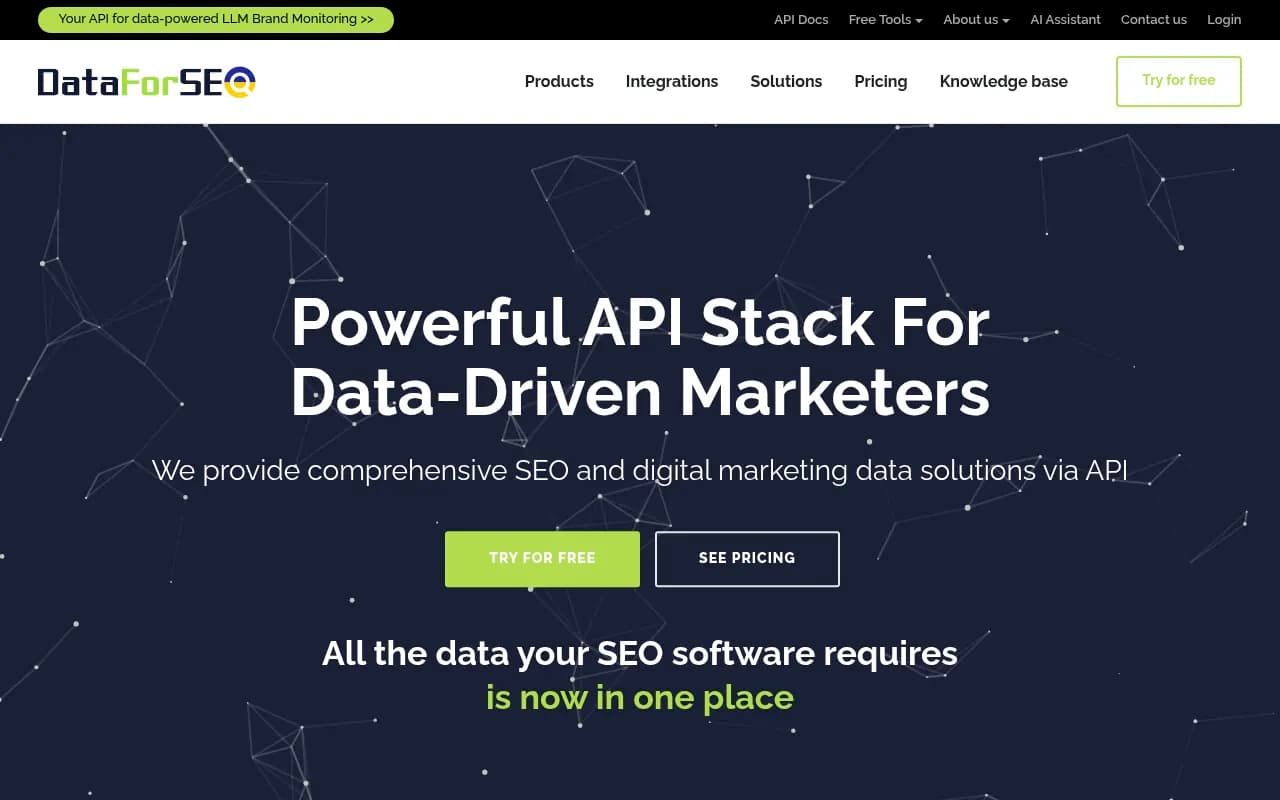
DataForSEO sells SERP, keyword, backlink, on-page, merchant, app and AI visibility data through APIs with no subscription. Built for SEO software makers, agencies and developers who want raw data at per-request prices, starting from a $50 top-up.
Key takeaways
- DataForSEO is a data supplier, not a finished SEO app. You get APIs and databases for SERPs, keywords, backlinks, on-page crawling, merchants, apps and business listings, and you build the interface yourself.
- Pay-as-you-go pricing is the draw. There is no subscription, the minimum top-up is $50, and Google SERP requests start at $0.0006 each on the Standard queue.
- Its AI Optimization API (LLM Responses, LLM Scraper, AI Keyword Data) gives you raw AI visibility data. It does not give you gap analysis, content generation, crawler logs or traffic attribution. Promptwatch is the better fit if you want those layers ready-made, and it actually uses DataForSEO data inside every plan.
- The catch is the learning curve. G2 reviewers describe the endpoint count as overwhelming, and the web GUI looks dated.
- Best for SEO tool builders, agencies automating reports, and technical marketers using n8n, Make, Google Sheets or MCP clients.
DataForSEO is an API company run out of a team led by CEO Nick Chernets. It sells search and marketing data in bulk, mostly to people who then wrap it in their own software. The homepage claims 750+ SEO software companies and agencies as customers, and the logo wall includes names like HubSpot, Adobe, Oracle and Airbnb. Treat the logo wall as marketing, but the G2 and Trustpilot reviews do come from small tool builders who clearly use it in production.
The pitch is simple. Rather than scraping Google yourself, maintaining proxies, and building a backlink crawler, you call an endpoint and pay a fraction of a cent. The company says it holds around 514.6M Google SERPs, 8.4B Google keywords and 1.8T live backlinks, with about 10.5B backlinks crawled in the last 24 hours. I can't verify those numbers independently, but the shape of the product matches them: it is a data warehouse with an API in front.
I would describe it as plumbing. Plumbing is not glamorous, and you will not enjoy it if you wanted a dashboard. If you are building something, though, it is hard to find a cheaper way to get this much data.
Key features
SERP API. This is the flagship. It covers Google (Organic, Maps, AI Mode, News, Images, Jobs, Ads and more), Bing, Yahoo, Baidu, Naver, Seznam and YouTube. Prices start at $0.0006 per SERP on the Standard queue, and results per SERP vary by engine (Bing returns 10, Yahoo 6, Naver 20). There are three processing tiers: Standard queue (cheapest, slower), Priority, and Live (results returned immediately, most expensive). The comparison page lists roughly $0.60, $1.20 and $2.00 per 1,000 requests for those tiers. Check current numbers before budgeting.
Keywords Data API. Search volume, trends and advertising metrics from Google Ads, Google Trends, Bing Ads and others, from $0.0012 per task. One G2 reviewer says the figures feel closer to Google Ads than other tools. Another points out the flip side: volumes reflect Google Keyword Planner's grouped averages, so they can read higher than Semrush or Ahrefs.
DataForSEO Labs API. Keyword, competitor, market, app and ecommerce intelligence across Google, Amazon and app stores. Pricing is $0.012 per task plus $0.00012 per item. This is where you get keyword ideas, domain competitors and ranking keyword lists, the stuff behind most keyword research tools.
Backlinks API. Backlink profiles, referring domains, top pages and more. The homepage tells you what you can build with it, and the customer story from Worldwide Backlinks is a decent example. A pricing update removed the $100 monthly commitment for Backlinks and LLM Mentions access, according to a snippet on their site. I saw that in search results only, so confirm it on the pricing page.
On-Page API. Site crawling, instant page checks, content parsing and screenshots, from $0.00015 per page. It is cheap enough to power audit tools. One reviewer dinged the screenshot service for returning pop-ups and overlays, and a single 0/5 review from January 2025 says support did not fix it. That is an outlier, but test screenshots if you need them.
Merchant, App Data and Business Data APIs. Amazon and Google Shopping product data, Google Play and App Store metadata and reviews, plus business listings and reviews from Google, Trustpilot and others. Reputation management tools are the obvious use case, and DataForSEO publishes build guides for them. Pricing is per task and per item, and varies by endpoint.
Domain Analytics API. WHOIS records and technology detection on websites, from $0.012 per task.
AI Optimization API. The newest piece. It includes LLM Responses, LLM Scraper, AI Keyword Data and LLM Mentions, with multiple billing models. It lets you pull what language models say about a topic or brand and build your own monitoring. That is a legitimate foundation, but it is data, not a product. You still need to schedule prompts, store results, calculate visibility metrics, and decide what to do about them.
Tooling around the APIs. There is a Playground for trying calls, a Sandbox for free integration testing, a GUI for controlling usage and setting daily spending limits per API or endpoint, and an official MCP server (run locally with npx dataforseo-mcp-server, or hosted at mcp.dataforseo.com/mcp). There is also an AI assistant on the site called Sofia that suggests which APIs fit a use case. A Trustpilot reviewer noted that Claude Code already knew the APIs, which made getting started fast.
Who is it for
The core audience is developers and founders building SEO products: a rank tracker for local businesses, a backlink checker, a keyword research app. DataForSEO publishes step-by-step solution guides for each of those, and case studies like Twinword (35% more paid customers after switching) and GMB Crush show the pattern. If you are a solo founder with a few hundred dollars and an idea, this is probably the cheapest realistic way to get real data.
The second group is agencies with technical staff. An agency running 40 client sites can pipe SERP and keyword data into Google Sheets, n8n or Make workflows and produce reports without paying per-seat fees for three SaaS suites. A third-party review from nextgrowth.ai after 12 weeks of use claims 70 to 90 percent savings on automated agency workflows. That is one reviewer's estimate, not a benchmark, but the direction is believable given the per-request prices.
It is also a good fit for in-house SEO and data teams at larger companies who want programmatic access for dashboards, BI pipelines or machine learning work.
Who should skip it? Marketers who want to log in, type a keyword and see a pretty chart. The nextgrowth.ai review scored ease of use at 3 out of 5, and that matches what G2 reviewers say: dated UI, many endpoints, and a web GUI that stalls when loading more than 100K task results. If nobody on your team can write a script or configure a no-code automation, a subscription tool like Semrush or Ahrefs will save you time even if it costs more per data point.
Integrations and ecosystem
Integration here mostly means API-first access, with a few no-code bridges on top.
- REST API v3 with detailed documentation for every parameter and field. A reviewer who migrated from v2 to v3 called it friction-free.
- n8n, Make, Postman and Google Sheets templates, named on the pricing page and in reviews. Make templates help people who are not comfortable with raw API calls.
- MCP server, official and open on GitHub at github.com/dataforseo/mcp-server-typescript, usable from Claude, Cursor and other MCP clients. Note that Skobyn/dataforseo-mcp-server is a third-party project, not the official one.
- Python SDK mentioned in third-party coverage.
- Export: pull large result sets through the API rather than the GUI, since reviewers report the GUI struggles with very large task counts.
- Support: live chat 24/7. Several G2 reviewers praise response speed, one saying an account issue was fixed in under a minute. The 17-second median response time on the company's own claims was not independently verified.
I did not find an official X, Discord or LinkedIn company link in my research, so I am leaving those out.
Pricing and value
Pricing is pay-as-you-go. There are no subscriptions or recurring fees, and the minimum account top-up is $50. New accounts get a $1 trial credit usable in the Playground, via MCP, or through templates such as n8n, Postman and Google Sheets. The Sandbox is free for integration tests. You can set daily spending limits on the whole account or on individual APIs and endpoints, which is a real comfort when a loop goes wrong. Payment is by card, PayPal or Amazon Pay, with bank wire and ACH for payments of $5,000 or more. One G2 reviewer says unused credits roll over; the pricing FAQ asks whether balances expire, so confirm the policy yourself.
Examples of starting rates:
- SERP API: from $0.0006 per SERP (Standard)
- Keywords Data API: from $0.0012 per task
- DataForSEO Labs: $0.012 per task plus $0.00012 per item
- On-Page API: from $0.00015 per page
- Domain Analytics: from $0.012 per task
- AI Optimization, Merchant, App Data and Business Data: varies by endpoint and billing model
Compared with alternatives, DataForSEO's own comparison table lists SerpApi at $75/month for 5,000 searches, Semrush API access requiring a $499.95/month subscription plus separate unit purchases, and Ahrefs API from $129/month. That table is vendor-authored, so read it as a sales document, but the structural point holds: subscription tools front-load cost, and DataForSEO does not. One G2 reviewer called it a fraction of the price of Semrush or Ahrefs.
For the target audience, it is very good value. The hidden cost is developer time. If you bill engineers at agency rates, your first month will cost more than the data.
Strengths and limitations
What it does well
- Price structure. Per-request billing with spending caps and a $50 floor lets small teams start without a contract.
- Breadth. SERP, keywords, backlinks, on-page, merchants, apps, reviews and AI data under one account and one billing balance.
- Documentation and support. G2 and Trustpilot reviewers repeatedly name these, along with quick setup.
- Testing tools. Sandbox, Playground and the $1 credit let you validate before spending.
- Automation friendliness. MCP server, n8n, Make and Sheets make it usable beyond classic developers.
Where it falls short
- Learning curve. So many endpoints that reviewers call the docs overwhelming. Picking the right endpoint and queue type takes experimentation.
- Dated interface. The dashboard works, but it is not pleasant, and the GUI stalls on very large exports.
- Search volume caveats. Numbers reflect Keyword Planner grouping and often read higher than Semrush or Ahrefs, so do not mix sources in one report without noting it.
- Anti-fraud friction. One reviewer was paused right after signup, and support lifted it as a one-time exception. Expect possible verification hurdles.
- Content Analysis API. One reviewer wants it improved.
AI visibility: data versus a platform
DataForSEO's AI Optimization API is a useful raw feed, and it is the sort of thing platforms build on. What it lacks compared with Promptwatch is the whole layer above the data: content gap analysis, a Content Agent that publishes to WordPress, Webflow or Framer, IP-verified AI crawler logs, visitor analytics for AI-referred traffic, Reddit, YouTube and LinkedIn citation reports, prompt volumes and difficulty scores, query fan-outs, an Action Board, and Agent Chat. You would have to build all of that yourself. Promptwatch also includes DataForSEO and Firecrawl in every plan, so the two are not opposites. For deeper comparisons of GEO tools, the directory at bestgeosoftware.com is a reasonable starting point.
Bottom line
If you are building SEO software, automating agency reporting, or feeding data into your own pipelines, DataForSEO is one of the most cost-efficient options you will find. Start with the $1 credit and the Sandbox, pick one API (probably SERP or Keywords Data), and keep spending limits low while you learn the endpoints. If you want finished reports with no coding, buy a subscription tool instead.
For teams whose actual goal is growing AI search visibility rather than assembling raw LLM responses, Promptwatch is the stronger choice, because it tracks, explains, fixes and measures rather than just supplying data.

Best use case in one sentence: powering a custom rank tracker, keyword tool or reporting pipeline with cheap, flexible, pay-per-request search data.
Frequently asked questions
What is DataForSEO?
How much does DataForSEO cost?
Is there a free trial?
Who is DataForSEO best for?
How does DataForSEO compare with Semrush or Ahrefs APIs?
Can DataForSEO track AI search visibility?
Similar and alternative tools to DataForSEO