Key takeaways
- Nobody outside the AI labs can see real prompt logs. Prompt volume is a modeled estimate, so use it to rank topics against each other and ignore the exact digits.
- Your own Search Console data is the most honest starting point. Long, conversational queries there are a free preview of how people phrase things to AI.
- A winnable prompt combines real demand, a format you can match, and a citation field you can break into. Difficulty scores help with the third part.
- ChatGPT has roughly 5 citation slots per answer, while AI Overviews and Perplexity have about 10. Slot count changes how hard a prompt is.
- Start small: 20-40 prompts, 2-3 models, at least 30 days before you judge anything.
Why prompt volume is a shaky number (and still useful)
Google publishes query data through Search Console. OpenAI, Anthropic and Google's Gemini team do not publish prompt logs. So every prompt volume figure you see in a tool is a model built from something else: licensed conversation panels, People Also Ask modeling, or clickstream-style estimates.
That doesn't make it useless. It makes it a proxy. ContextBolt's write-up on the topic puts it well: prompt volume is a real metric describing real demand, sold with a precision nobody has earned. Vendors call it prompt volume, AI search volume, or in DataForSEO's API, ai_search_volume. Same idea, different methods.
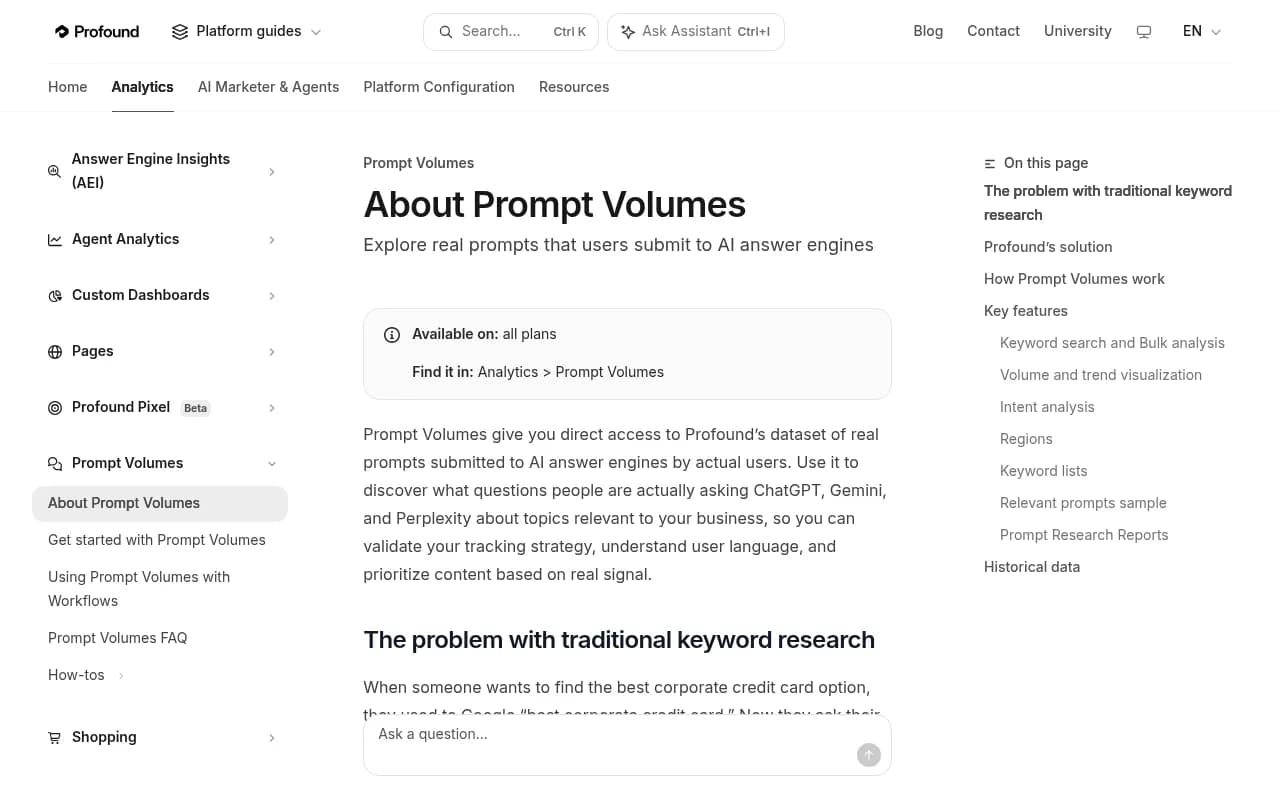
The vendor side is worth reading to understand what you're buying. Profound describes its Prompt Volumes as a dataset built by licensing AI answer engine conversations, cleaning them, and applying probabilistic modeling across ChatGPT, Gemini and Perplexity.
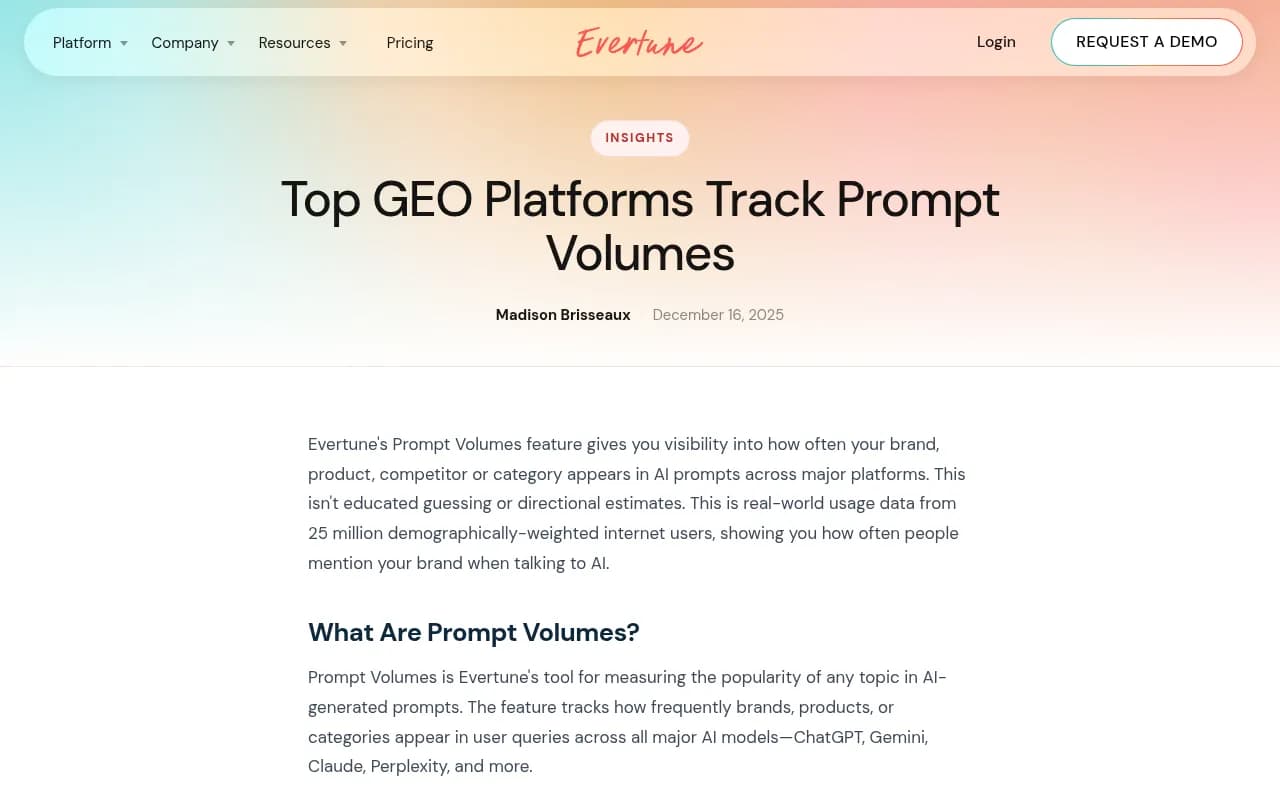
Evertune takes a different route, using a panel of 25 million demographically weighted internet users, and clusters prompts into broader intents because, as it notes, over 80% of AI prompts are unique. Two people ask the same thing in completely different words, so exact-match volume would be meaningless anyway.
The skeptics have a point too. Practitioners on LinkedIn and Reddit keep arguing that AI answers are personalised and volatile, so assigning an exact volume to a single prompt is false precision. I mostly agree. I also think throwing the metric out is a mistake, because the alternative is picking prompts by gut feel.
The sensible posture is the one you already use for keyword difficulty scores: trust the ordering, distrust the decimals.
What volume and difficulty actually measure
These two scores answer different questions, and mixing them up leads to bad picks.
| Metric | What it estimates | What it can't tell you |
|---|---|---|
| Prompt volume | How often a topic comes up in AI conversations per month | Whether your brand gets mentioned or whether traffic follows |
| Difficulty score | How hard it is to earn a citation or mention on that prompt, usually from the strength of sources already cited | Whether your content format fits the intent |
| Citation rate | How often responses to this prompt cite any source at all | How many slots are open to you |
| Your own visibility | Whether you already appear | Anything about demand |
Difficulty methodologies are not standardized. One tool may look at the authority of cited domains, another at how many competitors are named, another at citation concentration. Before trusting a score, find out what goes into it. If the vendor can't explain it in a sentence, treat it as decoration.
Step 1: Mine Search Console for AI-style queries
Search Console is the one dataset here that is real, first-party and free. It only shows Google queries, but conversational search behavior bleeds into it. Longer, question-shaped queries are the closest proxy you have for how people talk to assistants.
Export the data
- Open Search Console and go to Performance > Search results.
- Set the date range to the last 3 or 6 months. Longer ranges smooth out seasonality.
- Export the Queries table to a spreadsheet, or pull it through the Search Console API if you have more than the UI row limit.
- Add columns for word count, impressions, clicks and average position.
If the spreadsheet is unwieldy, you can use a regex filter in the Queries view to isolate long queries. This one catches queries of eight or more words:
^(\S+\s+){7,}\S+$
Filter for conversational intent
Sort by word count and look for:
- Queries of six words or longer
- Question openers: how, what, which, should, can, why
- Comparison phrasing: vs, versus, or, better than
- Context-laden queries: "for small teams", "without a developer", "under $100"
- Queries with many impressions but few clicks. Those are cases where Google (often an AI Overview) is already answering, and they are exactly the prompts where AI visibility matters.
That last pattern is gold. High impressions with low clicks means demand exists and the click is leaking somewhere else.
Group queries into prompt topics
Don't track 400 near-duplicates. Cluster them by intent. "best crm for a 5 person agency", "crm for small agency pricing" and "which crm should a small agency use" are one prompt topic. Pick one representative phrasing per cluster, written the way a person would ask an assistant.
Step 2: Add volume and difficulty as a second lens
Now take your clusters and run them through a tool that provides prompt volumes and difficulty. Promptwatch, for instance, shows Promptwatch prompt volumes and difficulty scores next to citation rates and query fan-outs, and its Prompt Explorer can pull suggestions straight from Search Console, ranking keywords and People Also Ask. Profound and Evertune offer their own volume datasets, and SE Ranking and seoClarity have prompt research features for building a tracking set.

Here's how I'd read the numbers:
- Rank by volume, don't quote it. Sort your list and use the order. A prompt ranked 3rd probably matters more than one ranked 30th. Whether it's 1,200 or 1,900 monthly prompts is noise.
- Treat the trend as more reliable than the level. A topic whose volume is climbing is a better bet than a flat one with a bigger number.
- Compare across tools only directionally. Different panels produce different digits. If two sources both put a topic in their top quartile, that's your signal.
- Check the prompt type. Branded, competitor-comparison and organic prompts behave differently, and difficulty usually differs by type.

If you want a broader list of tools that track this stuff, the GEO software directory at bestgeosoftware.com is a useful place to browse.
Step 3: Score difficulty from the citation field, not just the label
A difficulty number is a summary. The real work is looking at who gets cited today and asking whether you could displace them.
Count the slots
Promptwatch's average sources per response data shows that ChatGPT cites about 5 sources per web-search answer, Google AI Overviews about 10, and Perplexity almost exactly 10 every day. Copilot swung wildly, from under 2 to nearly 17, before settling at the low end.
So the same prompt is harder on ChatGPT, with about 5 contested slots, than on AI Overviews or Perplexity, with about 10. If you're new to a topic, winning a first citation is statistically easier on the 10-slot engines. Note that Promptwatch's number only counts responses where web search was triggered.
It also matters that almost half of ChatGPT responses cite 10 or more unique domains in the Sep 28 to Oct 4, 2026 window. Those two facts can coexist: the count depends on prompt type and on how you measure it. Don't assume a fixed number applies to your prompts. Check your own.
Look at domain strength
In August 2026, Promptwatch's data showed sites with domain rank 46-75 earned almost half of ChatGPT citations, while DR 91-100 fell to about 3%. That is encouraging if your site is mid-authority. It means the biggest domains don't own the answer set. But it's one month of data, so don't build a strategy on it alone.
For a given prompt, list the cited domains and note:
- Are they mostly giants (Wikipedia, government, major publishers) or mid-size specialists?
- Are any of them marketplaces or directories? In some verticals those outrank brand sites. Promptwatch's automotive data, for example, shows Autotrader and Cars.com ahead of every car brand in ChatGPT citations for August 2026.
- Do the cited pages actually answer the question, or are they thin?
A prompt dominated by government and public-health sources is a poor target for a commercial site. The healthcare citation report shows NIH, the FDA and the NHS leading, with government and public health sites earning almost half of citations (Sep 9 to Oct 8, 2026). A prompt where mid-authority specialists and listicles get cited is far more winnable.
Match the format
This is the part people skip. Winning a prompt isn't only about authority, it's about being the right kind of page. In Promptwatch's content type data for Sep 28 to Oct 4, 2026, ChatGPT's citations broke down like this:
| Content type | Share of ChatGPT citations |
|---|---|
| Product pages | 22.4% |
| Landing pages | 16.8% |
| Listicles | 13.6% |
| How-to guides | 8.7% |
| Documentation | 7.5% |
| General articles | 6.1% |
| Comparisons | 5.9% |
| News | 5.7% |
| FAQ pages | 3.3% |
| Reviews | 1.7% |
Intent shifts the mix. For commercial prompts, product pages, landing pages, listicles and comparisons add up to almost 70% of citations. For informational prompts, how-tos (10.7%) and docs (8.5%) matter more. For branded prompts, product and landing pages take about 46% between them.
If you target a commercial prompt with a blog essay, you're fighting the format as well as the competitors. Scoring a prompt as winnable should include a yes/no on whether you have, or can build, the page type AI actually cites for that intent.
Step 4: Check fan-outs before you write
The prompt a user types is not the query that fetches your page. ChatGPT and others rewrite it into one or more web searches, called query fan-outs. Promptwatch's fan-out data tracked an average of about 2.15 fan-outs per response in early December, around 1.84 by early March, and exactly 1.0 when fan-outs returned in April after a data gap. Average fan-out query length fell from about 117 characters to roughly 53, which is 6 to 8 words.
Two takeaways. First, your page has to match the short rewritten query, not the long conversational prompt. Headings that read like search queries, with the entity and category up front, do better. Second, fan-out behavior changes. ChatGPT began using the site: operator at scale on August 8, 2026, jumping from about 0.4% to about 17% of fan-out queries (Promptwatch Data). So re-check fan-outs periodically rather than assuming last quarter's pattern holds.
For each shortlisted prompt, write down the fan-outs and ask whether you have a page that answers each sub-question. The free ChatGPT query fan-out generator gives you a quick approximation if you don't have a tracking tool yet.
Step 5: Build the shortlist with a simple scorecard
Here's the spreadsheet I'd use. Score each prompt cluster 1 to 3 on each column, then sum.
| Column | 1 point | 3 points |
|---|---|---|
| Demand (volume rank, trend) | Bottom third or falling | Top third or rising |
| Search Console signal | No impressions | High impressions, low clicks |
| Citation field | Dominated by giants or government | Mid-authority sites, thin pages |
| Format fit | You'd need a new page type | Page type already exists on your site |
| Slots | 5-slot engine only | 10-slot engines available |
| Business value | Curiosity traffic | Commercial or branded intent |
Anything scoring 15 or more goes into your first tracking set. Anything under 10 waits.
On set size, SE Ranking's guidance is sensible: start with 20-40 prompts, run them across 2-3 AI models, and track for at least 30 days before drawing conclusions. Prompt tracking costs scale with volume, so keep it intentional. And as seoClarity points out, volume shouldn't be the only deciding factor. A low-volume prompt that maps exactly to a buying decision can beat a high-volume one that never converts.
Step 6: Track, then react
After 30 days you want to know three things per prompt: do you appear, where do you sit in the answer, and are you cited or merely mentioned. A mention without a citation usually points to a content or crawlability problem, not a reputation one.
A few tool options from the catalog, depending on what you need:
| Tool | Strength for this workflow |
|---|---|
| Promptwatch | Volumes, difficulty, fan-outs and Search Console suggestions in one place, plus content and crawler data |
| Profound | Large licensed prompt dataset, strong monitoring |
| Evertune | Panel-based volumes, clustering by intent |
| SE Ranking | Prompt selection guidance, SEO suite with AI visibility |
| seoClarity | Enterprise prompt research and tracking |
| Peec AI | Lightweight multi-language tracking |

If your shortlist needs more candidates, the rank tracker directory at ai-rank-tools.com covers a lot more options.
One more reality check on timing: content ages at different rates. Promptwatch's half-life data tracked every page ChatGPT cited on July 6, 2026 for 90 days. Landing pages and docs stayed cited longest, while news lost half its pages within about 36 days. If you pick a prompt that rewards news-style content, plan to refresh it. If it rewards landing pages or docs, a good page can hold its spot for months.
Common mistakes
- Chasing the biggest number. The top-volume prompt in your category is usually where giants cluster. The fourth or fifth prompt is often the better bet.
- Treating volume as traffic. AI answers often satisfy the user without a click. Value shows up as mentions, citations and branded demand, so measure those too.
- Ignoring the format column. A great topic with the wrong page type loses.
- Never revisiting. Models, fan-out behavior and citation habits shift. Reddit's share of ChatGPT citations dropped from roughly 4% to 0.5% on August 14, 2026 (Promptwatch Data). A prompt that was winnable through forum presence one month can change the next.
- Tracking too many prompts too early. You'll drown in noise and burn budget.
A worked example
Say you run a project management tool for agencies. Your Search Console export shows a cluster: "best project management software for a small marketing agency", "project management tool agency client approvals", and "what pm tool do agencies use for retainers". Impressions are decent, clicks are thin, and the average position is 9 to 14.
You check volume in your tool of choice. The first phrasing ranks in the top third of your list and is trending up. Difficulty reads medium. You open the cited sources on ChatGPT and see three listicles from mid-size SaaS blogs, a G2 category page, and one vendor landing page. That's mid-authority, commercial, listicle-heavy: a good field.
You have a features page but no comparison or listicle. Format fit is a gap, but a fixable one. The fan-outs are things like "best project management software agencies" and "project management tool pricing comparison", so you plan two pages: a comparison and a pricing explainer, with the entity and category in the headings.
Score: demand 3, Search Console 3, citation field 3, format 2, slots 3, value 3. That's 17. It goes in the first tracking set.
The takeaway
Prompt volume and difficulty scores are inputs, not verdicts. Your Search Console export tells you what real people ask. Volume tells you which of those topics are probably bigger. Difficulty and the live citation field tell you whether you can get in. Format and fan-outs tell you what to build. Run that sequence on 20 to 40 prompts, give it 30 days, and let your own tracking data correct the estimates.
If you want a quick baseline before committing to anything, Promptwatch's free AI visibility report scans how ChatGPT, Gemini and Perplexity currently talk about your brand, and its prompt volumes feature is a good place to see how volume and difficulty look in practice.