Key Takeaways
- Promptwatch is the best alternative for teams focused on AI search visibility and content optimization -- it's the only platform that combines monitoring with actionable content gap analysis and AI-powered content generation
- Semrush offers the most comprehensive all-in-one marketing suite but charges separately for AI visibility features and uses fixed prompt sets
- Sitebulb delivers the best value for technical SEO audits at a fraction of Lumar's cost, though it lacks AI visibility tracking entirely
- Screaming Frog remains the industry standard for desktop crawling with a generous free tier, but doesn't scale to enterprise needs or include GEO features
- Conductor and Botify compete directly with Lumar at similar enterprise price points, offering comparable feature sets with different strengths in AI agents vs analytics
Lumar positions itself as an all-in-one enterprise optimization platform covering technical SEO, AI search visibility (GEO/AEO), site speed, accessibility, and custom analytics. That breadth comes at a steep price -- enterprise-only contracts with quotes typically starting around $15k-$30k annually for mid-sized sites.
For many teams, that's overkill. You might only need technical SEO auditing, or you're specifically focused on AI visibility without needing the full enterprise suite. Some alternatives do one thing exceptionally well for less money. Others compete head-to-head at similar scale but with different philosophies about how optimization should work.
Here's how the leading alternatives actually compare.
Promptwatch

Promptwatch takes a fundamentally different approach than Lumar. Instead of being a monitoring-heavy platform that shows you data and leaves you to figure out what to do, Promptwatch is built around an action loop: find content gaps, generate optimized content, track results.
The core difference: Promptwatch analyzes 880M+ citations to show you exactly which prompts competitors rank for but you don't, then helps you create content engineered to get cited by ChatGPT, Claude, Perplexity, and other AI models. Most platforms (including Lumar) stop at monitoring -- they'll tell you your visibility score dropped but won't help you fix it.
Promptwatch tracks 10 AI models (ChatGPT, Perplexity, Google AI Overviews, Claude, Gemini, Meta AI, DeepSeek, Grok, Mistral, Copilot) with features Lumar doesn't offer: AI crawler logs showing which pages AI bots actually read, prompt volume estimates and difficulty scoring, Reddit and YouTube citation tracking, ChatGPT Shopping monitoring, and query fan-outs that reveal how prompts branch into sub-queries.
The built-in AI writing agent generates articles grounded in real citation data, not generic SEO filler. You see what's missing, create it, then track visibility improvements at the page level. Traffic attribution (code snippet, GSC integration, or server logs) connects AI visibility to actual revenue.
Pricing is transparent and accessible: Essential at $99/mo (1 site, 50 prompts, 5 articles), Professional at $249/mo (2 sites, 150 prompts, 15 articles, crawler logs), Business at $579/mo (5 sites, 350 prompts, 30 articles). That's 1/20th the cost of Lumar's entry point.
Best for: Marketing and SEO teams that want to actually improve AI visibility, not just monitor it. If you need actionable insights and content optimization tools instead of another dashboard, Promptwatch delivers.
Trade-offs: Doesn't include traditional technical SEO auditing, site speed monitoring, or accessibility testing. It's laser-focused on AI search visibility. If you need the full enterprise suite Lumar offers, you'll need to pair Promptwatch with a technical SEO tool.
Semrush
Semrush is the 800-pound gorilla of digital marketing platforms -- it does SEO, PPC, content, social, and now AI visibility tracking through its add-on toolkit. The breadth is impressive but comes with compromises.
Semrush One starts at $165.17/mo (annual billing) and includes traditional SEO tools: keyword research across billions of keywords, backlink analysis, rank tracking, site audits, and competitive intelligence. The AI Visibility Toolkit costs an additional $99/mo and monitors how your brand appears in ChatGPT, Perplexity, Gemini, and Google AI Overviews.
The AI visibility features are solid but limited compared to specialists. Semrush uses a fixed set of prompts rather than letting you define custom queries, so you're tracking generic brand mentions instead of the specific questions your customers actually ask. There's no content gap analysis showing which prompts competitors rank for but you don't, no AI crawler logs, no Reddit/YouTube tracking, and no built-in content generation.
Where Semrush shines is integration. If you're already using it for PPC campaign management, social scheduling, or content planning, adding AI visibility monitoring makes sense. The data lives in one platform instead of jumping between tools.
Best for: Marketing teams that need an all-in-one suite and want to add basic AI visibility tracking to their existing Semrush workflow. If you're starting from scratch and AI visibility is a priority, the fixed prompts and add-on pricing make this less compelling.
Trade-offs: AI visibility is an afterthought add-on, not a core strength. You're paying for breadth across marketing channels rather than depth in GEO optimization. The $99/mo AI add-on on top of base pricing makes this expensive for what you get compared to dedicated GEO platforms.
Conductor
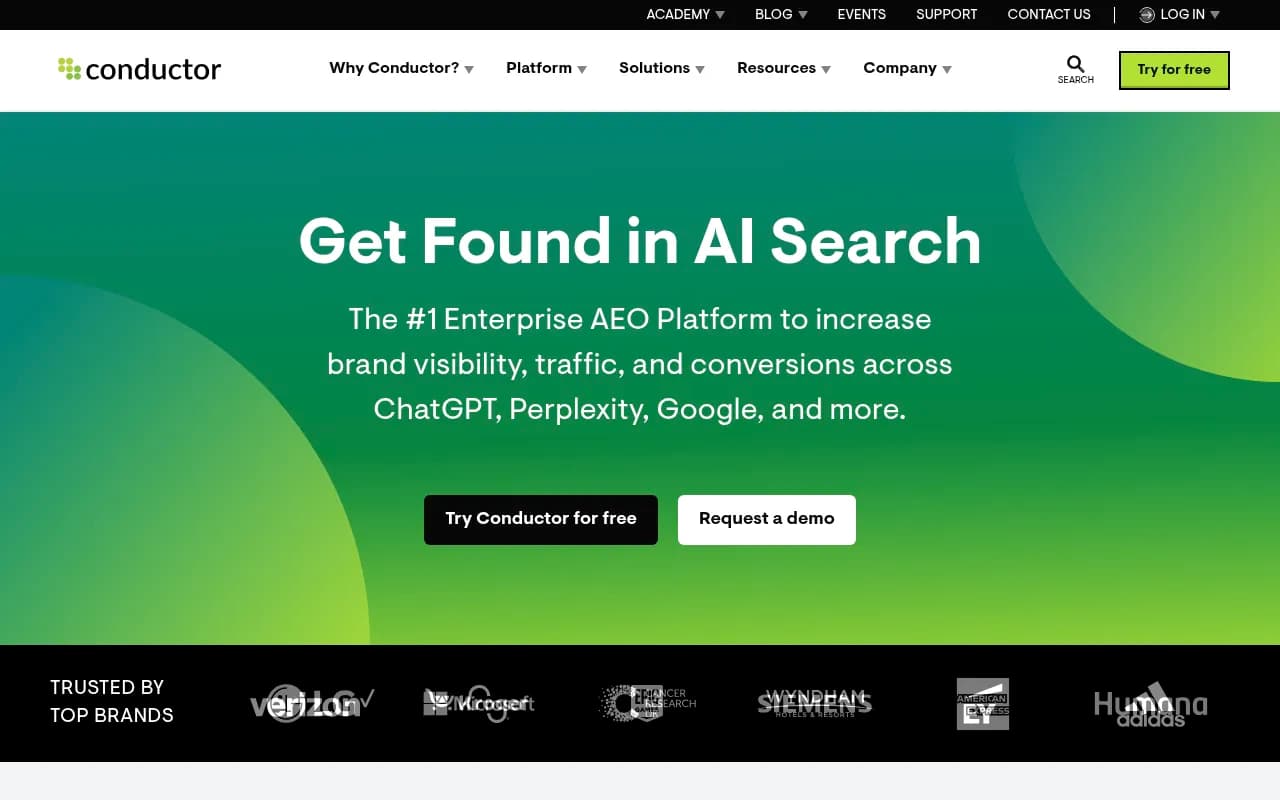
Conductor competes directly with Lumar in the enterprise AEO/GEO space. Both target large brands with complex sites, both offer AI visibility tracking alongside traditional SEO, and both require custom enterprise pricing (expect $10k-$30k+ annually).
Conductor's differentiator is persona-based monitoring. You can customize tracking by persona, intent, topic, brand, and region -- so instead of generic "how does my brand appear in AI," you're tracking "how do CFOs in the Northeast searching for enterprise software see us versus competitors." That granularity matters for enterprise brands with diverse audiences.
The platform includes AI content generation, 24/7 website monitoring, integrations with GA and GSC, and team collaboration features. Conductor emphasizes its "data engine" -- the underlying infrastructure that powers insights across traditional search and AI platforms.
Compared to Lumar, Conductor leans harder into AI visibility and content optimization. Lumar spreads focus across technical SEO, speed, accessibility, and custom analytics. If your primary goal is winning in AI search, Conductor's specialization makes sense. If you need the full technical SEO + speed + accessibility suite, Lumar's breadth wins.
Best for: Enterprise marketing teams at large brands (Verizon, Kroger, Wyndham scale) that want deep persona-based AI visibility tracking and are willing to pay enterprise prices for it.
Trade-offs: Pricing is opaque and high. The 3-week free trial requires a sales demo first. If you're a mid-sized company or agency, the enterprise focus and pricing model make this inaccessible. Conductor also doesn't offer the site speed monitoring or accessibility testing Lumar includes.
Sitebulb
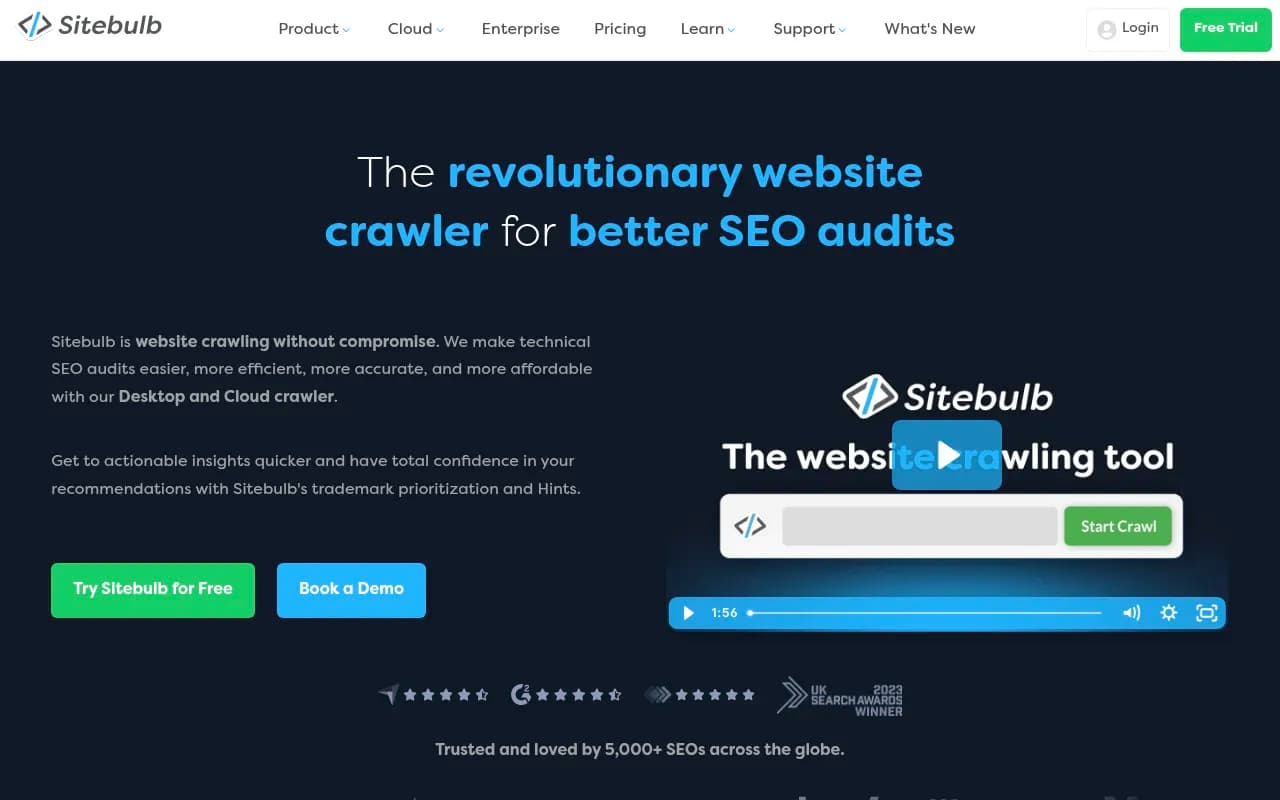
Sitebulb is the anti-Lumar: focused, affordable, and brutally good at one thing -- technical SEO audits. It doesn't try to be an all-in-one platform. It crawls websites, finds issues, prioritizes them with clear explanations, and gets out of your way.
Available as desktop software (from $35/mo Lite, $65/mo Pro) or cloud (from $125/mo Mini for 2 users, $245/mo Small for 5 users, $495/mo Medium for 10 users), Sitebulb crawls up to 10 million URLs and automatically checks 300+ SEO issues. The trademark feature is "Hints" -- contextual explanations for every issue that make technical SEO accessible to non-experts.
Sitebulb Desktop is what most SEO professionals use daily. The cloud version adds real-time team collaboration, unlimited projects, and the ability to run massive crawls without taxing your local machine. Both versions generate client-friendly PDF reports that actually explain problems instead of dumping raw data.
What Sitebulb doesn't do: AI visibility tracking, site speed monitoring beyond basic metrics, accessibility testing, or custom analytics. It's a technical SEO crawler, period. If that's what you need, it's the best value in the market at 1/10th to 1/50th the cost of Lumar.
Best for: SEO professionals, agencies, and in-house teams that need powerful technical auditing without enterprise bloat or pricing. If you're crawling sites under 500k pages and don't need AI visibility features, Sitebulb delivers everything you need.
Trade-offs: Zero AI visibility tracking. No site speed or accessibility modules. If you need GEO/AEO features or the full optimization suite Lumar offers, Sitebulb won't cut it. You'll need to pair it with other tools.
Oncrawl
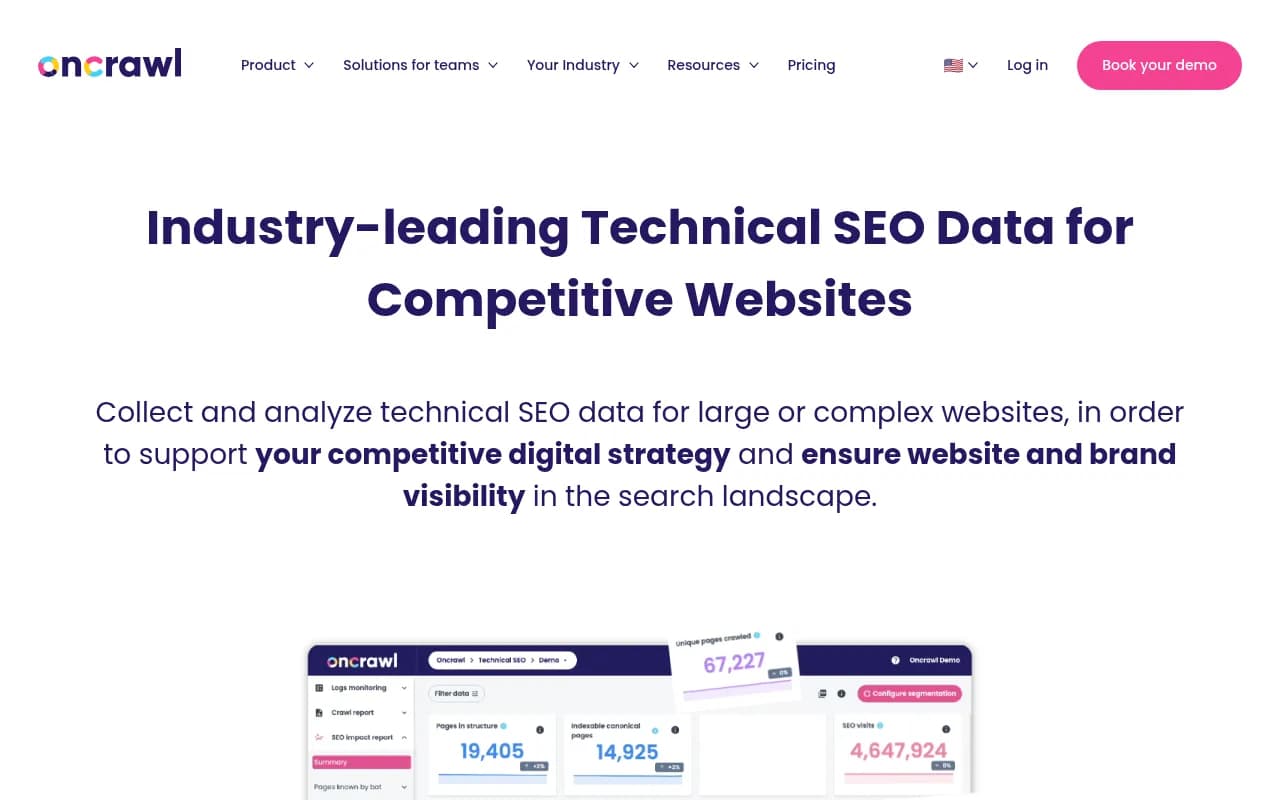
Oncrawl targets the same enterprise audience as Lumar but with a different philosophy. It's built for massive, complex websites -- e-commerce platforms with millions of SKUs, media sites with huge archives, job boards with constantly changing inventory.
The platform combines deep crawling, log file analysis, and AI bot monitoring. That last piece is interesting: Oncrawl detects and tracks hits from AI training bots (OpenAI, Claude, Mistral, Perplexity) and analyzes their crawl behavior. You see which pages AI bots visit, how often they return, and where they encounter errors. Most competitors don't surface this data at all.
Oncrawl's "Lenses" system guides analysis by aligning data views with specific SEO challenges -- content quality, technical health, crawl efficiency. The Content Lens uses AI to evaluate actual content quality and suggest specific improvements, not just flag missing meta descriptions.
Pricing starts around $4,500/year on annual contracts and scales with crawl volume and features. That's cheaper than Lumar's typical entry point but still enterprise-focused. The platform assumes you're managing large, technically complex sites where log file analysis and AI bot tracking justify the investment.
Best for: Enterprise SEO teams at e-commerce sites, media companies, and large publishers that need deep log file analysis and AI bot monitoring alongside traditional crawling. If you're managing millions of pages and want to understand how AI bots interact with your site, Oncrawl delivers.
Trade-offs: No site speed monitoring, no accessibility testing, no custom analytics. The focus is technical SEO and AI bot behavior. The annual contract requirement and enterprise pricing make this inaccessible for smaller teams.
Screaming Frog
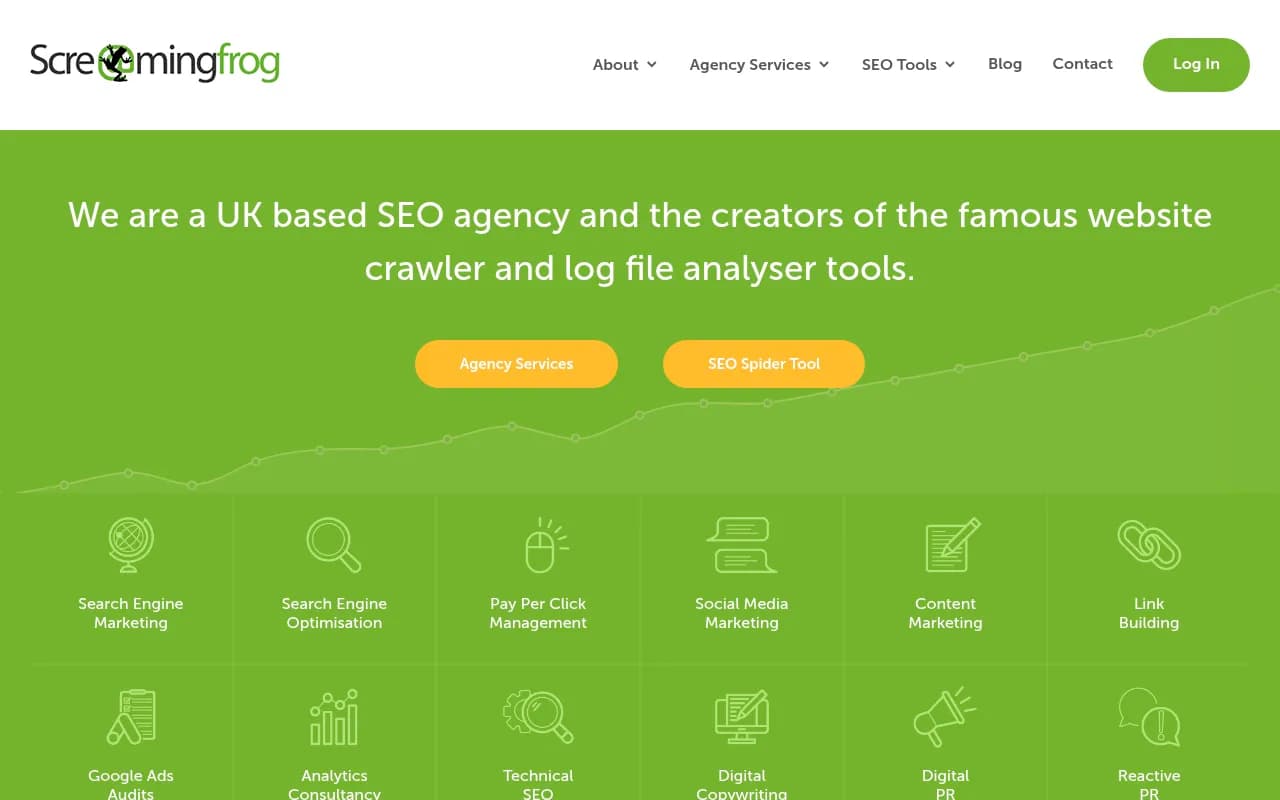
Screaming Frog SEO Spider is the industry-standard desktop crawler that every SEO professional knows. Free up to 500 URLs, £199/year (~$250) for unlimited crawling. It's been around since 2010 and remains the go-to tool for technical audits.
The Spider crawls websites, extracts data, finds broken links, analyzes page titles and meta descriptions, audits redirects, and exports everything to CSV for further analysis. It's fast, reliable, and endlessly customizable through custom extraction, API integrations, and scripting.
What makes Screaming Frog different from enterprise platforms: it's a tool, not a platform. You run crawls manually, analyze the data yourself, and build your own workflows. There's no AI visibility tracking, no automated monitoring, no team collaboration features, no pretty dashboards. Just raw crawling power.
For agencies and consultants, that's perfect. You control the analysis, you own the data, and you're not locked into a subscription that costs more than your rent. For enterprise teams managing dozens of sites with complex workflows, the manual nature becomes a bottleneck.
Best for: SEO consultants, freelancers, and small agencies that need powerful crawling without ongoing costs. If you're comfortable with technical tools and prefer control over automation, Screaming Frog is unbeatable value.
Trade-offs: Desktop-only (though they offer a cloud service for large crawls). No AI visibility features, no automated monitoring, no site speed or accessibility modules. You're doing technical SEO audits manually, not running an optimization platform.
Botify
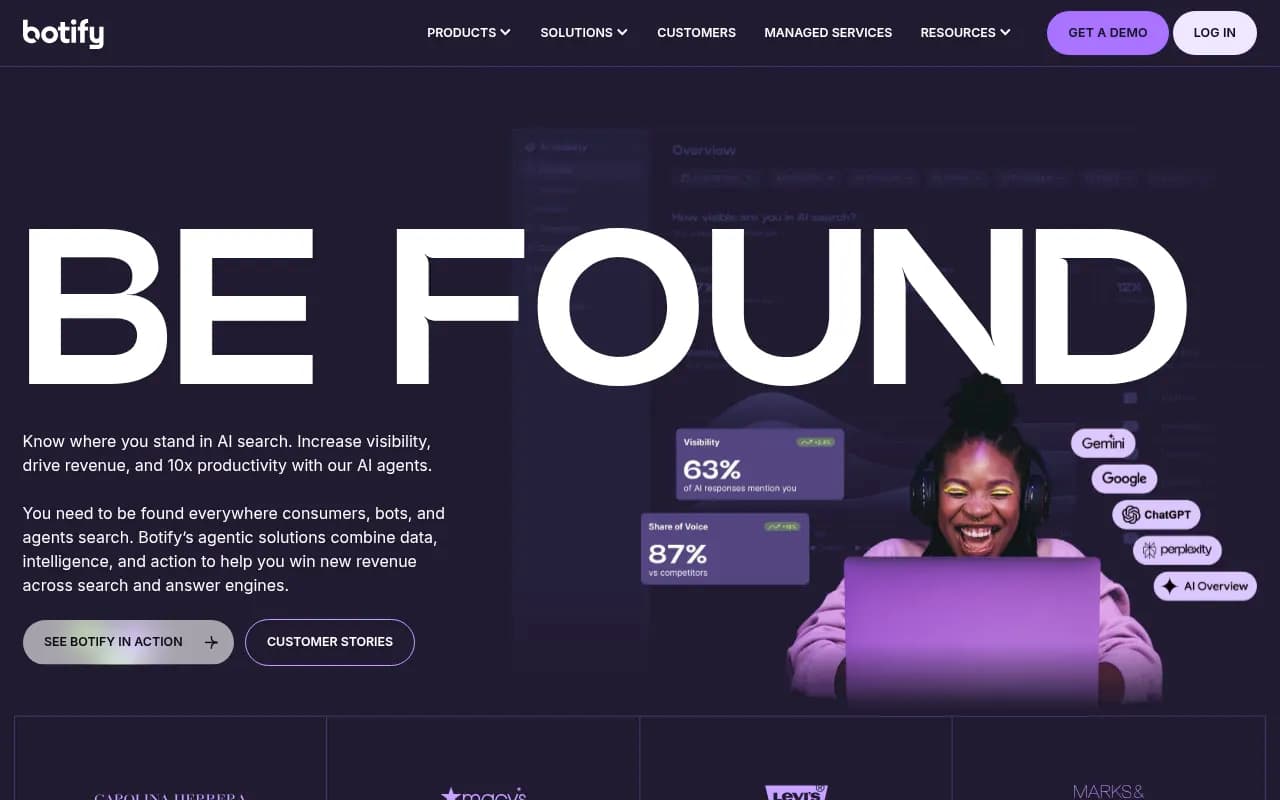
Botify is Lumar's closest competitor in the enterprise space. Both target Fortune 500 brands, both combine traditional SEO with AI visibility (AEO/GEO), both use AI agents to automate workflows, and both charge enterprise pricing starting around $10k/month.
Botify's pitch centers on "agentic solutions" -- AI agents that combine data, intelligence, and action to help you win across search and answer engines. The platform tracks visibility in ChatGPT, Perplexity, Google AI Overviews, and other AI platforms while providing traditional SEO analytics, automated recommendations, and content optimization.
The differentiator is Botify's emphasis on AI agents that 10x productivity. Instead of just showing you problems, the agents suggest fixes, generate implementation tickets, and track results. It's closer to Promptwatch's action-oriented philosophy than Lumar's monitoring-heavy approach.
Botify also emphasizes proving ROI. The platform connects technical improvements to traffic and revenue changes, helping enterprise teams justify SEO investments to executives who care about bottom-line impact.
Best for: Enterprise brands (L'Oreal, Carolina Herrera, Ralph Lauren scale) that want AI-powered automation and need to prove SEO ROI to executive stakeholders. If you're managing complex, multi-million-page sites and have the budget for enterprise tooling, Botify competes directly with Lumar.
Trade-offs: Pricing is opaque and high (expect $10k-$30k+/month). No transparent pricing tiers. The enterprise focus makes this inaccessible for mid-market companies and agencies. Also lacks the site speed and accessibility modules Lumar includes.
ContentKing (now Conductor Website Monitoring)
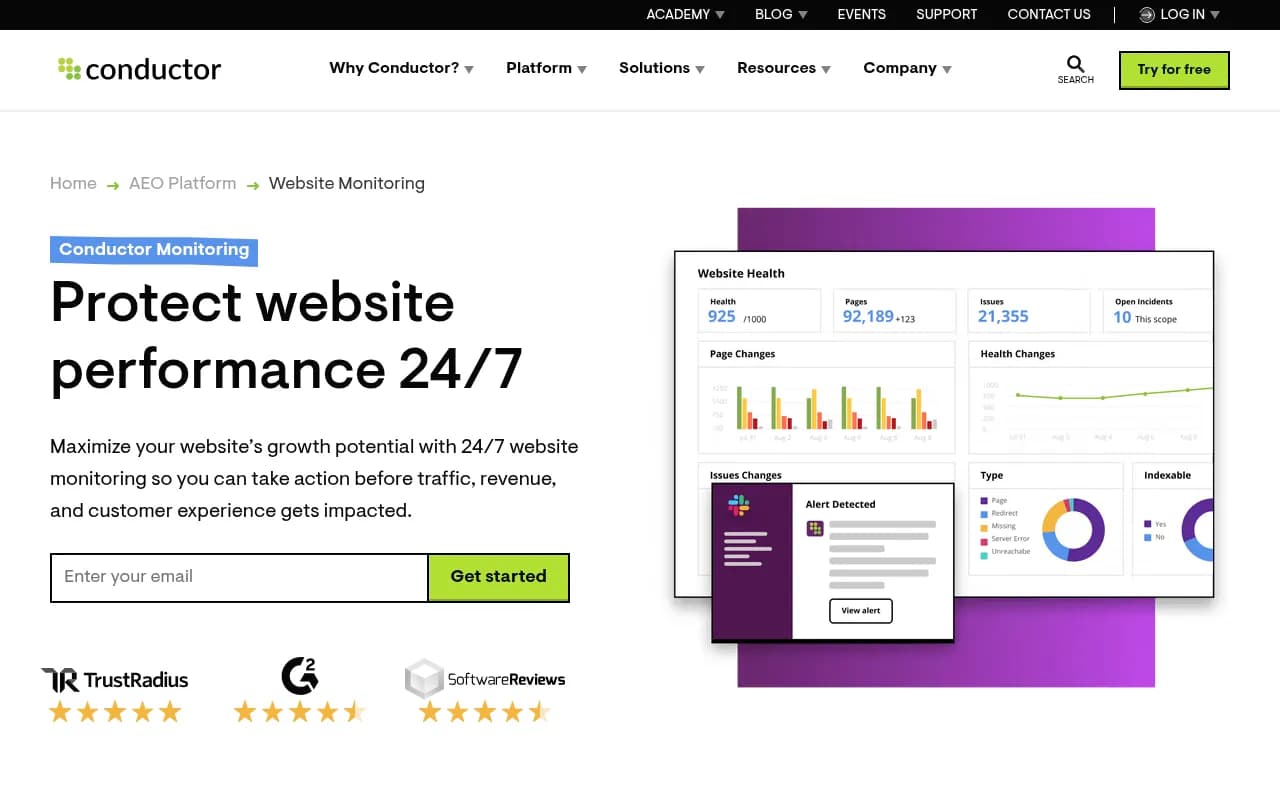
ContentKing was acquired by Conductor and rebranded as Conductor Website Monitoring. It's a real-time monitoring platform that tracks every change on your website 24/7 and alerts you instantly when issues occur.
The core value: you don't wait for weekly crawls to discover problems. ContentKing monitors continuously, so when someone accidentally noindexes your entire site or breaks critical redirects, you know within minutes instead of days. For enterprise sites where a few hours of downtime costs thousands in revenue, that speed matters.
Pricing ranges from $139/mo (Basic: 10k pages) to $1,279/mo+ (Enterprise: 100k+ pages), with Standard at $319/mo and Pro at $449/mo. That's more accessible than Lumar's enterprise-only model but still significant for monitoring alone.
ContentKing doesn't do AI visibility tracking, site speed analysis, or accessibility testing. It's purely real-time technical SEO monitoring. If you need comprehensive optimization, you're pairing this with other tools. If you need to catch issues before they impact traffic, it's purpose-built for that.
Best for: Enterprise SEO teams managing large sites where technical issues cause immediate revenue impact. If you've been burned by silent site-wide noindex tags or broken canonicals that went unnoticed for weeks, ContentKing prevents that.
Trade-offs: Expensive for what it does (monitoring only). No AI visibility, no speed or accessibility features. You're paying for real-time alerts and continuous monitoring, not a full optimization platform.
Siteimprove
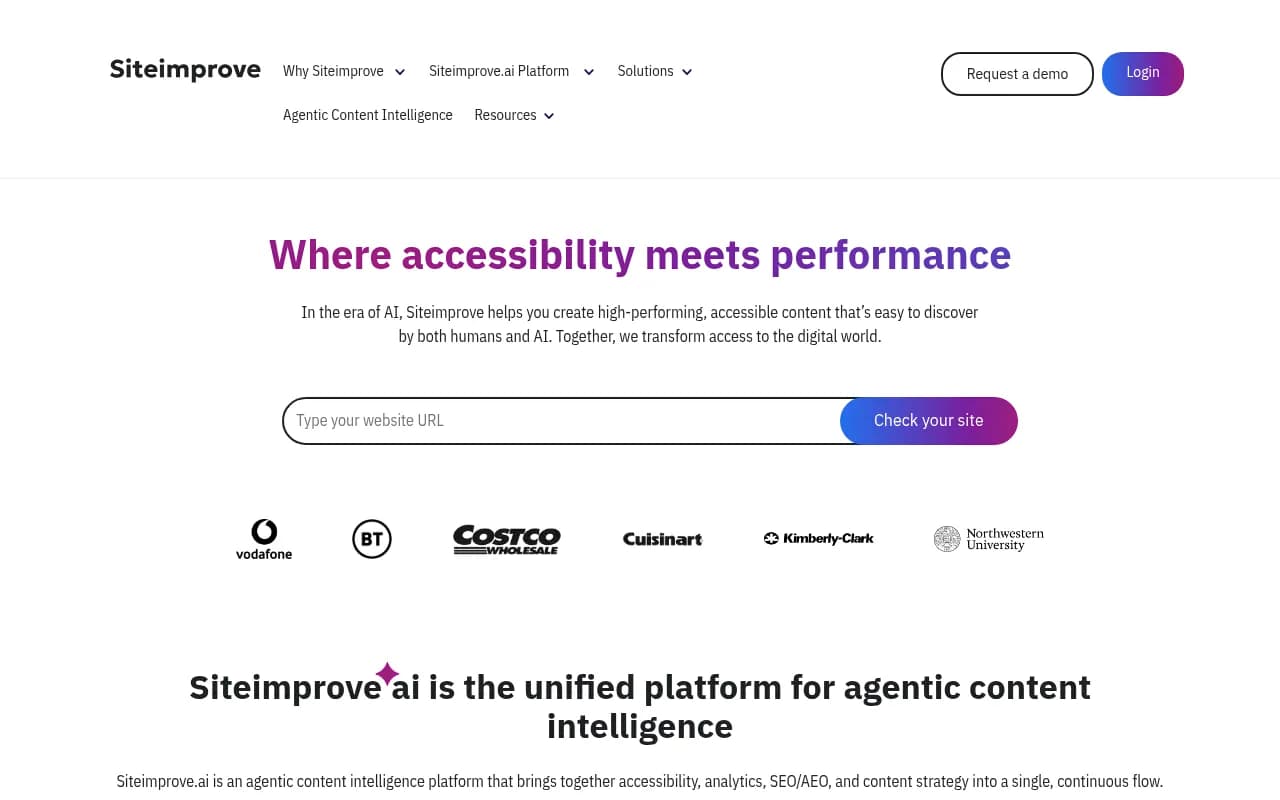
Siteimprove is the odd one out -- it's an enterprise content intelligence platform that combines accessibility compliance, SEO/AEO optimization, analytics, and content strategy. The accessibility focus is what sets it apart.
Used by major brands like Vodafone, BT, and Costco, Siteimprove deploys AI agents to help teams create content that's discoverable, compliant, and optimized for performance. The platform ensures accessibility across web, mobile, social, documents, and applications -- not just websites.
For organizations with legal compliance requirements (government agencies, universities, healthcare, finance), Siteimprove's accessibility testing is the primary draw. The SEO and AI visibility features are solid but secondary. The platform tracks visibility in search engines and LLMs while ensuring content meets WCAG accessibility standards.
Pricing is custom enterprise quotes only, with service tiers (Essential, Expert, Enterprise) but no transparent pricing. Expect costs similar to Lumar and Botify.
Best for: Enterprise organizations (especially government, education, healthcare) where accessibility compliance is mandatory and you need SEO/AEO optimization in the same workflow. If accessibility isn't a priority, other platforms deliver better value.
Trade-offs: Accessibility focus means you're paying for features you might not need. The enterprise-only pricing and opaque quotes make this inaccessible for smaller teams. If you just need SEO and AI visibility without accessibility compliance, other alternatives are more cost-effective.
How to Choose the Right Alternative
Lumar's strength is breadth -- technical SEO, AI visibility, speed, accessibility, and custom analytics in one platform. That's valuable if you need everything and have enterprise budget. For most teams, specialized tools deliver better results for less money.
If AI visibility is your priority: Promptwatch is the only platform that combines monitoring with actionable content gap analysis and AI-powered content generation. You're not just tracking visibility scores -- you're fixing the gaps that cause low visibility in the first place.
If you need comprehensive marketing tools: Semrush offers the broadest feature set across SEO, PPC, content, and social, with AI visibility as an add-on. The all-in-one approach makes sense if you're managing multiple marketing channels.
If technical SEO auditing is the focus: Sitebulb delivers the best value at a fraction of Lumar's cost. The desktop and cloud versions both excel at finding and explaining technical issues.
If you're managing massive enterprise sites: Conductor, Botify, and Oncrawl compete directly with Lumar at similar price points. Conductor emphasizes persona-based AI tracking, Botify focuses on AI agents and automation, Oncrawl specializes in log file analysis and AI bot monitoring.
If real-time monitoring is critical: ContentKing (Conductor Website Monitoring) catches issues before they impact traffic, though you're paying for monitoring alone without the full optimization suite.
If accessibility compliance is mandatory: Siteimprove is the only platform that treats accessibility as a first-class feature alongside SEO and AI visibility.
The common thread: Lumar's all-in-one approach comes at enterprise pricing that most teams don't need to pay. Specialized alternatives deliver better results in their focus areas for significantly less money. Pick the tool that solves your specific problem instead of paying for features you won't use.