Ryte Review 2026
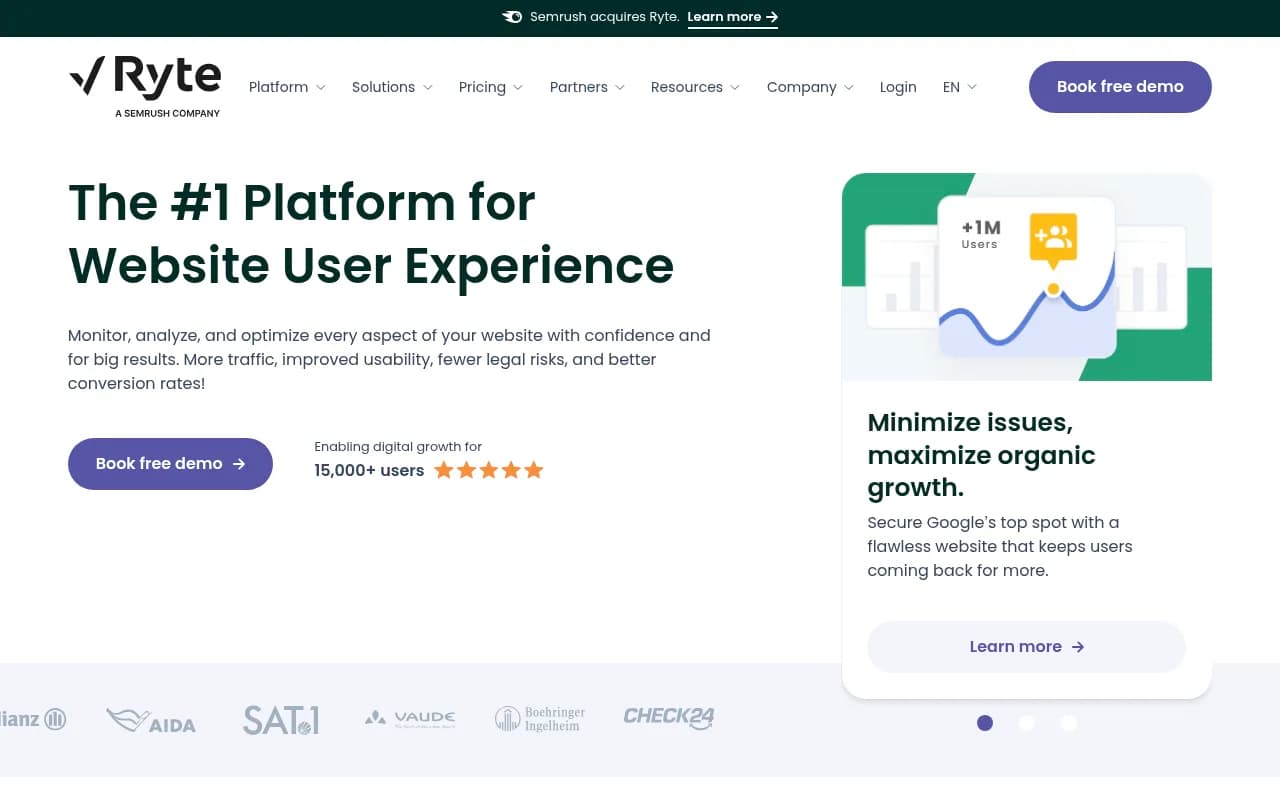
Ryte is a comprehensive website optimization platform used by 15,000+ users including Allianz, Tchibo, and Boehringer Ingelheim. It monitors and analyzes websites across seven pillars: SEO, performance, quality assurance, accessibility, sustainability, compliance, and content. Acquired by Semrush in
Key Takeaways:
- Ryte is an enterprise-grade website optimization platform built around seven pillars of Website User Experience (WUX): SEO, performance, quality assurance, accessibility, sustainability, compliance, and content
- Acquired by Semrush in July 2024, bringing together two major players in the SEO and website optimization space
- Used by major European brands like Allianz, Tchibo, Boehringer Ingelheim, and HomeToGo to monitor technical health, improve rankings, and ensure legal compliance
- Pricing starts at €99/month for basic plans, with business plans at €400/month -- positioned firmly in the enterprise segment
- Strong on technical SEO auditing and compliance monitoring, but lacks AI search visibility features that platforms like Promptwatch offer for tracking brand presence in ChatGPT, Perplexity, and other AI models

Ryte launched as a technical SEO platform and evolved into what it calls a "Website User Experience" (WUX) platform -- a holistic approach to website optimization that goes beyond traditional SEO. The company is based in Germany and serves primarily European enterprise clients, though it has users globally. In July 2024, Semrush acquired Ryte to strengthen its technical SEO capabilities, though Ryte continues to operate as a standalone product with its own branding and feature set.
The platform targets SEO managers, growth teams, and digital marketing departments at mid-to-large companies. If you're managing a single blog or small business site, Ryte is overkill. This is built for teams managing complex websites with thousands of pages, multiple stakeholders, and serious compliance requirements. The case studies feature companies like Personio (55% increase in organic impressions), HomeToGo (improved CTR and restored rankings), and Chefkoch (5 million Google impressions gained).
Website Crawling and Technical SEO Audits
Ryte's core feature is its website crawler that analyzes your entire site for technical SEO issues. You set up a project, point it at your domain, and Ryte crawls up to 50,000 URLs on the basic plan (100,000+ on higher tiers). The crawler runs monthly by default, though you can trigger manual crawls. It checks for broken links, duplicate content, missing meta tags, canonicalization issues, redirect chains, orphaned pages, and hundreds of other technical problems that hurt rankings. The interface groups issues by severity and provides specific recommendations for each one. Unlike Screaming Frog (which requires manual exports and analysis), Ryte stores historical data so you can track how issues evolve over time. The crawler respects robots.txt and can handle JavaScript-heavy sites, though rendering quality isn't quite at the level of tools like Lumar (formerly Deepcrawl).
WUX Score and Seven Pillars Framework
Ryte's differentiator is the WUX Score -- a single metric that combines data across seven optimization categories: SEO, web performance, quality assurance, accessibility, sustainability, compliance, and content. Each pillar gets its own score, and they roll up into an overall WUX Score for your site. The idea is to give executives and stakeholders a simple number they can track, while SEO teams dig into the detailed breakdowns. In practice, the WUX Score is useful for reporting but less actionable than the individual pillar reports. The seven-pillar framework is more marketing than methodology -- most of what Ryte does falls under traditional technical SEO and site quality monitoring. The sustainability pillar, for example, estimates your website's carbon footprint based on page weight and traffic, which is interesting but not something most teams optimize for in 2026.
Performance Monitoring
The performance pillar tracks page load times, Core Web Vitals (LCP, FID, CLS), and resource sizes. Ryte pulls data from real user monitoring (RUM) if you install their JavaScript snippet, or falls back to lab data from synthetic tests. You can see which pages are slow, what's causing the slowness (large images, render-blocking scripts, etc.), and get recommendations for fixes. This overlaps heavily with Google PageSpeed Insights and tools like GTmetrix, but having it integrated with your SEO data is convenient. The performance tracking isn't as granular as dedicated tools like SpeedCurve or Calibre -- you won't get waterfall charts or detailed resource timing breakdowns. It's good enough to identify problem pages and prioritize fixes, but frontend performance engineers will want more.
Accessibility and Compliance Audits
Ryte scans for WCAG 2.1 accessibility violations (missing alt text, low contrast ratios, keyboard navigation issues, etc.) and flags GDPR compliance problems like missing cookie consent banners or third-party trackers. The accessibility checks are based on automated testing, which catches maybe 30-40% of real accessibility issues. You still need manual testing and screen reader validation for full WCAG compliance. The compliance monitoring is more useful -- Ryte tracks which third-party scripts are loading on your pages, whether you have a privacy policy linked, and if your cookie banner meets legal requirements. For European companies facing GDPR fines, this is valuable. The compliance pillar also monitors for mixed content warnings (HTTP resources on HTTPS pages) and expired SSL certificates.
Content Optimization and Keyword Tracking
The content pillar includes a basic content editor with keyword suggestions, readability scoring, and SEO recommendations. You can create content briefs, write drafts, and publish directly to your CMS if you have the right integrations. The keyword research pulls from Ryte's own database, which is smaller than Ahrefs or Semrush's main keyword tools. The content features feel tacked on -- they're fine for basic optimization but not competitive with dedicated content platforms like Clearscope, Surfer SEO, or Frase. Ryte also tracks keyword rankings, but again, this is a secondary feature. If you're already using Semrush or Ahrefs for keyword research and rank tracking, you probably won't switch to Ryte's versions.
Quality Assurance and Monitoring
Ryte can monitor specific pages or site sections for changes and alert you when something breaks. You define "key assets" (homepage, product pages, checkout flow, etc.) and Ryte checks them daily for issues like broken links, missing elements, or unexpected redirects. This is useful for catching problems introduced by CMS updates or developer mistakes before users see them. The monitoring runs separately from the monthly crawl, so you get near-real-time alerts. You can integrate with Slack or email for notifications. The QA features are solid but not as comprehensive as dedicated uptime monitoring tools like Pingdom or UptimeRobot, which check server response times and availability from multiple locations.
Integrations and Data Export
Ryte integrates with Google Search Console (imports search query data and indexing status), Google Analytics (pulls traffic and conversion data), and a handful of CMS platforms (WordPress, Contentful, etc.). The integrations are basic -- you can view GSC data inside Ryte and correlate it with technical issues, but you can't do advanced analysis or custom reporting. Data export options include CSV downloads and a REST API for pulling raw data into your own systems. The API documentation is decent but not as robust as what you'd get from Ahrefs or Semrush. There's no Looker Studio connector or pre-built dashboard templates, so custom reporting requires manual work.
Who Is It For
Ryte is built for enterprise SEO teams and digital agencies managing large, complex websites. If you're a SaaS company with 10,000+ pages, an e-commerce site with dynamic product catalogs, or a media publisher with multiple domains, Ryte makes sense. The platform shines when you need to monitor technical health across a big site, ensure compliance with European regulations, and report progress to non-technical stakeholders. It's less useful for small businesses, bloggers, or startups with simple sites -- the feature set is overkill and the pricing reflects that. Agencies managing multiple client sites can use Ryte's white-label reporting and multi-project dashboards, though the per-project pricing adds up quickly. If you're in the US and don't care about GDPR compliance, you might find better value in tools like Screaming Frog (one-time purchase) or Sitebulb (lower monthly cost).
Pricing and Plans
Ryte's pricing starts at €99/month (roughly $105) for the Basic plan, which includes monthly crawling for up to 50,000 URLs and 100,000 monthly sessions. The Business plan is €400/month ($425) and adds more frequent crawls, higher URL limits, and advanced features like custom alerts and API access. Enterprise pricing is custom and includes dedicated support, SLA guarantees, and white-label options. All plans come with a 10-day free trial. Compared to competitors, Ryte is expensive. Screaming Frog Desktop costs £149/year ($185) for unlimited crawls. Sitebulb is $35-$135/month depending on crawl limits. Lumar (Deepcrawl) is enterprise-only and similarly priced to Ryte. The value proposition depends on whether you need the full WUX suite -- if you only care about technical SEO, cheaper alternatives exist.
Strengths and Limitations
Ryte excels at technical SEO auditing for large websites. The crawler is reliable, the issue categorization is clear, and the historical tracking helps you measure progress over time. The compliance and accessibility monitoring are genuinely useful for European companies. The WUX framework, while somewhat marketing-driven, does encourage teams to think holistically about site quality. The Semrush acquisition should bring better integrations and more resources for product development.
The limitations are significant. The content and keyword features are weak compared to dedicated tools. The performance monitoring is basic. The accessibility checks are automated-only, which misses most real issues. The pricing is high for what you get, especially if you're only using the technical SEO features. The platform feels dated -- the UI hasn't been modernized in years and lacks the polish of newer tools like Lumar or Oncrawl. Most importantly, Ryte is a traditional SEO platform with no visibility into AI search engines. It can't tell you if your brand appears in ChatGPT responses, Perplexity citations, or Google AI Overviews. For that, you need a platform like Promptwatch, which monitors brand presence across 10+ AI models, tracks citations, analyzes content gaps, and helps you optimize for AI search visibility -- capabilities Ryte completely lacks.
Bottom Line
Ryte is a solid technical SEO platform for enterprise teams managing large, complex websites, especially in Europe where compliance monitoring matters. The seven-pillar WUX framework is a useful mental model, even if some pillars feel like feature padding. The Semrush acquisition should improve integrations and development velocity. But the pricing is steep, the content features are weak, and the platform has no answer for AI search optimization. If you need traditional technical SEO auditing with compliance checks, Ryte works. If you want to understand and improve your visibility in AI search engines like ChatGPT, Perplexity, and Claude, Promptwatch is the platform built for that. Best use case: European enterprise SEO teams that need GDPR compliance monitoring and don't mind paying premium prices for a comprehensive technical audit platform.
Tags:
Frequently asked questions
What is Ryte and what does it do?
How much does Ryte cost?
Who owns Ryte?
Is Ryte suitable for small businesses?
What is the difference between Ryte and Semrush?
Does Ryte offer a free trial?
What companies use Ryte?
What are the seven pillars of Ryte's Website User Experience platform?
Similar and alternative tools to Ryte