Summary
- Speed wins: Teams are publishing content that ranks #1 in Google AI Overviews within 72 hours, not weeks or months
- The gap-first approach: Start with competitor analysis to find what AI models want but can't find on your site, then create content to fill that exact gap
- AI-assisted, human-driven: Use AI tools to speed up research and drafting, but keep human judgment at the center of strategy and editing
- Three-day sprint structure: Day 1 for gap analysis and research, Day 2 for writing and optimization, Day 3 for publishing and distribution
- Measurement matters: Track AI visibility (citations in ChatGPT, Perplexity, Claude) alongside traditional SEO metrics to see what's actually working
Why 72 hours matters (and why most teams take 10x longer)
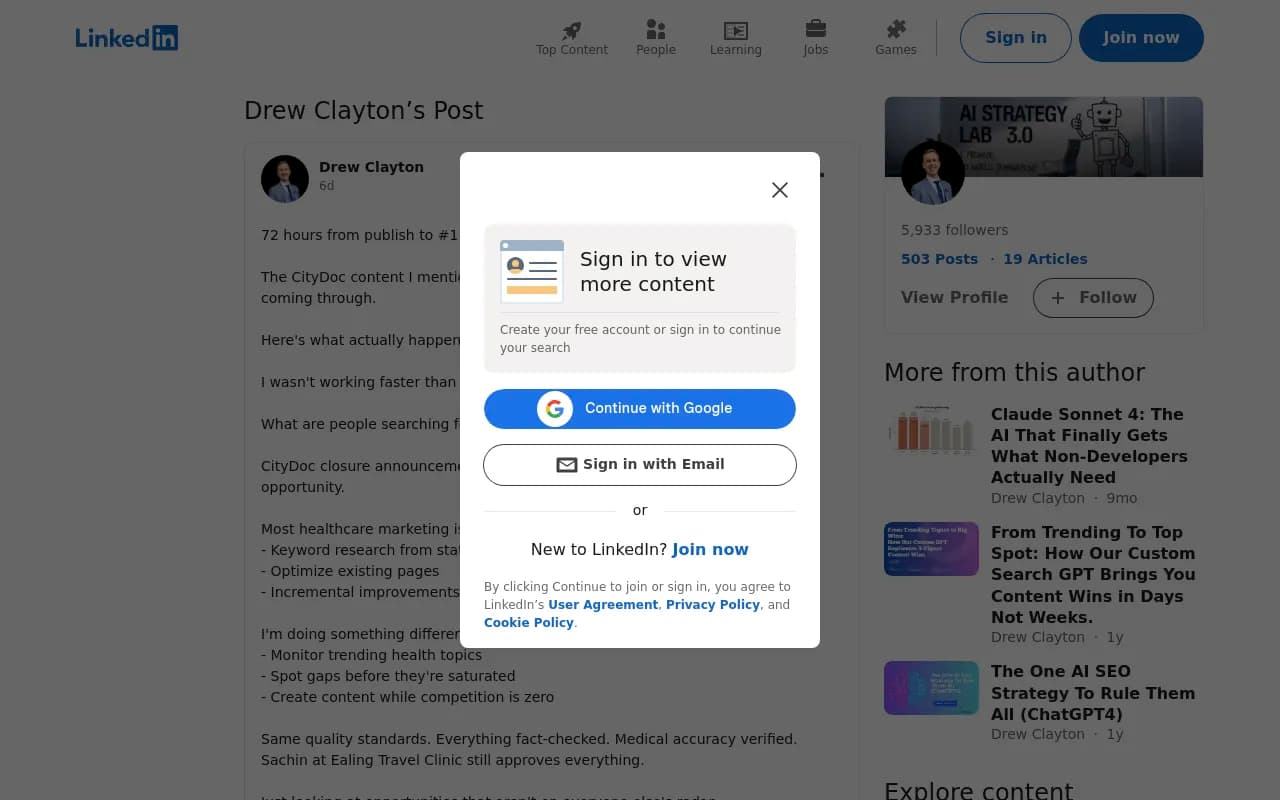
Drew Clayton published a piece of content for CityDoc and watched it hit #1 in Google's AI Overview within 72 hours. Search Console data confirmed it. While enterprise companies with unlimited budgets are seeing 95% of their AI pilots fail completely, small teams are moving fast and winning.
The difference isn't budget or team size. It's the gap between planning and execution. Most content workflows look like this:
- Week 1: Stakeholder meetings and strategy alignment
- Week 2: Keyword research and topic approval
- Week 3: Outline creation and more approvals
- Week 4: First draft
- Week 5-6: Revisions and legal review
- Week 7: Publishing (maybe)
By the time you publish, the competitive landscape has shifted. AI models have indexed new content. Your competitor gap is gone.
The 72-hour sprint flips this. You identify a gap on Monday morning, write on Tuesday, and publish on Wednesday. No committees, no endless revisions, just fast execution with a tight feedback loop.
The gap-first mindset: Start where competitors are invisible
Most content strategies start with "What should we write about?" Wrong question. The right question: "What are AI models looking for that they can't find on our site but can find on competitor sites?"
This is Answer Gap Analysis. Tools like Promptwatch show you exactly which prompts competitors rank for but you don't. You see the specific content your website is missing -- the topics, angles, and questions AI models want answers to but can't find on your site.

Here's what a real gap looks like:
- Prompt: "best project management tools for remote teams"
- Competitor A: Cited 8 times across ChatGPT, Perplexity, Claude
- Competitor B: Cited 5 times
- Your site: Zero citations
That's your gap. That's your 72-hour sprint target.
The gap-first approach works because you're not guessing. You're responding to proven demand. AI models are already citing content on this topic -- just not yours. Create a better version, optimize it for AI visibility, and you can capture those citations.
Day 1: Gap analysis and research (8 hours)
Hour 1-2: Find your gap
Start with competitor analysis. Use a tool like Promptwatch to see which prompts trigger citations for competitors but not you. Look for:
- High citation volume: Prompts that generate 50+ citations per month across AI models
- Low competition: Fewer than 5 domains consistently cited
- Topic relevance: Directly related to your product or expertise
Alternatively, use SE Ranking to identify which keywords trigger AI Overviews. Chris Raulf's team pivoted in 72 hours after analyzing which keywords triggered AI Overviews using SE Ranking's platform.
Pick one gap. Not five, not ten. One. You have 72 hours.
Hour 3-4: Understand the existing content landscape
Now reverse-engineer what's working. Look at the top 3-5 pieces of content AI models are citing for your target prompt:
- What format are they using? (Listicle, how-to guide, comparison table)
- What depth of information? (500 words or 3,000 words)
- What specific questions do they answer?
- What's missing or outdated?
Use Clearscope or Surfer SEO to analyze the semantic topics and keywords present in top-ranking content. This isn't about copying -- it's about understanding the baseline, then exceeding it.

Hour 5-6: Research your unique angle
Here's where human judgment matters. AI can summarize existing content, but it can't create a genuinely differentiated take. Ask yourself:
- What do I know from experience that isn't in these articles?
- What common advice is wrong or outdated?
- What specific use case or persona is underserved?
For example, if the gap is "best project management tools for remote teams," maybe the existing content focuses on Fortune 500 companies. Your angle: "best project management tools for 5-10 person remote teams with under $500/month budget." That specificity makes your content more useful and more likely to get cited for niche prompts.
Hour 7-8: Build your content brief
Create a one-page brief with:
- Target prompt: The exact query you're optimizing for
- Target AI models: ChatGPT, Perplexity, Claude, Google AI Overviews
- Unique angle: Your differentiated take in one sentence
- Key sections: 4-6 H2 headings that structure the piece
- Required elements: Comparison table, tool embeds, screenshots, specific examples
- Word count target: 1,500-2,500 words (enough depth to be authoritative, not so long it's hard to finish in one day)
This brief becomes your north star for Day 2.
Day 2: Writing and optimization (10 hours)
Hour 1-3: First draft with AI assistance
Use an AI writing tool like Jasper, Copy.ai, or Writesonic to generate a first draft based on your brief. But here's the key: treat the AI output as raw material, not finished content.
The AI will give you structure and fill in gaps, but it will also produce generic phrasing, outdated information, and zero original insight. Your job: rewrite every section to add:
- Specific examples: Real company names, real numbers, real case studies
- Personal experience: What you've seen work or fail in practice
- Contrarian takes: Where you disagree with conventional wisdom
- Concrete next steps: Actionable advice readers can implement today
This is the "human-driven, AI-assisted" approach that actually works. AI speeds up the process by 10x, but humans maintain quality and originality.
Hour 4-5: Add comparison tables and tool embeds
AI models love structured data. Add at least one comparison table that makes information scannable:
| Tool | Free tier | Best for | AI visibility |
|---|---|---|---|
| Tool A | Yes | Small teams | High |
| Tool B | No | Enterprise | Medium |
| Tool C | Limited | Agencies | Low |
Embed tool cards liberally. If you mention a tool by name, embed it with [tool:slug] so readers can explore it visually. This isn't just helpful for readers -- it signals to AI models that your content is a comprehensive resource.
Hour 6-7: Optimize for AI citations
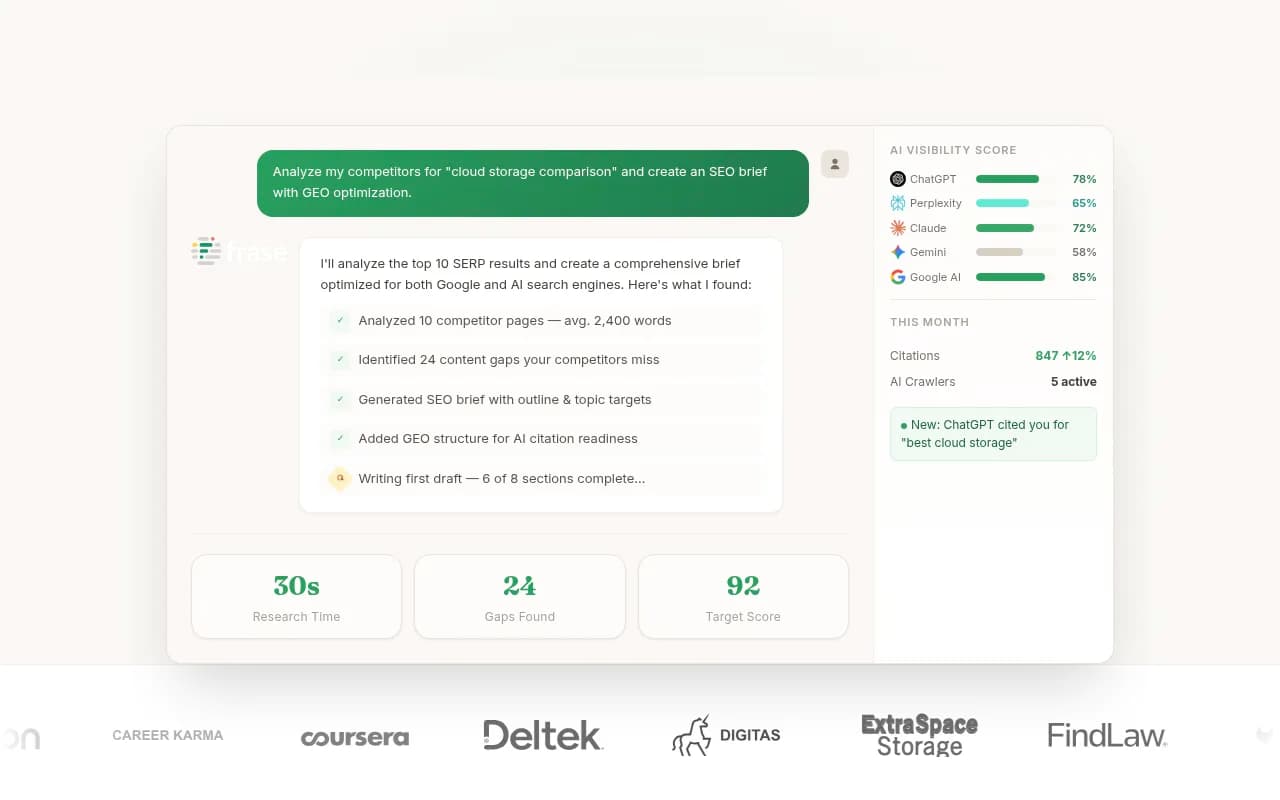
Use Frase or NeuronWriter to optimize your content for both traditional SEO and AI search. Focus on:
- Question-answer format: AI models prefer content that directly answers questions. Use H2 headings as questions when appropriate.
- Structured markup: Add FAQ schema, HowTo schema, or comparison schema where relevant.
- Internal linking: Link to other relevant content on your site to help AI models understand your site's topical authority.
- External citations: Link to authoritative sources (research papers, official documentation, industry reports) to signal credibility.
Hour 8-9: Human editing pass
This is where you remove all the AI tells. Read the draft out loud. Fix:
- Generic transitions ("Additionally," "Moreover," "Furthermore")
- Vague claims ("many experts believe," "studies show")
- Repetitive phrasing (synonym cycling)
- Lack of personality (inject your voice)
The goal: content that sounds like a knowledgeable person talking, not an algorithm assembling plausible sentences.
Hour 10: Final SEO and metadata check
Before publishing:
- Title tag: 60 characters max, includes target keyword, compelling
- Meta description: 155 characters max, includes target keyword, actionable
- URL slug: Short, keyword-rich, readable
- Image alt text: Descriptive, includes relevant keywords
- Internal links: At least 2-3 links to related content on your site
Use Semrush Writing Assistant to score your content for readability, SEO, and tone before hitting publish.
Day 3: Publishing and distribution (6 hours)
Hour 1-2: Publish and submit
Publish the article on your site. Then immediately:
- Submit the URL to Google Search Console for indexing
- Submit to Bing Webmaster Tools
- Ping your sitemap if you have one
Speed matters. The faster search engines and AI crawlers discover your content, the faster you can start ranking.
Hour 3-4: Distribute strategically
Don't just publish and pray. Distribute your content where your target audience and AI crawlers will find it:
- LinkedIn: Post a summary with a link to the full article. Tag relevant people or companies mentioned in the piece.
- Reddit: Find relevant subreddits and share the article if it genuinely answers a question being asked. Don't spam.
- Industry forums: Hacker News, Indie Hackers, niche Slack communities -- wherever your audience hangs out.
- Email list: If you have one, send a dedicated email or include the article in your next newsletter.
AI models index content from Reddit, YouTube, and other platforms. Distribution isn't just about traffic -- it's about creating citation opportunities across multiple sources.
Hour 5-6: Monitor early signals
Within 24-48 hours, you should start seeing early signals:
- Google Search Console: Impressions and clicks for your target keyword
- AI visibility tools: Check Promptwatch, Otterly.AI, or AthenaHQ to see if your content is being cited in AI responses yet
- Social engagement: Shares, comments, and backlinks from your distribution efforts


If you're not seeing any movement after 72 hours, don't panic. Some content takes a week or two to gain traction. But if you followed the gap-first approach and optimized for AI visibility, you should see at least some early signals.
Real results: What 72-hour sprints actually achieve
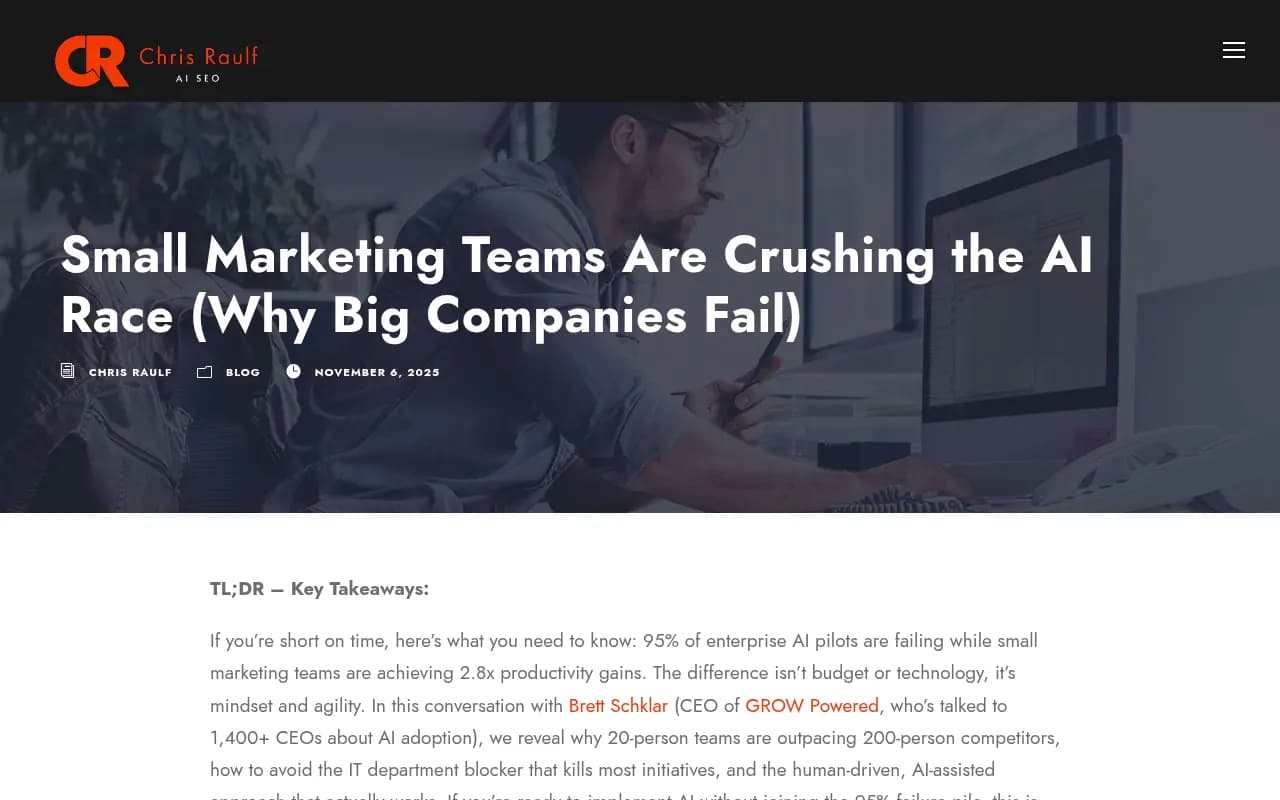
Chris Raulf's 20-person boutique SEO agency is getting cited regularly in AI Overviews and creating content that hits page one in 24 hours. Drew Clayton's CityDoc content ranked #1 in Google's AI Overview within 72 hours of publishing.
These aren't outliers. They're the result of a repeatable process:
- Find a competitor gap using AI visibility data
- Create content that directly fills that gap
- Optimize for AI citations, not just traditional SEO
- Publish fast and distribute strategically
- Track results and iterate
The teams winning in 2026 aren't the ones with the biggest budgets or the most sophisticated AI tools. They're the ones moving fast, learning from data, and executing without waiting for perfect conditions.
Common mistakes that kill 72-hour sprints
Mistake 1: Picking a gap that's too broad
"Best marketing tools" is not a 72-hour sprint. It's a 72-day project. Pick something narrow and winnable: "best email marketing tools for Shopify stores under 1,000 subscribers."
Mistake 2: Letting AI write the whole thing
AI-generated content is now 74% of web content, and it's destroying lead generation. If your article reads like every other AI-generated listicle, AI models won't cite it. Add original research, specific examples, and a unique point of view.
Mistake 3: Skipping the distribution step
Publishing without distribution is like opening a store in the desert. No one will find it. Spend at least 25% of your sprint time on strategic distribution.
Mistake 4: Optimizing for traditional SEO only
Keyword density and backlinks still matter, but AI models care more about structured data, direct answers, and authoritative citations. Optimize for both.
Mistake 5: Not tracking AI visibility
If you're only looking at Google Search Console, you're missing half the picture. Use Promptwatch or a similar tool to track citations in ChatGPT, Perplexity, Claude, and other AI models.
Tools to make your 72-hour sprint faster
Here's a practical toolkit for each phase:
Gap analysis:
- Promptwatch -- Answer Gap Analysis shows exactly which prompts competitors rank for but you don't
- SE Ranking -- Identify which keywords trigger AI Overviews
- Semrush -- Competitor keyword analysis and content gap identification
Content creation:
- Jasper -- AI writing assistant for first drafts
- Clearscope -- Content optimization for Google and AI search
- Frase -- AI-powered SEO and GEO platform that researches, writes, and optimizes
AI visibility tracking:
- Promptwatch -- Track citations across 10 AI models, see crawler logs, generate optimized content
- Otterly.AI -- Affordable AI visibility monitoring
- AthenaHQ -- Track and optimize visibility across 8+ AI search engines
Distribution:
- Zapier -- Automate social sharing and email notifications
- Buffer or Hootsuite -- Schedule social posts across platforms
The action loop: Find gaps, create content, track results
The 72-hour sprint isn't a one-time tactic. It's a repeatable cycle:
- Find the gaps: Use Answer Gap Analysis to see which prompts competitors are visible for but you're not. Identify the specific content your website is missing.
- Create content that ranks in AI: Write articles, listicles, and comparisons grounded in real citation data, prompt volumes, and competitor analysis. This isn't generic SEO filler -- it's content engineered to get cited by ChatGPT, Claude, Perplexity, and other AI models.
- Track the results: See your visibility scores improve as AI models start citing your new content. Page-level tracking shows exactly which pages are being cited, how often, and by which models.
This cycle -- find gaps, generate content, track results -- is what separates optimization platforms from monitoring-only dashboards. Most competitors stop at step one. Promptwatch helps you complete the full loop.
When to run a 72-hour sprint (and when not to)
Good candidates for 72-hour sprints:
- Competitor gap content (you found a specific prompt they rank for, you don't)
- Timely topics (industry news, product launches, seasonal content)
- Low-competition keywords (fewer than 5 domains consistently cited)
- Content updates (refreshing an existing article with new data)
Bad candidates for 72-hour sprints:
- Pillar content (comprehensive guides that require weeks of research)
- Technical documentation (requires engineering review and accuracy checks)
- Legal or medical content (requires expert review and compliance)
- Brand storytelling (requires creative iteration and stakeholder alignment)
Know the difference. Not every piece of content should be a sprint. But if you're trying to capture a competitor gap or respond to a timely opportunity, 72 hours is enough.
Scaling beyond one sprint: Build a content engine
Once you've proven the 72-hour sprint works, scale it. Run one sprint per week. That's 52 new pieces of optimized content per year, each targeting a specific competitor gap.
Over 90 days, this compounds:
- Week 1-4: Publish 4 articles, start seeing early rankings
- Week 5-8: Publish 4 more articles, first batch starts getting AI citations
- Week 9-12: Publish 4 more articles, track which topics drive the most visibility
Averi AI's research shows this approach can achieve up to 340% increase in organic traffic, 190% more demo requests, and thousands of new subscribers in 90 days. The key: consistency and focus on low-competition, high-value gaps.
Use Promptwatch's built-in AI writing agent to generate articles grounded in real citation data (880M+ citations analyzed), prompt volumes, persona targeting, and competitor analysis. This isn't generic SEO filler -- it's content engineered to get cited by AI models.
The mindset shift: From planning to execution
The biggest barrier to 72-hour sprints isn't skill or tools. It's mindset. Most marketing teams are trained to plan, align, and perfect before executing. That works for brand campaigns and product launches. It doesn't work for content that needs to rank in AI search.
The teams winning in 2026 have made a mindset shift:
- From "let's plan the perfect content strategy" to "let's publish something this week and learn from it"
- From "we need stakeholder buy-in" to "we'll show results first, then get buy-in"
- From "AI is a threat to quality" to "AI is a tool that speeds up execution when used correctly"
This doesn't mean abandoning quality. It means recognizing that speed is a feature, not a bug. Publishing fast lets you test hypotheses, gather data, and iterate. Waiting for perfect conditions means your competitors publish first.
Start your first 72-hour sprint today
You don't need a big team, a big budget, or a perfect plan. You need:
- One competitor gap (find it with Promptwatch or SE Ranking)
- One day to research and outline
- One day to write and optimize
- One day to publish and distribute
That's it. Pick a gap right now. Block 8 hours on your calendar for tomorrow. Start the sprint.
In 72 hours, you'll have a published, AI-optimized article targeting a real competitor gap. In 72 days, you'll have 10 of them. In 72 weeks, you'll have built a content engine that consistently ranks in AI search while your competitors are still planning their first piece.
The question isn't whether you can do this. The question is whether you'll start today or wait for perfect conditions that never come.