Key takeaways
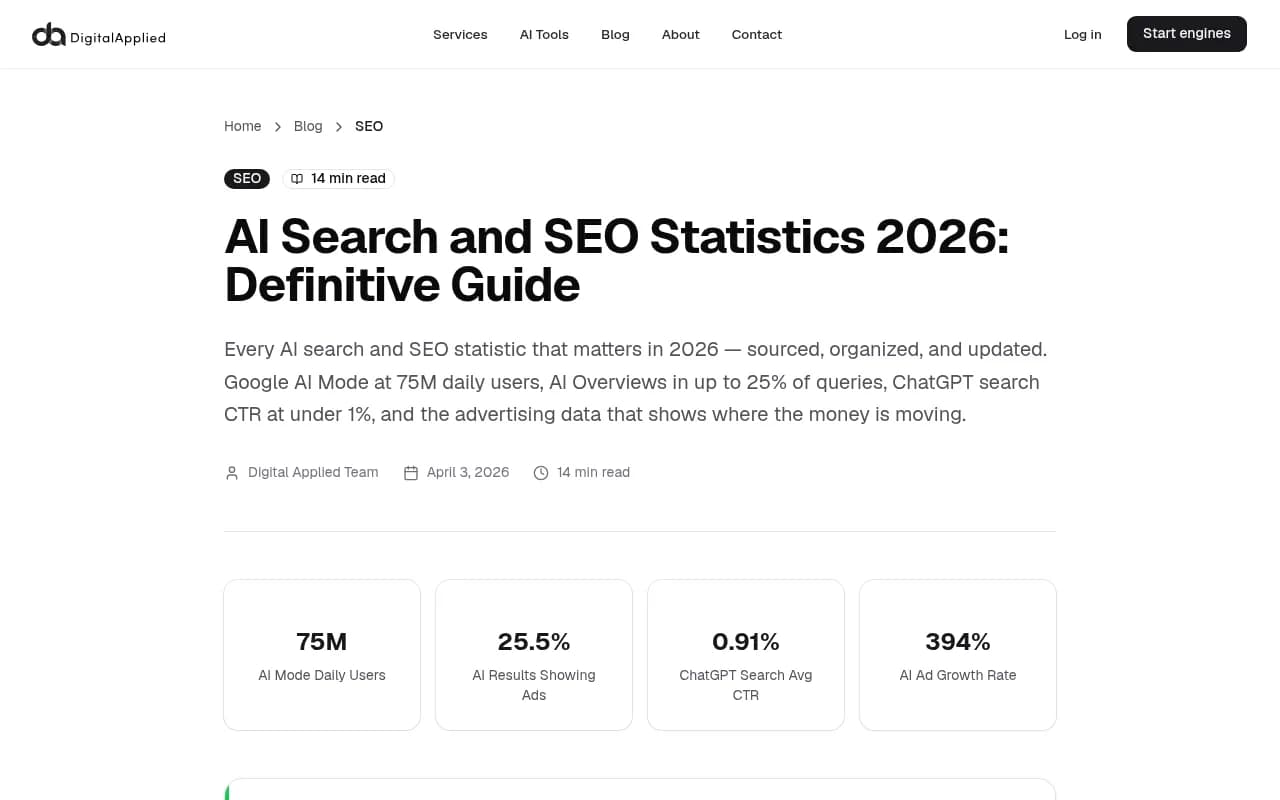
- AI search traffic grew 527% year-over-year, but traditional SEO metrics like organic rank and CTR don't capture this channel at all
- Citation rate -- how often AI models reference your pages -- is the single most predictive metric for AI-driven traffic growth
- Zero-click rates hit 93% in AI Mode, meaning visibility (being cited) matters more than click-through for most AI search scenarios
- Brands with consistent cross-platform entity signals get up to 10x more AI Overview features than competitors
- Only 16% of brands currently track their AI search performance systematically -- which means there's a real competitive gap to exploit right now
AI search traffic is up 527% year-over-year. That number is real -- it comes from Previsible's 2025 AI Traffic Report, which tracked 19 GA4 properties. And yet most marketing teams are still measuring their AI search performance with tools and metrics built for a world where Google's blue links were the only game in town.
That mismatch is expensive. If you're optimizing for traditional rank positions while your competitors are getting cited by ChatGPT, Claude, and Perplexity, you're playing a different game entirely -- and losing it without realizing.
The metrics below are the ones that actually predict whether your AI search presence will grow. Some overlap with traditional SEO. Most don't.
1. Citation rate across AI models
This is the foundational metric. Citation rate measures how often AI models (ChatGPT, Perplexity, Claude, Gemini, etc.) reference your pages when answering relevant queries. It's the AI equivalent of organic rank -- except it's not a position, it's a frequency.
A page that gets cited in 40% of relevant AI responses is doing something right. A page cited in 3% has a problem, even if it ranks #1 on Google.
The reason citation rate predicts traffic growth: AI referrals to top websites spiked 357% year-over-year in 2025, and that growth is concentrated among pages that AI models have "learned" to trust. Once you're in that citation loop, it compounds. Once you're out, you're invisible.
Track citation rate per page, per model, and per topic cluster. The variation across models is often surprising -- a page cited heavily by Perplexity might be ignored by ChatGPT, and vice versa.
Promptwatch tracks citation rate across 10 AI models simultaneously, with page-level granularity.

2. Share of voice in AI responses
Citation rate tells you how often you're cited. Share of voice tells you how often you're cited relative to your competitors. It's the metric that answers: "Are we winning or losing the AI search channel?"
If you appear in 25% of AI responses for your target queries but your top competitor appears in 60%, that gap is your opportunity -- and your risk. Share of voice in AI is not zero-sum in the same way traditional rankings are (multiple sources can be cited in one response), but the attention economics still favor the brands that appear most consistently.
Measure share of voice by topic cluster, not just brand name. You want to know who's winning the "best project management software for remote teams" conversation, not just who gets mentioned when someone types your brand name.

3. Answer gap score
This one is less about tracking what you have and more about quantifying what you're missing. An answer gap is a query where your competitors are being cited but you're not. The size of your answer gap -- how many such queries exist, and how much traffic they represent -- directly predicts your growth ceiling.
If you have a large answer gap, you have a large opportunity. If your answer gap is shrinking, your visibility is growing. It's one of the cleaner leading indicators in this space.
GEO techniques can boost visibility by up to 40% in AI-generated responses (per a 2023 Princeton study), but only if you know which gaps to close first. Prioritizing by prompt volume and competitive difficulty is what separates teams that see results from teams that publish content into the void.

4. Prompt volume and difficulty
Not all queries are equal. A prompt that 50,000 people ask ChatGPT every month is worth more than one asked by 200. Difficulty tells you how hard it is to displace the current citation leaders for that prompt.
This is the AI search equivalent of keyword volume and keyword difficulty -- and it's just as important for prioritization. Teams that ignore prompt volume end up optimizing for queries nobody asks. Teams that ignore difficulty end up frustrated when their content doesn't move the needle on competitive prompts.
The practical use: build a prompt priority matrix. High volume + low difficulty = quick wins. High volume + high difficulty = strategic targets. Low volume + anything = deprioritize.
Some platforms now provide query fan-outs too -- showing how a single prompt branches into related sub-queries. That's useful for understanding the full scope of a topic cluster before you invest in content.


5. AI crawler activity on your site
This one surprises people. Before an AI model can cite your content, its crawler has to read it. If ChatGPT's crawler is hitting your pages infrequently, encountering errors, or being blocked by your robots.txt, your citation rate will suffer regardless of how good your content is.
ChatGPT's user agent activity doubled in a single month in 2025 -- which tells you these crawlers are active and hungry for fresh content. Monitoring which pages they visit, how often they return, and what errors they encounter gives you a technical foundation for everything else.
Common issues that suppress AI crawler activity: slow page load times, aggressive bot-blocking rules, thin or duplicate content that crawlers deprioritize, and pages that aren't internally linked (so crawlers never find them).
Tools like DarkVisitors can help you see which AI agents are visiting your site.
6. Content freshness score
Pages not updated in 90+ days may see significant visibility drops as AI systems prioritize recent content. This is a structural shift: AI models with real-time web access (ChatGPT, Perplexity, Google AI Mode) actively favor fresh sources over stale ones.
Content freshness score is a measure of how recently your cited pages were updated and how that compares to competing sources. If your main competitor refreshes their comparison pages monthly and you last touched yours in 2024, you're at a systematic disadvantage.
This doesn't mean rewriting everything constantly. It means identifying which pages are in active citation competition and building a refresh cadence for those specifically. A quarterly audit of your top-cited pages is a reasonable starting point.
The freshness signal also interacts with entity authority -- a trusted domain that publishes fresh content gets a multiplier effect. A new domain publishing fresh content gets less benefit.
7. Entity authority score
This is probably the most underappreciated metric on this list. Entity authority measures how consistently AI models "know" who you are -- your brand, your products, your expertise -- across different contexts and queries.
Brands with consistent cross-platform entity signals get up to 10x more AI Overview features than competitors. That's a massive multiplier, and it comes from something most teams don't think about: whether your brand is described consistently across your website, Wikipedia, Wikidata, LinkedIn, industry publications, and the other sources AI models use to build their understanding of the world.
If ChatGPT has a confused or thin understanding of what your company does, it won't cite you confidently -- even if your content is excellent. Entity authority is the trust layer that makes everything else work.
Practical steps: audit how your brand is described across authoritative sources, fix inconsistencies, and build out your presence on platforms AI models draw from heavily (structured data on your site, third-party mentions, industry directories).
8. Zero-click visibility rate
Zero-click searches now account for 60% of all queries -- and when AI Overviews are present, that climbs to 83%. In AI Mode, it hits 93%. This means the traditional metric of "traffic from search" is increasingly incomplete as a measure of search performance.
Zero-click visibility rate measures how often your brand or content appears in AI responses even when no click happens. It's a brand awareness metric as much as an SEO metric, and it matters because users who see your brand cited repeatedly in AI responses are more likely to search for you directly, recognize your brand in ads, and convert when they do eventually visit.
This is a real shift in how to think about ROI. Brands cited in AI Overviews earn 35% more organic clicks than those appearing only in traditional results -- even accounting for zero-click behavior. Visibility drives downstream behavior even without an immediate click.
Measure this by tracking brand mention frequency in AI responses across your target query set, not just traffic from AI referrals.
9. AI traffic attribution rate
Here's where things get messy. Most teams undercount AI search traffic because it shows up in analytics as direct traffic, referral traffic from unfamiliar domains, or gets lost entirely. The actual volume of AI-driven visits is higher than what most GA4 dashboards show.
AI traffic attribution rate measures what percentage of your AI-driven traffic you can actually identify and attribute. Getting this number up requires either a tracking code snippet that captures AI referral signals, server log analysis (which catches visits that analytics scripts miss), or integration with tools that specialize in AI traffic identification.
Why does this matter for predicting growth? Because if you can't measure it, you can't optimize it. Teams with high attribution rates can connect specific content investments to actual revenue. Teams with low attribution rates are flying blind -- they might be getting significant AI traffic and not know it.
ChatGPT search delivers roughly 0.84-1.3% CTR on average, but sidebar citations achieve 6-10% CTR -- comparable to Google's organic positions 4-10. Knowing which type of citation you're getting, and from which model, changes your optimization strategy significantly.
10. Citation sentiment and context
The final metric is qualitative but increasingly measurable. It's not just whether AI models cite you -- it's how they cite you. Are you cited as a recommended solution, a cautionary example, a neutral reference, or a secondary source? The context of your citation shapes how users perceive your brand.
Citation sentiment analysis looks at the language surrounding your brand mentions in AI responses. A citation that says "many users report issues with X's customer support" is technically a citation -- but it's not the kind that drives growth.
This metric also captures something important about AI search that pure visibility scores miss: AI models synthesize and editorialize. They don't just list sources; they make recommendations. Being cited favorably as a top recommendation is worth far more than being cited as one of many options.
Track this by sampling AI responses that include your brand and categorizing the context: recommended, mentioned neutrally, mentioned with caveats, or mentioned negatively. The distribution tells you whether your AI search presence is actually working in your favor.
How these metrics work together
These 10 metrics aren't independent. They form a system:
| Metric | What it measures | Lag/Lead indicator |
|---|---|---|
| Citation rate | Core AI visibility | Lagging |
| Share of voice | Competitive position | Lagging |
| Answer gap score | Growth opportunity | Leading |
| Prompt volume & difficulty | Prioritization input | Leading |
| AI crawler activity | Technical foundation | Leading |
| Content freshness score | Crawl preference signal | Leading |
| Entity authority score | Trust multiplier | Leading |
| Zero-click visibility rate | Brand exposure | Lagging |
| AI traffic attribution rate | Revenue connection | Lagging |
| Citation sentiment | Quality of visibility | Lagging |
The leading indicators (answer gaps, crawler activity, entity authority, freshness, prompt volume) predict what your lagging indicators (citation rate, share of voice, traffic) will look like in 3-6 months. If you're only tracking the lagging ones, you're always reacting. Track the leading ones and you can get ahead of the curve.
Tools worth knowing about
A few platforms have built dashboards specifically around these metrics:
The honest reality is that this space is moving fast. Platforms that existed a year ago have added features; new ones have launched. The metrics above are stable -- the tools that measure them are still evolving. Pick one that covers your highest-priority metrics and build from there, rather than waiting for a single platform to do everything perfectly.
Where to start
If you're new to tracking AI search performance, don't try to implement all 10 metrics at once. Start with three:
- Citation rate -- run a sample of 20-30 target prompts through ChatGPT and Perplexity and manually note whether your site appears. This gives you a baseline.
- Answer gap score -- identify 5-10 prompts where competitors appear but you don't. These are your first content targets.
- AI crawler activity -- check your server logs or use a tool like DarkVisitors to confirm AI crawlers are actually reaching your key pages.
From there, layer in the others as your measurement infrastructure matures. The brands that will win AI search in 2026 aren't necessarily the ones with the biggest budgets -- they're the ones that started measuring the right things early enough to act on what they found.