Key takeaways
- AI Overview presence is not deterministic. It shifts by query, location, device and time, so a tracker needs repeat sampling and archived evidence, not a single "visibility score."
- Search Console does not show which URLs are cited in AI Overviews, which is why purpose-built trackers exist.
- AI Overviews cite very different sources than ChatGPT. Per-engine breakdowns matter more than one blended "AI search" number.
- The features that separate good tools from dashboards: URL-level citations, country and device segmentation, side-by-side organic comparison, and a path from data to action.
- Check the pricing page of any tool you shortlist before committing. Features and limits change quickly.
Why AI Overview tracking is its own job
A classic rank tracker answers a simple question: what position is this URL in for this keyword? An AI Overview doesn't have a position in that sense. Google builds the answer with a customized Gemini model, pulls from multiple sources, and links a handful of them. You might be cited for a query on one person's phone and left out for the same query on someone else's laptop five minutes later.
That changes what you should demand from a tool. The question moves from "do we rank?" to "are we cited, which URL was cited, who else was cited, and can I prove it?"
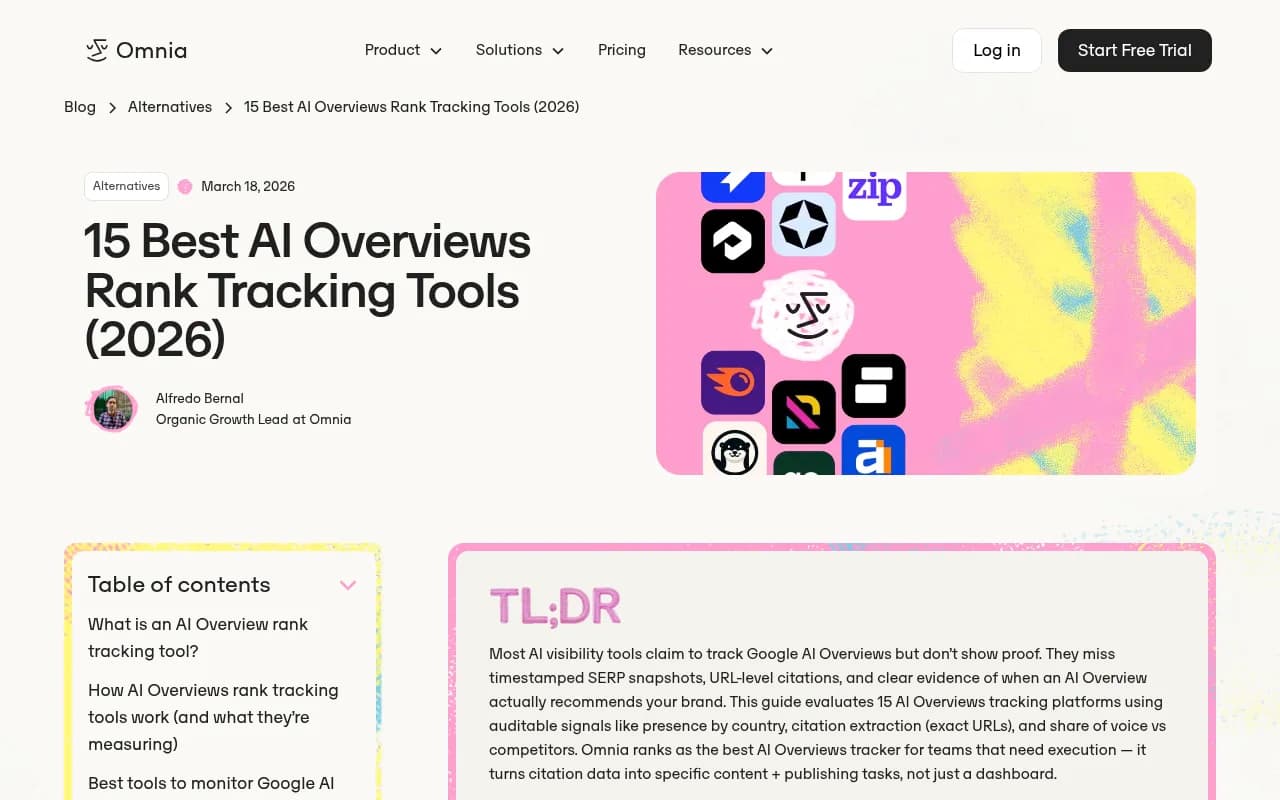
There's also a data problem. Omnia's roundup of AI Overview trackers points out that Google Search Console doesn't show which specific URLs are referenced inside AI-generated answers. You get impressions mixed into the broader performance report, but not the citation list. So you need a third-party tool, and the quality gap between those tools is large.
A caveat before we go on: most of the public roundups on this topic are written by vendors who rank themselves first. I used them for criteria, not for verdicts. Test anything you shortlist on your own keywords.
The 10 features that matter
1. Real SERP data, not just model API output
This is the first thing I'd ask any vendor. Where does the data come from? Some tools query an API and infer what Google would show. Others monitor the actual user interface in the target country. These can differ, because what a user sees in a live AI Overview, including citations and ordering, is not always what an API returns.
For AI Overviews specifically, you want collection from the real Google results page. Promptwatch, for example, collects from the real interfaces of Google AI Overviews, AI Mode and ChatGPT per country and language rather than relying on API outputs.

2. URL-level citation extraction
A tool that tells you "your brand appeared" is half useful. You need the exact cited URLs, for your site and for competitors. Without that you can't tell which page earned the citation, which page should have and didn't, or whether the cited page is even the one you'd want a customer landing on.
Seobility, SE Ranking and Omnia all list cited domains or URLs in some form. The depth varies, so check a sample export before you pay.
3. Timestamped, archived evidence
Because AI Overviews change so often, a number without proof is hard to trust. The better tools keep a dated snapshot of the SERP so you can see what Google actually displayed on a given day. This matters when a client or boss asks "wait, we were cited last month, what happened?"
It also matters for debugging. If your citations vanish on one date, a snapshot history lets you line that up with a content change, a site migration or a Google update.
4. Repeat sampling and a way to handle variance
One check per keyword per week will mislead you. Since presence is non-deterministic, a decent tracker either runs prompts multiple times or runs them daily and shows you a trend, not a coin flip. Ask how often each keyword is checked and how the tool smooths noise.
Refresh frequency and history retention go together. A tool that checks daily but keeps only 30 days of history limits your ability to see seasonal shifts.
5. Country, city and device segmentation
AI Overviews vary by location and device. If you sell in several markets, a single global number is almost meaningless. Look for a country selector at minimum. Tools like SE Ranking expose country and device segmentation inside the tracker.
Local businesses need more. Some platforms let you pin a monitor to specific coordinates so Google AI Overviews answer as if asked from that spot. That is useful for "near me" queries and multi-location brands, and Promptwatch offers it on its Business tier and above.
6. Side-by-side comparison with organic rankings
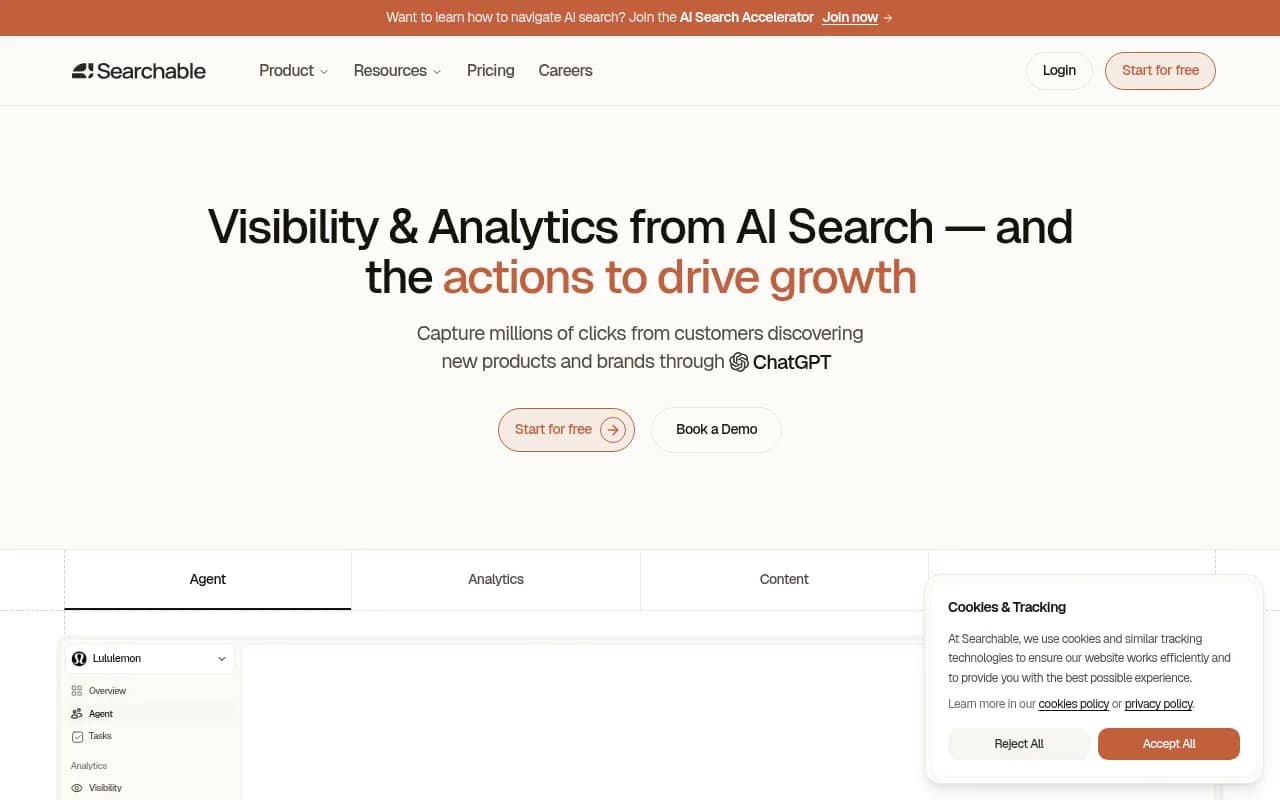
This one is underrated. You want to see, for the same keyword, your organic position and whether you're cited in the AI Overview. Searchable's own roundup flags this "reconciliation with traditional ranking" as a key criterion, and I agree even though they're a vendor.
Why it matters: a page ranking in the top 10 but never cited is a different problem from a page that's cited but ranks on page two. The first is usually about how extractable your content is. The second is more about authority.
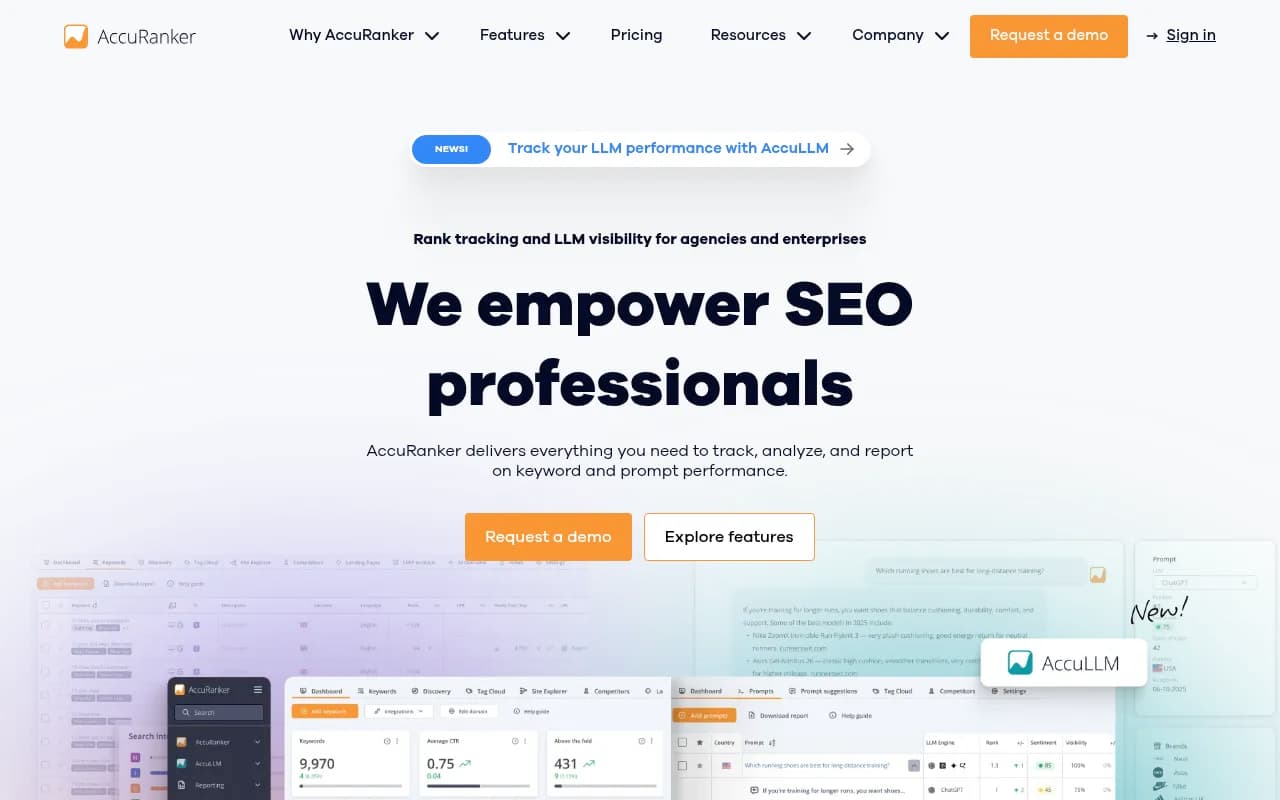
Rank trackers that added AI tracking to an existing SERP product tend to do this best. Advanced Web Ranking, SE Ranking and AccuRanker come at it from the rank tracking side.
7. Share of voice against competitors
Being cited is binary. Share of voice tells you how much of the pie you hold. Unlike organic search, an AI Overview cites several sources, so the competition is collaborative-ish: you can be one of five links and still be losing if your rivals appear in 80% of the answers and you appear in 20%.
Look for a tool that auto-discovers competitors, because the sites AI Overviews cite are often not the competitors you'd name in a sales meeting. Wikipedia, YouTube, Reddit and Quora show up constantly.
8. Classification of cited sources and content types
This is where I think a lot of cheaper tools fall short. The mix of what AI Overviews cite shifts, and a tracker that classifies it gives you a roadmap.
Promptwatch Data shows how much this moved in 2026. In its AI Overviews citation types report for July 2026, listicles averaged 18.0% of classified citations and product pages 16.3%, with how-tos at 15.1% and news articles at 13.5%. From July 28, product pages were the most cited format every day. Listicles had averaged about 26% in Q1, and product pages were near 9% in January. Video grew from roughly 2.7% to over 6% over the same stretch.
If your tracker can't show format mix over time, you're optimizing blind.
A related point: Google cites its own properties. Promptwatch's June 2026 AI Overview citation share data (May 31 to Jun 26, month-to-date) put YouTube at 4.16%, Reddit at 2.72% and google.com at 2.30%, all 2026 highs. YouTube plus google.com means roughly 6.5% of sources are Google's own surfaces. A tracker should capture and label those separately, not bury them in an "other" bucket. (June was a partial month, so treat momentum claims carefully.)
9. Per-engine breakdowns, not one blended score
Searchable reports that of 80,525 prompt-and-domain pairs cited by AI Overviews in its data, only 25.2% were also cited by ChatGPT. Different engines, different sources. Our own numbers point the same way. In Promptwatch's social media citations data for Sep 28 to Oct 4, 2026, social platforms made up 12.2% of AI Overviews citations versus 0.46% for ChatGPT, roughly 26 times higher. Within AI Overviews, YouTube was 4.28%, Facebook 2.38%, Reddit 2.15%, Instagram 1.61% and LinkedIn 1.55%.
So if you only care about AI Overviews, don't accept a tool that averages across ChatGPT, Perplexity and Google into one number. And if you care about all of them, make sure the tool tracks each separately. ChatGPT's Reddit behavior alone is a good example of why: reddit.com's share of ChatGPT citations collapsed from roughly 4% to 0.5% on August 14, 2026, while Google surfaces declined far more gradually.
10. A path from data to action
This is the feature that decides whether your tracker pays for itself. A dashboard that says "you were not cited" is a to-do you already knew you had. What you want is the why and the fix: which prompts you're missing, which competitor pages win them, what your page lacks, and ideally a way to create and publish the content and see if it worked.
Promptwatch leans hard into this with content gap analysis, an Action Board of prioritized tasks and a Content Agent that can plan, write and publish to WordPress, Webflow or Framer. Omnia and Searchable pitch similar execution layers. Pure monitors can still be the right choice if you already have a content team and just need clean data.
How the main options compare
This table sums up how a few well-known tools line up on the criteria above. I'm working from vendor descriptions and public feature lists, so verify specifics on each pricing page.
| Tool | Starts from | Strongest on | Watch out for |
|---|---|---|---|
| Promptwatch | Rank tracking of AI engines plus content workflow | Real UI data, crawler logs, content gap analysis, action loop | More than you need if you only want a keyword flag |
| SE Ranking | Classic rank tracker | Organic and AI Overview side by side, country and device segments | Less depth on non-Google AI engines |
| Advanced Web Ranking | Classic rank tracker | SERP accuracy and long history | Fewer content-side features |
| Omnia | AI visibility platform | Timestamped SERP evidence, URL citations, execution tasks | Vendor-authored claims, test on your queries |
| Searchable | AI visibility platform | Multi-engine tracking with mention, citation and position | Check AI Overview position depth |
| Seobility | SEO suite | Presence flag inside rank tracker, citation list | Lighter on competitor analysis |
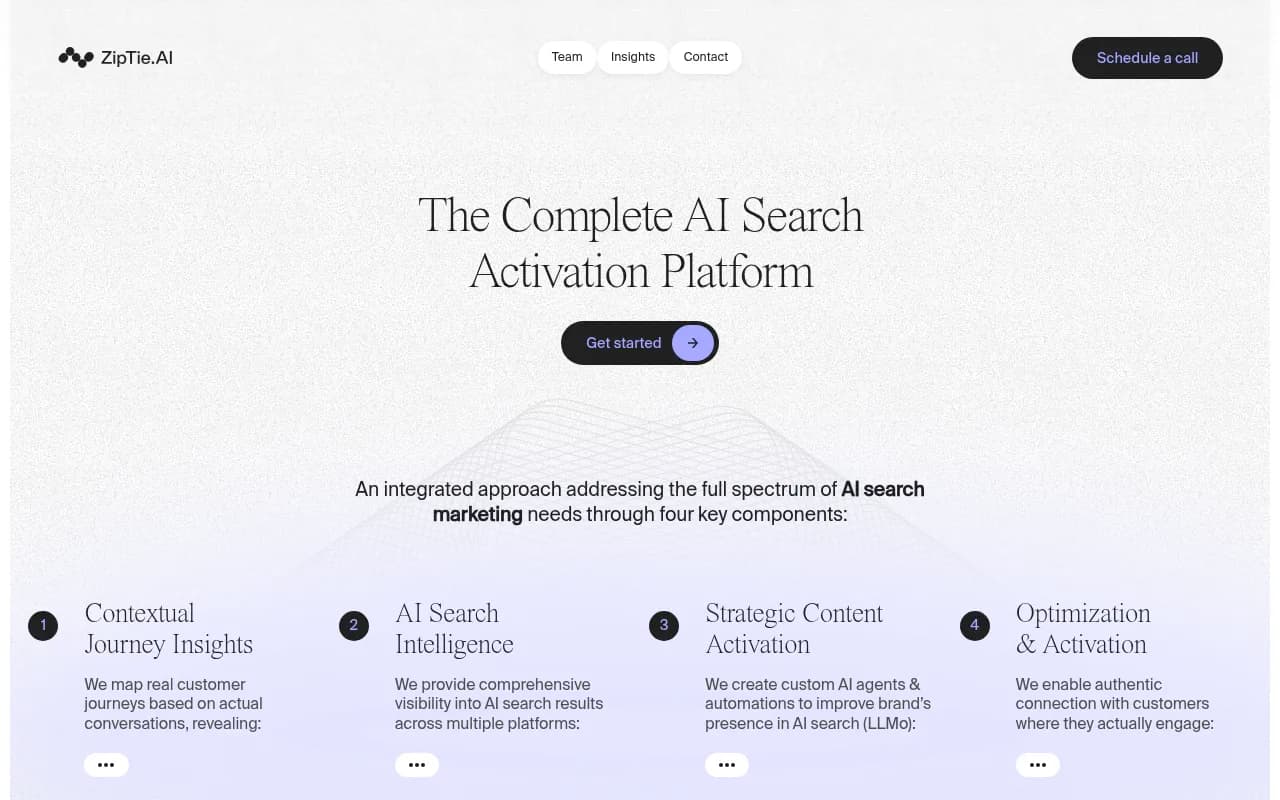
| ZipTie | AI search tracker | Simple onboarding, bulk keywords, small-team pricing | Narrower reporting |
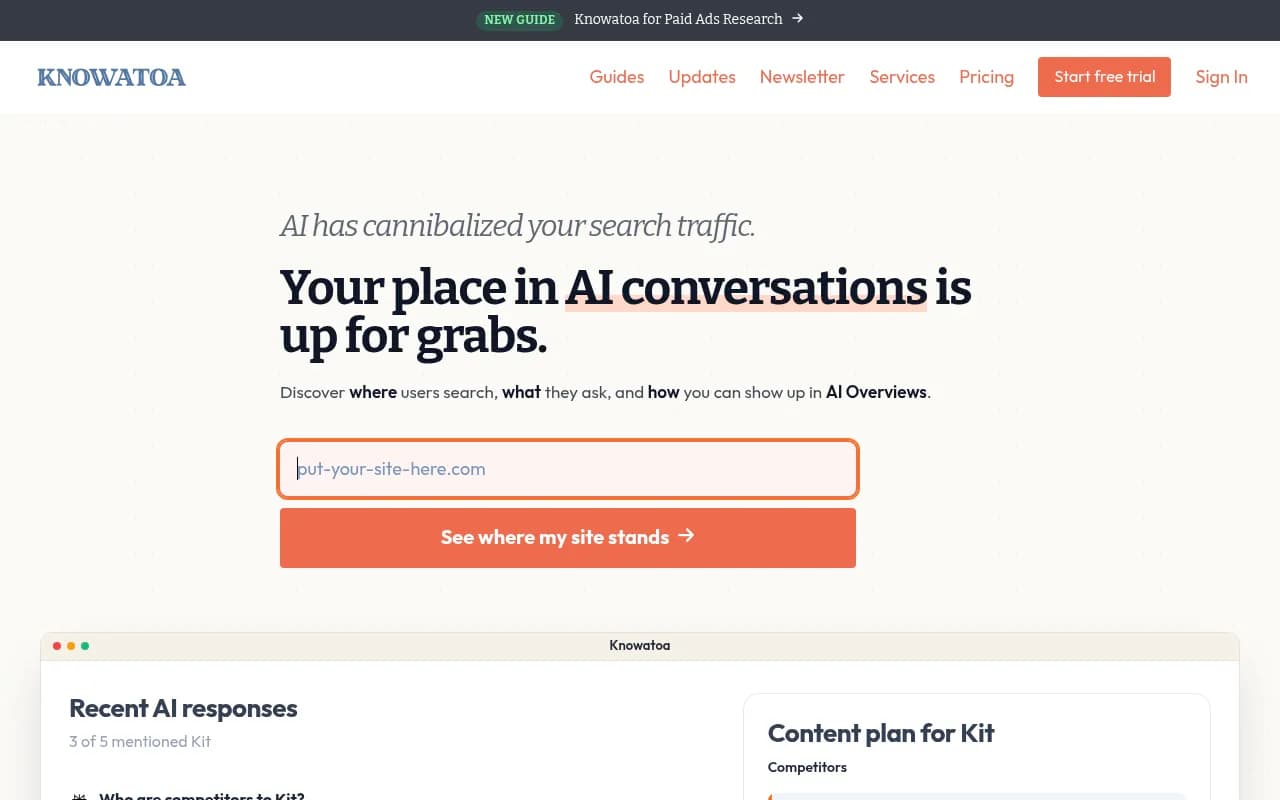
A few more worth a look if you're building a shortlist: Knowatoa and Finseo, which focus specifically on AI Overviews and AI Mode, and Nightwatch, Nozzle and Keyword.com if you want AI tracking attached to an existing SERP workflow.
For a wider set of options, the GEO software directory at bestgeosoftware.com and the rank tracker listings at ai-rank-tools.com are good places to keep browsing.
Picking by situation
You already pay for a rank tracker
Check whether it has AI Overview tracking before buying anything new. SE Ranking, Advanced Web Ranking, AccuRanker and Nightwatch all added it. The organic-plus-AI comparison is already built in, and you avoid another login.
You need AI Overviews plus ChatGPT, Perplexity and others
Choose a dedicated AI visibility platform with per-engine reporting. Promptwatch, Searchable, Omnia and Profound live here. The deciding factors are usually data collection method, whether it tracks Reddit and YouTube citations, and what it does after the data comes in.

You're an agency
Look at white-label reporting, client workspaces and unlimited projects. Pricing models differ a lot: some charge per prompt, some per response, some per seat. Do the math on your real client count.
You're a small team on a budget
A light tracker like ZipTie, Otterly.AI or Peec AI can be enough, as long as you accept shallower data. Start with a free scan or trial and compare it to what you see in an actual incognito Google search.


A quick evaluation checklist
Before you sign up, run a short test. It takes an hour and saves months of regret.
- Pick 20 keywords: 10 where you know an AI Overview appears, 10 where you're unsure.
- Check them manually in a clean browser in your target country and note the cited URLs.
- Run the same keywords in the trial and compare. Are the citations right? Are the URLs exact?
- Ask for the snapshot or evidence for three of them.
- Check refresh frequency and history retention.
- Export the data. If you can't get it out as CSV, an API or a dashboard connector, think twice.
- Look at the cost per tracked keyword or response at your real volume, not the entry price.
A 70-80% match with manual checks is normal given variance. Below that, or if the tool can't show its evidence, move on.
What to do with the data once you have it
Tracking doesn't improve citations by itself. A few patterns from the research I'd act on first:
- Content that's easy to extract wins. Clear headings, lists and tables reduce the work the model does to pull an answer.
- About 70% of AI Overview sources come from the top 10 organic results, according to Surfer's Academy video, so classic SEO still feeds this.
- Brand mentions inside the answer text can matter more than the link itself. Track mentions, not just citations.
- Watch format trends. If product pages and how-tos are rising and listicles fading, rebalance your content plan.
The tracker is the instrument. The work is still writing better pages and getting them crawled, cited and clicked.
Final thoughts
If I had to rank the ten features by importance, I'd put real SERP data, URL-level citations and a clear route to action at the top. Everything else is useful but secondary. A beautiful dashboard fed by approximated data is worse than a plain table fed by the real thing.
Shortlist two or three tools, run the 20-keyword test, and confirm current limits on each vendor's pricing page. Then keep the one whose numbers match what you see in the browser.