Key takeaways
- YouTube overtook Reddit as the #1 social citation source in AI search in early 2026, with 16% of LLM answers citing YouTube vs. 10% for Reddit -- making both channels essential to track.
- Searchable covers basic AI visibility monitoring but has gaps in Reddit and YouTube citation tracking that matter more than ever.
- The best alternatives in 2026 go beyond monitoring: they show you which Reddit threads and YouTube videos are driving citations, then help you act on that data.
- Tools like Promptwatch include dedicated Reddit and YouTube insights as part of a full GEO optimization loop -- not just a dashboard.
- Pricing across alternatives ranges from free tiers to $500+/month; the right choice depends on whether you need monitoring only or actual optimization.
Why Reddit and YouTube citations suddenly matter so much
For most of 2025, Reddit was the dominant social platform for AI citations. Then in January 2026, Adweek published data from AI marketing platform Bluefish showing a complete reversal: YouTube now appears in 16% of LLM answers, while Reddit sits at 10%. That's a 78% increase for YouTube and a 29% drop for Reddit in just six months.
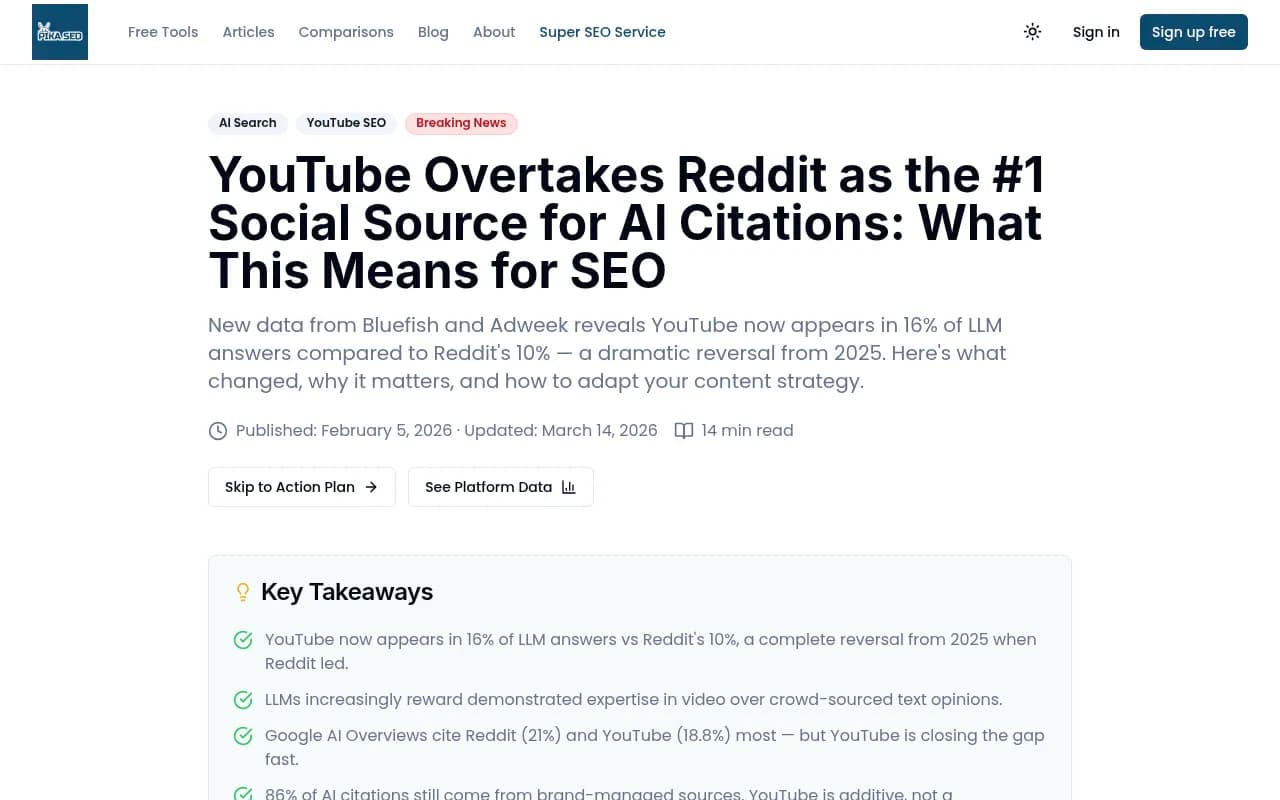
The reason matters. LLMs are increasingly rewarding demonstrated expertise -- the kind you find in a well-structured YouTube video with transcripts and metadata -- over crowd-sourced opinion threads. YouTube is now cited approximately 200x more than any other video platform in AI search results. Reddit hasn't disappeared; Google AI Overviews still cite Reddit at 21%. But the gap is closing fast, and both platforms now sit at the top of the social citation stack.
Here's why this should change how you think about your tooling: AI search traffic converts at 14.2% compared to Google's 2.8%. That's roughly five times more valuable per visit. If your AI visibility platform can't tell you which Reddit threads and YouTube videos are driving citations in your category, you're flying blind on some of the highest-leverage content in the ecosystem.
That's where Searchable falls short for a lot of teams -- and why it's worth looking at what else is out there.
What Searchable does (and where it stops)
Searchable is a reasonable starting point for AI visibility monitoring. It tracks brand mentions across major LLMs, gives you a visibility score, and surfaces some citation data. For teams that just want to know "are we showing up in ChatGPT?" it does the job.
The gaps show up when you ask more specific questions:
- Which Reddit threads are AI models actually citing when someone asks about my category?
- Which of my competitors' YouTube videos are getting pulled into AI answers?
- What content should I create to capture citations from those channels?
Searchable doesn't answer those questions well. It's a monitoring tool, not an optimization tool -- and in 2026, that distinction matters more than it used to.
The best Searchable alternatives in 2026
Promptwatch -- best overall for Reddit and YouTube citation tracking
Promptwatch is the most complete option here, and the one most directly built around the problem this guide is addressing. It has dedicated Reddit and YouTube insights that surface discussions and videos directly influencing AI recommendations -- a channel most competitors ignore entirely.
The core loop is what separates it from monitoring-only tools: find the gaps (Answer Gap Analysis shows which prompts competitors rank for that you don't), create content to fill them (Content Agents generate articles grounded in real citation data), and track the results as AI models start citing your new content. Page-level tracking shows exactly which pages are being cited, how often, and by which model.
For Reddit and YouTube specifically, Promptwatch shows you which external citations -- threads, videos, third-party pages -- are driving AI visibility outside your own site. That's offsite citation analysis, and it's rare. Most tools only look at your own domain.
It monitors 10 AI models: ChatGPT, Perplexity, Google AI Overviews, Google AI Mode, Claude, Gemini, Meta/Llama, DeepSeek, Grok, Mistral, and Copilot. Pricing starts at $99/month for the Essential plan (1 site, 50 prompts, 5 articles), with the Professional plan at $249/month adding crawler logs and state/city tracking.

Bluefish -- best for enterprise Reddit and YouTube citation data
Bluefish is the platform behind the January 2026 Adweek report on YouTube overtaking Reddit. That's not a coincidence -- their data architecture is built around tracking social citations at scale, including Reddit threads and YouTube videos that appear in AI-generated answers.
It's an enterprise-tier tool, which means the pricing reflects that. But if you're a larger brand that needs granular social citation data across LLMs, Bluefish has the most comprehensive dataset in this specific area.
Scrunch AI -- good mid-market option with social citation visibility
Scrunch AI covers AI search visibility monitoring with reasonable depth on citation sources. It won't give you the full Reddit/YouTube breakdown that Promptwatch or Bluefish offer, but it surfaces citation data at a price point that works for mid-market teams.
Worth considering if you're coming from Searchable and want more citation context without jumping to enterprise pricing.
Otterly.AI -- affordable monitoring, limited social citation depth
Otterly.AI is one of the more affordable options in the space. It tracks brand mentions across major AI engines and gives you a solid visibility overview. The limitation is that it's primarily a monitoring dashboard -- it doesn't dig into which Reddit threads or YouTube videos are influencing citations, and there's no content generation to act on what you find.
Good for: teams with a small budget that want basic AI visibility data and are okay researching Reddit/YouTube manually.

Peec AI -- multi-language monitoring with citation tracking
Peec AI is strong on multi-language and multi-region tracking, which matters if your brand operates across markets. Citation tracking is included, though the Reddit and YouTube-specific layer is thinner than Promptwatch or Bluefish.
If international AI visibility is your primary concern and Reddit/YouTube tracking is secondary, Peec AI is worth a look.

AthenaHQ -- solid monitoring, limited optimization
AthenaHQ tracks visibility across 8+ AI search engines and has a clean interface. The honest assessment: it's monitoring-focused. You'll see where you're visible and where you're not, but the platform doesn't help you act on citation gaps or identify which social content is driving competitor visibility.

Profound -- strong data quality, higher price point
Profound was one of the early movers in AI visibility tracking and has some genuinely differentiated features -- real-user prompt volume data and front-end response capture that most competitors don't match. Their data (cited in the Adweek YouTube/Reddit report) is solid.
The pricing is the friction point. The Starter plan at $99/month only covers ChatGPT. Adding Perplexity and Google AI Overviews jumps to $399/month. Claude, Gemini, and the rest are enterprise pricing. For teams that need broad model coverage, the cost adds up fast.

Rankscale -- lightweight tracking with citation visibility
Rankscale is a lighter-weight option that covers AI search ranking and citation tracking. It won't give you deep Reddit or YouTube insights, but it's a reasonable step up from Searchable if you want more citation context without a major budget commitment.
SE Ranking -- best for teams that want SEO + AI visibility in one platform
SE Ranking has built out an AI visibility toolkit alongside its traditional SEO features. If your team already uses SE Ranking for keyword tracking and rank monitoring, the AI visibility layer is a natural extension rather than a separate tool to manage.
The Reddit/YouTube citation tracking isn't as deep as dedicated GEO platforms, but for teams that want one platform covering both traditional and AI search, it's a practical choice.
LLM Pulse -- comprehensive LLM response tracking
LLM Pulse focuses on tracking how LLMs respond to prompts across multiple models. It's more technical in orientation -- useful for teams that want to understand response patterns and citation behavior at a granular level.
Feature comparison: Searchable vs. top alternatives
| Tool | Reddit tracking | YouTube tracking | Content generation | Crawler logs | Price from |
|---|---|---|---|---|---|
| Promptwatch | Yes | Yes | Yes (Content Agents) | Yes | $99/mo |
| Bluefish | Yes (enterprise) | Yes (enterprise) | No | No | Enterprise |
| Searchable | Limited | Limited | No | No | Varies |
| Scrunch AI | Partial | Partial | No | No | Mid-market |
| Profound | No | No | No | No | $99/mo (ChatGPT only) |
| Otterly.AI | No | No | No | No | Low |
| Peec AI | No | No | No | No | Low-mid |
| AthenaHQ | No | No | No | No | Mid-market |
| SE Ranking | No | No | Partial | No | $65/mo |
| LLM Pulse | No | No | No | No | Mid-market |
What to actually look for when evaluating these tools
Real citation data vs. constructed prompts
Most AI visibility platforms work by scheduling prompts, storing responses, and building a dashboard. That's fine as far as it goes. The problem is that many tools construct their own prompts -- they guess what users might ask, run those queries, and report back. The visibility scores you see may reflect responses to questions no real human ever asked.
The better tools ground their data in real search behavior. Ahrefs Brand Radar, for example, pulls from 243M+ prompts based on actual "People Also Ask" data with measurable search volume. Promptwatch tracks how AI search engines behave in real user interfaces, not just through APIs -- which matters because user-facing answers and citations can differ from API outputs.
When evaluating any tool, ask: where does the prompt data come from?
Offsite citation analysis
Most tools only look at your own domain. But if a Reddit thread or YouTube video is driving AI citations in your category, that's happening offsite -- and you need to know about it whether or not you control that content.
Offsite citation analysis is the feature that directly answers the question this guide is about. Promptwatch has it. Bluefish has it at the enterprise level. Most other tools don't.
The monitoring vs. optimization gap
This is the most important distinction in the 2026 GEO tool landscape. Monitoring tells you where you're visible. Optimization helps you get visible where you're not.
If a tool shows you that a competitor's YouTube video is being cited for a high-value prompt in your category, what do you do with that? A monitoring-only tool leaves you to figure it out. An optimization platform like Promptwatch shows you the gap, helps you understand what content would fill it, and generates a brief (or the content itself) grounded in real citation data.
For teams that care about Reddit and YouTube citations specifically, the monitoring-only approach is particularly limiting. You can see that social content is influencing AI answers, but without optimization tools, you can't systematically build a presence on those channels in a way that's informed by actual citation data.
Crawler logs and AI agent analytics
One underrated feature: knowing when AI crawlers are visiting your site, which pages they're reading, and whether those pages are making it from crawl to citation. This is how you diagnose why your content isn't getting cited even when it should be.
Promptwatch's Professional plan ($249/month) includes crawler logs. Most competitors -- including Searchable -- don't offer this at all.
Which tool should you choose?
The honest answer depends on what you actually need.
If you want the most complete Reddit and YouTube citation tracking with optimization tools to act on what you find, Promptwatch is the clear choice. The offsite citation analysis, Content Agents, and crawler logs cover the full loop from "why is that Reddit thread outranking my content in AI answers?" to "here's the article that fixes it."
If you're at an enterprise scale and need the deepest possible social citation dataset, Bluefish is worth the conversation -- their data quality on YouTube and Reddit citations is what put them on the map.
If budget is the primary constraint and you just need basic AI visibility monitoring as a step up from Searchable, Otterly.AI or Peec AI will get you started. Just know that you'll hit the ceiling quickly once you want to understand the social citation layer.
If your team already lives in SE Ranking or a similar SEO platform, the AI visibility toolkit there is a reasonable starting point -- it won't give you Reddit/YouTube depth, but it reduces tool sprawl.
The shift from Reddit to YouTube as the top AI citation source happened fast, and it'll keep shifting. The teams that will win in AI search aren't the ones with the best monitoring dashboards -- they're the ones who can see where citations are coming from and move quickly to create content that earns them.
That requires more than a tracker. It requires an optimization platform.