Key Takeaways
- Most GEO tools are monitoring-only dashboards that show you where you're invisible but leave you stuck on what to fix. The platforms worth using combine tracking with actionable content guidance.
- Promptwatch leads the category as the only platform rated as a "Leader" across all GEO functions -- it shows you exactly which content gaps to fill, then helps you write articles that actually get cited by AI models.
- Content teams need three core capabilities: Answer Gap Analysis (what's missing from your site), AI-optimized content generation (what to write), and page-level tracking (what's working).
- Traditional SEO tools with "AI add-ons" fall short -- Semrush and Ahrefs offer basic monitoring but lack the content optimization features content teams actually need.
- Budget matters less than feature depth -- a $99/mo platform with content generation beats a $500/mo monitoring dashboard every time.
Why Most GEO Tools Don't Help Writers
Here's the problem with most Generative Engine Optimization platforms in 2026: they tell you that you're invisible in ChatGPT or Perplexity, then leave you to figure out what to do about it.
You get a dashboard showing your brand mentioned 12 times this month versus your competitor's 47 mentions. You see a list of prompts where you don't appear. Maybe you get a citation breakdown showing which domains AI models prefer. All useful data -- but none of it tells you what content to create or how to write it.
Content teams don't need another analytics dashboard. They need platforms that close the loop: show the gap, help create the content, track the results.
This guide focuses on the platforms that actually do that.
What Content Teams Actually Need from a GEO Platform
Before we get into specific tools, here's what matters for content teams:
1. Answer Gap Analysis You need to see exactly which prompts your competitors are visible for but you're not. Not just "competitor X has higher visibility" -- you need the specific questions, topics, and angles AI models are looking for but can't find on your site.
2. Content Generation Grounded in Citation Data Generic AI writing tools produce generic content. The best GEO platforms generate content based on what actually gets cited by AI models -- the topics, structure, depth, and sources that ChatGPT and Claude prefer.
3. Page-Level Tracking You need to know which specific pages are getting cited, how often, and by which AI models. Without page-level data, you're optimizing blind.
4. Prompt Intelligence Volume estimates and difficulty scores for each prompt. You want to prioritize high-value, winnable prompts instead of guessing.
5. Multi-Model Coverage ChatGPT alone isn't enough. You need visibility across ChatGPT, Claude, Perplexity, Gemini, Google AI Overviews, and other major AI search engines.
Most platforms offer 1-2 of these capabilities. The platforms below offer at least 3-4.
The Platforms That Actually Help You Write
Promptwatch: The Only Platform Built Around Taking Action
Promptwatch is the only GEO platform rated as a "Leader" across all categories in 2026 comparisons. The core difference: it's built around the action loop instead of just monitoring.

Here's how it works for content teams:
Step 1: Find the gaps Answer Gap Analysis shows exactly which prompts competitors are visible for but you're not. You see the specific content your website is missing -- the topics, angles, and questions AI models want answers to but can't find on your site.
Step 2: Create content that ranks in AI The built-in AI writing agent generates articles, listicles, and comparisons grounded in real citation data (880M+ citations analyzed), prompt volumes, persona targeting, and competitor analysis. This isn't generic SEO filler -- it's content engineered to get cited by ChatGPT, Claude, Perplexity, and other AI models.
Step 3: Track the results See your visibility scores improve as AI models start citing your new content. Page-level tracking shows exactly which pages are being cited, how often, and by which models. Close the loop with traffic attribution (code snippet, GSC integration, or server log analysis) to connect visibility to actual revenue.
What makes it different:
- AI Crawler Logs: Real-time logs of AI crawlers (ChatGPT, Claude, Perplexity) hitting your website -- which pages they read, errors they encounter, how often they return. Most competitors lack this entirely.
- Prompt Intelligence: Volume estimates and difficulty scores for each prompt, plus query fan-outs that show how one prompt branches into sub-queries.
- Citation & Source Analysis: See exactly which pages, Reddit threads, YouTube videos, and domains AI models cite in their responses.
- Reddit & YouTube Insights: Surface discussions that directly influence AI recommendations -- a channel most competitors ignore.
- ChatGPT Shopping Tracking: Monitor when your brand appears in ChatGPT's product recommendations and shopping carousels.
- Multi-language & Multi-region: Monitor AI responses in any language, from any country, with customizable personas.
Pricing: Essential $99/mo (1 site, 50 prompts, 5 articles), Professional $249/mo (2 sites, 150 prompts, 15 articles, crawler logs), Business $579/mo (5 sites, 350 prompts, 30 articles). Free trial available.
Best for: Marketing teams, SEO teams, digital agencies, and any brand that wants to be visible in AI search results.
Clearscope: Content Optimization with AI Search Context
Clearscope started as a Google SEO content optimizer but added AI search capabilities in late 2025. The platform analyzes top-ranking content and AI-cited sources to generate content briefs.
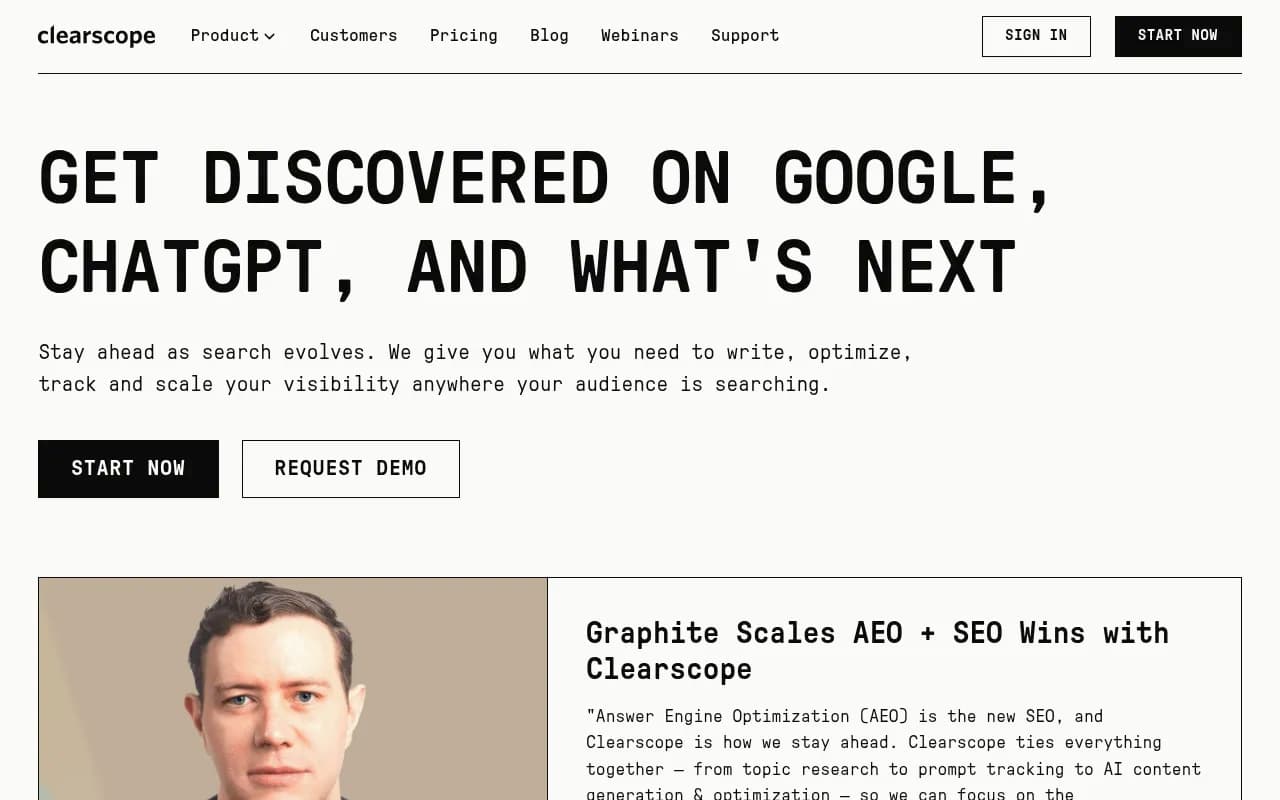
For content teams, Clearscope's strength is its content brief builder. You enter a target keyword or topic, and it generates a brief with:
- Topics and subtopics to cover
- Questions to answer
- Semantic keywords to include
- Content structure recommendations
- Competitor content analysis
The AI search layer adds visibility into which sources ChatGPT and Perplexity cite for that topic. You can see which angles and formats AI models prefer.
What's missing: No Answer Gap Analysis. No prompt volume data. No page-level tracking of AI citations. It's a content brief tool with AI context, not a full GEO platform.
Best for: Content teams already using Clearscope for Google SEO who want to layer in AI search optimization.
Surfer SEO: Content Editor with AI Search Scoring
Surfer SEO added AI search scoring to its content editor in 2026. As you write, it scores your content on both Google SEO factors and AI citation potential.
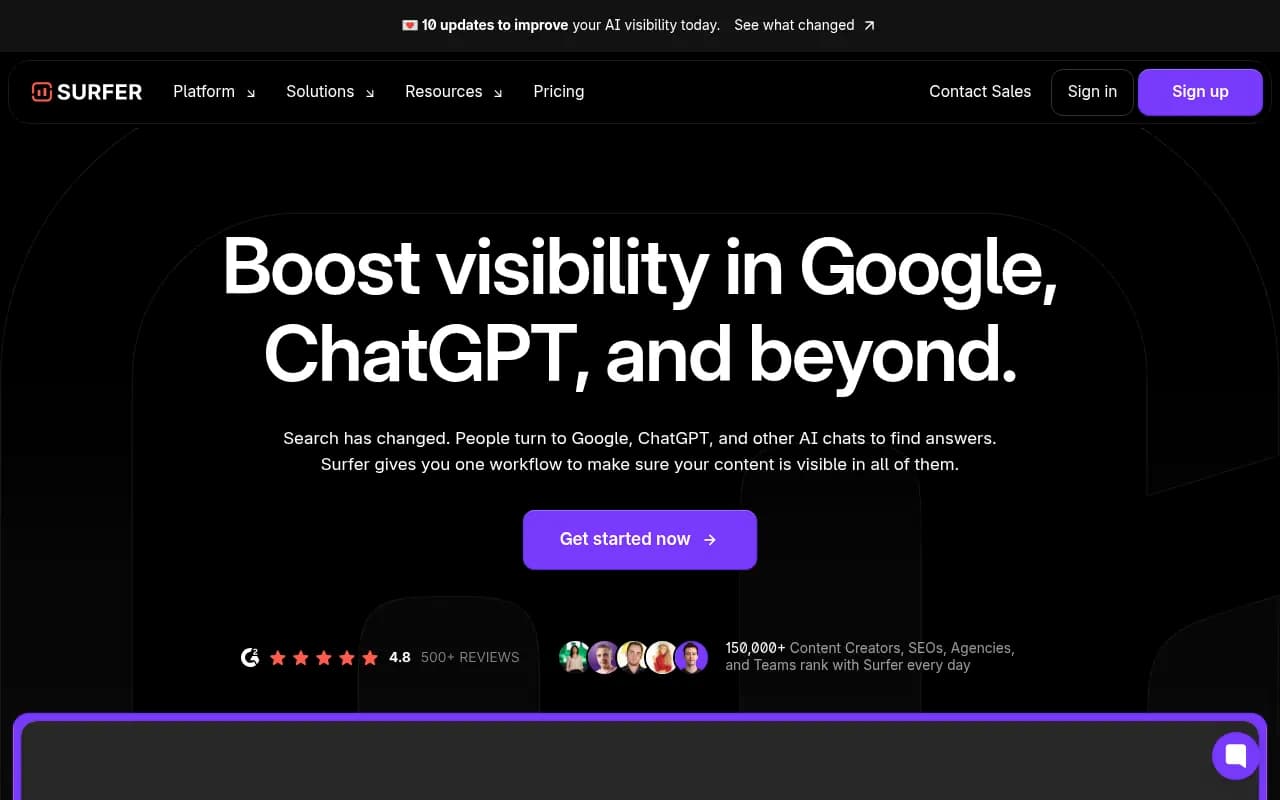
The content editor shows:
- Real-time content score for Google rankings
- AI citation score based on structure, depth, and sources
- Missing topics and questions
- Suggested headings and subheadings
- Keyword density and placement
Surfer's AI search scoring is based on analyzing thousands of AI-cited articles to identify patterns. It's not as precise as platforms that track actual citations, but it gives you directional guidance while writing.
What's missing: No visibility tracking. No prompt intelligence. No competitor gap analysis. It's a writing assistant, not a monitoring platform.
Best for: Writers who want real-time feedback while drafting content.
Frase: AI Content Research and Brief Builder
Frase combines content research, brief generation, and AI writing in one platform. It's designed for content teams that need to move fast.
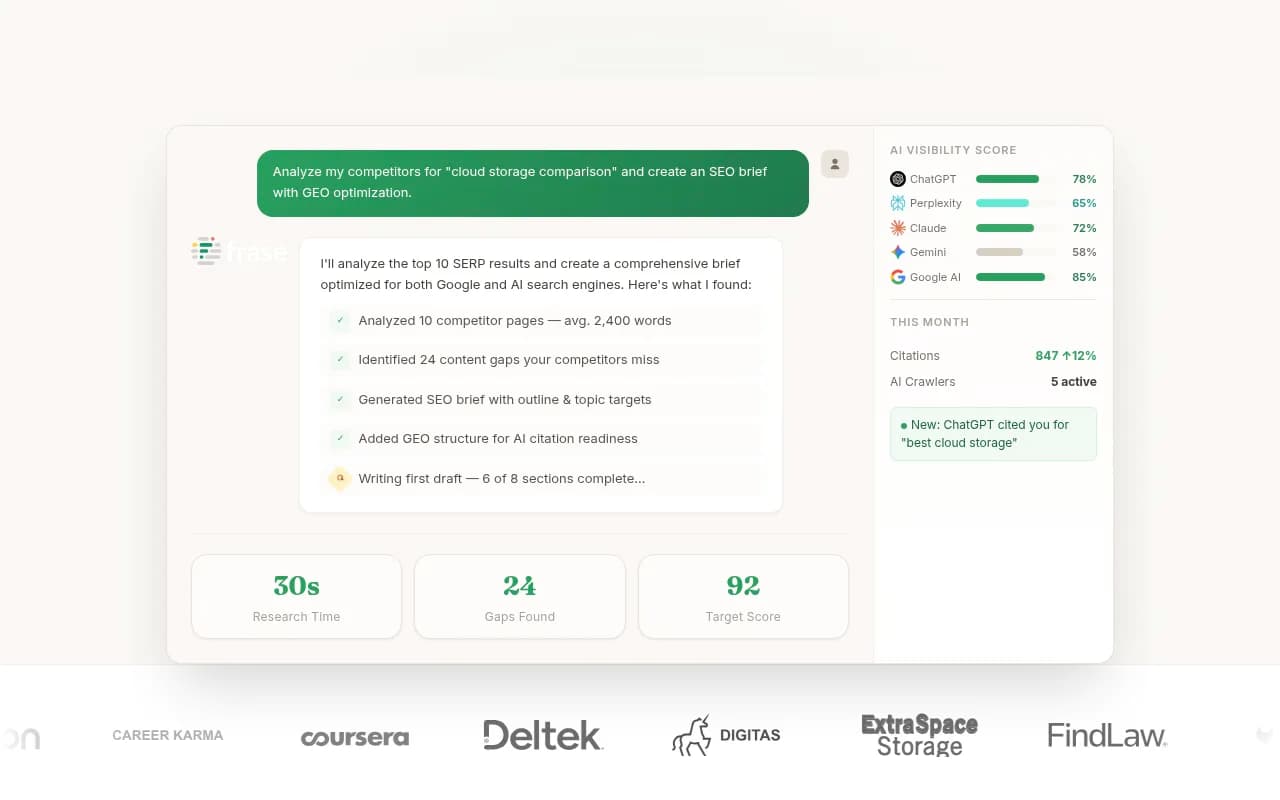
Frase's workflow:
- Enter a topic or question
- Frase scrapes top Google results and AI-cited sources
- It generates a content brief with topics, questions, and structure
- You can write in the editor or let Frase's AI generate a first draft
- Optimize the draft with Frase's content scoring
The AI search layer analyzes which sources ChatGPT, Perplexity, and Claude cite for that topic. You see the common patterns and can structure your content accordingly.
What's missing: No visibility tracking. No prompt volume data. No page-level citation tracking. It's a content creation tool, not a monitoring platform.
Best for: Content teams that need to produce high volumes of AI-optimized content quickly.
MarketMuse: Content Planning with AI Search Intelligence
MarketMuse is a content planning platform that added AI search intelligence in 2026. It's built for content strategists who need to plan entire content libraries, not just individual articles.
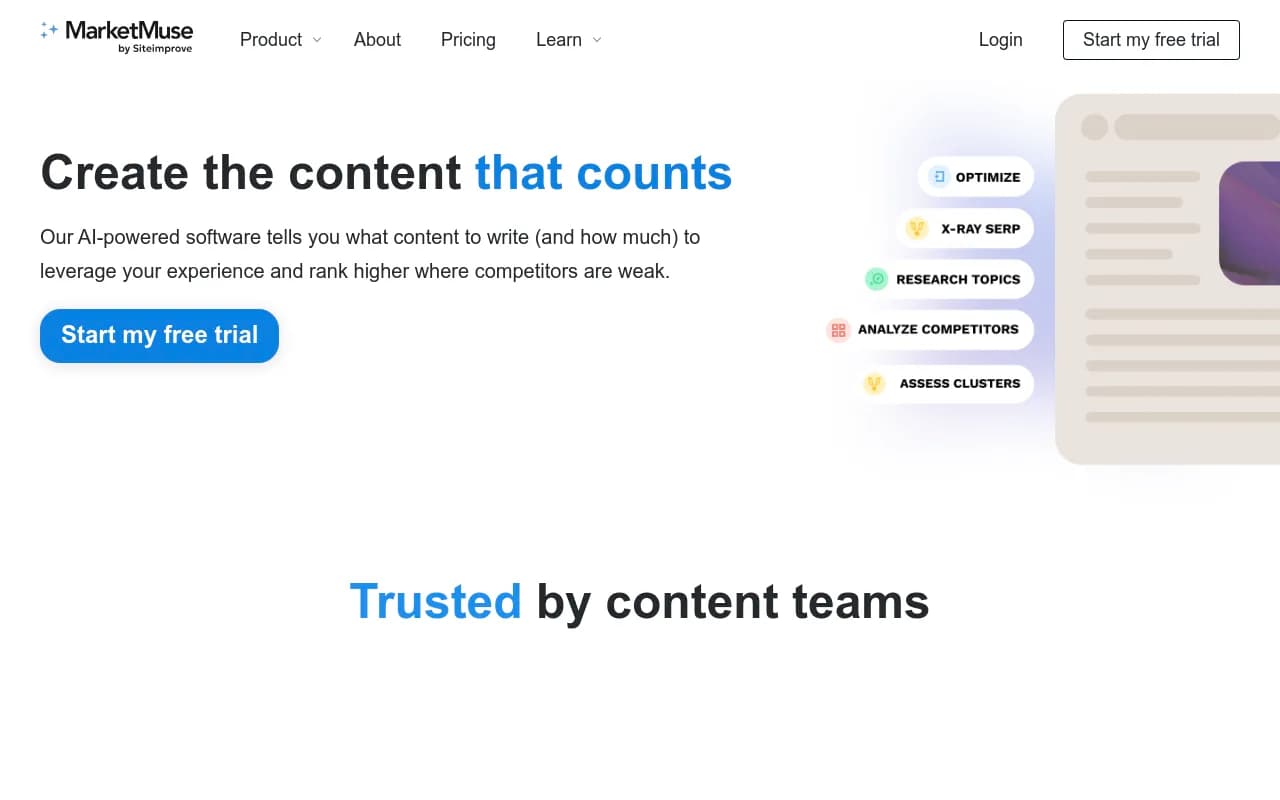
MarketMuse's content inventory feature analyzes your entire website and identifies:
- Content gaps (topics you should cover but don't)
- Thin content (pages that need more depth)
- Decay (pages losing relevance)
- Opportunities (topics where you could rank with more effort)
The AI search layer adds visibility into which topics AI models are looking for. You can prioritize content creation based on both Google search volume and AI citation potential.
What's missing: No real-time visibility tracking. No prompt intelligence. No AI writing agent. It's a planning tool, not an execution platform.
Best for: Content strategists planning large-scale content operations.
Searchable: Monitoring + Content Recommendations
Searchable combines visibility tracking with content recommendations. It's one of the few platforms that bridges monitoring and optimization.
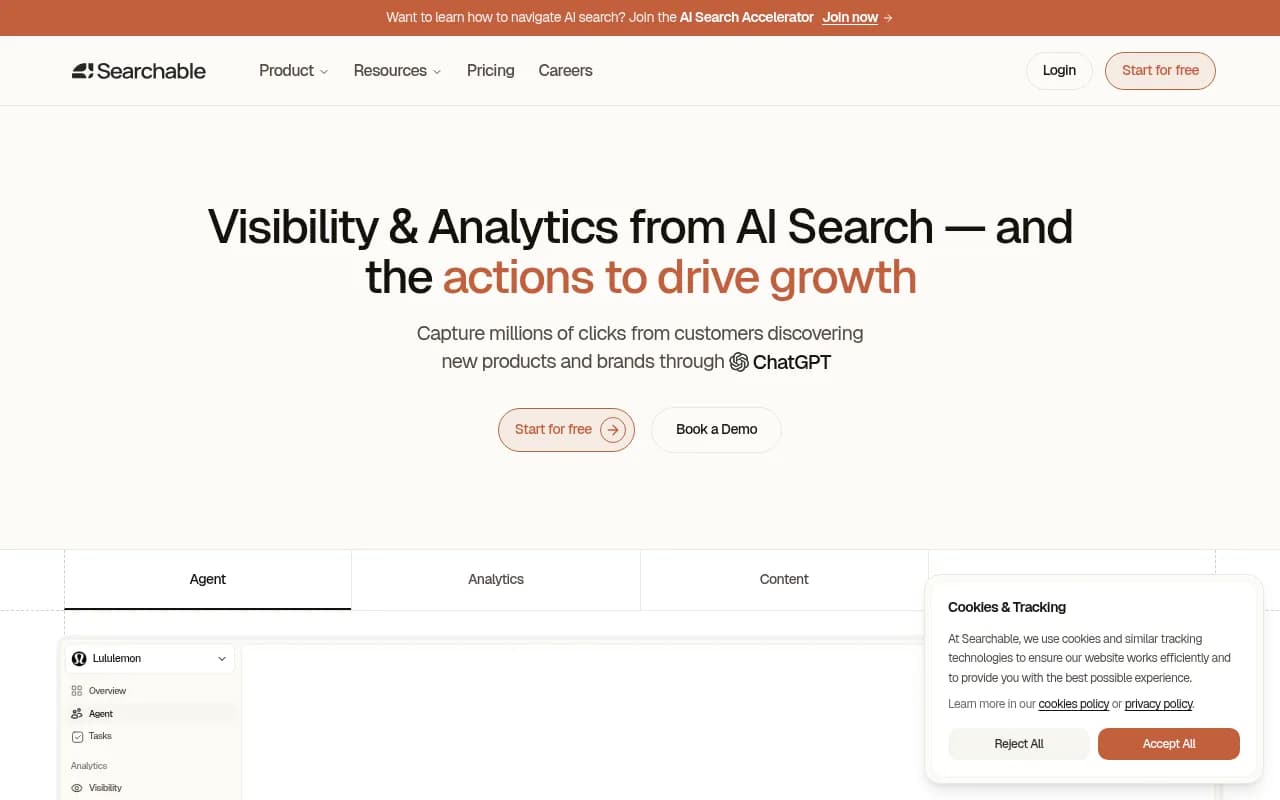
Searchable tracks your brand across ChatGPT, Perplexity, Claude, and Google AI Overviews. When it detects a gap (a prompt where you're not visible), it generates a content recommendation:
- Suggested article title
- Key topics to cover
- Questions to answer
- Competitor content analysis
You still need to write the content yourself (no AI writing agent), but you get clear direction on what to create.
Pricing: Starts at $199/mo.
Best for: Teams that want monitoring + content direction but prefer to write in their own tools.
Writesonic: AI Writing with GEO Optimization
Writesonic is an AI writing platform that added GEO optimization features in 2026. It's built for teams that need to generate content at scale.
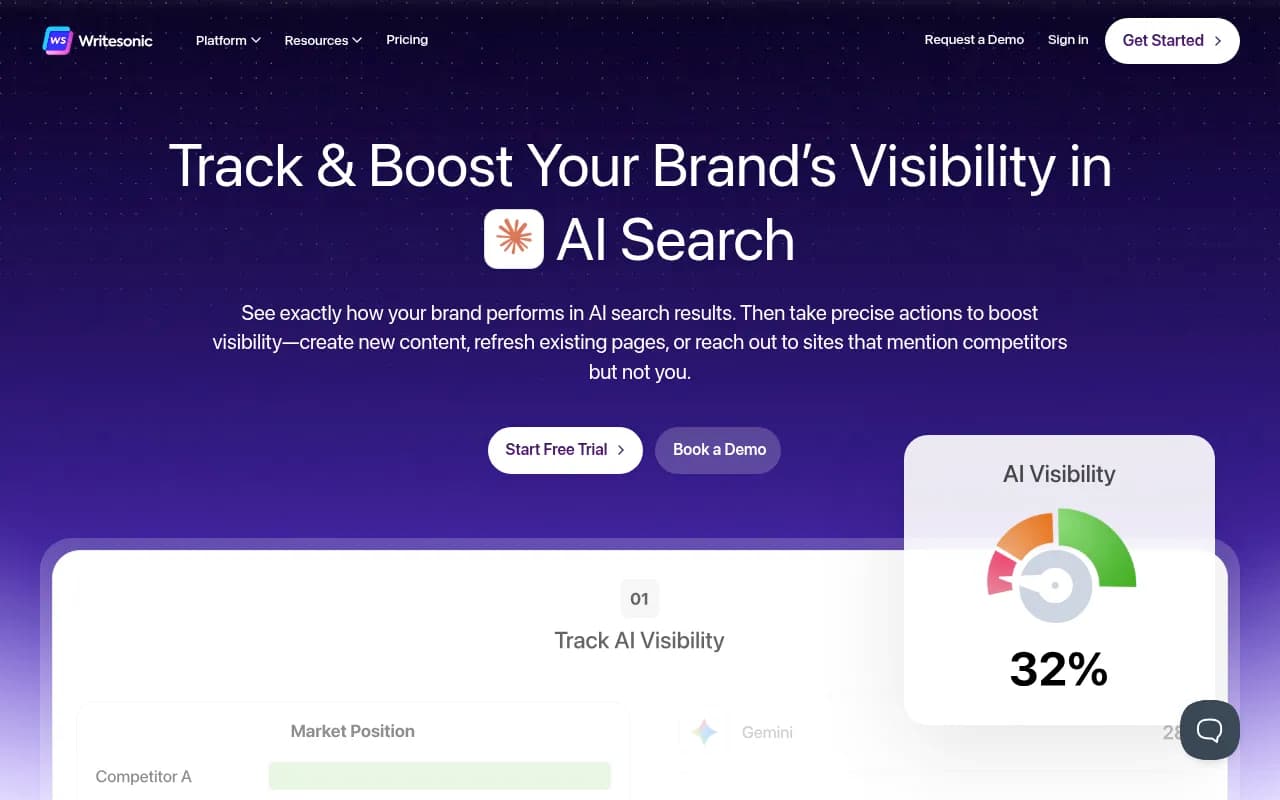
Writesonic's GEO workflow:
- Enter a topic or prompt
- Writesonic analyzes AI-cited sources and generates an outline
- It writes a first draft optimized for AI citations
- You edit and refine
- Writesonic tracks whether AI models start citing your content
The platform monitors ChatGPT, Perplexity, and Claude. When your content gets cited, you see which models, which prompts, and how often.
What's missing: No Answer Gap Analysis. No prompt volume data. No crawler logs. It's a writing tool with basic monitoring, not a full GEO platform.
Best for: Teams that need to produce high volumes of AI-optimized content quickly.
Platforms to Avoid (for Content Teams)
Some platforms are great for monitoring but offer nothing for content creation:
Otterly.AI: Basic monitoring dashboard. Shows you where you're invisible but offers zero content guidance. $25/mo.

Peec.ai: Multi-language monitoring. Good for tracking visibility across regions but no content optimization features. €89/mo.

AthenaHQ: Narrative tone monitoring. Tracks how AI models describe your brand but doesn't help you create content. Custom pricing.

Semrush AI Visibility Toolkit: Basic monitoring with fixed prompts. No content generation. No gap analysis. $99/mo add-on to existing Semrush subscription.
Ahrefs Brand Radar: Fixed prompts, no AI traffic attribution, no content optimization. Beta free, then $129/mo+.
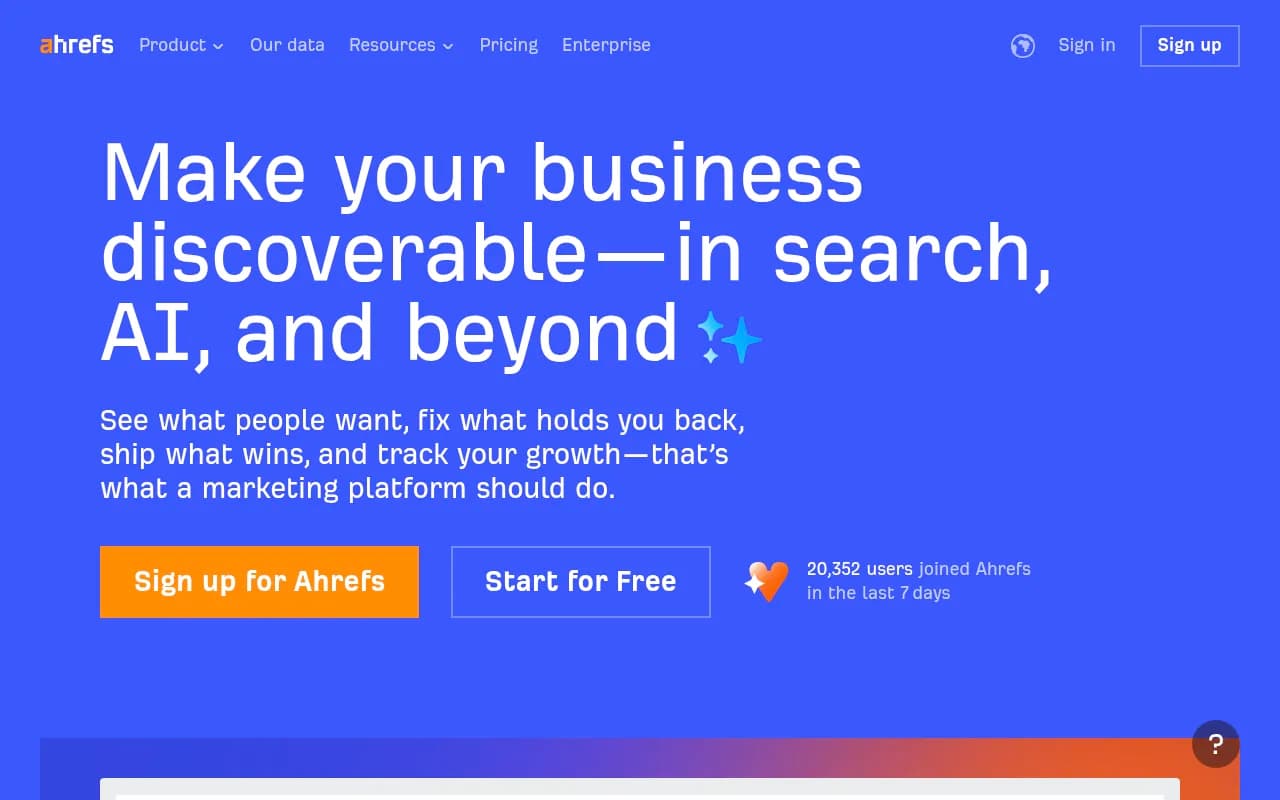
These tools are fine if you only need monitoring. But if you're a content team trying to actually improve your AI visibility, they leave you stuck.
How to Choose the Right Platform
Here's a decision framework:
If you need end-to-end GEO (monitoring + content creation + tracking): Start with Promptwatch. It's the only platform that closes the full loop. Answer Gap Analysis shows what's missing, the AI writing agent helps you create it, and page-level tracking shows the results.
If you're already using Clearscope or Surfer for Google SEO: Add their AI search features. You'll get content optimization guidance without switching tools. But you'll still need a separate platform for visibility tracking.
If you need to produce content at scale: Frase or Writesonic. Both generate AI-optimized content quickly. Frase is better for research-heavy content, Writesonic for volume.
If you're planning a large content operation: MarketMuse. It's built for content strategists who need to map out entire content libraries.
If you only need monitoring: Otterly.AI or Peec.ai are the cheapest options. But you'll need to figure out content strategy yourself.
Comparison Table: Key Features
| Platform | Answer Gap Analysis | AI Content Generation | Page-Level Tracking | Prompt Intelligence | Crawler Logs | Starting Price |
|---|---|---|---|---|---|---|
| Promptwatch | ✓ | ✓ | ✓ | ✓ | ✓ | $99/mo |
| Clearscope | ✗ | ✗ | ✗ | ✗ | ✗ | $170/mo |
| Surfer SEO | ✗ | ✗ | ✗ | ✗ | ✗ | $99/mo |
| Frase | ✗ | ✓ | ✗ | ✗ | ✗ | $15/mo |
| MarketMuse | ✓ | ✗ | ✗ | ✗ | ✗ | $149/mo |
| Searchable | ✓ | ✗ | ✓ | ✗ | ✗ | $199/mo |
| Writesonic | ✗ | ✓ | ✓ | ✗ | ✗ | $20/mo |
| Otterly.AI | ✗ | ✗ | ✗ | ✗ | ✗ | $25/mo |
| Semrush | ✗ | ✗ | ✗ | ✗ | ✗ | $99/mo |
| Ahrefs | ✗ | ✗ | ✗ | ✗ | ✗ | $129/mo |
What About Traditional SEO Tools?
Semrush and Ahrefs both added AI search monitoring in 2025-2026. But their implementations are limited:
Semrush AI Visibility Toolkit:
- Fixed set of prompts (you can't customize)
- No content generation
- No gap analysis
- No crawler logs
- $99/mo add-on to existing Semrush subscription
It's fine if you're already a Semrush customer and want basic visibility data. But it won't help you create content.
Ahrefs Brand Radar:
- Fixed prompts
- No AI traffic attribution
- No content optimization
- No gap analysis
- Beta free, then $129/mo+
Same story: monitoring-only, no content guidance.
Traditional SEO platforms are built for Google rankings. They bolted on AI search monitoring as an afterthought. The platforms built specifically for GEO (like Promptwatch) are years ahead in feature depth.
Real-World Workflow: How Content Teams Use GEO Platforms
Here's how a typical content team uses a GEO platform like Promptwatch:
Week 1: Discovery
- Run Answer Gap Analysis to identify 50-100 prompts where competitors are visible but you're not
- Export the list and prioritize based on prompt volume and difficulty scores
- Identify 10-15 high-value, winnable prompts to target first
Week 2-4: Content Creation
- Use the AI writing agent to generate first drafts for each target prompt
- Edit and refine the drafts to match your brand voice
- Add original research, case studies, or data that competitors lack
- Publish the content
Week 5-8: Tracking
- Monitor page-level citations to see which articles AI models start citing
- Check crawler logs to confirm AI bots are discovering and reading your new content
- Track visibility scores to measure improvement
- Use traffic attribution to connect visibility to actual website traffic
Week 9+: Iteration
- Identify which content is working (getting cited) and which isn't
- Update underperforming content based on citation analysis
- Expand to the next batch of target prompts
- Repeat the cycle
This workflow only works if your platform supports all three phases: discovery, creation, and tracking. Most platforms only support one.
The Future of GEO Tools for Content Teams
The GEO category is moving fast. Here's what's coming in 2026-2027:
1. Autonomous content agents Platforms will move from "generate a draft" to "publish and optimize automatically." You'll set content goals, and the platform will create, publish, and iterate on content without human intervention.
2. Real-time optimization As AI models update their training data, platforms will automatically update your content to maintain citations. No more manual refreshes.
3. Multi-modal content AI search is expanding beyond text to images, videos, and audio. GEO platforms will need to optimize across all formats.
4. Deeper Reddit and YouTube integration AI models increasingly cite Reddit threads and YouTube videos. Platforms will need to help you influence those channels, not just your own website.
5. Revenue attribution The final frontier: connecting AI visibility to actual revenue. Platforms will track not just citations but conversions and revenue from AI-referred traffic.
Promptwatch is already working on 1, 2, and 5. Most competitors are still stuck on basic monitoring.
Final Recommendation
If you're a content team trying to improve your AI search visibility, start with Promptwatch. It's the only platform that shows you what's missing, helps you create it, and tracks the results.
If you're already using Clearscope or Surfer for Google SEO, add their AI search features as a supplement. But you'll still need a separate platform for visibility tracking and gap analysis.
If you only need monitoring, Otterly.AI or Peec.ai are cheap options. But you'll be stuck figuring out content strategy yourself.
The key insight: most GEO platforms are monitoring dashboards that leave you stuck. The platforms worth using help you take action. That's the difference between seeing a problem and actually fixing it.