
Key takeaways
- Most AI visibility tools were built English-first. Multi-country support ranges from a country dropdown to real per-market monitors with local-language prompts, so check what a vendor actually does.
- The features that matter are real-interface data per country, prompts in the local language, per-market competitor sets, and a way to act on gaps in each language.
- Several vendor claims about APAC and country coverage come from vendor blogs or press releases. Verify them in a trial.
- Promptwatch, Peec AI, OptimizeGEO, Conductor and Kai Footprint all pitch some form of multi-market support, but they differ a lot in depth and in whether they help you fix problems.
- Run a two-week pilot in your hardest market before you sign an annual contract.
Why multi-country AI search is harder than it looks
An English-speaking marketer checking ChatGPT for their brand gets one answer. A brand selling in Germany, Japan and Brazil gets at least three, and they can differ in sources, in which competitors show up, and even in whether your brand exists at all.
I have seen teams track 50 English prompts, report a healthy visibility number, and then discover that the Spanish-language answers named three local competitors and never mentioned them. The English dashboard looked great. The market that mattered was invisible.
There are a few reasons this gets messy:
- AI engines answer from different sources depending on the language and location of the question. A French query tends to pull French-language pages, and your English content may never enter the mix.
- Google AI Overviews and AI Mode are region-specific. The same query can produce an overview in one country and none in another.
- Translated prompts are not the same as native prompts. People in Tokyo do not phrase a question the way a literal translation of your London prompt does.
- ChatGPT splits a prompt into several web searches (query fan-outs). Promptwatch's ChatGPT query fanout data shows a single prompt can trigger "3-8+" searches. Nobody has published a clean breakdown of whether those searches run in the user's language or in English for each market, so treat that as something to test yourself.
That last point is worth sitting with. Plenty of vendors will tell you how AI behaves in other languages. Few have published evidence. Promptwatch Data does not currently have a report splitting citations by language or country, so I will not pretend otherwise. What the data does show is that engines differ in how many sources they cite: ChatGPT cites about 5 sources per web-search answer, while Google AI Overviews and Perplexity cite about 10 (Promptwatch's average sources per response data). With more slots, AI Overviews and Perplexity are often easier places for a local mid-authority site to get in, which matters when you are competing against global brands in a smaller language market.
What to look for in a multi-country platform
Before comparing tools, write down the checklist. These are the questions that separate real multi-market tracking from a marketing bullet point.
Real interface data, per country
API answers and what a user sees in the product can differ, especially for shopping results and citations. Ask whether the vendor collects from the real ChatGPT, AI Overviews, AI Mode, Gemini and Perplexity interfaces in the country you care about, or just calls an API with a locale parameter.
Native-language prompts
Can you set a monitor to Dutch or Korean and write prompts in that language, with the analysis (mention detection, sentiment) working in that language too? Brand names that are also common words cause real trouble here. Look for a way to define what counts as a mention.
Separate markets that do not mix
If a tool blends all your countries into one visibility score, the number is useless. You want a monitor, project or workspace per market, with a roll-up view on top.
Local competitors
Your competitor set in Poland is not the one in the US. Check that each market can have its own competitors, and that auto-discovery of competitors works in non-English answers.
City and region targeting
For multi-location brands, country-level tracking is the minimum. State and city targeting matters for local queries.
A way to act
Monitoring tells you Germany is weak. It does not write German pages, publish them, or tell you whether crawlers can read them. If you operate in ten markets with a small team, this is the difference between a dashboard you stare at and a workflow you can use.
Crawler and traffic data per market
If your German pages are never fetched by AI bots, no amount of prompt tracking explains why. Crawler logs and AI-referred visitor analytics close that loop.
Platform comparison
Here is how the main candidates stack up on what they publicly claim. Treat the "claimed" items as a starting point for your trial, not as verified fact.
| Platform | Multi-country / language claim | Acts on gaps (content, publishing) | Best for |
|---|---|---|---|
| Promptwatch | Monitors per country and language, real interfaces, city/state tracking and local targeting on higher plans | Yes: Content Agent, Action Board, CMS publishing | Brands and agencies that want to fix gaps, not only see them |
| Peec AI | Positioned around multi-language tracking | Mainly monitoring | Teams that want straightforward tracking across languages |
| OptimizeGEO | Says one workspace covers multiple languages, regions and brands | Automated remediation claimed | Reporting consistency across markets |
| Conductor | Profound's blog lists 160+ countries with city-level tracking (vendor-biased source) | Enterprise SEO workflows | Large enterprises already on Conductor |
| Kai Footprint | Reported strength in non-English prompts and APAC (third-party comparison) | Focus on AEO tracking | APAC-heavy international brands |
| Addlly AI | Multilingual content generation (per Profound's blog) | Content and GEO audit | Teams that need multilingual drafts |
| Profound | Enterprise monitoring across engines | Monitoring-led | Large budgets, monitoring depth |
| Semrush One / Ahrefs Brand Radar | Existing country databases from classic SEO | Limited AI-specific action | Teams already inside those suites |
The platforms, one by one
Promptwatch
Promptwatch is the one I would put first on a shortlist for multi-market work, mostly because it covers the whole loop. Monitors are panels of prompts that run across the models, countries and languages you pick, and a monitor's language and location are fixed once it is created, so markets never blend into one number. Data comes from the real interfaces of ChatGPT, Google AI Overviews, Google AI Mode, Gemini, Perplexity, Copilot, Meta AI and Alexa, in each country and language.
Three things matter specifically for non-English markets. Brand Book analysis instructions let you write plain-language rules for what counts as a mention, which helps when your brand name is a common word in another language. Personas let you prompt like your actual buyers in each market. And the Content Agent writes in the prompt's language, then publishes to WordPress, Webflow or Framer, so a gap you find in Spanish can turn into a Spanish page without a translation agency in the middle.
On the tracking side, country tracking is on every plan, state and city tracking and local GEO/SEO targeting at exact coordinates are on Business and above, and IP-verified AI crawler logs show whether bots actually read your localized pages. Pricing starts at $95/month for Essential and $579/month for Business, which is the first plan with the Content Agent. Confirm current numbers at promptwatch.com/pricing. The honest caveat: if you only want a cheap country dropdown and a chart, you do not need all of this.

Agencies running several client markets should look at the agency plans, which include unlimited projects and AI Visibility Reports for pitching. There is also a head-to-head with Peec and one against Profound if you are choosing between them.
Peec AI
Peec AI is listed in our catalog as multi-language AI visibility tracking, and it is a common pick for European teams comparing tools. It is a monitoring tool. If you already have content resources in each market and just need a clean read on visibility, it fits. If you also need crawler logs, traffic attribution or content production, you will be stitching other tools around it.

OptimizeGEO
OptimizeGEO says it tracks multiple languages, regions and brands from a single workspace, so one team can report consistently across markets. That claim comes from the vendor's own blog, so check how it handles prompt translation and local competitors during a trial. The pitch of automated remediation is interesting for lean teams.
Conductor
Conductor appears in Profound's roundup with "160+ countries with city-level tracking". Profound is a competitor, so I would read that as a lead rather than a fact. For enterprises already running Conductor for classic SEO, the geographic coverage may be the draw, along with persona customization.
Kai Footprint
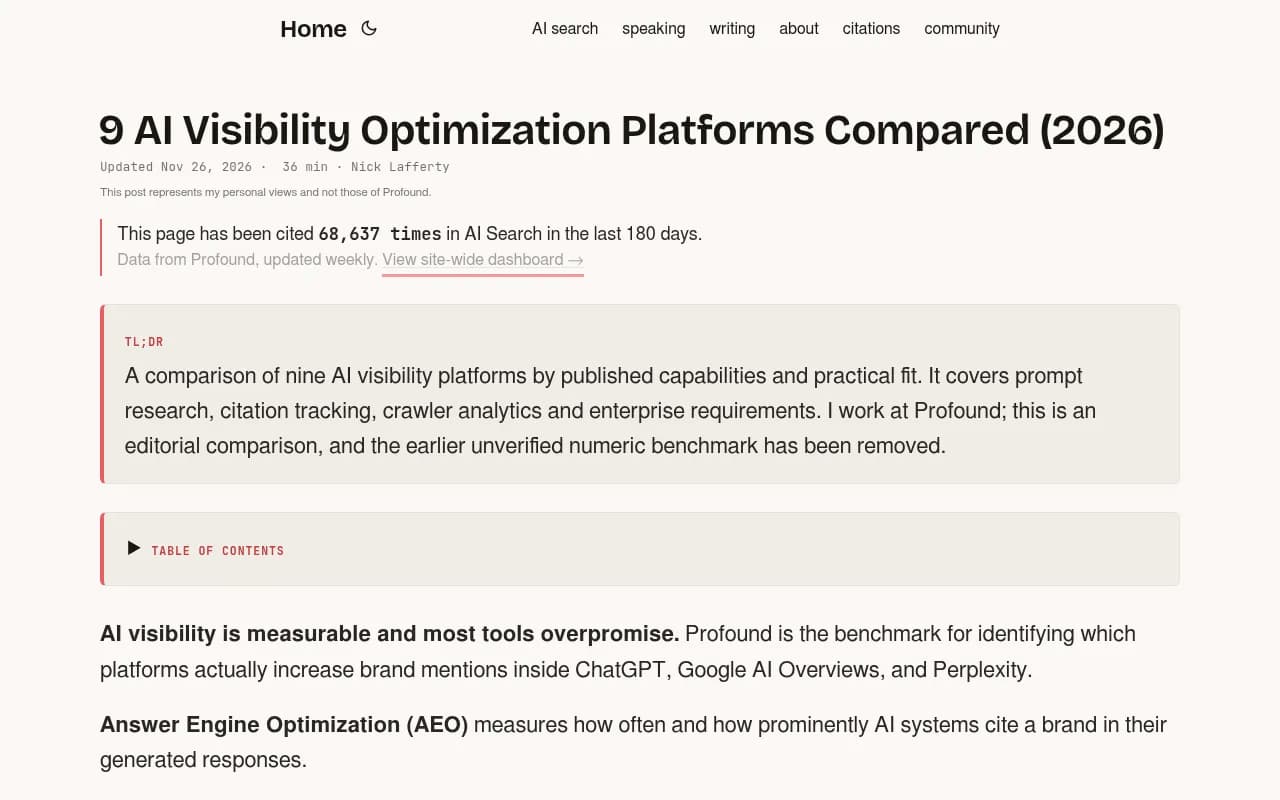
Nick Lafferty's comparison calls Kai Footprint strong at tracking visibility across non-English prompts, particularly in APAC markets. That is a single third-party mention, so test it in your language before relying on it. If Japanese, Korean or Southeast Asian markets are your priority, it deserves a trial.
Profound
Profound is a well-funded monitoring platform and often shows up as the benchmark in comparisons. It is priced at the higher end and focuses on tracking rather than execution. Worth a look if you have enterprise budget and mainly need analysis.

Addlly AI
Addlly AI is notable for multilingual content generation and GEO audits. It sits more on the content side than the tracking side, so pair it with a monitoring tool if you go this way.
SE Ranking and Semrush
Classic SEO suites already have country-level databases, and both have added AI visibility modules. They are a reasonable first step if you already pay for them. The AI data is usually shallower than in dedicated tools, with fixed prompt sets in some cases.
Other tools worth testing
A few more catalog entries come up in multi-market conversations: [tool:sistrix] is strong in German-speaking markets for classic SEO and now tracks AI visibility, and [tool:llm-pulse] and [tool:qwairy] are monitoring-focused alternatives. For a longer list, the GEO software directory at bestgeosoftware.com is a good place to browse.
A note on press-release lists
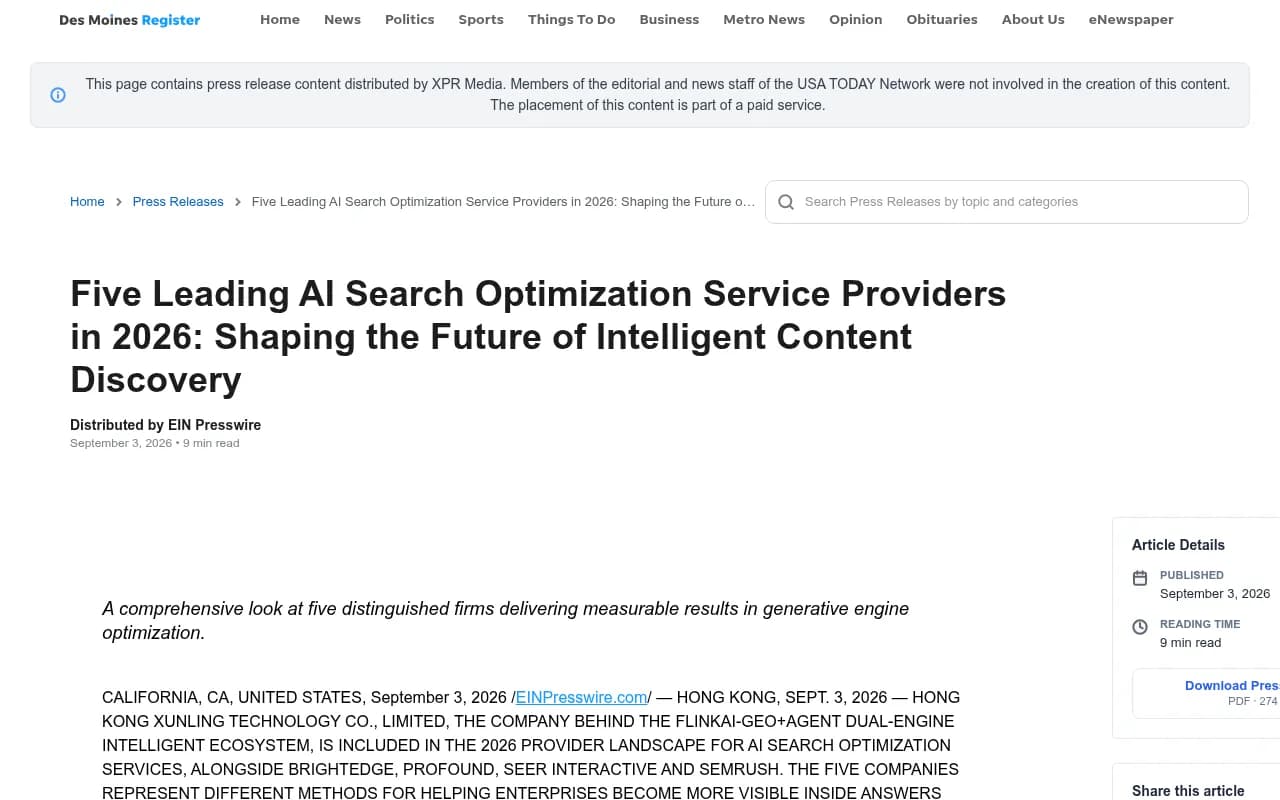
When you search for the best platforms you will find roundups like the EINPresswire piece syndicated by The Des Moines Register on September 3, 2026. It lists FlinkAI alongside BrightEdge, Profound, Seer Interactive and Semrush, and it was issued by FlinkAI's own company. That is promotional material, not independent testing, so it should not drive a buying decision. The same caution applies to vendor blogs ranking themselves or competitors.
Independent comparisons are more useful, such as Nick Lafferty's nine-platform comparison, which includes a coverage matrix of engines and notes on data retention.
How to run a fair multi-market pilot
Demos are always in English with a US brand. Do this instead.
- Pick your two hardest markets. One should be a non-Latin-script language if you have one. The other should be a market where local competitors dominate.
- Write 20 prompts per market in the local language, ideally with a native speaker. Include branded, competitor comparison and category prompts.
- Run the same prompts manually in the real ChatGPT, AI Overviews and Perplexity UIs from that country. Save the answers.
- Load the prompts into each shortlisted tool and compare their recorded answers against your manual ones. If a tool misses your brand when the manual answer names it, that is a mention-detection problem.
- Check competitor discovery. Did the tool find the local players you know?
- Test the action path. Take one gap and see how far the tool gets you toward a published page in that language.
- Check crawler visibility for localized pages. Verify your hreflang pages are being fetched by AI bots. Free options include the Agentic Readiness Check and the AI crawler URL inspector.
Test query fan-outs per market
Because there is no published answer on whether fan-out queries follow the user's language, run a few prompts in each market and look at the searches ChatGPT actually performs. The free GEO Inspector Chrome extension shows fan-outs and the sources fetched versus cited. If the searches run in English even for a Portuguese prompt, your English pages may matter more than you think. If they run in Portuguese, you need local content.
Promptwatch's own advice from the fanout data is to write headings that read like short keyword queries, with the entity and category first, and to re-audit them after major ChatGPT updates. That advice holds in any language, but the exact phrasing has to be native.
Metrics to report by market
Do not roll everything into one number. Report these per market:
- Visibility Score and Share of Voice against that market's competitors
- Position within answers, since being named fifth is a different problem than not being named
- Self-citation rate, which shows whether AI cites your local pages or some third party
- Sentiment, scored separately
- AI-referred visits and conversions, so the work connects to revenue
The Promptwatch Academy explains how these metrics read together. Low share of voice is a coverage problem, late position is a prominence problem, and mentions without self-citations point at content or crawlability.
Choosing by situation
| Your situation | Start with |
|---|---|
| Several markets, small team, need to produce local content | Promptwatch |
| Agency managing multi-country clients | Promptwatch agency plans or another agency-focused tool |
| Mostly need a simple tracker in several European languages | Peec AI |
| APAC focus and monitoring only | Kai Footprint, tested against your languages |
| Already deep in an enterprise SEO suite | Conductor, BrightEdge or Semrush modules |
| Need multilingual drafts only | Addlly AI plus a separate tracker |
If you want hands-on help rather than another tool, 1001 SEO Media runs international SEO and GEO programs and uses Promptwatch for AI visibility work.
Common mistakes
Tracking translated English prompts is the big one. Close behind is a single global score that hides weak markets. Then there is trusting a vendor's country count: 160 countries means little if the tool cannot detect your brand in Thai.
Another trap is ignoring the technical layer. If your localized pages sit behind a bot-blocking rule or a language redirect, AI crawlers may never see them. Crawler logs will tell you in minutes what a month of prompt tracking cannot.
Finally, do not forget freshness. Promptwatch's data on content half-life found news pages lose half their citations within 36 days, while landing pages and docs last longest (ChatGPT content half-life). Localized evergreen pages are worth the investment for that reason.
FAQ
Do I need a separate platform for each country?
No. Pick a tool with per-market monitors and a roll-up view. Separate tools make comparison and reporting painful.
Are AI answers really different by country?
Yes in practice, especially for Google AI Overviews and AI Mode, which are region-specific. Promptwatch Data has no published language split yet, so run your own pilot to see the size of the difference for your category.
Which engines matter most for non-English markets?
It depends on the market. Google AI Overviews and AI Mode matter wherever Google dominates search. ChatGPT is strong broadly, and Perplexity and others vary by region. Track all of them at first, then focus.
How many prompts per market should I track?
Start with 20 to 50 native-language prompts per market. Add more once you know which topics move the numbers.
Can I trust a vendor's multilingual claims?
Only after your own test. Several claims in public roundups come from vendor blogs or press releases, so verify with prompts you wrote yourself.
To see where you stand today, the free AI visibility report gives a quick read, and the 7-day free trial is enough time to run the pilot above in one market.