
Key takeaways
- GEO ROI can't be measured with traditional click-based metrics alone -- AI search creates an "invisible funnel" where buyers form preferences before ever visiting your site
- The most useful metrics split into two tiers: leading indicators (mention rate, citation rate, share of voice) and lagging indicators (AI-referred traffic, pipeline influenced, revenue)
- Attribution is the hardest part -- most GEO value shows up as assisted influence, not last-click conversion
- A working measurement framework has six steps: set a baseline, define KPIs, build attribution, implement tracking, analyze, and optimize
- Tools that combine visibility tracking with content generation give you the fastest path from gap to improvement to measurable result
Why GEO ROI is genuinely hard to measure
If you try to measure GEO the way you measure paid search -- spend goes in, clicks come out, divide revenue by spend -- you'll conclude it doesn't work. That's the wrong model.
AI search engines like ChatGPT, Perplexity, and Google AI Overviews now handle an estimated 14 billion searches per month, and that number has grown roughly fivefold in two years. But the way people use these tools is different from how they use Google. They ask longer questions. They get synthesized answers. They form opinions about vendors before they ever click a link. By the time someone lands on your website from an AI referral, they've often already decided you're worth talking to.
That's the invisible funnel. It's real, it influences decisions, and it's almost entirely invisible to your standard analytics setup.
This doesn't mean ROI is unmeasurable. It means you need a different framework -- one that accounts for influence, not just last-click conversion.
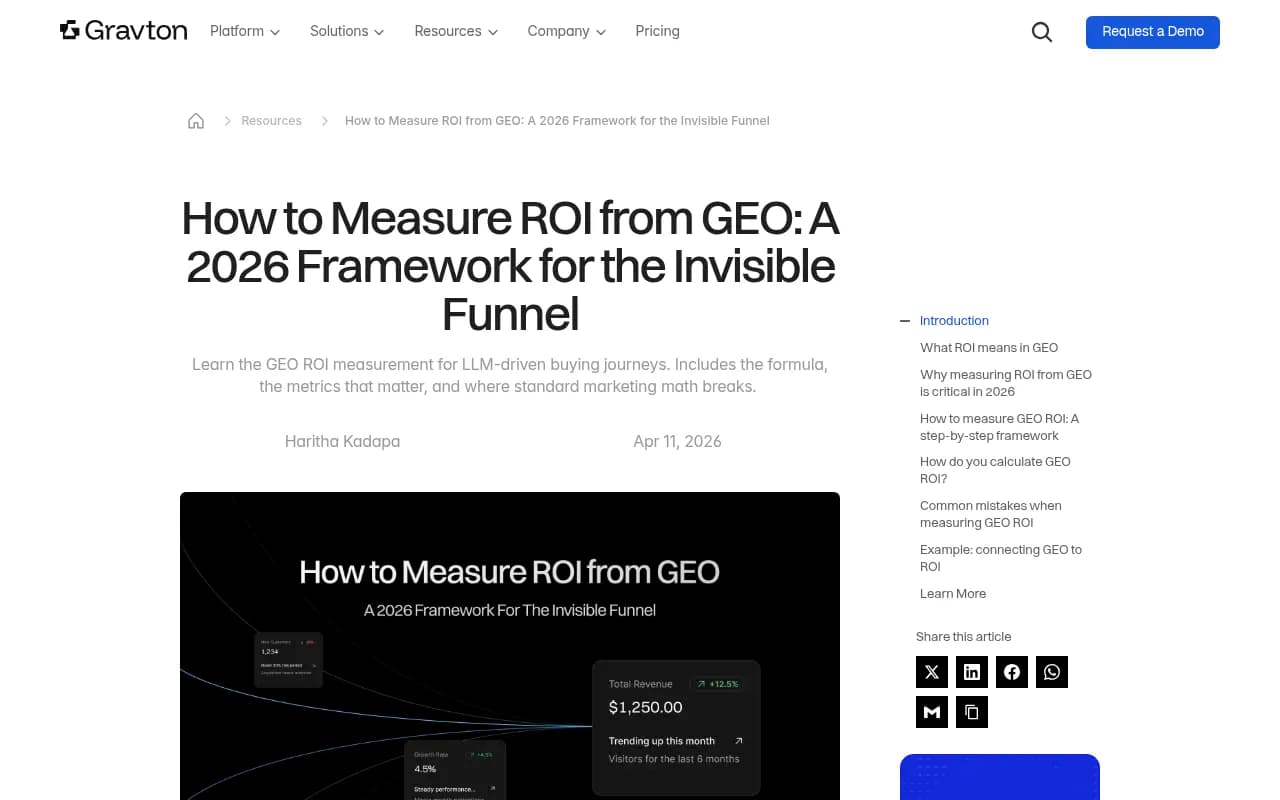
Step 1: Establish your baseline before you do anything else
You can't measure improvement without knowing where you started. This sounds obvious, but most teams skip it and then spend months arguing about whether GEO is "working."
Your baseline should capture, at minimum:
- How often your brand appears in AI responses for your target prompts (mention rate)
- Which AI models are citing you and which aren't
- How much traffic you're currently receiving from AI referrals (check your analytics for referrals from perplexity.ai, chatgpt.com, claude.ai, etc.)
- Your share of voice relative to two or three direct competitors
Run this baseline across the specific prompts your customers actually use -- not generic industry terms, but the real questions buyers ask when they're evaluating solutions like yours. "Best [category] tools for [use case]" type prompts are a good starting point.
Document the date. Take screenshots. Export the data. You'll need this in three months when someone asks whether the program is delivering.
Step 2: Define the KPIs that actually matter
There are two tiers of GEO metrics. Both matter, but for different reasons and on different timescales.
Tier 1: leading indicators
These move first. They tell you whether your GEO efforts are gaining traction before revenue shows up.
- Mention rate: The percentage of relevant prompts where your brand appears in the AI response. If you track 100 prompts and appear in 23 of them, your mention rate is 23%.
- Citation rate: How often your specific pages are cited as sources. This is more granular than mention rate -- you can appear in a response without being cited as a source.
- Share of voice (AI): Your mention rate compared to competitors across the same prompt set. If you appear in 23% of prompts and your main competitor appears in 41%, that gap is your opportunity.
- Sentiment in AI responses: Are AI models describing your brand accurately and positively? Are they getting your positioning right? This matters more than most teams realize.
Tier 2: lagging indicators
These take longer to move but connect directly to business outcomes.
- AI-referred traffic: Sessions that originate from AI platforms. Set up source/medium filters in GA4 to capture this properly (more on that below).
- AI-influenced pipeline: Deals where AI referral or AI-assisted research played a role in the buyer's journey. This requires some CRM hygiene and honest attribution modeling.
- Conversion quality from AI traffic: AI-referred visitors often convert at higher rates than organic search traffic because they arrive pre-qualified. Track this separately.
- Revenue influenced: The hardest number to pin down, but the one your CFO actually cares about.
| Metric | Tier | Time to move | Difficulty to track |
|---|---|---|---|
| Mention rate | Leading | 2-6 weeks | Medium |
| Citation rate | Leading | 2-6 weeks | Medium |
| Share of voice (AI) | Leading | 4-8 weeks | Medium |
| Sentiment accuracy | Leading | Ongoing | High |
| AI-referred traffic | Lagging | 6-12 weeks | Low |
| Pipeline influenced | Lagging | 3-6 months | High |
| Conversion rate (AI traffic) | Lagging | 6-12 weeks | Low |
| Revenue influenced | Lagging | 6-12 months | Very high |
Step 3: Fix your tracking setup
Most analytics setups miss a significant chunk of AI-referred traffic. Here's what to do.
GA4 configuration
AI platforms send referral traffic, but the referral strings vary. Create a custom channel grouping in GA4 that captures traffic from:
- perplexity.ai
- chatgpt.com
- claude.ai
- gemini.google.com
- copilot.microsoft.com
- you.com
- phind.com
Also watch for "direct" traffic spikes that correlate with AI activity -- users who copy a URL from an AI response and paste it into a browser show up as direct in GA4.
UTM parameters for AI content
If you're publishing content specifically designed to rank in AI responses, tag it. When AI models cite a page and someone clicks through, you want to know which piece of content drove that visit.
CRM attribution fields
Add an "AI-influenced" field to your opportunity records. Train your sales team to ask prospects where they first heard about you. "I asked ChatGPT for recommendations" is an answer you're going to hear more and more.
AI crawler log monitoring
This is something most teams overlook entirely. AI crawlers like GPTBot (OpenAI), ClaudeBot (Anthropic), and PerplexityBot visit your site before they cite it. Monitoring these logs tells you which pages AI models are reading, how often they return, and whether they're hitting errors. A page that gets crawled frequently but never cited is a signal that something in the content isn't working.
Tools like Promptwatch surface this data directly, showing you the timeline from crawl to citation at the page level.

Step 4: Build an attribution model that doesn't lie to you
Attribution is where GEO measurement gets genuinely messy, and anyone who tells you otherwise is selling something.
The core problem: AI search is almost always an assist, not a closer. A buyer might ask ChatGPT "what are the best project management tools for remote teams," see your brand mentioned, then do more research, then get a demo, then buy -- six weeks later. Last-click attribution gives GEO zero credit for that deal.
A few approaches that work better:
First-touch attribution: Gives credit to the first touchpoint in the buyer's journey. If AI search is where buyers first encounter your brand, this model captures that. The downside is it ignores everything that happened after.
Multi-touch attribution: Distributes credit across all touchpoints. More accurate, but requires good data across the full journey. B2B revenue intelligence platforms like HubSpot or Dreamdata can help here.

Influenced pipeline reporting: Rather than trying to assign precise revenue credit, track how much pipeline had at least one AI touchpoint. This is a softer number but easier to defend and easier to collect.
Lift analysis: Run a controlled test. Increase GEO investment in one market or product line and hold it steady in another. Compare pipeline growth. This is the most rigorous approach but requires enough volume to be statistically meaningful.
For most teams, a combination of influenced pipeline reporting and first-touch attribution gets you 80% of the way there without requiring a data science team.
Step 5: Calculate a defensible ROI number
Here's the basic formula:
GEO ROI = (Revenue influenced by AI visibility - Total GEO program cost) / Total GEO program cost × 100
The hard part is "revenue influenced." A few ways to estimate it:
Method 1: AI-referred revenue Take all deals that had at least one session from an AI referral source. Sum the closed revenue. This is conservative (it misses deals where AI influenced the buyer but they never clicked through) but it's defensible.
Method 2: Assisted conversion value In GA4, look at the "assisted conversions" report for your AI channel grouping. Assign a value to each conversion based on your average deal size. Multiply by your close rate.
Method 3: Share of voice to revenue correlation If you have 12+ months of data, you can often find a correlation between share of voice improvements and pipeline growth. This is the most sophisticated approach and requires patience to build the dataset.
For a $15,000/month GEO program, you need to attribute roughly $180,000 in annual revenue to break even at 1:1. In practice, well-run GEO programs should target 3:1 to 5:1 ROI within 12-18 months -- but the first six months are often investment-heavy with limited measurable return.
Set that expectation with stakeholders before you start.
Step 6: Track the right things at the right frequency
Different metrics need different review cadences.
Weekly: Mention rate and citation rate for your top 20-30 prompts. These move fast enough to catch problems early. If a competitor suddenly starts appearing in prompts where you used to dominate, you want to know within days, not months.
Monthly: AI-referred traffic, conversion rates from AI traffic, share of voice trends. These move more slowly and monthly review is sufficient.
Quarterly: Pipeline influenced, revenue influenced, full ROI calculation. This is your reporting cadence for leadership.
Annually: Full baseline reset. Reprompt your entire tracking set, reassess competitors, and update your KPI targets based on what you've learned.
Tools that make this measurable
Tracking GEO ROI manually is painful. You'd need to query dozens of AI models across hundreds of prompts, manually log citations, cross-reference against your analytics, and do the attribution math yourself. That's not sustainable.
A few tools worth knowing:
Promptwatch is the most complete option for teams that want to close the loop between visibility and revenue. It tracks mention rates and citations across 10 AI models, shows you AI crawler logs at the page level, and connects visibility data to traffic attribution. The answer gap analysis shows exactly which prompts competitors appear for that you don't -- which is where your content investment should go. The content agents then generate articles designed to close those gaps, and the page-level tracking shows when new content moves from crawl to citation.
For teams that want something simpler to start:


For B2B attribution specifically, pairing a GEO visibility tool with a revenue intelligence platform gives you the full picture:
| Tool | Visibility tracking | Crawler logs | Content generation | Attribution | Best for |
|---|---|---|---|---|---|
| Promptwatch | 10 models | Yes | Yes (AI agents) | Yes | Full GEO program management |
| Rankscale | Multiple models | No | No | No | Visibility monitoring |
| Peec AI | Multiple models | No | No | No | Multi-language tracking |
| Otterly.AI | Multiple models | No | No | No | Budget monitoring |
| HockeyStack | No | No | No | Yes | B2B revenue attribution |
| Dreamdata | No | No | No | Yes | B2B pipeline attribution |
The honest reality of GEO ROI timelines
GEO is not a paid channel. You can't turn it on and see results next week. The typical timeline looks something like this:
- Months 1-2: Baseline established, tracking set up, first content published. No measurable ROI yet.
- Months 3-4: AI crawlers start indexing new content. Mention rates begin to move. Still limited revenue signal.
- Months 5-6: Citation rates improve. AI-referred traffic starts to tick up. Early pipeline influence visible.
- Months 7-12: Compounding effect kicks in. Share of voice improvements translate to consistent traffic and pipeline. ROI becomes measurable.
Teams that abandon GEO programs at month three because "we can't see the revenue yet" are making the same mistake as teams that abandoned SEO in 2005 because it "takes too long."
The difference is that GEO compounds faster than traditional SEO, because AI models update their knowledge more frequently than Google's index changes rankings. A well-cited piece of content can start influencing AI responses within weeks of publication.
A note on what not to measure
A few metrics that look useful but aren't:
Raw citation counts: A vanity metric. Being cited 500 times in irrelevant prompts is worth less than being cited 20 times in high-intent purchase prompts. Always weight citations by prompt intent and volume.
AI "rankings": Unlike Google, AI models don't have a fixed ranking system. The same prompt can produce different responses depending on the user's context, conversation history, and the model's current knowledge state. Chasing a "rank 1" position in AI is the wrong mental model.
Traffic volume from AI alone: High AI-referred traffic with low conversion rates means you're getting cited in informational prompts but not purchase-intent prompts. Volume without quality is a distraction.
Focus on mention rate in high-intent prompts, conversion rate from AI traffic, and pipeline influenced. Those three numbers tell you most of what you need to know.
Putting it all together
GEO ROI measurement isn't simple, but it's not mysterious either. The framework is:
- Set a baseline across your target prompts before you start
- Track leading indicators (mention rate, citation rate, share of voice) weekly
- Fix your analytics to capture AI-referred traffic properly
- Build an attribution model that accounts for AI's role as an assist, not a closer
- Calculate influenced pipeline and revenue quarterly
- Use the data to prioritize which content gaps to close next
The teams that will win at GEO measurement in 2026 are the ones who treat it as a discipline, not an afterthought. That means investing in proper tracking infrastructure, setting realistic timelines with stakeholders, and connecting visibility data to revenue data in a systematic way.
The invisible funnel is real. The question is whether you're measuring it.