
Key takeaways
- In Promptwatch's October 2026 software citation report (Sep 28 to Oct 4), GitHub led ChatGPT with 1.2% of citations, followed by learn.microsoft.com at 0.98% and G2 at 0.73%.
- Documentation and help centers earn 2.64% of software citations. Vendor sites add 2.01%. Together that is roughly three times the 1.57% earned by review sites and analysts.
- Docs are not only cited for support questions. ChatGPT cites them for "how does it work" prompts too.
- Review sites mostly decide who gets into the candidate pool and how the AI describes you, not who ranks first.
- Gated docs are invisible to AI crawlers. If a bot cannot read it, nobody can cite it.
What the software citation data actually says
If you ask ChatGPT a software question, you might expect it to quote review blogs and listicles. The data points somewhere less glamorous. Promptwatch's data on ChatGPT software citations (organic software prompts, Sep 28 to Oct 4, 2026) shows that the most-cited domains are a code host, a few cloud docs sites, and one review platform.
| Domain | Share of ChatGPT software citations |
|---|---|
| GitHub | 1.2% |
| learn.microsoft.com | 0.98% |
| G2 | 0.73% |
| AWS docs | 0.41% |
| Google Cloud | 0.35% |
| Gartner | 0.34% |
| Capterra | 0.32% |
| Intercom | 0.28% |
| Zapier | 0.24% |
Those percentages look small. They are shares of all software citations, not of the 23 domains in the chart, which together earn 7.89%. The long tail is enormous, so a single domain at 1% is a heavyweight.
Group the same data by source type and the pattern is clearer:
| Source type | Share of software citations |
|---|---|
| Documentation and help centers | 2.64% |
| Vendor sites | 2.01% |
| Review sites and analysts | 1.57% |
| GitHub | 1.2% |
| App stores | 0.47% |
Docs and vendor sites combine for 4.65%. Review sites and analysts (G2, Gartner, Capterra, Software Advice) get 1.57%, which still beats any single vendor, Microsoft included. So both matter. They just do different jobs.
Why these three sources win
I think the explanation is boring, and that is a good sign. Each source type answers a different kind of question, and each is easy for a model to read and trust.
GitHub: structured, public, and specific
READMEs, issue threads, and examples are plain text with clear titles and real usage detail. When someone asks "how do I connect X to Y" or "what's an open source alternative to Z", a repo is often the most direct answer on the web. No login wall, no cookie modal, no marketing fluff.
Docs and help centers: the answer to "how does it work"
This is the part many SaaS marketers miss. In Promptwatch's content type report (Sep 28 to Oct 4, 2026), documentation is 7.5% of all ChatGPT citations, but 8.5% on informational prompts. Promptwatch's reading is that ChatGPT cites docs to explain how a product works, not just to resolve support tickets. Your docs are doing sales work whether you planned it or not.
G2: third-party proof
Review platforms give the model something it cannot get from your own site: outside opinions about pros, cons, and who the product is for. On branded prompts like "[brand] reviews", reviews jump to 5.6% of citations, more than three times their 1.7% share across all prompts.
What each source does for you
| Source | What it influences | Best prompt types | Your lever |
|---|---|---|---|
| Docs and help centers | Explanations and how-to answers | Informational, how-it-works | Crawlable, well-structured pages |
| GitHub | Developer tool recommendations | Technical, integration questions | Public repos, strong READMEs |
| G2 and Capterra | Inclusion in the shortlist and how you are described | Evaluation, "X vs Y", branded | Complete, current profiles and fresh reviews |
| Vendor site | Product and pricing facts | Commercial, branded | Clear product and landing pages |
Product pages are the single most cited content type at 22.4% of all ChatGPT citations, with landing pages at 16.8%. On commercial prompts like "best CRM", product pages, landing pages, listicles, and comparisons add up to almost 70% of citations. Docs rarely win the "best tool" question. They win the "how does it work" question that comes right after.
Do review counts and ratings matter?
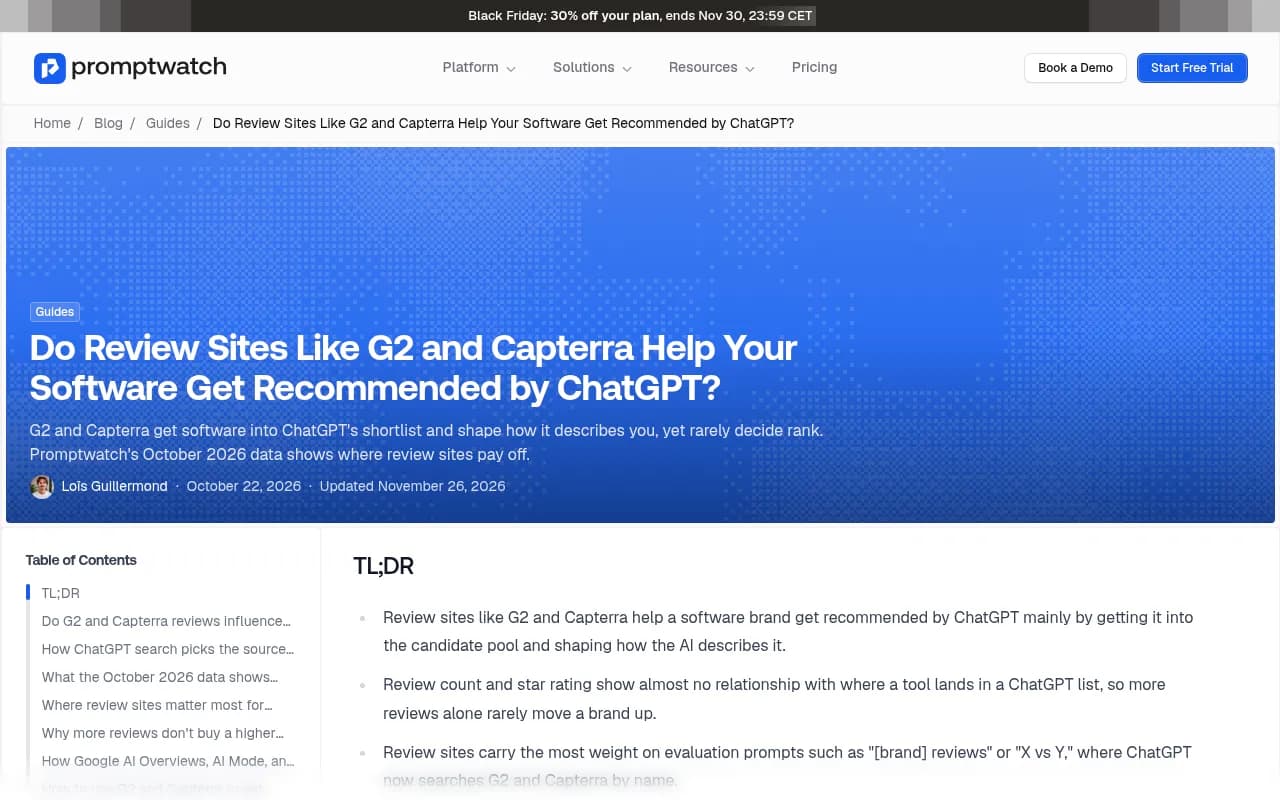
Promptwatch's G2 and Capterra analysis found that review sites help get software into ChatGPT's shortlist and shape how it describes you, but review count and star rating show almost no relationship with where a tool lands in a list. That cuts against a claim you will see elsewhere, that 500 reviews at 4.5 stars beats 30 reviews at 4.8 (from BrandCited). I could not verify that number, so treat it as a rule of thumb at best.
What I would take from the data: be present, be complete, be current. A bare G2 profile with a dozen stale reviews is a missed shot at the candidate pool. A thousand extra reviews will not necessarily move you from fifth to first.
Other third-party figures point the same way on presence. Get3rd reports G2 cited in AI answers for 60% of the B2B SaaS companies it tracks, and Semrush's AI Visibility Index, via MarTech, ranks G2 fourth among ChatGPT's most-cited sources in tech and SaaS. Different methods, so don't compare them to the Promptwatch numbers directly.
How to make your documentation citable
The research does not give a documentation checklist, so this section is my practical read, anchored to what the data does show.
1. Take docs out from behind the login
If your docs sit behind authentication, no AI crawler can read them and nothing gets cited. Keep help centers and API reference public. If part of it must be gated, publish a public overview of each feature.
2. Check that AI crawlers are allowed in
Audit robots.txt and your CDN rules. Plenty of sites block GPTBot or OAI-SearchBot by accident through a blanket bot rule. Free tools help here: the Agentic Readiness Check shows which AI crawlers can read your site, and the AI Crawler URL Inspector tests a specific page. A full list of bots and robots.txt guidance lives at promptwatch.com/bots.
3. Answer the question in the first lines
Every heading should be answered in the first sentence or two beneath it. Models quote what they can lift cleanly. Write "How does X work?" sections as short, direct explanations, then add detail.
4. Cover the questions that come before you are shortlisted
Because docs earn a larger share of informational prompts, write conceptual pages, not only reference pages. "How SSO works in [product]" or "How usage-based billing is calculated" are the kind of explainers that surface in comparison research.
5. Keep pages fresh
Promptwatch's content half-life report says news loses half its cited pages within about five weeks, while landing pages and docs hold on for months. Docs are durable, but only if the facts stay right. An outdated pricing or limits page teaches the model the wrong thing.
6. Do not rely on markdown tricks
Markdown files are only 0.05% of AI search citations, per Promptwatch's markdown report. Files like llms.txt may help AI agents, but they are not what drives citations in AI search. Put your effort into readable HTML pages first.
How to use GitHub for visibility
If you sell a developer product, a public GitHub presence is close to a requirement, and Promptwatch's report says as much. Practical moves:
- Publish SDKs, example apps, and integration templates in public repos.
- Write READMEs that state what the project does, who it is for, and a working quickstart in the first screen.
- Link back to your docs and name your product consistently so the repo and the brand connect.
- Answer issues publicly. Threads become source material.
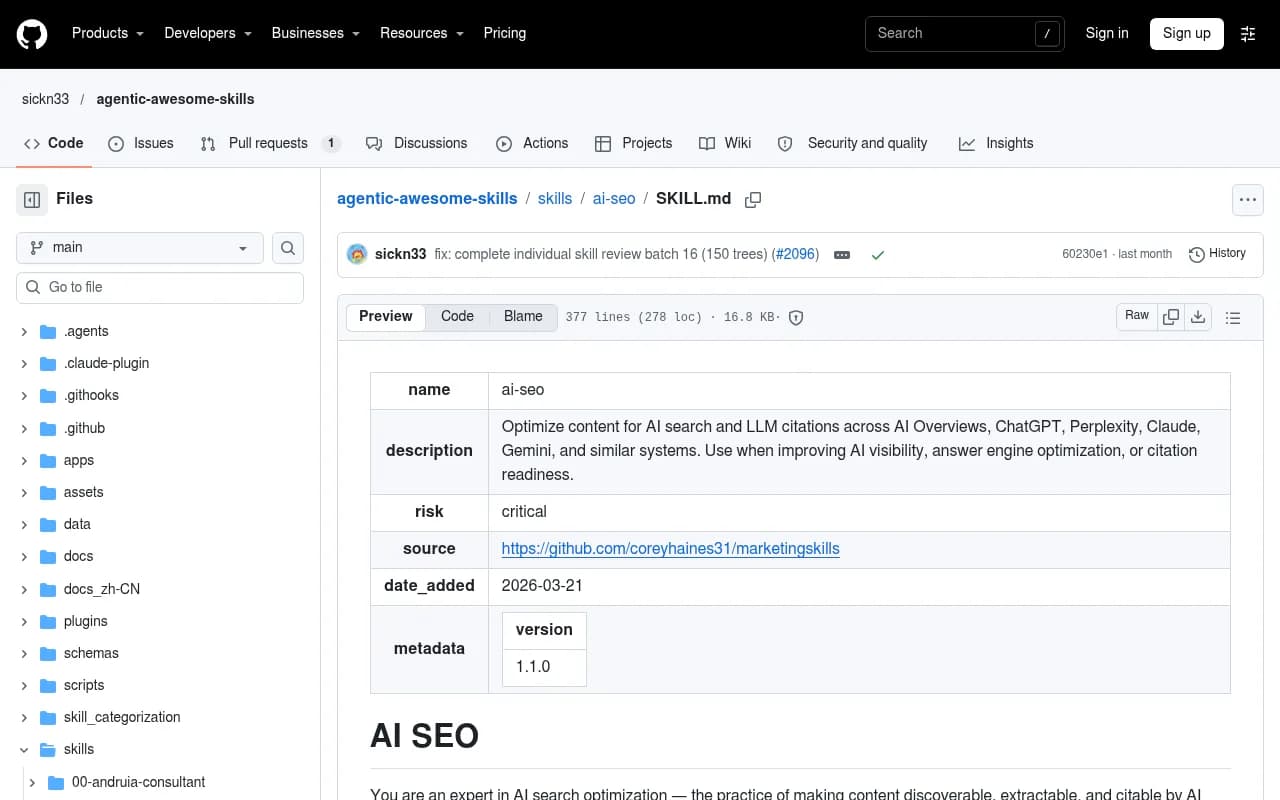
The agentic skills repos that circulate on GitHub, such as the AI SEO skill in the sickn33 collection (adapted from coreyhaines31/marketingskills), are a small example of the same effect: openly readable instructions that get reused and referenced.
How to run your review-site presence
- Claim and complete your G2 and Capterra profiles. Fill every field: categories, features, pricing, integrations.
- Ask for reviews continuously, not in a single burst. Recent, detailed reviews feed the pros and cons AI repeats.
- Read your reviews as a preview of how the AI will describe you. A repeated complaint will probably show up in answers.
- Prioritize evaluation prompts. "X vs Y" and "[brand] reviews" are where review sites carry the most weight.
- Don't forget Gartner and Software Advice. Together with G2 and Capterra they hold that 1.57% review-and-analyst share.
Measuring whether it works
Citation share data is only useful if you can see your own numbers. You need to know which prompts mention you, which pages get cited, and whether AI crawlers can fetch your docs at all.
Promptwatch covers that loop: it tracks prompts across ChatGPT, Google AI Overviews, Gemini, and others, shows which of your pages and which third-party pages (including review profiles) get cited, and has IP-verified AI crawler logs so you can tell a crawl access problem from a content problem. Its Action Board then lists what to fix.

Other options exist if you want to compare. Several of these are monitoring-focused, so check whether they also show crawler activity and what to fix:



For a broader list, the GEO software directory at bestgeosoftware.com is a good place to browse.
| Need | What to look for |
|---|---|
| See which prompts name you | Prompt tracking across ChatGPT, AI Overviews, Gemini |
| See which pages get cited | Citation and page-level tracking, including G2 and docs URLs |
| Know if bots can read your docs | AI crawler logs with error detail |
| Turn findings into work | Prioritized actions, content gap analysis |
A simple 30-day plan
- Week 1: Make sure docs, help center, and API reference are public. Fix robots.txt and CDN rules that block AI crawlers.
- Week 2: Audit the top 20 informational questions your buyers ask. Check whether a doc page answers each one in its first lines.
- Week 3: Complete G2 and Capterra profiles and start a steady review request cadence.
- Week 4: Publish or tidy public GitHub repos with quickstarts that link to the docs. Then measure which of your pages show up as citations.
Then repeat. The citation numbers move month to month, so the Promptwatch Data reports are worth rechecking. The data hub lists them all.
Frequently asked questions
Is G2 more important than my own docs for ChatGPT?
No. In the October 2026 data, docs and vendor sites earn about three times what review sites and analysts do. Review sites matter for the shortlist and the description of your product, docs for explanation.
Do I need a GitHub presence if I sell non-technical software?
Probably not as a priority. GitHub's lead is strongest for developer tools. For other products, docs, help centers, and review profiles come first.
Can gated documentation be cited?
No. If AI crawlers cannot read a page, it cannot be cited. Make at least the conceptual docs public.
How often should I check the numbers?
Monthly is reasonable. The data in this guide covers Sep 28 to Oct 4, 2026, and shares shift as models update.
The bottom line
GitHub, docs, and G2 dominate software citations because each one gives a model something clean to quote: code and examples, explanations, and outside opinion. You do not need all three to be perfect. Start by opening your docs to crawlers, then fill out your review profiles, then tend your repos. Check whether it is working with real prompt data before you spend more.