
Key takeaways
- Visibility in 2026 depends more on being cited inside AI answers than on page position. Most marketers now say AI search is an extension of SEO, not a separate discipline.
- Several 2025 tactics went stale. Reddit's share of ChatGPT citations fell from roughly 4% to 0.5% in August, and Wikipedia dropped out of ChatGPT's top 20.
- Product pages and landing pages, not blog posts, earn the largest share of ChatGPT citations (about 39% combined, Sep 28 to Oct 4, 2026).
- Each engine behaves differently. YouTube is 6.71% of AI Overviews citations, while social posts barely register in ChatGPT.
- Measurement matured: citation frequency, share of voice, accuracy, crawler logs, and AI-referred conversions replaced rank reports as the core scorecard.
The big shift: from ranking to being cited
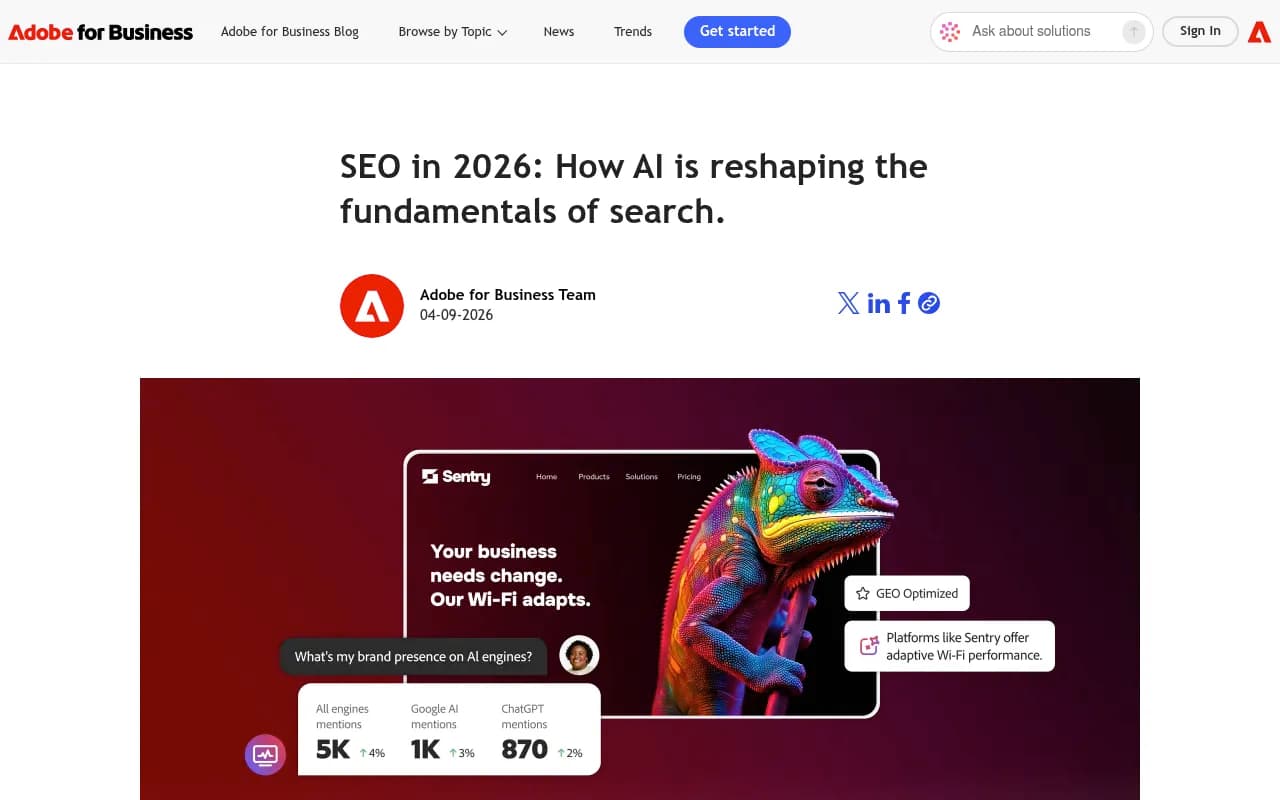
If I had to compress the year into one sentence, it would be this one from Adobe's 2026 SEO overview: visibility depends less on page position and more on whether a brand is cited within AI-generated responses.
That framing sounded dramatic in 2025. In 2026 it became routine. Google said at I/O in May that AI Mode had passed one billion monthly users one year after launch, and the company announced a rebuilt AI-powered search box and agents you can invoke just by asking a question. You can read the details in Google's I/O 2026 search announcement.
The click data explains why marketers cared. Pew Research's browsing study found users click a traditional result in 8% of visits when an AI summary appears, versus 15% when none does. Links inside the summary itself drew clicks in about 1% of visits. At the same time, Alphabet reported Google Search ad revenue up 19% year over year in Q1 2026, which it tied to query growth from AI features. So searches grew while clicks per search shrank. Both things are true.
The practical upshot: you can be present in a buying decision without ever getting a visit. That is an opportunity and a measurement headache, since analytics tools often file this influence under "Direct" or miss it.
How marketers actually responded
The surveys are a bit self-congratulatory, so treat them with some salt, but the direction is consistent.
- Semrush's operational gap study found 85% of marketers say AI changed their search strategy (32% "significantly evolved," 53% "some adjustments"). 77% call AI search an extension of SEO, and only 15% see it as separate. Only 22% had fully integrated the two.
- The IAB's 2026 outlook, as quoted in an SEO Essex analysis, says 73% of marketers now prioritize content built to be cited in AI answers. That is a secondhand figure, so check the original before repeating it in a deck.
- BrightEdge reported AI Overviews on about 48% of tracked queries in February 2026, up from about 30% a year earlier. Also worth verifying at the source.
The 77% "extension of SEO" number is the one I find most useful. It killed the awkward 2025 debate about whether GEO replaces SEO. It doesn't. Crawling, indexing, technical accessibility, and genuinely useful content are still the foundation. What changed is the finish line.
What the citation data says changed
This is where 2026 got interesting. Advice that was repeated everywhere in 2025 stopped being true.
Reddit and Wikipedia faded from ChatGPT
On August 14, 2026, reddit.com's share of ChatGPT Search citations collapsed from roughly 4% to 0.5%, according to Promptwatch Data on Reddit citations dropping in ChatGPT. AI Overviews and AI Mode declined more gradually. By November, Reddit sat at 0.23% of ChatGPT citations, still the most cited popular site, per Promptwatch's November ChatGPT citation share report. In June it had 3.71%. Wikipedia went from 0.56% to 0.03% and fell out of the top 20.
The same report shows the top 20 tracked sites together earn under 2% of citations. The rest is spread across hundreds of thousands of domains. Five of the top 10 spots are review sites: G2, Gartner, BBB, Capterra, and Trustpilot. If you were told to "just get on Reddit and Wikipedia" for ChatGPT, that playbook is dead.
Social platforms matter, but engine by engine
Promptwatch's social citation report for Oct 11 to Nov 9, 2026 split it cleanly:
| Engine | Social share of citations | Leading platform |
|---|---|---|
| Google AI Overviews | 13.16% | YouTube, 6.71% (up from 4.28%) |
| Perplexity | 1.94% | Reddit, 0.82% |
| ChatGPT | 0.64% | Reddit, 0.40% |
AI Overviews cites social about 20 times as often as ChatGPT. YouTube alone beats the other six platforms combined there. One caveat from the report: October covered 7 days and November covered 30, so the month-to-month comparison isn't like for like. The takeaway is still clear. Put video first if Google buyers matter to you, lean on Reddit and LinkedIn for Perplexity, and don't count on social posts to reach ChatGPT.
Product and landing pages beat blog posts
I expected editorial content to dominate. It doesn't. In Promptwatch's content type analysis (Sep 28 to Oct 4, 2026), product pages earned 22.4% of ChatGPT citations and landing pages 16.8%. Listicles followed at 13.6%, then how-tos at 8.7% and documentation at 7.5%. For commercial prompts, product pages, landing pages, listicles, and comparisons make up almost 70% of citations. For branded prompts, reviews are 5.6%, more than three times their overall share.
In plain terms: your money pages need to be written for machines and buyers. Thin product pages with a hero image and three bullets lose.
Shelf life matters too. In Promptwatch's half-life study, landing pages and docs stayed cited for months, while news lost half its pages within about 36 days. Evergreen assets compound. News posts burn.
Authority got more nuanced
In the November domain rank distribution, the median cited domain was DR 56 or 57 in all four engines. But DR 100 sites earned 13.7% of AI Overviews citations versus 0.3% in ChatGPT. And August data showed DR 46 to 75 sites taking almost half of ChatGPT citations. You do not need a giant domain to get cited in ChatGPT, but Google's surfaces still lean toward the giants.
Engine behavior shifted under everyone's feet
Two changes caught teams off guard.
- On March 4, the GPT-5.3 rollout cut average citations per response across GPT-5.3, GPT-5.4, and GPT-5-Mini (citation drop report).
- On August 8, ChatGPT began using the site: operator at scale. It jumped from about 0.4% to about 17% of fan-out queries overnight, and searches per response nearly doubled (site: operator report). ChatGPT is increasingly checking specific domains directly, which rewards sites that are clearly structured and easy to crawl.
On the crawler side, Meta-WebIndexer rose from about 2% to nearly 38% of tracked AI crawler requests between mid-July and August 9 (Meta-WebIndexer data). Meta is crawling like it is building an index. If your robots.txt was written in 2024, it probably doesn't mention these bots. Markdown files, for what it's worth, are only 0.05% of AI search citations (markdown report), so don't rebuild your site as .md files for AI search.
One more: ChatGPT stopped sending a referrer on October 8, which makes AI traffic harder to attribute. Tagging links with utm_source=chatgpt.com where you control them helps.
What stopped working and what still does
| 2025 advice | 2026 reality |
|---|---|
| Seed Reddit and Wikipedia for ChatGPT | Both are tiny shares now |
| Publish lots of blog posts | Product and landing pages lead citations |
| Track rankings only | Citations, share of voice, accuracy, AI traffic |
| One strategy for every AI engine | Engines differ sharply on sources |
| Keyword density | Entity clarity, extractable answers, semantic depth |
The boring fundamentals held up. Fast pages, clean HTML, correct canonicals, schema where it clarifies something, strong internal linking, and real expertise. One commenter in the research put it well: AI "will punish sloppy, me-too content and reward sites that are clear, useful, and trustworthy."
How measurement matured
By year end, a serious AI search scorecard looked like this:
- AI visibility: the share of tracked prompts where your brand appears.
- Share of voice against competitors on the same prompts.
- Accuracy: whether AI states your facts correctly.
- Platform coverage: YouTube, Reddit, LinkedIn, and the review sites AI leans on.
- Branded search lift, since people who see you in an answer often search for you later.
- AI-referred visitors versus organic: engagement and conversion, page by page.
Adobe's advice on ROI is sensible: tie visibility gains to qualified traffic, pipeline acceleration, and influenced revenue, not to ranking improvements alone.
Tools for the job
The tool market exploded. Monitoring is now a commodity, and the useful question is whether a tool helps you fix what it finds. Promptwatch covers the full loop: it tracks ChatGPT, Gemini, Perplexity, AI Overviews, and others through their real interfaces, shows which pages get cited, logs AI crawler visits, and its Content Agent writes and publishes pages for the gaps. Its AI crawler logs are useful for separating access problems from content problems.

Other options worth a look, depending on your stack:



| Tool | Type | Good for |
|---|---|---|
| Promptwatch | Tracking plus content creation, crawler logs, traffic attribution | Teams that want to act on the data |
| Profound | Enterprise monitoring | Large brands needing deep tracking |
| Peec AI | Prompt tracking | Multi-language monitoring on a budget |
| Otterly.AI | Lightweight monitoring | Small teams starting out |
| Semrush One | SEO suite with AI visibility | Teams already living in Semrush |
| Ahrefs Brand Radar | Brand monitoring in AI results | Ahrefs users adding AI checks |
For a wider view of the category, the GEO software directory at bestgeosoftware.com lists far more options than fit here.
A practical plan for Q1 2027
I would not try to do everything. Here is the order I would work in.
- Audit access. Check robots.txt and CDN rules against the AI crawlers that matter, including the newer Meta bots. Verify your key pages render as plain HTML. Crawler logs tell you whether bots even arrive.
- Rewrite your money pages first. Product and landing pages are the most cited types in ChatGPT. Answer the buyer's question in the first 100 words, add missing key facts, and replace stale stats and dates.
- Match channels to engines. Invest in YouTube if Google AI Overviews matters to your buyers. Don't spend a quarter on X.
- Fix what AI says about you. Check whether answers state your pricing, features, and positioning correctly, and update the pages the wrong claims come from.
- Refresh evergreen content on a schedule and stop expecting news posts to keep earning citations.
- Fix attribution. Add AI referrers to analytics, use UTM tags where possible, and compare AI visitor conversion to organic.
- Review sites count. With G2, Gartner, Capterra, and Trustpilot dominating the top 10, a thin review profile is a visibility gap.
Should you hire help?
If your team doesn't have the bandwidth, an agency that covers technical SEO, content, and AI search together is the sensible route. 1001 SEO Media is one example, working across technical SEO, content, digital PR, and generative engine optimization. Whoever you pick, ask how they measure citations and what they do when a tactic stops working, because 2026 showed that happens fast.
What I would take from 2026
The year taught a humbling lesson: any tactic tied to a single platform's quirks has a short half-life. Reddit's overnight drop in ChatGPT is the clearest example. The durable work is the unglamorous part: useful pages, clean technical foundations, accurate facts, and measurement that connects visibility to revenue. Build on that, and check your citation data monthly, because the numbers keep moving.
FAQ
Is SEO dead in 2026?
No. Most marketers treat AI search as an extension of SEO, and crawling, indexing, and useful content are still the foundation. The goal now includes being cited in AI answers, not just ranking.
Which content type does ChatGPT cite most?
Product pages, at 22.4% of citations from Sep 28 to Oct 4, 2026, followed by landing pages at 16.8% and listicles at 13.6%.
Should I still focus on Reddit?
For ChatGPT, much less than before. Its share fell from roughly 4% to 0.5% in August. Reddit still matters somewhat for Perplexity and AI Overviews, but check current data before investing heavily.
How do I measure ROI from AI search?
Track AI visibility, share of voice, and accuracy, then connect them to AI-referred traffic, conversions, and influenced pipeline. Expect some influence to show up as direct traffic or branded search.
Where can I see more of the data?
The Promptwatch Data hub publishes regularly updated citation and crawler research.