
Key takeaways
- Traditional metrics like keyword rankings and CTR don't reflect how AI search engines work — you need a different measurement framework entirely
- The five metrics that actually matter: mention frequency, citation rate, ghost citation rate, sentiment accuracy, and platform coverage
- "AI rankings" are largely a fiction — fewer than 1 in 1,000 prompt runs produce the same brand list, so point-in-time checks are meaningless
- AI search visitors convert at roughly 2x the rate of traditional organic visitors, making visibility a revenue issue, not just a branding one
- Most tools stop at monitoring; the ones worth using help you act on what you find
Something broke in 2025. Marketing teams started noticing that their organic traffic numbers looked fine, but leads were quietly dropping. The culprit, in many cases, was AI search. Users were getting answers directly from ChatGPT, Perplexity, and Google AI Overviews without ever clicking through to a website. And the brands showing up in those answers? Often not the ones with the best SEO.
The problem is that most teams are still measuring the wrong things. They're checking keyword rankings for a world where AI doesn't rank pages the same way Google does. They're optimizing click-through rates for a channel where clicks are increasingly optional. And they're ignoring the metrics that actually reflect whether AI models trust, cite, and recommend their brand.
This guide cuts through the noise. Here's what to track, what to stop tracking, and how to think about AI search visibility measurement in 2026.
Why traditional SEO metrics fail in AI search
Classic SEO gave us a clean measurement model: rank for keywords, earn clicks, convert visitors. The metrics followed that logic — position tracking, impressions, CTR, organic sessions.
AI search breaks every assumption in that model.
When someone asks ChatGPT "what's the best project management tool for remote teams," there's no rank 1 through 10. There's a synthesized answer that might mention three tools, might mention none, and will probably look different the next time someone asks the same question. AirOps research found that only 30% of brands maintain consistent visibility from one AI answer to the next, and just 20% stay visible across five consecutive runs of the same prompt.
That volatility makes position tracking nearly useless. You can't "rank #1" for a prompt the way you rank #1 for a keyword. The answer changes based on the model, the user's conversation history, the time of day, and dozens of other factors you can't control.
What you can measure is whether you show up, how often, in what context, and what the AI says about you when it does mention you. Those are the metrics worth building a program around.
The metrics that actually matter
Mention frequency (visibility rate)
The most basic question: when AI models respond to prompts relevant to your category, do they mention your brand?
Mention frequency is typically expressed as a percentage. If you track 100 prompts and your brand appears in 34 of the responses, your mention frequency is 34%. Track this over time and across models — your visibility on Perplexity might look very different from your visibility on Claude or Google AI Overviews.
This metric is the foundation. Everything else builds on it.
Citation rate
Mention frequency tells you if you're named. Citation rate tells you if you're trusted.
A citation means the AI model linked to or explicitly attributed a claim to your content. That's a stronger signal than a bare mention — it means the model treated your site as a source worth pointing users to, not just a name worth dropping.
Citation rate matters for two reasons. First, cited sources get clicks, and those clicks convert at higher rates than typical organic traffic. Second, citations are a proxy for how much AI models trust your content. A high mention rate with a low citation rate suggests you're being referenced but not relied on — which is a content quality problem worth investigating.
Ghost citation rate
This one gets overlooked, but it's genuinely important.
A ghost citation happens when an AI model uses information from your website without crediting you. The model absorbed your content during training or retrieval, but the answer it produces doesn't mention your brand or link to your page. You influenced the response; you got none of the credit.
Ghost citations are hard to detect without dedicated tooling, but they matter because they represent a gap between your actual influence and your measured influence. If your ghost citation rate is high, it means your content is being consumed but your brand isn't being associated with it — often a signal that your content lacks clear brand attribution or that competitors have stronger entity associations with the same topics.
Sentiment accuracy
When AI models do mention your brand, what do they say?
Sentiment accuracy isn't just about whether the sentiment is positive or negative — it's about whether it's accurate. AI models sometimes repeat outdated information, conflate brands, or describe products incorrectly. A model might describe your pricing as "expensive" based on a three-year-old review, or list a feature you discontinued.
Track not just the tone of AI mentions but the factual accuracy. Incorrect information in AI responses is harder to fix than a bad review, because there's no obvious "flag this" button — the fix usually requires updating your own content and waiting for models to recrawl and update their knowledge.
Platform coverage
Different AI models have different user bases and different citation behaviors. ChatGPT skews toward general consumers and business users. Perplexity attracts research-oriented users who often want sources. Google AI Overviews reaches anyone doing a Google search. Claude tends to be used by developers and knowledge workers.
Your visibility might be strong on one platform and near-zero on another. Platform coverage measures how consistently you appear across the models your target audience actually uses. A brand that's well-cited on Perplexity but invisible in Google AI Overviews has a real problem if most of their customers start searches on Google.
Share of voice in AI search
Beyond your own metrics, you need to know how you compare to competitors.
AI share of voice measures what percentage of relevant AI responses mention your brand versus competing brands. If you and three competitors are all tracking the same 200 prompts, and your brand appears in 60 of those responses while the category leader appears in 140, you have a 30% share of voice against their 70%.
This is where AI visibility gets strategic. Share of voice tells you whether you're winning or losing ground relative to the competitive set, not just whether your own numbers are going up. A rising mention frequency can still mean you're falling behind if competitors are growing faster.
Competitor heatmaps — which show you which prompts each competitor is winning and which they're not — are particularly useful here. They reveal the specific topics and questions where you're invisible but your competitors aren't, which is exactly where content investment pays off.
Prompt-level intelligence: volume and difficulty
Not all prompts are equal. "Best CRM for small business" gets asked far more often than "CRM with Zapier integration for solopreneurs." Tracking visibility across both is useful, but winning the high-volume prompt matters more.
Prompt volume estimates how often a given query is being asked across AI platforms. Prompt difficulty estimates how hard it is to break into the AI responses for that query — typically based on how entrenched the current cited sources are.
Together, these metrics help you prioritize. A prompt with high volume and low difficulty is a clear opportunity. A prompt with high volume and high difficulty might require significant content investment before you see results. Without this data, most teams end up optimizing for prompts that either don't matter or can't be won.
AI crawler activity: the metric most teams ignore
Here's something that doesn't get talked about enough: AI models don't just use training data. Systems like Perplexity, ChatGPT Browse, and Google AI Overviews actively crawl the web to retrieve fresh information. That means your site is (or isn't) being visited by AI crawlers right now, and those visits directly affect whether you get cited.
Monitoring AI crawler logs tells you which pages AI agents are reading, how often they return, what errors they encounter, and — critically — whether pages that get crawled eventually turn into citations. If an AI crawler hits your page but you never get cited for that topic, there's probably a content quality or structure issue worth investigating.
This is a layer of measurement that most monitoring-only tools don't provide at all.
Attribution: connecting AI visibility to revenue
The hardest problem in AI search measurement is attribution. When someone sees your brand mentioned in a ChatGPT response, then searches for you directly, then converts — how do you know the AI mention was part of that journey?
A few approaches work reasonably well:
Direct traffic patterns are the most accessible signal. An uptick in branded direct traffic after you start appearing in AI responses for a category is a reasonable (if imperfect) indicator of AI-driven awareness. Look for correlation between your visibility scores and direct traffic trends.
Assisted attribution models try to reconstruct the customer journey by looking at touchpoints before conversion. If a user visited your site via an AI referral link (Perplexity, for example, does pass referral traffic), that can be tracked directly. For models that don't pass referral data, you're relying on inference.
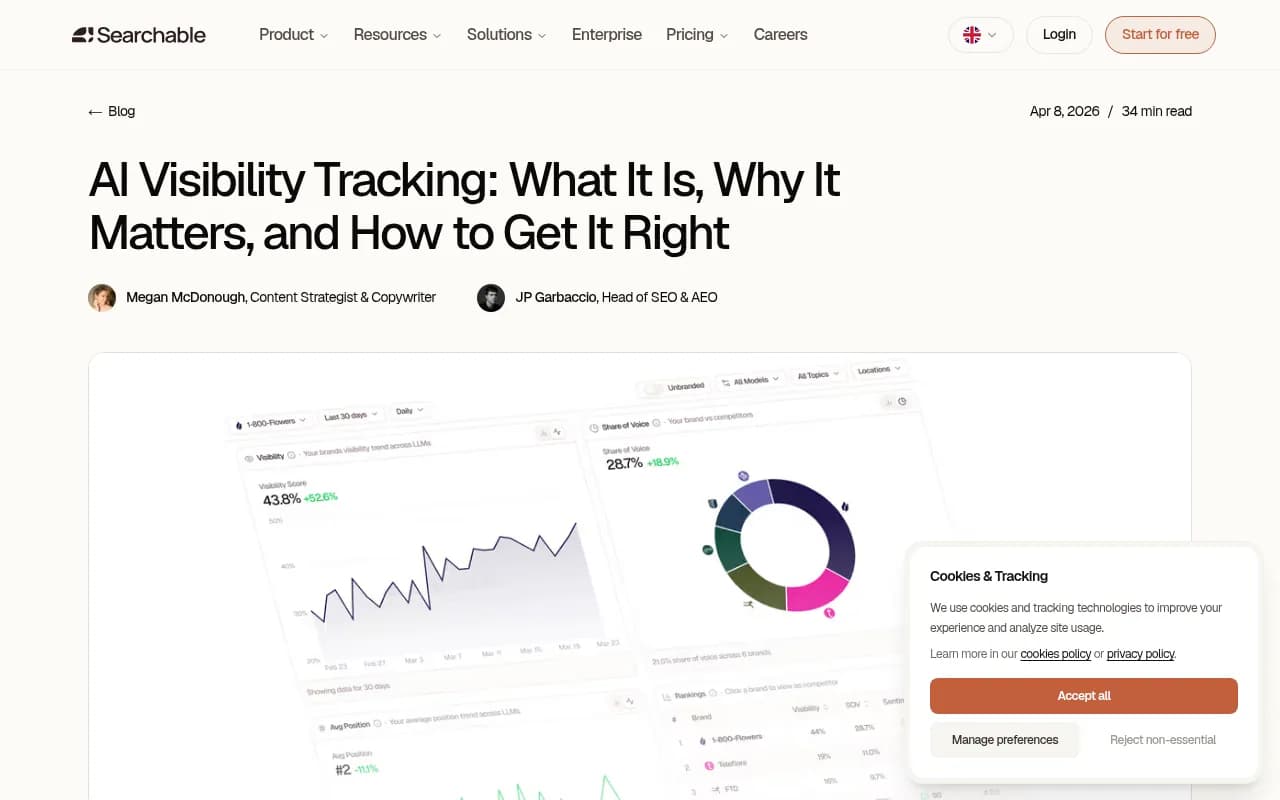
On-page engagement metrics — time on page, scroll depth, return visits — can help distinguish AI-referred visitors from other traffic types. The data point from Searchable that AI search visitors convert at 2x the rate of traditional organic visitors suggests these users arrive with higher intent, which should show up in engagement metrics if you're looking for it.
What to stop tracking (or at least stop obsessing over)
Keyword rankings for AI search
Some tools market "AI rankings" as if they work like Google positions. They don't. The same prompt asked to the same model five times in a row can produce five different sets of cited sources. Treating a point-in-time rank check as a stable metric is misleading. Track visibility frequency across many runs instead.
Raw impression counts from AI Overviews
Google Search Console now shows AI Overview impressions, but this number is noisy and doesn't tell you whether your content was cited, what context it appeared in, or whether users found it useful. Use it as a directional signal, not a primary KPI.
Vanity mention counts without context
"We were mentioned 47 times in AI responses this month" sounds good until you realize 40 of those mentions were negative comparisons to a competitor. Raw mention counts without sentiment and context are close to meaningless.
CTR from AI-heavy queries
Click-through rates on queries where AI Overviews dominate have dropped significantly — sometimes to near zero — because users get their answer without clicking. Optimizing for CTR on these queries is fighting the wrong battle. The goal is to be the source AI cites, not to outrank the AI Overview itself.
Tools worth knowing about
The market for AI visibility tools has grown fast, and there's a real spectrum from basic monitoring dashboards to full optimization platforms.
On the monitoring end, tools like Otterly.AI and Peec AI track brand mentions across AI models and give you visibility scores. They're accessible and affordable, but they mostly show you data without helping you act on it.


Profound and AthenaHQ go deeper on analytics — competitive benchmarking, platform breakdowns, share of voice tracking. Still primarily monitoring-focused, but more sophisticated in what they measure.

For teams that want to close the loop between measurement and action, Promptwatch is worth looking at. It covers the full cycle: Answer Gap Analysis shows which prompts competitors are winning that you're not, Content Agents generate content targeting those specific gaps, and page-level tracking shows when new content starts getting cited. It also includes AI crawler logs — the real-time data on which AI agents are visiting your site and what they're reading — which most tools don't offer at all.

SE Ranking has added a solid AI visibility toolkit to its existing SEO platform, which makes it a reasonable option if you want to consolidate tools.
Brandlight and Scrunch AI are worth knowing about for brand-focused teams, though both are more limited in scope than the full-stack platforms.
Comparison: what different tools actually track
| Tool | Mention tracking | Citation rate | Crawler logs | Content generation | Share of voice | Prompt volume data |
|---|---|---|---|---|---|---|
| Promptwatch | Yes | Yes | Yes | Yes | Yes | Yes |
| Profound | Yes | Yes | No | No | Yes | Limited |
| AthenaHQ | Yes | Yes | No | No | Yes | No |
| Otterly.AI | Yes | Basic | No | No | Limited | No |
| Peec AI | Yes | Basic | No | No | Limited | No |
| SE Ranking | Yes | Yes | No | No | Yes | No |
| Semrush | Limited | Limited | No | No | Limited | No |
The pattern is consistent: most tools handle the "what's happening" question reasonably well. The gap is in "why is it happening" and "what do I do about it."
Building a practical measurement program
You don't need to track everything at once. A reasonable starting point:
Pick 30 to 50 prompts that represent how your target customers actually ask about your category. Include category-level prompts ("best [category] tools"), comparison prompts ("X vs Y"), and problem-oriented prompts ("how do I [problem your product solves]").
Run those prompts weekly across at least three AI models — ChatGPT, Perplexity, and Google AI Overviews cover the majority of AI search volume for most B2B and B2C categories.
Track your mention frequency, citation rate, and share of voice against two or three direct competitors. Look for the prompts where competitors appear and you don't — those are your content gaps.
Set a monthly review cadence to assess sentiment accuracy. Read the actual AI responses that mention your brand, not just the aggregate scores. You'll catch factual errors and outdated information that automated sentiment scoring misses.
Once you have a baseline, you can start connecting visibility changes to content changes. Publish a piece targeting a specific gap, watch for crawler activity, and track whether your citation rate for that prompt cluster improves over the following weeks. That feedback loop is where measurement becomes optimization.
The bottom line
AI search visibility measurement is genuinely new territory, and the metrics that matter are different from what most SEO teams are used to. The core shift is from measuring your position in a static ranking to measuring your presence in a probabilistic, model-generated response ecosystem.
That means tracking mention frequency, citation rate, ghost citations, sentiment accuracy, and platform coverage — and ignoring the temptation to treat AI "rankings" as if they work like Google positions.
The teams getting this right in 2026 aren't just monitoring their visibility. They're using that data to identify content gaps, create targeted content, and verify that the content actually starts getting cited. Measurement without action is just a dashboard.