
Key takeaways
- Watch your data weekly, review strategy monthly, and re-evaluate the platform itself quarterly. Add an unscheduled review after any major model release.
- AI engines change behavior overnight. ChatGPT cited about 27% fewer sources per response after the GPT-5.3 rollout on March 4, 2026, so a one-off audit goes stale fast.
- The question to ask each quarter is not "is the dashboard pretty?" but "did this tool help us change something, and did the change work?"
- Switch platforms when the tool stops matching your prompts, markets, or workflow, not because a competitor launched a feature.
- Most cadence advice online comes from vendors. Treat it as a starting point and adjust it to how fast your own category moves.
Why a fixed review schedule matters here
With classic SEO you could pick a rank tracker, set it up, and mostly forget about it for a year. AI search does not allow that. The engines you are tracking get new models, change how many sources they cite, and swap out which sites they trust, sometimes in a single day.
Two examples from Promptwatch Data make the point. When ChatGPT rolled out GPT-5.3 on March 4, 2026, average citations per search-enabled response fell from about 6.4 to roughly 4.7-4.9 within weeks, and it had not recovered a month later. GPT-5.3, GPT-5.4 and GPT-5-Mini all dropped at once. Then on August 14, 2026, reddit.com's share of ChatGPT citations fell from about 4% to 0.5%. By Nov 1-25 it sat at 0.23%, per Promptwatch's November 2026 citation share report.
If your platform was built around the assumption that Reddit would drive a big slice of your citations, that platform's playbook went stale in a day. That is the real reason to put a review on the calendar. You are not only checking whether the vendor is any good. You are checking whether your whole approach still matches how the engines behave.
I should be upfront about one thing. I found no independent study on how often teams actually switch AEO platforms. The cadence below is my own reasoning from the volatility data, plus what a couple of vendors recommend. Adjust it.
The four layers of review
The mistake most teams make is lumping everything into one "review." There are really four different jobs on four different clocks.
| Layer | Frequency | What you look at | Who owns it |
|---|---|---|---|
| Data check | Weekly or biweekly | Visibility swings on tracked prompts, new citations, crawler errors | SEO or content lead |
| Strategy review | Monthly | Visibility trend, sentiment, competitor citation share, content gaps | Marketing lead |
| Platform review | Quarterly | Coverage, data quality, workflow fit, cost per useful insight | Marketing lead plus whoever pays the bill |
| Event review | After a major model or engine change | Did the change hit everyone, or just you? | Whoever sees it first |
Weekly: the data check
Vendors agree on this one. Cognizo suggests weekly or biweekly monitoring of actively tracked prompt sets because answers shift as models update or new content gets indexed. That is a vendor source, but it matches what the volatility data suggests.
The weekly check is short. Did visibility on your core prompts move more than usual? Did a new domain start getting cited? Are AI crawlers hitting errors on your key pages? Fifteen minutes is enough. You are looking for a reason to dig deeper, not doing the digging.
Monthly: the strategy review
This is where decisions get made. Look at Visibility Score trends, sentiment shifts, and which competitors are gaining citation share. Cognizo describes the same monthly rhythm. It is also the right time to check which of your pages are decaying.
Promptwatch's content half-life study tracked every page ChatGPT cited on July 6, 2026 for 90 days. After 60 days, ChatGPT still cited about 69% of landing pages, 67% of docs and 63% of comparisons. Product pages, reviews and how-tos hit their half-life after 74-77 days. News was the outlier: half its pages were gone after 36 days. A monthly review is frequent enough to catch listicles and product pages before they drop out.
Quarterly: the platform review
This is the one the article title is about. Profound's July 2026 guide recommends a standing quarterly review of your highest-traffic and highest-intent pages. I would apply the same rhythm to the tool itself. Three months is long enough for a vendor to ship something meaningful and for you to see whether your workflow actually changed. It is short enough that you are never locked into a bad choice for more than a season.
Annual contracts complicate this. Annual billing is usually cheaper, often around 17% off, but it means the quarterly review only has teeth if you can act on it. A sensible compromise: run monthly for the first two quarters while you learn what you need, then move to annual once the answer is stable.
Event-driven: after model releases
Promptwatch's advice here is worth repeating: check model-release dates before you blame your own content for a traffic dip, and track citations per response so you can tell "we lost visibility" from "ChatGPT cites fewer sources across the board." If your platform cannot show you that second number, that is a finding for your next quarterly review.
Other events worth an unscheduled look:
- ChatGPT starting to use the
site:operator at scale on August 8, 2026, which jumped from roughly 0.4% to about 17% of fanout queries overnight (report) - Crawler shifts, like Meta-WebIndexer going from about 2% to nearly 38% of tracked AI crawler requests between mid-July and August 9 (report)
- Your own big changes: a rebrand, a pricing change, a new market, a new product line
The quarterly platform scorecard
Do not re-evaluate on vibes. Score the platform on the same questions every quarter so you can see drift.
1. Coverage
Does it still track the engines your buyers use? New assistants and AI modes appear regularly. Check whether the tool collects from real user interfaces or only APIs, because user-facing answers and citations can differ from API output. Also check country and language coverage if you have expanded.
2. Data quality
Pick five prompts and run them by hand. Compare what you see to what the tool reports. If they disagree often, you have a data problem. Also ask how often prompts run. Daily is the baseline. Some situations, like a launch, call for tighter cadence.
3. Diagnosis
Can it explain why you are or are not cited? Citation sources, crawler logs, and content gap analysis separate a platform from a scoreboard. A score that goes up and down with no explanation is trivia.
4. Action
This is the question I weigh most. In the last 90 days, how many changes did you ship because of this tool? If the answer is zero, you are paying for a report. Either the tool does not surface actions, or your team is not using it, and both are worth knowing.
5. Measurement of impact
Can you connect AI visibility to traffic and conversions? Most AI answers do not include a clickable link, so cognizo's advice of a two-stage funnel (mentions and citations first, AI-referred traffic second) is sensible. A platform that only does stage one will leave you guessing on stage two.
6. Cost and fit
Pricing in this category varies a lot. A vendor comparison lists starting prices ranging from about $50/mo to $499/mo, but I could not verify those on vendors' own pages, so check current pricing yourself. More useful than sticker price is cost per useful decision. A cheap tracker that never changes what you publish is more expensive than a pricier tool you act on weekly.
Score each from 1 to 5 and keep the sheet. After two quarters you will see a trend, and the trend matters more than any single number.
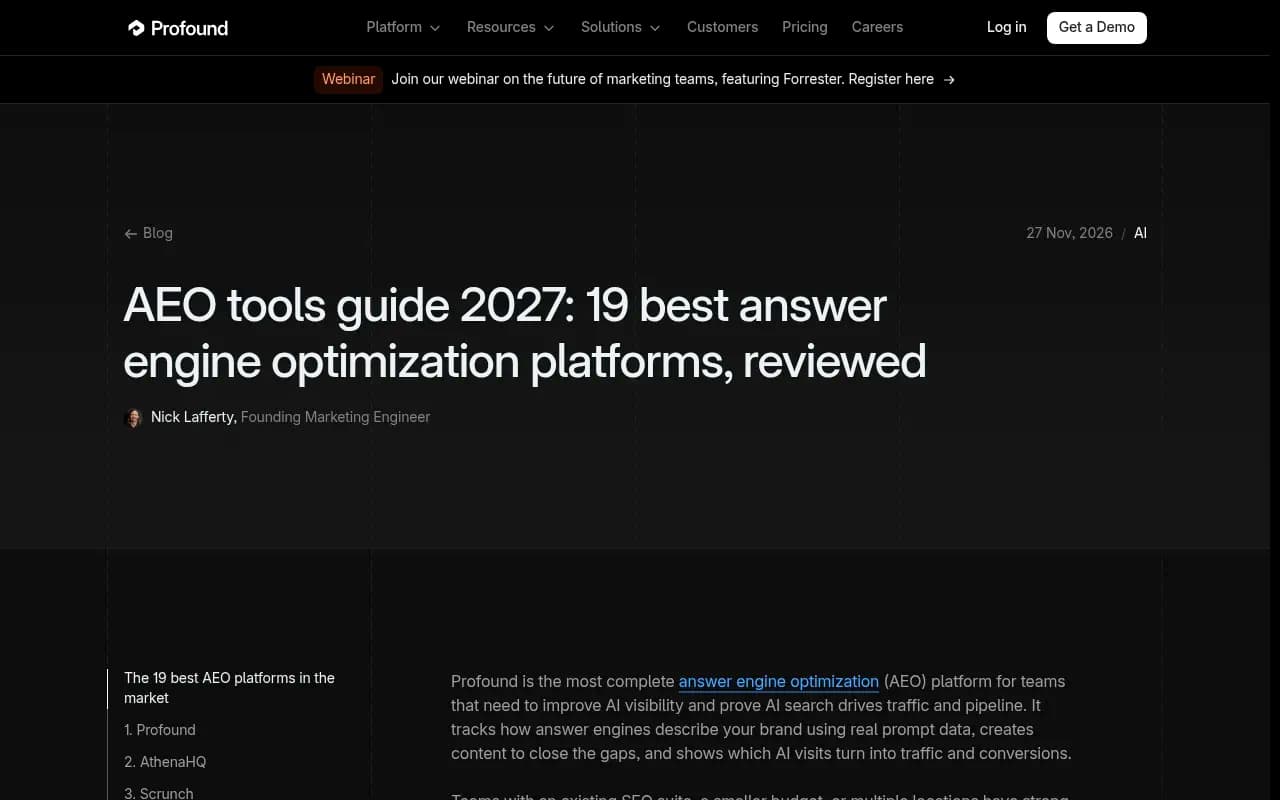
Profound's 2026 platform roundup is a handy starting point for building a shortlist, though keep in mind it is published by a vendor that is one of the platforms it ranks.
Signals that it is time to switch
A quarterly review should end in one of three decisions: keep, adjust, or replace. Here is what usually justifies replacing.
- You outgrew it. More markets, more brands, or more clients than the plan was built for.
- It tracks but does not help. You have all the dashboards and nobody knows what to do on Monday.
- Your data disagrees with reality. Manual spot checks keep contradicting the tool.
- A required capability is missing. For example crawler logs, Shopping tracking, or local targeting.
- The cost curve changed. Prompt or response limits force you to drop tracking you actually need.
And here is what does not justify switching: a competitor's launch announcement, a nicer interface, or a single bad week of data. Given how volatile the engines are, one bad week often says more about ChatGPT than about your vendor.
Which kinds of tools to compare when you do switch
The category splits roughly into three groups, and knowing which you have tells you what to compare against.
| Type | What it does | Examples | Typical fit |
|---|---|---|---|
| Monitoring-focused trackers | Report mentions, visibility, and citations | Otterly.AI, Peec AI, Rankscale | Small teams that want a lightweight score |
| SEO suites with AI add-ons | Fold AI tracking into an existing SEO workflow | Semrush, Ahrefs Brand Radar, SE Ranking | Teams already living in those suites |
| End-to-end optimization platforms | Monitor, diagnose, create content, and measure results | Promptwatch, Profound, AthenaHQ | Teams that want the tool to drive action |





If you want a wider view of the market, the GEO software directory at bestgeosoftware.com lists many more options than these.
Where Promptwatch fits in a review
If your quarterly scorecard keeps coming back weak on diagnosis, action and impact, that is the profile of a monitoring-only tool. Promptwatch is built around that gap: it tracks prompts across the real interfaces of ChatGPT, AI Overviews, Gemini, Perplexity and others, then adds IP-verified AI crawler logs, an Action Board, and a Content Agent that writes and publishes pages, with visitor analytics to check whether they got crawled, cited and clicked. That makes the quarterly question (did the fix work?) answerable inside one product.

The Content Agent and faster-than-daily tracking start on the Business plan, so check pricing against your needs. There is a 7-day free trial, and the free AI visibility report is a quick way to get a baseline before you compare. If you are weighing it against a specific tool, the head-to-head pages such as Promptwatch vs Profound and Promptwatch vs Peec are a faster read than starting from scratch.
How to run a switch without losing your history
Switching is where teams get hurt. A few habits make it painless.
- Export your prompts, tags and topics before you cancel. Most tools support CSV or API export.
- Run both tools in parallel for two to four weeks. Compare the numbers on the same prompts. Differences in method are normal, so look for consistent direction, not identical values.
- Keep a note of the date you switched in any trend chart. Otherwise the break in methodology will look like a real change in visibility.
- Do not switch the week after a major model release. Your baseline will be moving anyway.
A sample calendar
| When | Task | Time |
|---|---|---|
| Every Monday | Scan visibility swings, crawler errors, new citations | 15 minutes |
| First week of the month | Strategy review: visibility, sentiment, competitors, decaying pages | 1-2 hours |
| End of each quarter | Platform scorecard, keep/adjust/replace decision, contract check | Half a day |
| After a major model release | Compare citations per response before blaming your content | 30 minutes |
| Once a year | Full market scan, vendor shortlist refresh | 1 day |
If you do not have the in-house time to run this, that is a legitimate reason to bring in help. 1001 SEO Media, which publishes this site, runs GEO programs for clients and uses Promptwatch for AI visibility work, though a good internal owner and a calendar reminder will get you most of the way.
The short version
Treat your AI search platform like a subscription you earn the right to keep. Watch the data weekly, decide strategy monthly, and put the platform itself on trial every quarter. Add a review whenever a major model ships. The engines will keep changing without asking, so your cadence should be set by how fast they move, not by your contract renewal date.
FAQ
How often should I review my AI search optimization platform?
Quarterly for the platform itself, with weekly data checks and a monthly strategy review. Add an extra review after any major model release.
Is quarterly too often?
For most teams, no. AI engines can change citation behavior overnight, and three months is long enough to judge whether the tool changed what you ship. Low-movement topic clusters can be reviewed less often.
Should I switch platforms every year?
No. Switch when the tool stops fitting your coverage, workflow or budget. Constantly switching breaks your trend data.
What is the biggest red flag in a review?
No actions taken in 90 days. If the platform has not changed anything you published or fixed, it is a report, not an optimization tool.
Do I need to re-evaluate after every ChatGPT update?
You need a quick check, not a full review. Look at citations per response and your core prompts to see whether the shift is industry-wide or specific to you.