Key takeaways
- Peec.ai is a solid monitoring tool but caps out at 100 prompts, 4 base AI engines, and has no content creation or optimization features
- Most GEO tools poll AI APIs directly -- which can produce different results from what real users actually see in ChatGPT, Perplexity, or Gemini's interfaces
- The best alternatives either use real user-interface data, real search query datasets, or both -- giving you visibility scores grounded in actual behavior
- If you just need monitoring, there are cheaper and broader options than Peec. If you need to act on the data (fix gaps, create content, track results), you need a platform with optimization built in
- Tools range from $0 to $500+/mo -- the right choice depends on whether you need monitoring only, content tools, or a full GEO optimization loop
Peec.ai has a lot going for it. Clean interface, multi-language support, unlimited countries at no extra cost, and a straightforward approach to tracking brand visibility across AI engines. For teams just getting started with GEO, it's a reasonable first tool.
But it has a ceiling, and a lot of teams hit it fast.
The Pro plan (€199/mo) covers four base AI engines. Want Claude, Gemini, or Google AI Mode? Those are Enterprise add-ons with custom pricing. You're capped at 100 prompts and 9,000 AI answers per month. There's no content creation, no site audits, no shopping visibility tracking, and no way to act on what you find.
The bigger issue for some teams is the data methodology. Many GEO tools -- Peec included -- query AI models through their APIs to collect response data. That's fast and scalable, but API outputs don't always match what users see in the actual ChatGPT or Perplexity interface. Citations, shopping recommendations, and answer formats can differ. If you're making optimization decisions based on API data, you might be optimizing for something slightly different from what your customers actually experience.
Here are 10 alternatives worth evaluating, with a focus on data quality and what you can actually do with the results.

1. Promptwatch
Promptwatch is the most complete option on this list if you need to both understand and improve your AI visibility. It monitors 10 AI engines (ChatGPT, Perplexity, Google AI Overviews, Google AI Mode, Claude, Gemini, Meta/Llama, DeepSeek, Grok, Mistral, Copilot) and tracks how those models behave in real user interfaces -- not just through API calls. That distinction matters when you're trying to understand what customers actually see.
What separates it from most tools here is the action loop. Answer Gap Analysis shows you exactly which prompts competitors appear for but you don't. Content Agents then generate articles, comparisons, and briefs built around those specific gaps -- grounded in real prompt volumes, citation data, and competitor analysis. AI Crawler Logs show you in real time which pages ChatGPT, Claude, and Perplexity are crawling, how often they return, and when a crawled page actually starts getting cited. Most competitors don't have anything like this.
It also tracks Reddit and YouTube as citation sources, monitors ChatGPT Shopping appearances, and connects visibility data to actual traffic and revenue attribution.
Pricing starts at $99/mo (Essential: 1 site, 50 prompts), $249/mo (Professional: 2 sites, 150 prompts, crawler logs), and $579/mo (Business: 5 sites, 350 prompts). Free trial available.

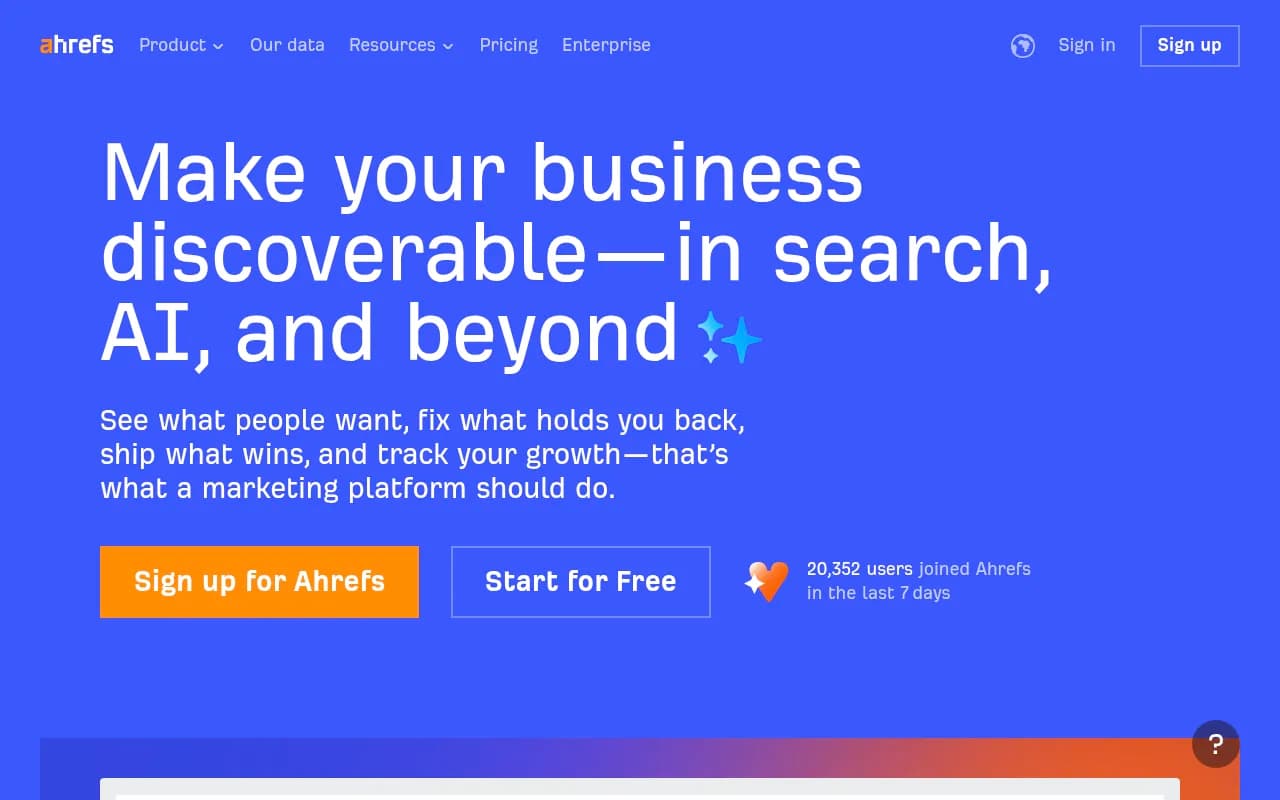
2. Ahrefs Brand Radar
Ahrefs Brand Radar takes a different approach to the "real data" problem. Instead of constructing hypothetical prompts, it pulls from 243M+ prompts derived from real "People Also Ask" queries -- questions with actual search volume behind them. Every visibility score is anchored in something a real person typed, not a prompt someone at Ahrefs invented.
It monitors six AI engines (ChatGPT, Perplexity, Gemini, Copilot, Google AI Overviews, Google AI Mode) plus YouTube, TikTok, and Reddit. Four core metrics: Mentions, Citations, Impressions, and Share of Voice. The competitive benchmarking is solid.
The trade-off is that it's a monitoring tool. You get excellent data quality, but there's no content gap analysis, no content generation, and no optimization workflow built in. It's a great source of truth, but you'll need other tools to act on it.
Pricing: $50/mo (2,500 checks), $100/mo (7,000 checks), $250/mo (25,000 checks), or $699/mo for all 6 AI indexes with 2,500 custom prompt checks.
3. Profound
Profound is the analytics-heaviest option in this category. It covers 10+ AI engines and uses real user interface data rather than API polling -- so what you see in the dashboard reflects what users actually experience. It also offers Prompt Volumes, which are actual estimates of how often real users are asking specific questions in AI search.
That prompt volume data is genuinely useful for prioritization. Instead of guessing which prompts matter, you can rank them by estimated demand and focus optimization effort where it counts.
The platform skews toward enterprise teams. The feature set is deep, the reporting is detailed, and the price reflects that. If you're a mid-market team that needs breadth of data without the enterprise price tag, it might be more than you need. But if data quality and depth are the priority, it's one of the strongest options.

4. Scrunch AI
Scrunch AI is built for larger organizations that need AI visibility monitoring at scale -- multiple brands, multiple markets, multiple stakeholders. It covers a broad range of AI engines and has solid competitive benchmarking features.
The enterprise focus means it handles complexity well: multi-brand setups, white-label reporting, and integrations with existing marketing stacks. The trade-off is that it's not particularly accessible for smaller teams, and the pricing reflects the enterprise positioning.
If you're running a large brand or agency with multiple clients and need centralized AI visibility reporting, Scrunch is worth evaluating. If you're a 5-person marketing team, it's probably overkill.
5. AthenaHQ
AthenaHQ tracks brand visibility across 8+ AI search engines with a focus on sentiment analysis alongside raw visibility metrics. The idea is that it's not just about whether AI mentions you -- it's about whether those mentions are positive, neutral, or negative, and how that compares to competitors.
The sentiment angle is useful for brand teams that care about reputation, not just presence. You might be getting mentioned frequently but in a context that's hurting you. AthenaHQ surfaces that.
The limitation is that it's primarily a monitoring platform. There's no content generation, no gap analysis workflow, and no crawler log data. Good for understanding the current state; less useful for changing it.

6. Otterly.AI
Otterly.AI is one of the more accessible options in this space -- simpler interface, lower price point, and a focused feature set. It covers the main AI engines (ChatGPT, Perplexity, Gemini, Google AI Overviews) and tracks brand mentions, citations, and share of voice.
It's a good fit for teams that want basic AI visibility monitoring without committing to an enterprise platform. The data is straightforward, setup is fast, and it doesn't require a long onboarding process.
The ceiling is real, though. No content tools, no crawler logs, no prompt volume data, and limited competitive analysis compared to the deeper platforms. Think of it as a starting point rather than a long-term solution for teams serious about GEO.

7. SE Ranking (AI Visibility Toolkit)
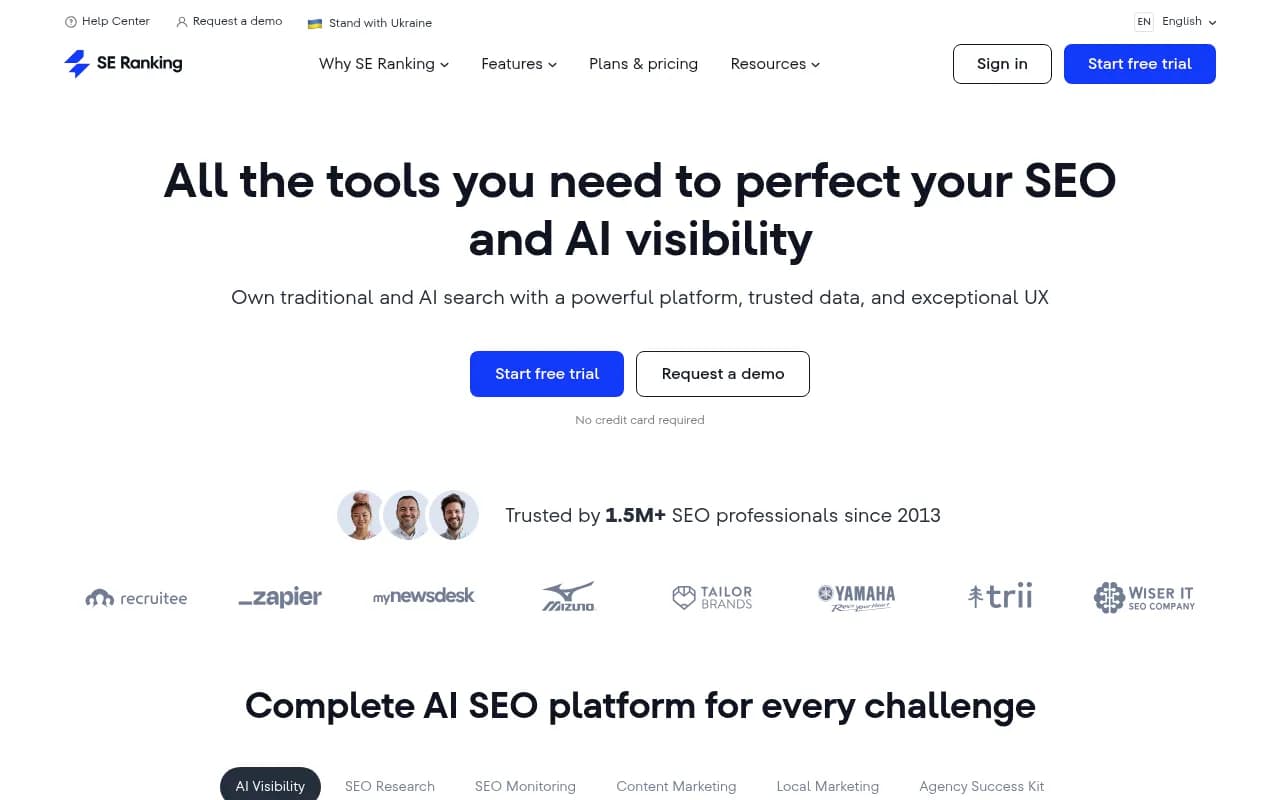
SE Ranking is primarily an all-in-one SEO platform, but its AI Visibility Toolkit has become a legitimate option for teams that want AI monitoring bundled with traditional SEO features. You get rank tracking, site audits, keyword research, and AI visibility in one subscription.
The AI visibility component covers ChatGPT, Perplexity, Gemini, and Google AI Overviews. It's not as deep as dedicated GEO platforms, but if you're already paying for an SEO tool and want to add AI monitoring without a separate subscription, it's a practical choice.
The data methodology leans more toward API-based polling than real UI data, which is worth keeping in mind when interpreting visibility scores.
8. Rankscale
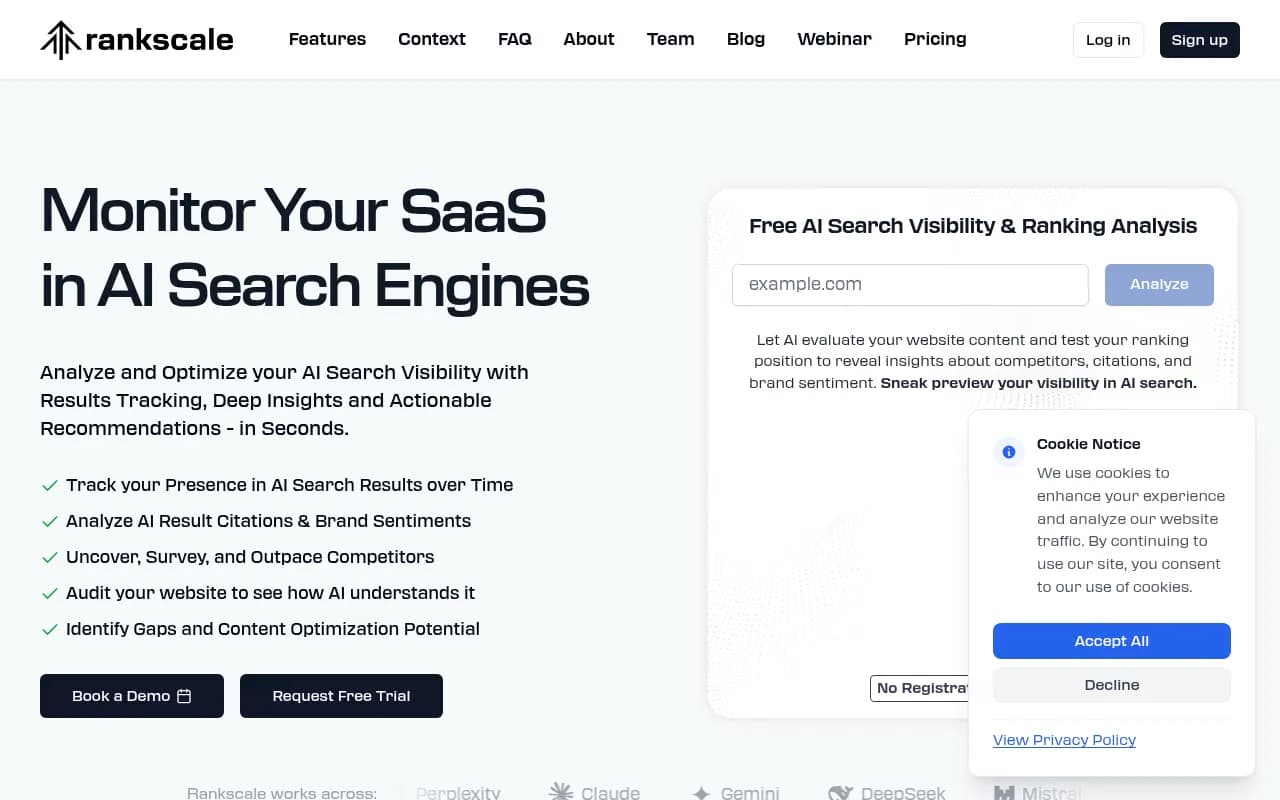
Rankscale focuses on competitive AI visibility benchmarking -- where you stand relative to specific competitors across AI engines, broken down by prompt category. The competitive heatmap view is one of the cleaner implementations of this in the market.
It's useful for teams that have a clear competitive set and want to track relative position over time, rather than just absolute visibility scores. The prompt-level breakdown helps identify where competitors are outperforming you and why.
Like most tools in this space, it's primarily a monitoring and benchmarking tool. The data is solid; the optimization workflow is limited.
9. Omnia
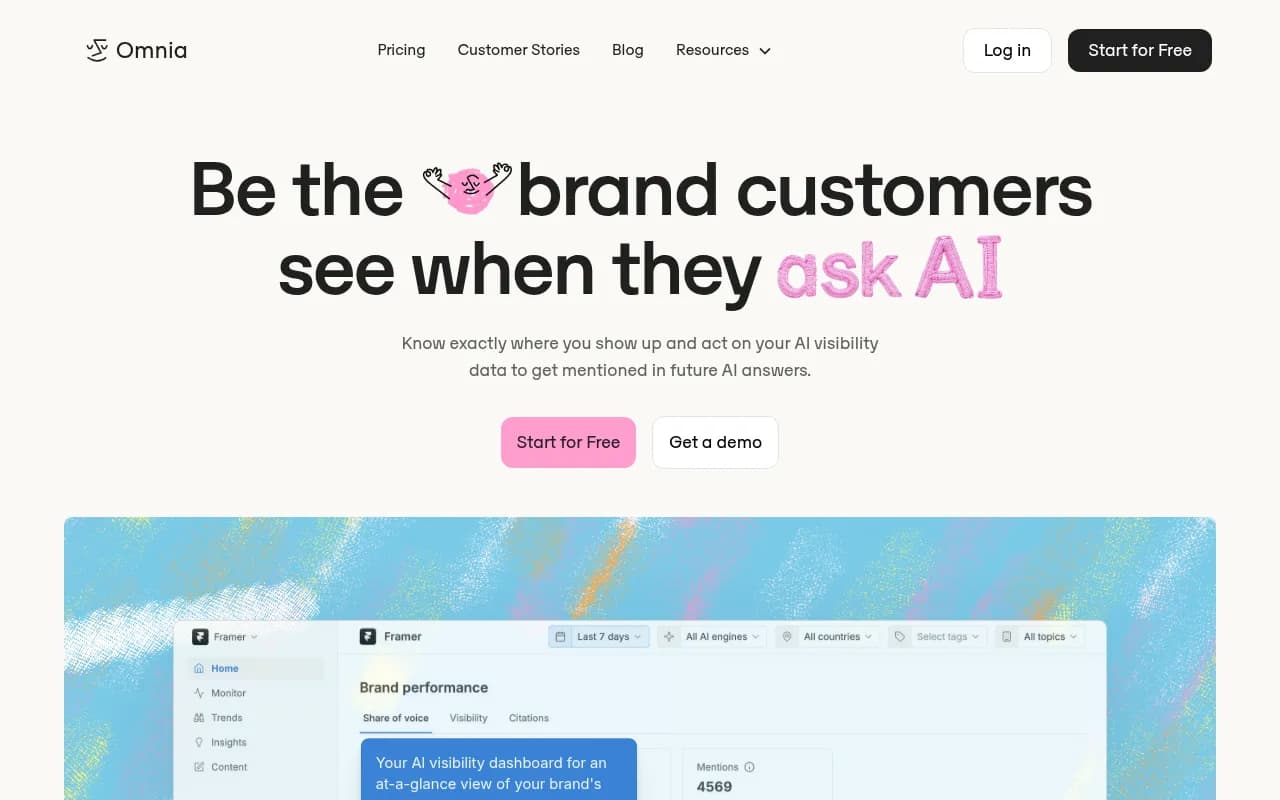
Omnia tracks brand visibility across ChatGPT, Perplexity, Google AI Overviews, and Google AI Mode with a particular focus on share of voice metrics. It's positioned toward scaleups and growth-stage companies that need more than basic monitoring but aren't ready for enterprise pricing.
The share of voice framing is useful -- it contextualizes your visibility relative to the total conversation happening in your category, not just in absolute terms. The interface is clean and the reporting is accessible for non-technical marketing teams.
Coverage is narrower than some alternatives (four engines vs. the 10+ that broader platforms track), but for teams focused on the highest-traffic AI engines, that's often sufficient.
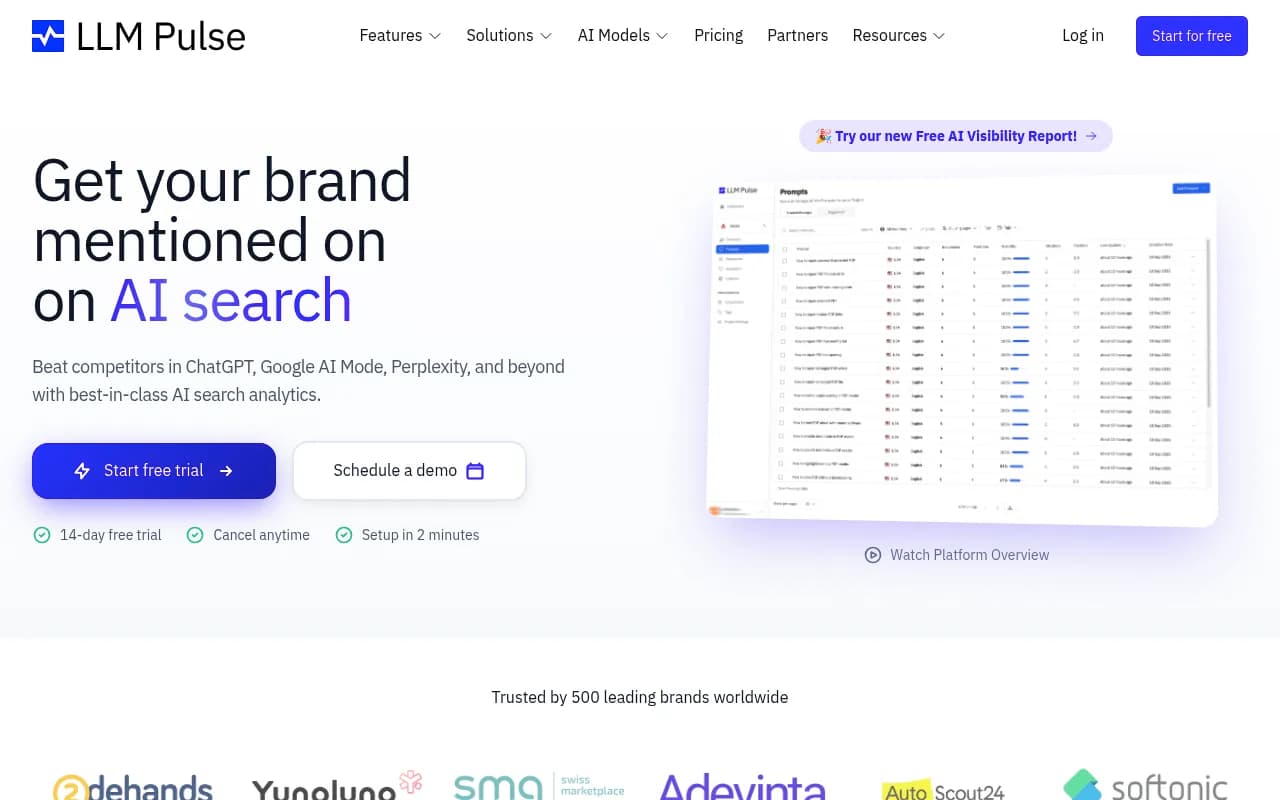
10. LLM Pulse
LLM Pulse is a more lightweight option focused on tracking how AI models respond to specific prompts over time. It's useful for monitoring prompt-level changes -- when AI models update their training data or change how they respond to certain queries, LLM Pulse surfaces those shifts.
The use case is narrower than the other tools here. It's less about comprehensive brand visibility and more about tracking specific prompts or topics you care about. For teams that have already identified their key prompts and want to monitor them closely, it's a practical and affordable option.
How these tools compare
| Tool | Real UI data | AI engines covered | Content tools | Crawler logs | Pricing from |
|---|---|---|---|---|---|
| Promptwatch | Yes | 10 | Yes (Content Agents) | Yes | $99/mo |
| Ahrefs Brand Radar | Real search data | 6 + social | No | No | $50/mo |
| Profound | Yes | 10+ | No | No | Custom |
| Scrunch AI | Yes | Multiple | No | No | Custom |
| AthenaHQ | Yes | 8+ | No | No | Custom |
| Otterly.AI | Partial | 4-5 | No | No | ~$49/mo |
| SE Ranking | API-based | 4 | No | No | ~$65/mo |
| Rankscale | API-based | Multiple | No | No | Custom |
| Omnia | Yes | 4 | No | No | Custom |
| LLM Pulse | API-based | Multiple | No | No | Freemium |
| Peec.ai (baseline) | Partial | 4 base | No | No | €89/mo |
The API polling problem, explained
Most GEO tools work by sending queries to AI model APIs and recording the responses. It's fast, cheap, and scalable. But there's a catch.
AI models often behave differently depending on how they're accessed. The ChatGPT interface that your customers use has different citation behavior, different formatting, and sometimes different answers compared to what the OpenAI API returns. Perplexity's web interface includes real-time web search; the API version may not. Google AI Overviews in a real browser session can differ from what a headless API call returns.
When a tool reports that your brand has "X% visibility" based on API polling, that number reflects how the API responds -- not necessarily what your customers see. For some use cases, the difference is minor. For others, especially if you're tracking citations, shopping recommendations, or specific answer formats, it can be significant.
Tools that use real UI-level data (Promptwatch, Profound, Scrunch AI, AthenaHQ) capture what's actually happening in the user-facing product. Tools that use real search query datasets (Ahrefs Brand Radar) anchor their prompts in actual user behavior even if the response collection method differs. Both approaches are meaningfully better than pure API polling for making optimization decisions.
What to look for beyond the data source
Data quality matters, but it's not the only thing worth evaluating. A few other questions worth asking:
Can you act on the data? Monitoring tells you where you're invisible. It doesn't fix it. Tools with content gap analysis, content generation, or at least detailed briefs let you close the loop. Most tools on this list stop at monitoring. Promptwatch is the main exception with its Content Agents and Answer Gap Analysis.
What happens after a page is published? AI Crawler Logs (available in Promptwatch's Professional plan and above) show you when AI crawlers visit your pages, what they read, and when those pages start getting cited. Without this, you're publishing content and hoping for the best.
How are prompts selected? Some tools let you define your own prompts. Others suggest them. The best platforms combine both -- your custom prompts plus data-driven suggestions based on what real users are actually asking. Prompt volume estimates (how often a query is asked) help you prioritize.
Does it track offsite citations? Your AI visibility isn't just about your own website. Reddit threads, YouTube videos, third-party listicles, and review sites all influence what AI models recommend. Platforms that track these offsite sources give you a more complete picture.
Which tool is right for you
If you're just starting out and want basic monitoring without a big commitment, Otterly.AI or LLM Pulse are reasonable starting points. Low cost, easy setup, good enough for initial benchmarking.
If data quality is the priority and you want visibility scores anchored in real search behavior, Ahrefs Brand Radar is hard to beat for the price. The prompt dataset is the best in class.
If you're at an enterprise scale and need multi-brand monitoring with deep analytics, Profound or Scrunch AI are worth evaluating -- budget for custom pricing conversations.
If you want to actually improve your AI visibility rather than just measure it, Promptwatch is the only platform on this list with the full loop: gap analysis, content generation, crawler logs, and traffic attribution in one place. The monitoring is solid; the optimization tools are what make it different.
The honest answer is that most teams will outgrow a pure monitoring tool within six months. The question is whether you want to switch platforms then or start with something that scales.