Key Takeaways
- Promptwatch is the best choice if you need deep AI search optimization with content gap analysis, AI content generation, and crawler logs -- not just monitoring
- Semrush offers the most comprehensive feature set but at a higher price point, with AI visibility as an add-on rather than core functionality
- Ahrefs Brand Radar works well if you already use Ahrefs for SEO and want basic AI brand monitoring included
- Moz Pro is ideal for teams who want a simpler, more beginner-friendly interface with solid traditional SEO tools
- Surfer SEO excels at content optimization and AI-powered writing but lacks rank tracking and backlink analysis
SE Ranking positions itself as an all-in-one SEO platform that recently added AI visibility tracking. The pitch is simple: if you're already using their SEO tools, you can tack on AI search monitoring for an extra $71/month. But that's also the problem. The AI features feel like an afterthought, not a core part of the platform. You're paying for two separate products bundled together, and neither side is best-in-class.
The real question is what you actually need. If you want deep AI search optimization with tools that help you create content that ranks in ChatGPT and Claude, SE Ranking isn't built for that. If you need enterprise-grade SEO features, there are better options. And if you're on a budget, you're paying for a lot of features you might not use.
Here's what actually works better, depending on what you're trying to do.
Promptwatch

Promptwatch is the platform to use if you care about AI search visibility and want to actually do something about it. Most AI monitoring tools show you where you're invisible and leave you stuck. Promptwatch shows you the gaps, then helps you fix them.
The core difference is the action loop. Answer Gap Analysis tells you exactly which prompts your competitors rank for but you don't. You see the specific content your site is missing -- the topics, angles, and questions AI models want but can't find on your pages. Then the built-in AI writing agent generates articles grounded in 880M+ citations analyzed, prompt volumes, and competitor data. This isn't generic SEO filler. It's content engineered to get cited by ChatGPT, Claude, Perplexity, and other models.
You also get AI crawler logs -- real-time data showing which pages ChatGPT, Claude, and Perplexity are reading, errors they hit, and how often they return. SE Ranking doesn't have this. Neither do most competitors. It's the difference between guessing why you're not getting cited and knowing exactly what's broken.
Promptwatch tracks 10 AI models (ChatGPT, Perplexity, Google AI Overviews, Claude, Gemini, Meta AI, DeepSeek, Grok, Mistral, Copilot). You get prompt intelligence with volume estimates and difficulty scores, citation and source analysis, Reddit and YouTube insights, ChatGPT Shopping tracking, and competitor heatmaps. Multi-language and multi-region support. Looker Studio integration and API access.
Pricing is straightforward. Essential is $99/month (1 site, 50 prompts, 5 AI articles). Professional is $249/month (2 sites, 150 prompts, 15 articles, crawler logs, state/city tracking). Business is $579/month (5 sites, 350 prompts, 30 articles). Annual billing saves 25%. There's a 7-day free trial.
The trade-off: Promptwatch is focused on AI search optimization. If you need traditional SEO tools like backlink analysis or technical site audits, you'll need to use something else alongside it. But if your goal is to rank in AI search and you want a platform that helps you create content that actually gets cited, this is the one that works.
Semrush
Semrush is the enterprise option. It has everything: keyword research, site audits, backlink analysis, rank tracking, content tools, social media management, PPC tools, and now AI visibility tracking. The breadth is impressive. The problem is the price and the fact that AI features are an add-on, not core.
Semrush One starts at $165.17/month (annual billing). The AI Visibility Toolkit is an extra $99/month. So you're looking at $264/month minimum to get both traditional SEO and AI monitoring. That's more than double what SE Ranking charges, and the AI features are still monitoring-focused. You see where your brand appears in ChatGPT, Perplexity, and Gemini, but Semrush doesn't help you create content that ranks. No content gap analysis. No AI writing agent. No crawler logs.
The traditional SEO tools are solid. Keyword research pulls from a massive database. Site audits are thorough. Backlink analysis is detailed. Rank tracking works across multiple search engines and locations. The content tools include an AI writing assistant, but it's optimized for Google, not AI models.
Semrush is best for large marketing teams or agencies that need a single platform for everything and have the budget to match. If you're a solo marketer or small team, you're paying for features you won't use. And if AI search is your priority, you're better off with a platform built around it.
Ahrefs Brand Radar
Ahrefs Brand Radar is Ahrefs' answer to AI brand monitoring. It's included with your Ahrefs subscription, which starts at $129/month (Lite plan, annual billing). If you already use Ahrefs for SEO, this is a convenient add-on. If you don't, it's not worth subscribing just for Brand Radar.
The feature tracks brand mentions across AI-powered search engines and traditional search. You see when your brand appears in AI responses, how often, and in what context. That's it. There's no content gap analysis. No AI content generation. No crawler logs. No prompt intelligence. It's monitoring only.
Ahrefs' core SEO tools are excellent. The backlink database is one of the best. Site Explorer gives you deep competitor insights. Keyword research is fast and accurate. Rank tracking works well. But the AI features are basic compared to dedicated platforms.
The pricing structure is also a problem. You can't buy Brand Radar separately. You have to subscribe to Ahrefs, which means paying for a full SEO suite even if you only want AI monitoring. Lite is $129/month, Standard is $249/month, Advanced is $449/month, Enterprise is $999/month. All annual billing.
Ahrefs Brand Radar makes sense if you're already an Ahrefs user and want basic AI brand tracking included. If you're starting from scratch or AI search is your main focus, look elsewhere.
Moz Pro
Moz Pro is the beginner-friendly option. The interface is cleaner and less overwhelming than Semrush or Ahrefs. The tools are solid without being overly complex. If you're new to SEO or want something that doesn't require a steep learning curve, Moz is a good fit.
Pricing starts at $49/month (Starter plan) and goes up to $299/month (Premium plan). There's a 30-day free trial. Annual billing saves 20%. The Starter plan is limited (5 campaigns, 300 keywords tracked, 5,000 pages crawled per week), but it's enough for small sites or solo marketers.
Moz Pro includes keyword research with search volume and difficulty scores, rank tracking across multiple search engines, site audits that catch technical issues, competitor analysis, and backlink analysis. The MozBar browser extension is included with paid plans. You also get custom reporting and Looker Studio integration.
The AI features are minimal. Moz has added some AI-powered search intent insights to keyword research, but there's no dedicated AI visibility tracking. No monitoring of ChatGPT or Claude. No content gap analysis. No AI content generation. If you care about AI search, Moz isn't built for it.
Moz Pro works well for traditional SEO. The tools are reliable, the data is accurate, and the interface is easy to use. But you're not getting cutting-edge features or deep AI capabilities. It's a safe, solid choice for teams that want to improve their Google rankings without dealing with complexity.
Surfer SEO
Surfer SEO is built around content optimization. It analyzes top-ranking pages for your target keywords and tells you exactly what to include in your content to rank higher. The AI writing assistant generates articles based on that analysis. If you're focused on creating content that ranks in Google, Surfer is one of the best tools available.
Pricing starts at $99/month (Essential plan: 1 site, 360 AI prompts, 50 Content Editors, 5 AI articles). Professional is $199/month. Business is $579/month. AI-generated articles cost extra: $29 per article on Essential, $20 per article on Professional, $17 per article on Business. Annual billing is available. There's a 7-day money-back guarantee.
Surfer's Content Editor is the standout feature. You write or paste your content, and Surfer scores it in real-time based on keyword usage, content structure, readability, and other ranking factors. You see exactly what to add, remove, or change to improve your score. The AI writing assistant can generate full articles based on your target keyword and Surfer's analysis.
The problem is what Surfer doesn't do. There's no rank tracking. No backlink analysis. No site audits. No competitor research beyond content analysis. And the AI features are focused on Google, not AI search engines. You're not tracking visibility in ChatGPT or Claude. You're not analyzing content gaps for AI models. You're optimizing for traditional search.
Surfer works well as a specialized content tool. If you're a content marketer or blogger who wants to create articles that rank in Google, it's worth the price. But it's not a full SEO platform, and it's not built for AI search optimization.
Serpstat
Serpstat is the budget-friendly all-in-one option. It has keyword research, competitor analysis, site audits, rank tracking, and backlink analysis. The features are solid, the data is reliable, and the pricing is lower than most competitors. If you need a full SEO suite and don't have a big budget, Serpstat is worth considering.
Pricing starts at $50/month (Individual plan, annual billing). Team is $100/month. Agency is $250/month. There's a 7-day free trial. Lifetime deals are occasionally available, which can save you a lot if you're willing to pay upfront.
Serpstat covers 230 countries and supports multiple languages. Keyword research pulls from a large database with search volume, difficulty scores, and related keywords. Competitor analysis shows you which keywords your competitors rank for and which pages drive the most traffic. Site audits catch technical issues. Rank tracking monitors your positions across search engines. Backlink analysis shows you who's linking to your site and your competitors.
The interface is less polished than Semrush or Ahrefs. The learning curve is steeper. And there are no AI visibility features. You're not tracking brand mentions in ChatGPT or Claude. You're not analyzing content gaps for AI models. You're not generating AI-optimized content. Serpstat is built for traditional SEO only.
Serpstat makes sense if you need a full SEO toolkit and want to save money. The features are comparable to more expensive platforms, and the data is accurate. But you're sacrificing polish and AI capabilities.
Ubersuggest
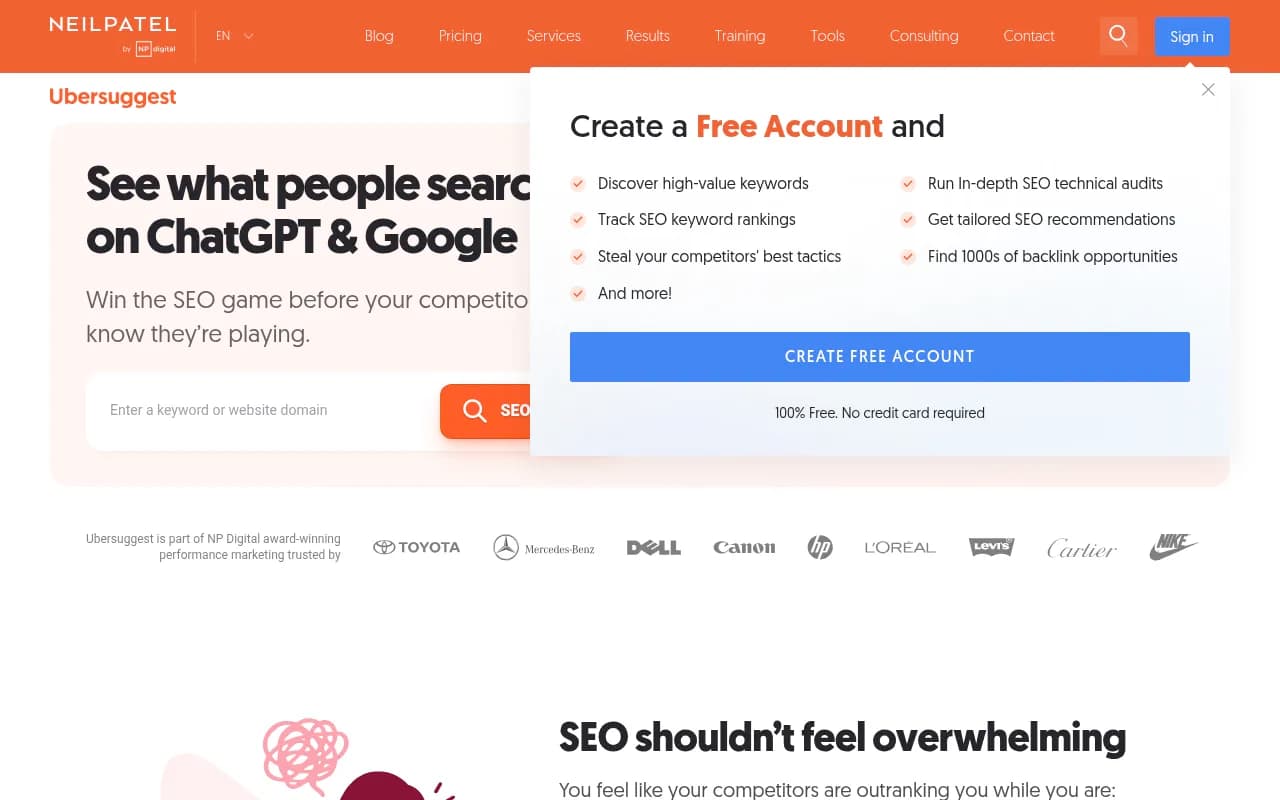
Ubersuggest is Neil Patel's SEO platform. It's designed to be simple and affordable. The lifetime pricing model is unusual: you pay once and own the tool forever. Individual is $120 (lifetime), Premium is $200 (lifetime), Enterprise is $290 (lifetime). There's also a monthly option starting at $12/month. There's a free tier with 3 searches per day.
Ubersuggest includes keyword research, competitor analysis, site audits, rank tracking, and backlink analysis. The features are basic compared to Semrush or Ahrefs, but they cover the essentials. The interface is clean and easy to use. The data is accurate enough for most use cases.
The AI features are limited. Ubersuggest recently added AI-powered keyword ideas and search intent analysis, but there's no dedicated AI visibility tracking. You're not monitoring ChatGPT or Claude. You're not analyzing content gaps for AI models. You're not generating AI-optimized content.
Ubersuggest works well for beginners or small businesses that want basic SEO tools without a recurring subscription. The lifetime pricing is appealing if you're on a tight budget. But you're not getting advanced features or AI capabilities. It's a starter tool, not a professional platform.
Mangools
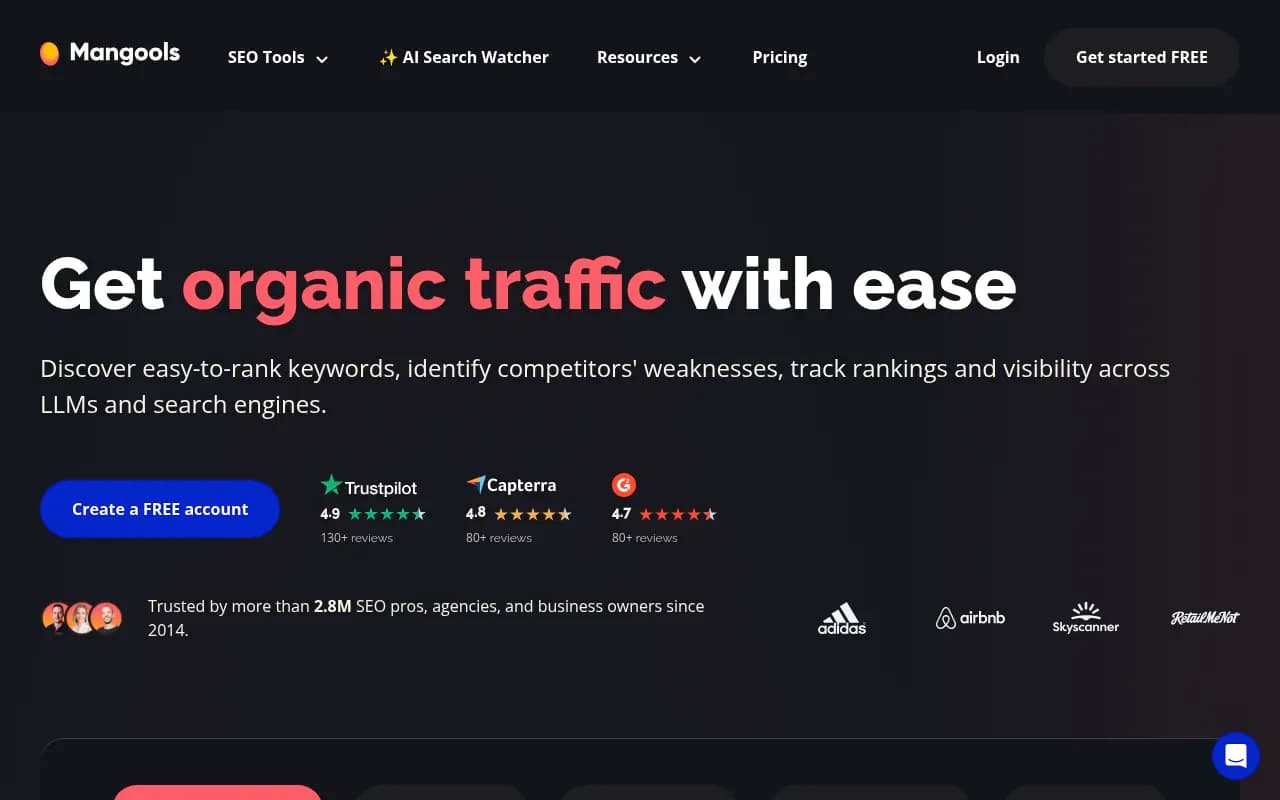
Mangools is a suite of five SEO tools: KWFinder (keyword research), SERPChecker (SERP analysis), SERPWatcher (rank tracking), LinkMiner (backlink analysis), and SiteProfiler (competitor research). The tools are simple, well-designed, and affordable. If you want an easy-to-use SEO toolkit without complexity, Mangools is a solid choice.
Pricing starts at $29/month (Basic plan, annual billing). Premium is $52/month. Agency is $97/month. There's a 10-day free trial, no credit card required. AI Search Watcher is sold separately starting at $15.60/month.
KWFinder is the standout tool. It finds keyword ideas with search volume, difficulty scores, and trend data. The interface is clean and intuitive. SERPChecker analyzes search results and shows you metrics for top-ranking pages. SERPWatcher tracks your rankings over time. LinkMiner finds backlink opportunities. SiteProfiler gives you an overview of any website's SEO metrics.
The AI Search Watcher add-on tracks brand mentions in AI search engines, but it's basic. You see when your brand appears in AI responses, but there's no content gap analysis, no AI content generation, no crawler logs. It's monitoring only.
Mangools is best for small businesses, freelancers, or beginners who want affordable SEO tools with a clean interface. The features are solid for traditional SEO. But if you need advanced capabilities or deep AI search optimization, look elsewhere.
Which alternative is right for you?
If you're looking for an SE Ranking alternative, the right choice depends on what you actually need.
Choose Promptwatch if you care about AI search visibility and want a platform that helps you create content that ranks in ChatGPT, Claude, and Perplexity. It's the only platform that combines monitoring, content gap analysis, AI content generation, and crawler logs in one workflow. The action loop -- find gaps, generate content, track results -- is what makes it an optimization platform instead of just another tracker.
Choose Semrush if you need a comprehensive marketing platform with every feature imaginable and have the budget to match. It's the enterprise option with the broadest feature set, but you're paying a premium and the AI features are still basic.
Choose Ahrefs Brand Radar if you already use Ahrefs for SEO and want basic AI brand monitoring included. Don't subscribe just for Brand Radar -- the core value is in Ahrefs' traditional SEO tools.
Choose Moz Pro if you want a beginner-friendly SEO platform with a clean interface and solid traditional tools. It's not built for AI search, but it's a safe choice for improving Google rankings.
Choose Surfer SEO if you're focused on content optimization and want an AI writing assistant that helps you create articles that rank in Google. It's a specialized tool, not a full SEO platform.
Choose Serpstat if you need a full SEO toolkit on a budget and don't care about AI visibility features. The pricing is lower than most competitors, and the features are solid for traditional SEO.
Choose Ubersuggest if you're a beginner or small business that wants basic SEO tools with lifetime pricing. It's a starter platform, not a professional solution.
Choose Mangools if you want affordable, easy-to-use SEO tools with a clean interface. It's best for small businesses and freelancers who don't need advanced features.
The real shift happening right now is that AI search is becoming a primary discovery channel. People are asking ChatGPT and Claude for recommendations instead of Googling. If you're not visible in those responses, you're missing traffic. SE Ranking added AI monitoring as an afterthought. Most alternatives are doing the same thing. Only a few platforms -- Promptwatch being the clearest example -- are built around helping you actually rank in AI search, not just track where you're invisible.