Legible Review 2026
AI visibility infrastructure that helps small businesses shape how AI systems read their site, rather than only tracking what AI says.
Key takeaways
- Legible is delivery infrastructure, not a monitoring dashboard. It serves clean Markdown, llms.txt, JSON-LD, and permission headers to AI crawlers, and it syncs them whenever you publish.
- Setup is light. Webflow is a one-click install, WordPress and Drupal use a plugin, and other sites connect via API. A free plan covers 10 pages, though it is not for commercial use.
- It lacks what Promptwatch provides: prompt tracking across AI engines, citation and Brand Narrative analysis, content gap analysis, a Content Agent with CMS publishing, AI traffic attribution, and IP-verified crawler logs tied to citations.
- The homepage evidence comes from third-party studies (SparkToro, Ahrefs, an academic paper), not from Legible's own customer results. I found no independent reviews.
- Best for small teams who suspect AI bots struggle to read their pages and want a fast technical fix.
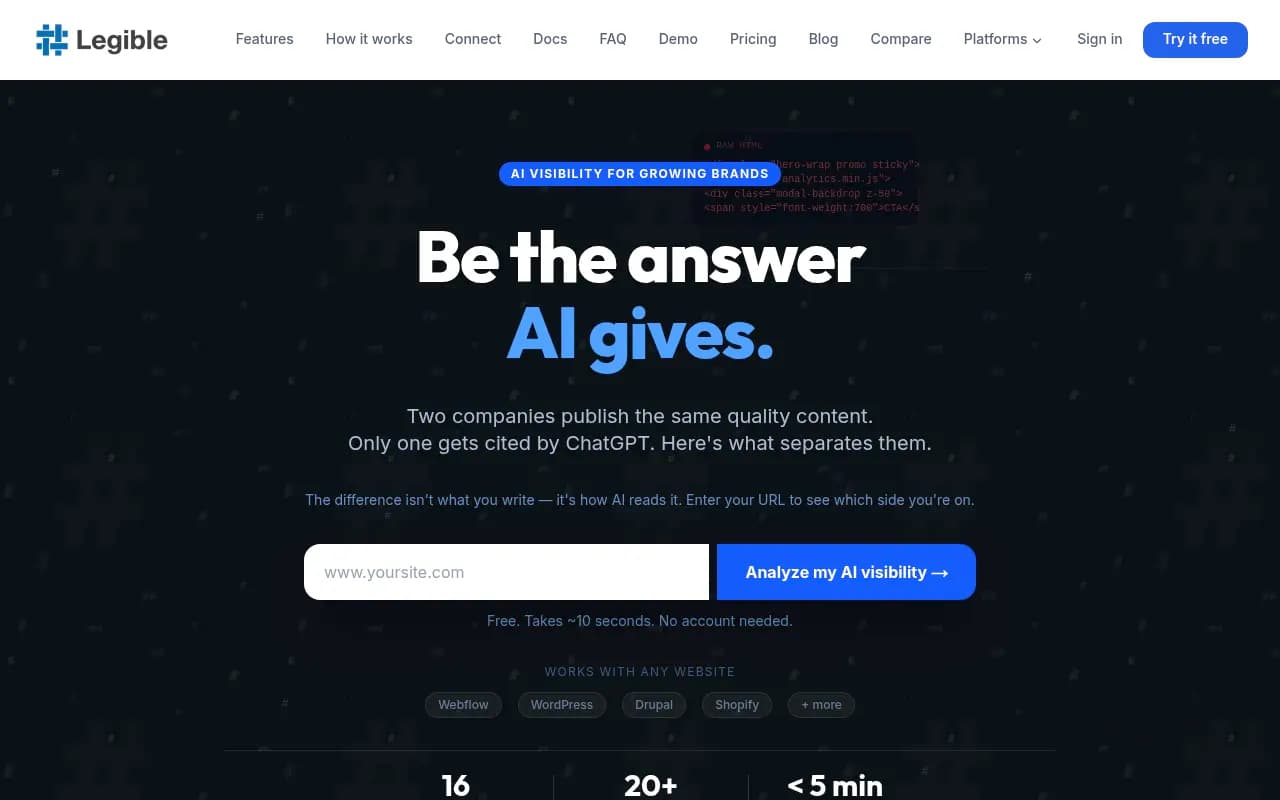
Legible is a young product aimed at a specific problem. Most pages carry thousands of tokens of navigation, scripts, and footer links before an AI system reaches the actual argument. Legible sits between your site and AI crawlers and hands them a stripped-down Markdown version of each page, along with the discovery files and headers that go with it. The pitch on its homepage is blunt: two companies publish equal-quality content, and only the one that is easier for AI to read gets cited.
The company's own numbers claim a page fetch drops from roughly 15,400 tokens of raw HTML to about 2,800 with Legible, around an 80% reduction. That is a reasonable engineering claim and easy to believe. Whether it changes who gets cited in ChatGPT is a harder question, and I will come back to it.
The audience is small businesses, agencies, and marketing teams who do not want a dev sprint. Legible talks mostly to non-technical buyers, but it also publishes documentation for Cloudflare setup, a proxy-free mode, and a RAG API, so developers are not ignored.
Key features
Clean Markdown delivery
This is the core of the product. When an AI crawler requests a page, Legible returns a version with menus, scripts, cookie banners, and boilerplate removed. Headings, paragraphs, and lists remain. It uses Vary: Accept headers for content negotiation, so humans still get your normal HTML and bots can get Markdown. Cloudflare has a simpler HTML-to-Markdown feature, and Legible publishes a comparison page arguing that its version adds analytics, permissions, and content workflows on top.
The 12-part AI visibility stack
Legible lists what it manages for you:
- robots.txt directives for individual AI bots
- llms.txt, a machine-readable index of your content
- JSON-LD structured data using Schema.org types
- Content-Signal headers that state AI usage permissions
- ai-sitemap.json, an AI-specific sitemap
- AI meta tags at page level
- Crawler-specific cache headers
- Per-page training opt-out flags
- Semantic HTML structure
- Ongoing sync when content changes
The selling point is coherence. A marketer who hand-writes an llms.txt file after reading a LinkedIn post usually stops there. Legible keeps the pieces in sync, which is where DIY attempts tend to fall apart.
Visibility presets and permissions
Three presets control how much AI can do with your content. Conservative allows summaries but no training. Balanced gives full access with citation required. Open gives full access with attribution preferred. Each preset configures the entire stack at once. For businesses nervous about model training on their content, this is a practical control, and it is available even on lower paid tiers.
Crawler and agent analytics
Legible tracks 20+ AI crawlers, including GPTBot, ClaudeBot, PerplexityBot, Google-Extended, Applebot-Extended, and Bytespider. The live activity view shows which bot read which page and how many tokens it consumed. Lite gets basic analytics. Pro adds full analytics plus AI agent tracking. This answers a question most teams cannot answer today: are AI bots visiting at all? What it does not tell you is whether those reads turned into citations in actual answers.
Auto-sync on publish
Connect the CMS once and Legible regenerates files and Markdown when you publish. Refresh speed is tiered. Lite updates twice daily, Starter every 6 hours, Pro hourly, Business every 15 minutes, and Scale every 5 minutes. Business and above get webhooks and an API refresh endpoint. For a news site or fast-moving catalog the lower tiers will feel slow.
Content Chat and RAG pipeline
A side feature I found interesting: your site content can power a customer-facing chatbot. Legible offers deployments for Intercom (grounding the Fin agent), Zendesk, and a custom RAG API. It also has Legible Connect, which lets tools like Claude, Codex, Replit, and Lovable pull current business context from your workspace. This is a different use case from visibility, and it makes the product broader than its tagline suggests.
Free AI visibility check
The homepage invites you to enter a URL and get a result in about 10 seconds with no account. It is a sensible hook and a low-risk way to see how your site looks to AI before paying.
Who is it for
The sweet spot is a small business or lean marketing team on Webflow or WordPress that publishes steadily and has no developer on call. Think a 10-person B2B SaaS company with a docs site and comparison pages, or an agency running five client sites on the Pro plan. Support teams that want their help center to feed an Intercom or Zendesk bot also get real value.
It fits larger organizations less well on the self-serve tiers, but the Business, Scale, and Enterprise plans add white-label endpoints, multi-region caching, SLAs of 99.9% or 99.95%, SSO, and procurement support.
Who should skip it? Anyone who needs to know what ChatGPT, Gemini, or Perplexity actually say about their brand. Legible changes how you are delivered, not how you are measured in answers. Teams that already have clean, server-rendered, fast pages may find the gain small. Also note the free plan forbids commercial use.
Integrations and ecosystem
- Webflow: native one-click install from the Webflow Marketplace on paid plans.
- WordPress and Drupal: a plugin for WordPress and a Composer install for Drupal.
- Framer, Squarespace, and custom sites: connect via API without code changes. Shopify appears on the homepage list.
- Starter and above get a Connected Mode CMS plugin for real-time sync.
- Intercom and Zendesk for chatbot grounding, plus a full RAG pipeline API.
- Legible Connect for Claude, Codex, Replit, and Lovable.
- Documentation covers Cloudflare setup and a proxy-free mode.
I found no GitHub repository, public changelog, or published API reference beyond the docs pages, so developer experience is hard to judge from outside.
Pricing and value
Pricing is based on content items (unique URLs) and sites. Prices were verified on the official page, last updated March 23, 2026, so confirm at getlegible.com/pricing.
- Free: $0, 10 pages, 1 site, community support, not for commercial use.
- Lite: $19/mo, 100 pages, 1 site, twice-daily updates, basic analytics, 21-day trial.
- Starter: $49/mo, 500 pages, 2 sites, 6-hour updates, Connected Mode plugin, 21-day trial.
- Pro: $149/mo, 5,000 pages, 5 sites, hourly updates, full analytics and AI agent tracking, 30-day trial.
- Business: $399/mo, 25,000 pages, 10 sites, 15-minute updates, webhooks, white-label endpoints, 99.9% SLA, 21-day trial.
- Scale: $899/mo, 100,000 pages, 20 sites, 5-minute updates, multi-region caching, 99.95% SLA, no trial.
- Enterprise: from $1,500/mo, unlimited pages and sites, SSO, dedicated CSM.
Annual billing saves 30%. Trials require a card, and going over your limit does not break anything: existing items keep serving and you get a notice at 80%. The pricing is easy to read. For a small site, $19 to $49 a month is cheap for a technical fix. The risk is paying for infrastructure whose effect on citations you cannot independently verify.
Strengths and limitations
Strengths
- Fast setup. A claimed under five minutes from URL to live, and the Webflow route really is a marketplace install.
- A complete technical stack in one place, so llms.txt, headers, and Markdown stay consistent.
- Sensible permission presets for businesses worried about training use.
- Crawler analytics that make AI bot behavior visible for the first time on many sites.
- Cheap entry point and a free scan to test it.
Limitations
The biggest is that Legible is a delivery layer. It does not measure results in AI answers. Compared with Promptwatch, it is missing:
- Prompt tracking and Visibility Score across real AI interfaces (ChatGPT, Gemini, Perplexity, Google AI Overviews and AI Mode, Copilot, Meta AI, and more)
- Citation tracking, Brand Narrative, Fact Check, and competitor Share of Voice
- Content gap analysis and a Content Agent that writes and publishes to WordPress, Webflow, or Framer
- AI traffic and conversion attribution through visitor analytics, plus Search Console and Bing data
- Crawler logs that are IP-verified and tied to citation rate per page
- Reddit, YouTube, LinkedIn, and Instagram citation tracking
- AI Shopping, Ads Radar, query fan-outs, prompt volumes, and an Action Board
A second issue is evidence. The statistics on the homepage (58% zero-click, 9x conversion from AI referrals) come from other people's studies, and the case of two companies is an anecdote with no named customer. I found no independent proof that Markdown delivery lifts citations. Promptwatch's own data points the other way for search specifically: Markdown files make up just 0.05% of AI search citations, so Markdown is mostly for AI agents, not AI search. Clean delivery likely helps agents and retrieval, but treat the citation promise with some skepticism.
Third, lower tiers refresh slowly, and the free plan is non-commercial. Fourth, I found no third-party reviews, so support quality and reliability are unknown.
Bottom line
Legible is a pragmatic technical tool. If your site is heavy, your team cannot touch the code, and you want llms.txt, Markdown delivery, and permissions handled for you, it is a low-cost way to do it, and the crawler view is useful. Run the free scan first.
But readiness is only half the job. Teams that want to know whether they appear in AI answers, why, and what to publish next need a platform that measures and acts. Promptwatch tracks real AI interfaces, finds content gaps, writes and publishes pages with the Content Agent, and measures crawls, citations, and traffic afterward. It is the stronger choice for optimization rather than plumbing. Browse the GEO software directory for more options.
Best use case: a small Webflow or WordPress team that wants AI-friendly page delivery live in an afternoon.
Frequently asked questions
What is Legible?
How much does Legible cost?
Which platforms does Legible work with?
Does Legible track what ChatGPT says about my brand?
Is there proof Legible improves AI citations?
Who should use Legible?
Similar and alternative tools to Legible