Key takeaways
- Brandlight is a polished enterprise AI visibility tracker, but its own content workflow routes drafts to human/legal review rather than publishing, and pricing starts opaque and climbs into $4K-$15K/month enterprise territory.
- Scalenut, Writesonic, AthenaHQ, Profound, and Sight AI all bundle real content generation into their AI visibility platforms, at prices ranging from $24/month to $579/month.
- Content-gen features vary wildly in depth: some tools cap you at 3 articles/month on a mid tier, others run autonomous "research, write, publish" loops straight into your CMS.
- Per Promptwatch's citation-type tracking, how-to content nearly doubled its share of ChatGPT citations in August 2026 while social-post citations collapsed, so a content generator that only spits out listicles or social snippets is optimizing for a shrinking slot.
- If you want visibility tracking and content production under one roof with crawler logs and CMS publishing included, tools like Promptwatch are worth a look alongside the options below.
Why Brandlight buyers go looking for alternatives
Brandlight built something genuinely useful: a multi-brand command center that tracks mentions across ChatGPT, Gemini, Perplexity, Copilot, and Grok, with sentiment layered on top. Fortune 500 names like Volkswagen, LG, and TD Bank use it. That's not nothing.
But two things push buyers toward alternatives. First, pricing. There's no public pricing page, third-party estimates put entry near $199/month with an activation tier around $750/month, and enterprise deals reportedly land between $4,000 and $15,000 a month (some sources say higher). You need a sales call to find out where you land.
Second, and more relevant to this guide, is content production. Brandlight's own content tool runs drafts through a multi-agent workflow, strategist to writer to editor to validator, then routes the output to your CMS for human and legal review. It does not auto-publish. That's a deliberate, defensible choice for an enterprise brand-safety tool. But if you're a growing team that wants a visibility platform to also close the gap it finds, without shipping the draft to a second tool, that workflow feels like an extra step you didn't sign up for.
What "content generation built in" should actually mean
Before comparing tools, it's worth being specific about what "built in" means, because vendors use the phrase loosely. Some platforms genuinely research a citation gap, draft the article, and push it live. Others let you generate a handful of AI articles a month as a bolt-on feature behind a higher tier.
The content itself matters too. Promptwatch's citation-type data from August 2026 shows product pages still lead ChatGPT citations at roughly 28.7% on average, but that share slipped from around 30% to 25% in the back half of the month. How-to content nearly doubled, from 4.3% of citations in week one to 9.1% by month's end, and documentation climbed from 3.3% to 8.2%. Social posts, meanwhile, collapsed from 4.4% to under 1% after August 14, the same day Reddit's citation share fell off a cliff. If a content-gen tool's default output is social snippets or generic listicles, it's chasing a format that's losing ground. A tool that can produce tight how-to pages and documentation is chasing where the citations are actually moving. See the full breakdown in Promptwatch's ChatGPT citation types data for August 2026.
Domain authority matters less than most buyers assume, which is good news if you're not competing with a Fortune 500 media budget. Promptwatch's domain-rank analysis for the same month found mid-authority sites in the DR 46-75 range picked up nearly half of all ChatGPT citations, while DR 91-100 "top of the web" domains fell to around 3% by mid-August. You don't need flagship authority, you need focused, citation-ready pages. Details in Promptwatch's citation share by domain rank report.
And the stakes per citation slot differ by engine. ChatGPT cites roughly 5 sources per web-search response, about half a classic Google results page, which makes each slot contested. Google AI Overviews cites around 10, and Perplexity sits at almost exactly 10 with little variance day to day, making it a steadier test bench for GEO work. Copilot is still volatile, swinging from under 2 to nearly 17 sources per response within weeks. See Promptwatch's average sources per response data for the full picture. The practical read: build narrow pages that answer one question completely, rather than broad pages hoping to catch several.
The alternatives, compared
| Tool | Content generation depth | Entry pricing | Notable ceiling |
|---|---|---|---|
| Scalenut | Full GEO content creation, optimization, internal linking, publishing | $24/mo (promo) | 5-150 articles/mo depending on tier |
| Writesonic | AI articles on entry tier, full Action Center on Growth | $79/mo (annual) | Growth tier ~$399-499/mo for full features |
| AthenaHQ | Named "Content Agent," base and advanced versions | $95-295/mo | Credit-based, burns fast (reported ~14 days for 3,600 credits) |
| Profound | Content Agents generate articles from gap data | $99/mo (single platform) | Growth tier caps at 3 articles/mo |
| Sight AI | 13+ specialized agents, Autopilot research-write-publish | pricing not public | Content-first, visibility is secondary |
| Scrunch | No content generation (AXP page optimization only) | ~$100-300/mo | Not a fit for this list, included for contrast |
A few of these deserve more detail.
Scalenut

Scalenut is the most content-production-centric option here. Its pricing is metered by monthly output rather than seats: Starter at $24/month (promo, list $59) gives you 10 tracked prompts and 5-10 GEO articles; Plus at $36/month bumps that to 30-60 articles; Professional at $80/month unlocks 75-150 articles and adds Perplexity tracking. Scalenut frames its edge against pure-monitoring tools directly: find a content gap, move straight into content creation without exporting the insight to a separate tool. For a small team that needs to publish a lot on a tight budget, this is probably the best value on the list.
Writesonic
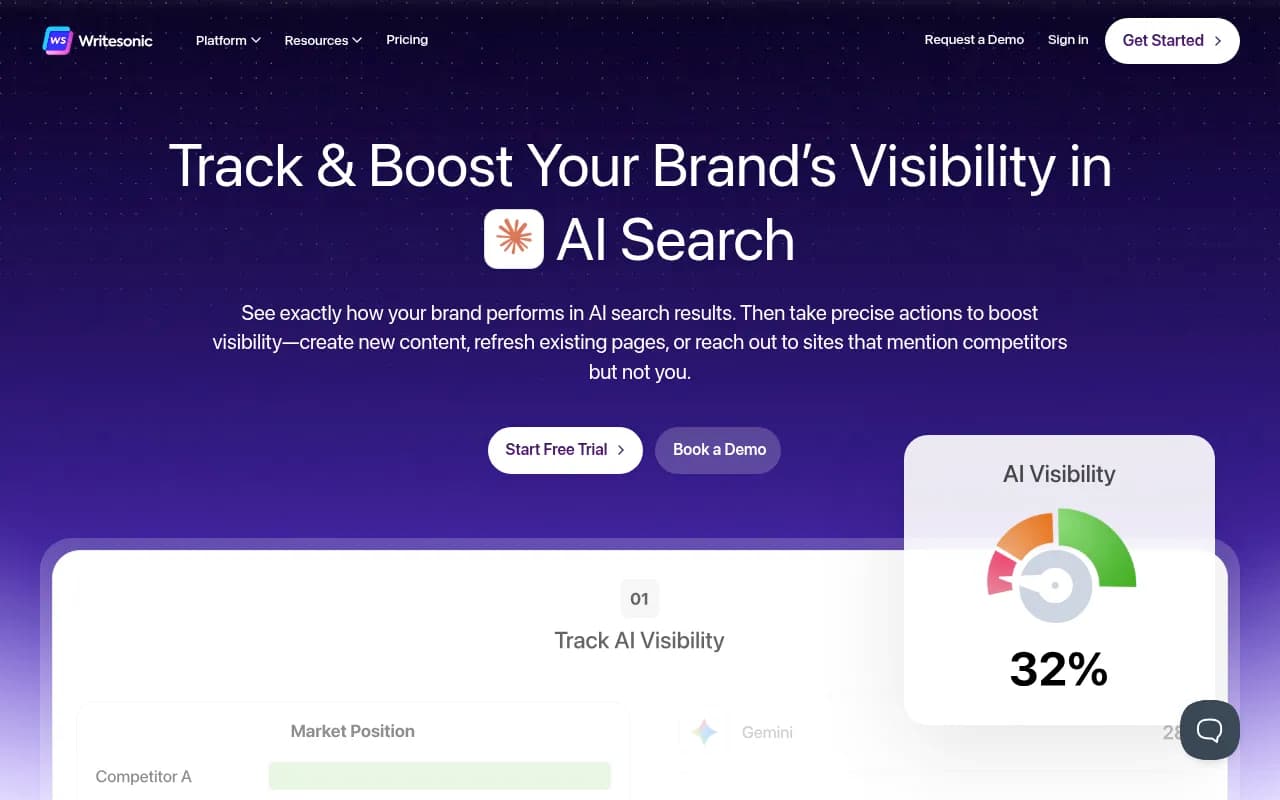
Writesonic starts at $79/month (annual billing) and includes brand tracking across ChatGPT, Gemini, and AI Overviews plus AI articles and site audits. The catch is that the full "Action Center", which covers citation opportunities, content recommendations, and social engagement tracking, only unlocks on the Growth tier, priced around $399-499/month depending on the source. Writesonic markets itself explicitly against Scrunch, arguing that real-time GEO monitoring plus a detailed Action Center plus content creation beats a $300/month monitoring-only subscription. That's a fair pitch if you'll actually use the higher tier's features.
AthenaHQ

AthenaHQ's Self-Serve plan runs $295/month (some sources cite a $95 introductory rate) for 3,600 credits across up to 11 tracked models, with extra credits at $100 per 1,250. Its Content Agent is a named, explicit feature, base version on Self-Serve, advanced on Enterprise, and the company claims a 5x increase in AI content citations on its own site. The recurring complaint across independent reviews is that credits burn fast. One hands-on test found 3,600 credits gone in about 14 days, which means the advertised monthly price doesn't always reflect what you'll actually spend once you're running it for real.
Profound

Profound bills itself as an "AI Marketer," not just a tracker, and its Content Agents generate articles based on visibility-gap data it identifies. The Starter tier is $99/month for single-platform ChatGPT tracking; Growth at $399/month adds AI-assisted article generation, but that generation is capped at 3 articles a month, which is a meaningful constraint if you're trying to close a content gap at any real scale. Profound also runs a credit-based model for its agents above the base tiers, so costs can move around depending on how complex your agent runs get.
Sight AI
Sight AI flips the usual order: it positions itself as a content generation platform first, with AI visibility tracking bundled in, rather than the other way around. It runs 13+ specialized agents for listicles, guides, and explainers, has an Autopilot mode that researches, writes, and publishes against a content calendar, and includes CMS auto-publishing plus IndexNow integration for fast indexing. No public pricing is listed, you have to go through their pricing page directly. Worth a look if content velocity is your primary problem and visibility tracking is secondary.
What deliberately skips content generation (and why that's not automatically wrong)
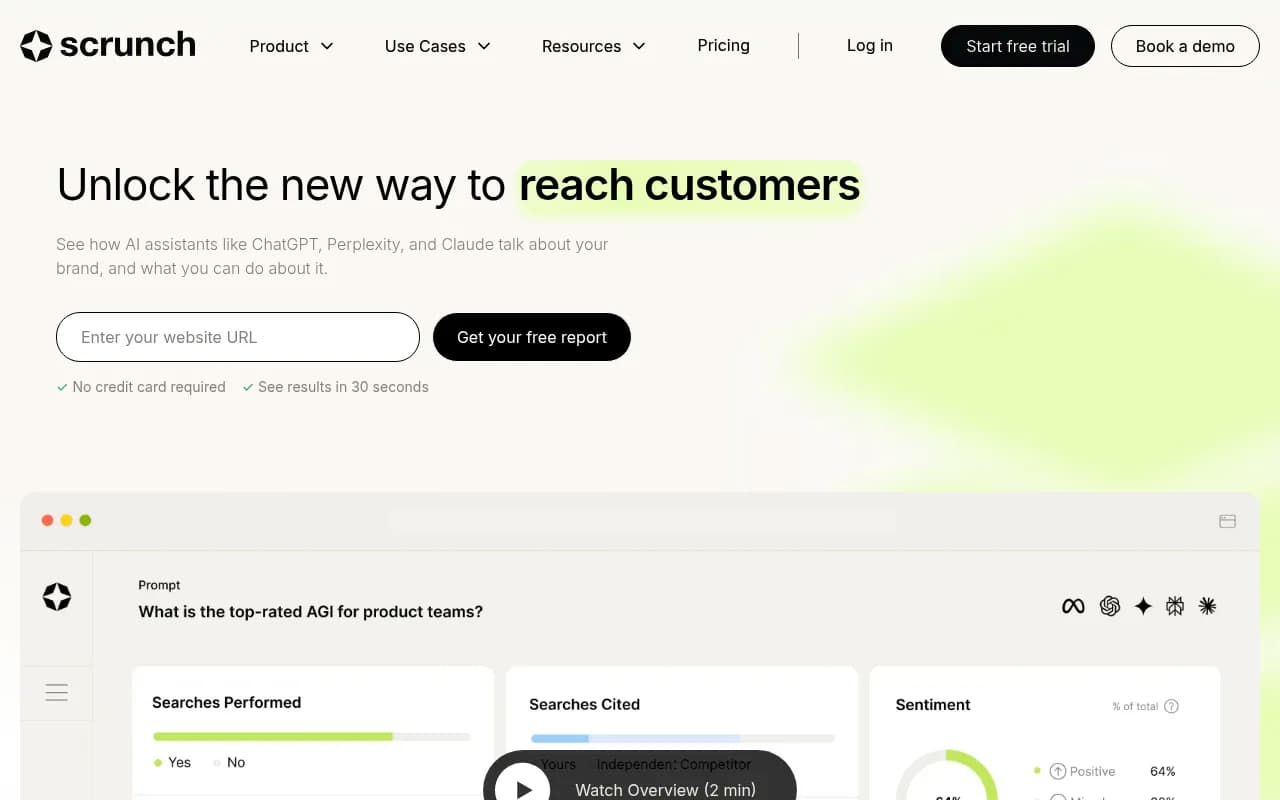

Scrunch and Peec AI both leave content generation out on purpose. Peec AI's own positioning is blunt about it: writing content at AI scale carries sourcing, expertise-signal, and uniqueness risks that need human oversight, and their terms don't guarantee article uniqueness if you do use a bundled generator. Scrunch's differentiator instead is its Agent Experience Platform, which makes your existing pages more legible to AI crawlers rather than generating new ones. If your real bottleneck is that your content team already produces plenty of good material and it's just not structured for AI retrieval, a monitoring-only tool like these might actually be the better fit than anything on the content-gen list above.
Where a full visibility-plus-action stack fits
The tools above solve half the Brandlight complaint: they generate content. But content generation alone doesn't tell you why a specific page isn't getting cited, whether AI crawlers even reached it, or what traffic that citation actually drove once it landed. Promptwatch approaches this as one connected loop rather than two separate jobs. It tracks citations, Reddit mentions, and YouTube recommendations across ChatGPT, Gemini, Claude, Perplexity, and Google AI Overviews and AI Mode, logs when AI crawlers actually hit your pages (and whether they hit errors), then uses that same data to prioritize and generate the content that closes the gap, publishing straight to Webflow, Framer, or WordPress.

That matters for the exact caution raised above: a content generator that doesn't know which format is gaining citation share is just guessing. Promptwatch's own citation-type and domain-rank data (the reports linked throughout this guide) feed directly into its content briefs and Unified Actions list, so the "what to write next" decision is grounded in what's actually getting cited right now, not a static playbook. Crisp, one of its customers, used this to scale to 5-10 published articles a day and saw 2x higher conversion rates from AI traffic than from traditional channels.
Pricing starts at $95/month for the Essential plan (1 site, 50 prompts, 5 AEO articles, full LLM tracking), with Professional at $245/month adding automated content generation and 15 AEO articles a month, and Business at $579/month for larger teams needing 30 articles and deeper crawler log volume. There's also a free Explore tier if you just want to see how your brand shows up in ChatGPT before committing to anything.
How to choose
If you're publishing at volume on a tight budget, Scalenut's metered pricing is hard to beat. If you already have a content team and just need AI-native distribution and error visibility, Writesonic's Growth tier or AthenaHQ's Content Agent both work, just budget for credit overages. If content velocity is the whole point, Sight AI's autopilot model is worth evaluating directly against its pricing page. And if you want the visibility data and the content production decision to come from the same place, rather than guessing which format to write next, a platform like Promptwatch is built for exactly that loop.
For a broader look at GEO platforms beyond this shortlist, the directory at bestgeosoftware.com is a reasonable place to keep comparing options as new entrants launch.