Visby Review 2026
Monitors brand mentions across ChatGPT, Claude and Gemini, scans your site for gaps, and generates technical, content and review tasks ranked by impact. Built for startups.
Key takeaways
- Visby is a startup-friendly AI visibility tracker that pairs mention monitoring with a ranked list of GEO tasks (technical, content and review fixes). Plans start at $79/month.
- Compared with Promptwatch, it lacks IP-verified AI crawler logs, prompt volumes and difficulty scoring, query fan-outs, Reddit/YouTube/LinkedIn citation reports, Ads Radar, an agent chat, and automated CMS publishing to WordPress, Webflow or Framer.
- Every plan is capped at 3 of the 4 supported engines, and Perplexity is not supported at all. Prompt limits are small: 15 on Starter, 90 on Growth.
- Setup is quick (the site says about 30 minutes to first tasks), and reviewers on G2 praise the interface and the clarity of the tasks.
- Best for small marketing teams and Shopify-style e-commerce brands that want a guided to-do list rather than a deep analytics suite.
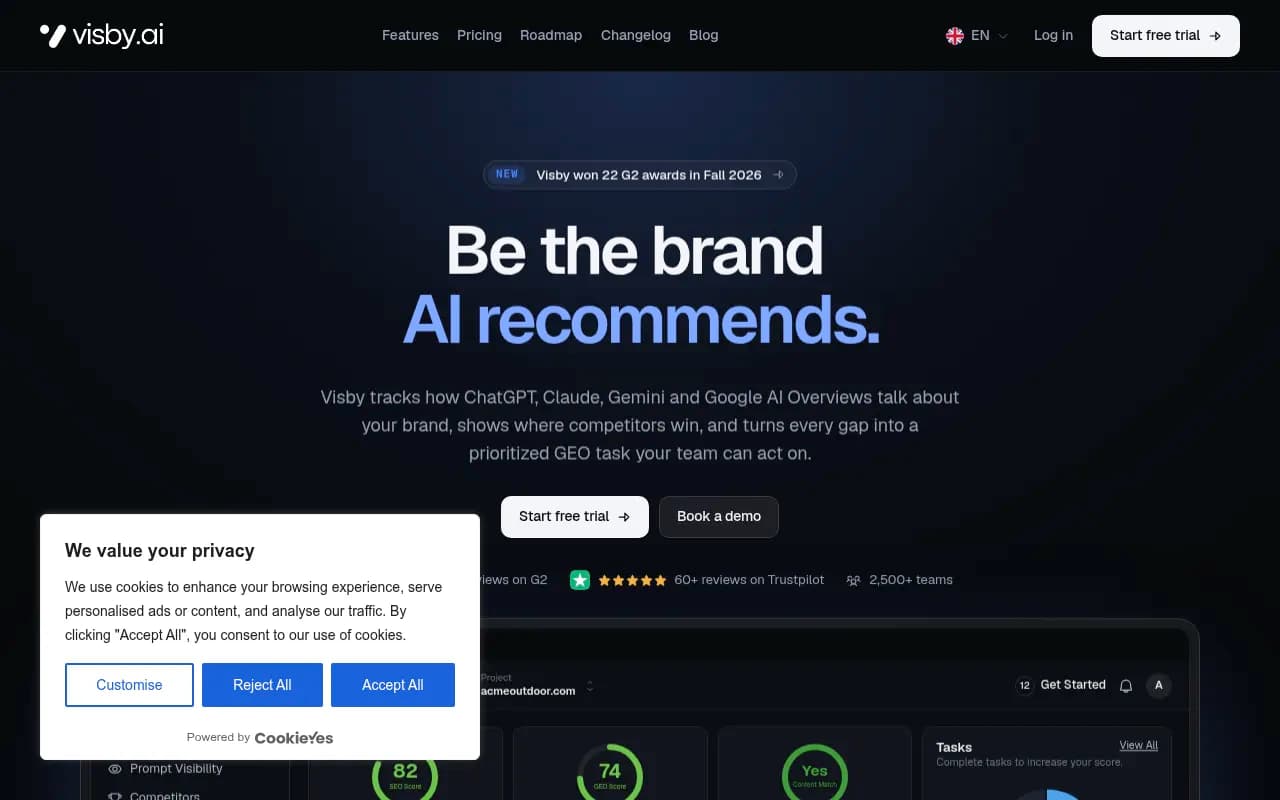
Visby is an AI visibility platform that monitors how ChatGPT, Claude, Gemini and Google AI Overviews talk about your brand. You enter your site, it builds a set of prompts, runs them against the engines, and reports whether you are mentioned, where, with what sentiment, and which competitors show up instead. The part it leans on hardest is what comes next: a task engine that converts the gaps into a prioritized list of technical, content and review actions.
The product is aimed at startups and small teams who know AI search matters but do not have an analyst to interpret raw mention data. Visby claims 2,500+ teams, and its homepage cites 100+ G2 reviews and 60+ Trustpilot reviews. G2 currently shows a 4.8 rating from roughly 109 reviews, and Visby announced 22 G2 badges for Fall 2026. Those are strong numbers for a young category, though the review counts are modest compared with the usage claim.
I would describe it as a tracker with an opinionated to-do list bolted to it. That is a useful combination for a lean team, but it is not a full optimization stack, and the plan limits make that obvious quickly.
Key features
Visibility tracking. Visby runs your tracked prompts against the engines you choose and records mentions, position, sentiment, competitors and citations. Each "AI answer analyzed" is one prompt run on one engine. You get visibility scores and trends over time, plus a Prompt Visibility view showing per-engine mention rates for each prompt (for example, a prompt like "best tents for winter camping" showing different percentages on ChatGPT, Claude and Gemini).
Competitor analysis. A share of voice view benchmarks you against rivals by engine and by funnel stage. The more useful bit is the list of prompts that name a competitor but not you, which is the shortest path to deciding what to write or fix. Promptwatch goes further with Visibility Score, Position, heatmaps and win rate across more engines, but for a small prompt set Visby's view is easy to read.
GEO task engine. This is the headline feature. Visby scans your site and your visibility gaps, then generates tasks such as adding FAQ schema to a pricing page, publishing a specific guide, fixing a blocked GPTBot in robots.txt, or requesting reviews from customers. Tasks carry a priority (High, Medium) and explain what to do and why. Reviewers on G2 like the clarity here. One noted that suggested tasks occasionally repeat, a minor glitch, and that support responded quickly. Promptwatch's Action Board does something similar, but backs it with a Discovery agent, crawler logs and 360 Insights data, so its priorities rest on more evidence.
Funnel-based tracking. Prompts are split into top, middle and bottom of funnel. Top-funnel prompts are problem searches, middle are comparisons ("acme vs ridgeway"), bottom are purchase intent ("is acme worth it"). It is a sensible way to see where you drop out of the conversation, and it is included on every plan.
AI traffic and revenue reporting. Connect GA4, Search Console and Bing Webmaster Tools to see sessions from ChatGPT, Gemini, Claude, Perplexity and Copilot, engagement time, and revenue attributed to AI. The dashboard also shows traffic by landing page. Notably, traffic attribution covers more engines than visibility tracking does, so you can see Perplexity visits even though Visby won't track Perplexity answers. There is a Report Builder, still labelled Beta.
Review and social proof tracking. AI engines lean on G2, Trustpilot and Reddit, and Visby tracks sentiment and counts across those sources and creates tasks to strengthen them. A competitor like Promptwatch tracks Reddit, YouTube and LinkedIn citations in dedicated reports, and Visby's coverage here is narrower. One G2 reviewer reported that the Reviews area showed zero results with no guidance on next steps, so expect some rough edges.
Gap analysis and content generation. Gap Analysis lists sources AI engines cite for your prompts but not for you, split into content gaps and outreach opportunities, with ready-to-send pitches. The Content area generates new articles from briefs, optimizes existing pages, or builds from a cited URL, with automatic FAQs and internal links and a Draft, Approved, Published workflow. Article generations are capped: 5 a month on Starter, 15 on Growth, 25 on Enterprise. There is no mention of automated publishing to a CMS, which is where tools with a publishing agent pull ahead.
Shopify and Merchant Center. Connect Shopify to audit product content against checks (the demo shows scores like 94 and 13 of 16 checks passed), fix issues in bulk and review AI drafts before they sync. Google Merchant Center brings your product feed in. For e-commerce teams this is a real differentiator among budget tools.
Visby MCP. An MCP server lets you query your prompts, competitors and tasks from Claude, ChatGPT and other assistants. Promptwatch offers a hosted MCP with 110+ tools; Visby's tool count is not published.
Who is it for
The sweet spot is a startup or small business with one to three domains and a marketer or founder who wants to be told what to do. Think a DTC outdoor brand on Shopify tracking 15 to 90 prompts, or a B2B SaaS team of three trying to appear in "best X tools" answers. Setup is quick, the task list gives you a Monday-morning agenda, and the pricing does not require a procurement conversation.
Small agencies may find it workable for pitching, but the domain limits (1, 3, or 5+) are tight for anyone managing many clients, and one G2 reviewer specifically called the lower-plan domain limits too restrictive for multiple projects. There is also no white-label client portal mentioned.
Who should skip it: enterprise teams that need broad model coverage, crawler-level diagnostics or large prompt volumes; anyone who needs Perplexity monitoring; developer-tool companies who care about coding agents; and teams that want content published automatically. Some G2 users also report a learning curve because of the number of features, and ask for more templates and step-by-step tips.
Integrations and ecosystem
The confirmed integrations are Google Analytics 4, Google Search Console, Bing Webmaster Tools, Shopify, Google Merchant Center and the Visby MCP. A public roadmap page lists more platforms as coming soon. I found no public API documentation, no browser extension and no mobile app, so treat programmatic access as MCP-only for now. Data export options were not documented on the site.
By comparison, Promptwatch supports crawler logs via Cloudflare, CloudFront, Fastly, Vercel and others, CMS publishing to WordPress, Webflow and Framer, Looker Studio, Slack, a REST API v2 and a ChatGPT plugin. Visby covers the analytics basics but not the infrastructure layer.
Pricing and value
- Starter, $79/month: 1 domain, 15 tracked prompts, 45 AI answers analyzed per month, 5 article generations, 1 seat.
- Growth, $199/month: 3 domains, 90 tracked prompts, 270 answers analyzed, 15 article generations, 3 seats.
- Enterprise, custom: 5+ domains, 250+ prompts, 750+ answers, 25 article generations, 10+ seats, a GEO deep-dive audit by an expert and a consultation call. G2 lists a range up to $499, but Visby's page gives no figure.
Every plan lets you pick any 3 of the 4 engines and includes funnel tracking, GEO task generation and review tracking. There is a free trial on Starter via sign-up, but the length and card requirement are not stated, and there is no permanent free tier. You can cancel anytime; downgrades apply at the next billing cycle.
The math on Starter is thin. 15 prompts across 3 engines gives 45 answers, which implies one run per prompt per engine each month. That is a sample, not monitoring. Promptwatch's Essential at $95/month gives 50 prompts, 6,000 responses, all AI models, crawler tooling, site audit and 500 Agent Credits, so cost per response is far lower. Visby is cheaper at the entry point, but you get much less for it. Check promptwatch.com/pricing and visby.ai/pricing before buying.
Strengths and limitations
Strengths
- Ranked GEO tasks give non-specialists a clear next step.
- Fast onboarding: enter your site and it generates prompts and data.
- AI traffic and revenue attribution through GA4, Search Console and Bing.
- Shopify product audits and Merchant Center support, uncommon at this price.
- Funnel-based prompt grouping is included on every plan.
Limitations
- Only 3 of 4 engines per plan, and no Perplexity, Copilot, Alexa or coding-agent tracking.
- Small prompt and response allowances, so trend data is shallow.
- Some reviewers hit empty states (Reviews) and repeating tasks.
What it lacks compared with Promptwatch
Visby is a direct competitor to Promptwatch, and the gaps are specific:
- No IP-verified AI crawler logs or crawl-to-citation tracking, so you cannot see whether GPTBot or ClaudeBot actually read the page you just fixed.
- No prompt volumes, difficulty scoring or query fan-outs documented.
- No dedicated Reddit, YouTube or LinkedIn citation reports, and no Offsite Mentions or Page Tracker.
- No AI Shopping tracking in ChatGPT or Alexa, and no Ads Radar.
- No automated Content Agent publishing to WordPress, Webflow or Framer. Content generation is capped at 5 to 25 articles a month.
- No Agent Chat, Search Insights overlay per page, or weekly 21-check site audit as described.
- Real-UI coverage is narrower: four engines, three at a time, versus Promptwatch's 15+ including Codex and Claude Code.
Bottom line
Visby is a sensible first AI visibility tool for a small team that wants a short, prioritized task list and basic AI traffic attribution without paying for an enterprise platform. The Shopify tooling and quick setup are real pluses, and G2 sentiment is good.
If you want optimization rather than monitoring, with crawler logs, content gap analysis, automated publishing and tracking that closes the loop, Promptwatch is the stronger choice. You can compare other options in the GEO software directory at bestgeosoftware.com.
Best use case: a lean e-commerce or SaaS team that needs a guided GEO to-do list on a small budget.

Frequently asked questions
What is Visby?
How much does Visby cost?
Which AI engines does Visby track?
How does Visby compare to Promptwatch?
Does Visby measure AI traffic and revenue?
Who is Visby best for?
Similar and alternative tools to Visby