Key takeaways
- Getting cited in AI search and getting clicked are two different goals that require different content strategies — but they're not mutually exclusive.
- AI models favor content that is structured, authoritative, and directly answers specific questions. Conversational tone, schema markup, and concise summaries (40-60 words) all improve citation rates.
- Traditional SEO still matters: a BrightEdge study found that over half of AI Overview citations came from pages already ranking in the top 10 organic results.
- Topical authority — owning a subject area deeply, not just ranking for isolated keywords — is the clearest path to consistent AI visibility.
- Tracking which pages AI models actually cite (and which they ignore) is now a core part of any content strategy worth running.
The problem nobody warned you about
Search used to be simple. You ranked, users clicked, you got traffic. The whole game was about position.
That game has changed, and not gradually. ChatGPT, Perplexity, Gemini, and Google AI Overviews now answer questions directly — summarizing, synthesizing, and recommending — before a user ever sees a list of links. Your content might be cited inside one of those answers. Or it might not exist at all, as far as the AI is concerned.
Here's the uncomfortable part: you can rank #1 on Google and still be invisible in AI search. And you can be cited constantly by ChatGPT without a single click coming your way.
Both of those outcomes are real. Both of them cost you.
The brands winning in 2026 have figured out how to do both: write content that AI models want to cite, and structure it in a way that still pulls users through to the actual page. This guide covers exactly how to do that.
How AI models decide what to cite
Before you can optimize for AI citations, you need to understand what these systems are actually looking for. It's not the same as Google's ranking signals, though there's more overlap than you might think.
AI search engines are essentially trying to answer a question as accurately and helpfully as possible. They pull from sources they trust. Trust, in this context, comes from a few things:
- The source has been indexed and crawled by the model's underlying infrastructure
- The content directly and clearly answers the specific question being asked
- The source has external credibility signals (backlinks, media mentions, established domain authority)
- The content is structured in a way that's easy to extract and quote
That last point is underappreciated. AI models don't read your page the way a human does. They're looking for extractable chunks — sentences or paragraphs that can be lifted and used as part of a synthesized answer. If your content is buried in long narrative prose with no clear structure, it's harder to cite even if it's excellent.
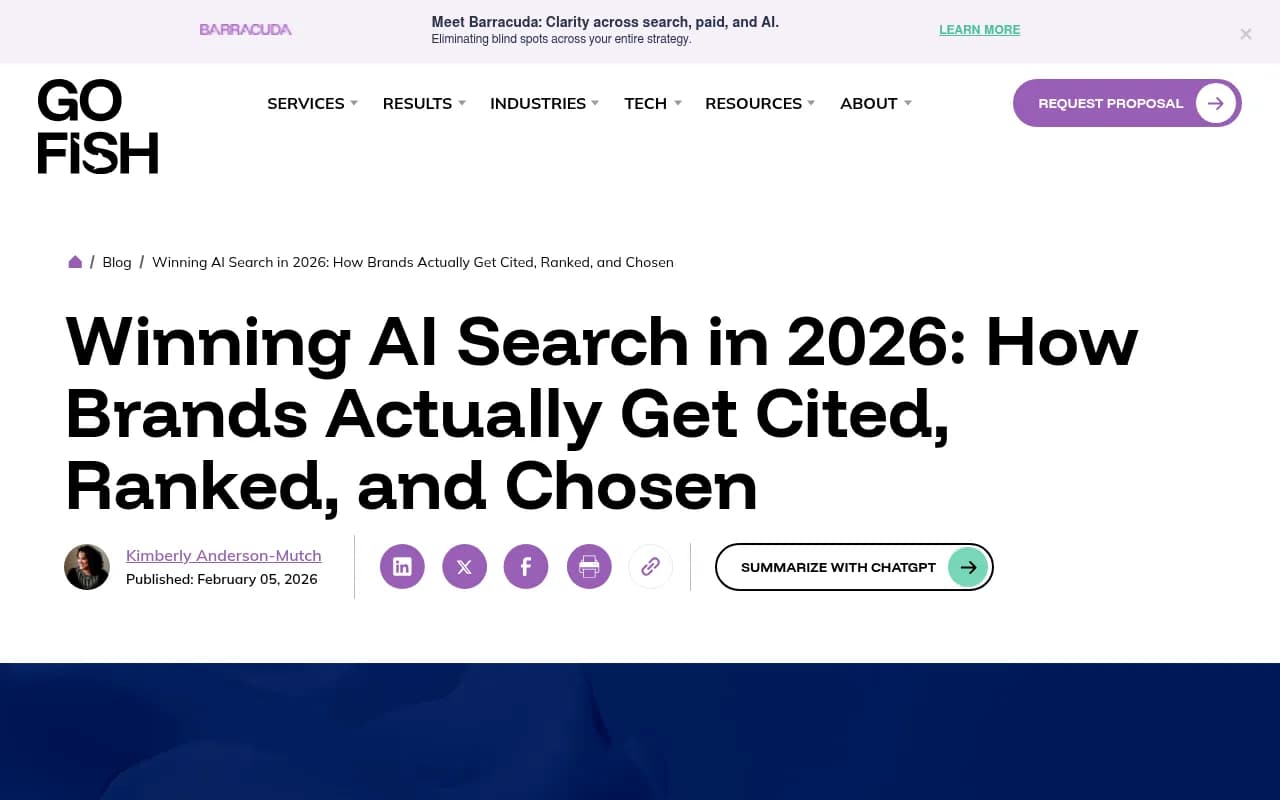
The BrightEdge finding is worth sitting with: more than half of AI Overview citations come from pages already in the top 10 organic results. That means traditional SEO isn't dead — it's still the foundation. But it's no longer sufficient on its own.
Writing content that earns citations
Structure your content around specific questions
AI models are prompt-driven. Someone types a question, the model finds the best answer. Your content needs to be the best answer to a specific question, not a general exploration of a topic.
This means moving away from broad, keyword-stuffed articles and toward content that owns a specific question. "What is the best CRM for small businesses?" is a question. "CRM software" is a keyword. These require completely different content approaches.
Practically, this looks like:
- Using question-based headings (H2s and H3s phrased as actual questions)
- Providing a direct, concise answer immediately after each question heading
- Following the direct answer with supporting detail, evidence, or context
The 40-60 word summary rule is real. If you can answer the core question in 40-60 words right at the top of a section, you give AI models a clean, citable chunk. Then expand below it for the humans who want depth.
Use conversational tone — but stay precise
"Conversational" doesn't mean casual or vague. It means writing the way a knowledgeable person would explain something to a colleague. Short sentences. Direct language. No jargon for its own sake.
AI models are trained on human language. They respond to content that sounds like a real person explaining something clearly, not content that sounds like it was written to satisfy a keyword density requirement.
That said, precision matters. Vague answers don't get cited. "It depends" is not a citable response. "It depends on X, Y, and Z — here's how to decide" is.
Add schema markup
Schema markup is structured data that tells search engines (and AI crawlers) what your content is about. For AI citation purposes, the most relevant schema types are:
FAQPage— marks up question-and-answer content explicitlyHowTo— structures step-by-step guidesArticle— signals that content is editorial and authoritativeProductandReview— for commercial content
This isn't a magic bullet, but it removes ambiguity. When an AI crawler hits your page, schema markup tells it exactly what kind of content it's looking at and how to interpret it.
Build topical authority, not just individual pages
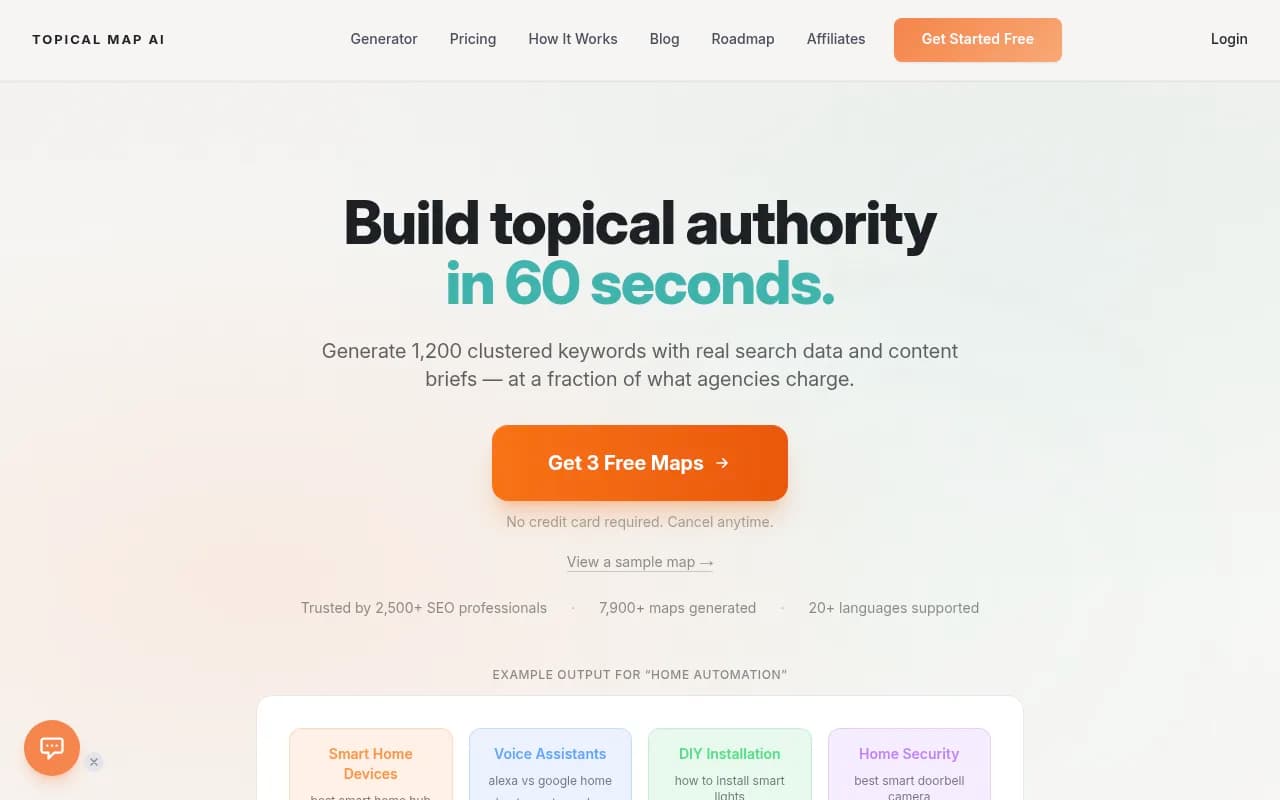
One of the clearest patterns in AI citation data is that models tend to cite sources they've seen repeatedly across a topic area. A site that has 40 well-structured articles about project management software is more likely to get cited for project management questions than a site with one excellent article on the same topic.
This is topical authority, and it's how AI models build trust in a source. They're not just evaluating the page — they're evaluating the domain's expertise across the subject.
The practical implication: content strategy in 2026 needs to be about owning a topic area, not just targeting individual keywords. Build clusters. Cover the topic from multiple angles. Answer the sub-questions, the follow-up questions, and the edge cases.
Get cited off your own site
AI models don't only pull from your website. They pull from Reddit threads, YouTube videos, Wikipedia, media coverage, and third-party review sites. If your brand or content is being discussed in those places, that increases your chances of appearing in AI-generated answers — even when the citation doesn't link back to you directly.
This is why media mentions, PR coverage, and community presence matter more than they did in the traditional SEO era. A mention in a well-trafficked Reddit thread can influence what ChatGPT says about your product. That's a new kind of visibility that most content strategies aren't built to capture.
The click problem: getting traffic from AI search
Citations are great. Traffic is better. The challenge is that AI search is inherently zero-click by design — the model answers the question, the user moves on.
So how do you still get clicks?
Give the answer, but not the whole answer
There's a balance to strike here. You want to give AI models enough to cite you, but you also want to leave something for the user to click through for. The way to do this is to answer the immediate question completely, then make it clear that there's more depth, nuance, or a specific tool/resource available on your page.
"Here's the short answer. For the full breakdown with examples and a comparison table, see the full guide."
That kind of structure works because the AI cites the short answer, but users who want more have a reason to click.
Target prompts where users need to go deeper
Not all queries are equal for click-through. "What is content marketing?" is a definition question — the AI will answer it completely and nobody needs to click anywhere. "What's the best content marketing tool for a 3-person team with a $500/month budget?" is a decision question. The AI might give a general answer, but the user has enough specificity in their need that they'll want to verify, compare, and dig in.
Decision-stage and comparison-stage content drives more clicks from AI search than awareness-stage content. This is a meaningful shift from traditional SEO, where informational content often drove the most traffic.
Use your brand as the answer
When AI models recommend specific products, tools, or services by name, that's a different kind of citation — and it drives direct traffic. Someone who hears "Promptwatch is a good option for tracking AI visibility" from ChatGPT is likely to search for Promptwatch directly or visit the site.
This is why brand visibility in AI search is a real metric worth tracking. It's not just about being cited as a source — it's about being named as the solution.
Promptwatch tracks exactly this: which prompts mention your brand, how often, across which AI models, and whether that visibility is translating into actual site traffic.

The content formats AI models cite most
Some content types get cited more than others. Based on what's visible in AI-generated responses across ChatGPT, Perplexity, and Gemini, the patterns are clear:
| Content format | Citation frequency | Click-through potential | Notes |
|---|---|---|---|
| Listicles and "best X" articles | Very high | Medium | AI loves structured lists; users click to verify |
| Comparison articles | High | High | Decision-stage content drives clicks |
| How-to guides | High | Medium | Step-by-step structure is easy to extract |
| Definition/explainer content | High | Low | AI answers these completely; fewer clicks |
| Original research and data | Medium | High | Cited when unique; users click for full data |
| Opinion and commentary | Low | High | Hard for AI to cite authoritatively; but drives loyal traffic |
| Product pages | Low | High | Rarely cited directly; but named brands get traffic |
The takeaway: if you want citations, write listicles, comparisons, and how-to guides with clear structure. If you want clicks, lean into comparison content and original research that gives users a reason to go deeper.
Technical foundations that support AI visibility
Make your pages crawlable by AI bots
AI crawlers are different from Googlebot. ChatGPT's crawler (OAI-SearchBot), Claude's crawler (ClaudeBot), and Perplexity's crawler each visit your pages independently. If you're blocking them in your robots.txt — intentionally or accidentally — you won't be cited, full stop.
Check your robots.txt file. Make sure you're not blocking the major AI crawlers unless you have a specific reason to do so.
Page speed and accessibility
Slow pages get crawled less frequently. Pages with accessibility issues are harder to parse. These aren't new problems, but they matter more now because AI crawlers are less patient than human users — they're hitting thousands of pages and will move on quickly if yours is slow to load or poorly structured.
Internal linking
Internal links help AI crawlers understand the structure of your site and the relationships between your content. A well-linked content cluster signals topical authority more clearly than a collection of isolated pages. Link your related articles together, and make sure your most important pages are reachable within a few clicks from your homepage.
How to track what's actually working
This is where most content strategies fall apart in 2026. You can write excellent, well-structured content and have no idea whether it's being cited, by which models, or whether those citations are driving any traffic.
The metrics you need to track:
- Which of your pages are being cited in AI-generated responses
- Which AI models are citing you (ChatGPT, Perplexity, Gemini, etc.)
- Which prompts trigger citations of your content
- Whether AI visibility correlates with traffic from AI referrals
- Which competitor pages are being cited instead of yours
Traditional analytics tools don't give you this. Google Search Console shows you organic search data, but it doesn't show you AI Overview citations or ChatGPT referrals in any meaningful way.
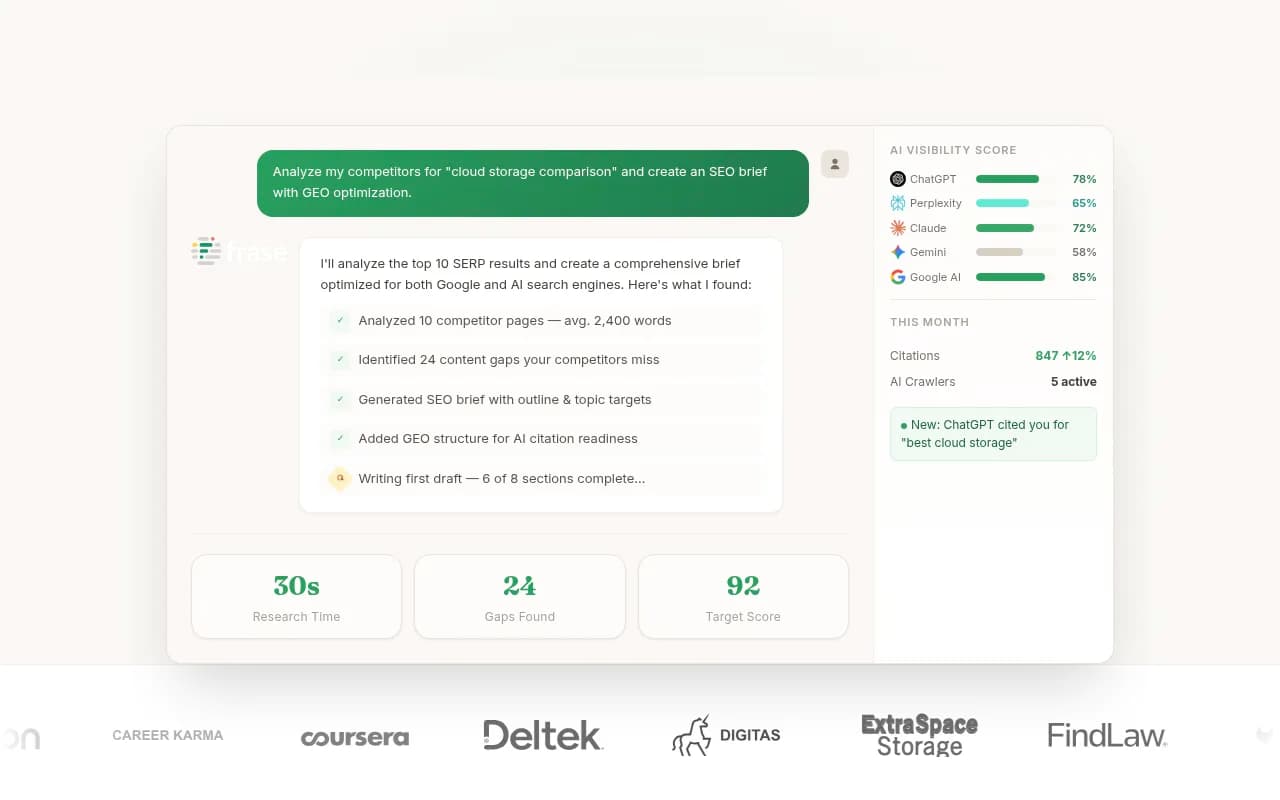
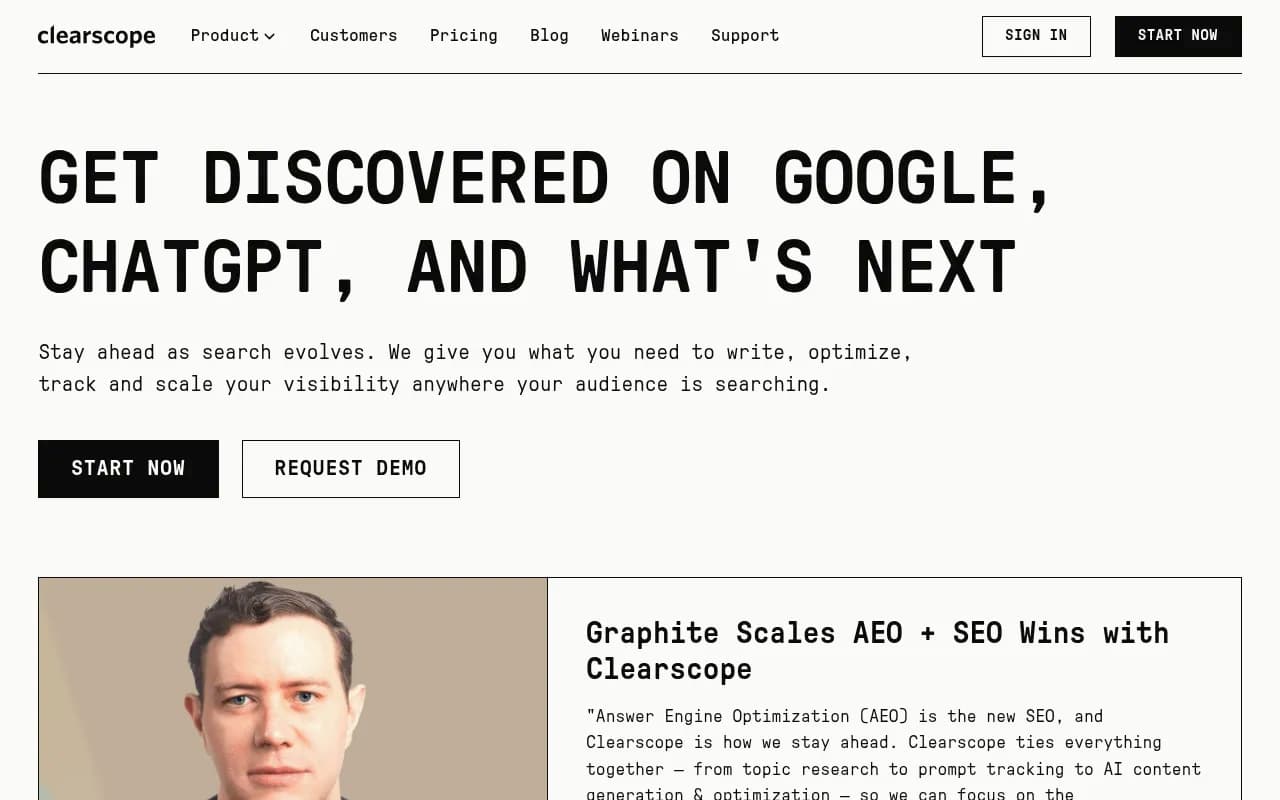
Tools built specifically for AI visibility tracking are now essential. A few worth knowing:



The difference between these tools matters. Most of them show you monitoring data — you can see where you're being cited and where you're not. Promptwatch goes further by showing you the specific content gaps (prompts where competitors are cited but you're not) and then helping you create content to close those gaps. For teams that want to act on the data rather than just observe it, that distinction is significant.
Putting it together: a practical content workflow for 2026
Here's how this looks as an actual workflow, not just a list of principles:
-
Identify the high-value prompts in your category — the questions your target customers are asking AI models. Prompt volume and difficulty data helps you prioritize.
-
For each priority prompt, audit whether your site has content that directly answers it. If not, that's a gap.
-
Write content that answers the question directly and completely in the first 40-60 words, then expands with depth, examples, and supporting evidence.
-
Structure with question-based headings, add appropriate schema markup, and link to related content on your site.
-
Publish and track: monitor which AI models start citing the new content, how often, and whether it's driving traffic.
-
Repeat for the next gap.
This is a loop, not a one-time project. AI models update their training data and retrieval indexes continuously. What gets cited today might not get cited in three months if a competitor publishes something better. The brands that win are the ones running this cycle consistently.
What most brands are still getting wrong
A few patterns show up repeatedly in brands that are struggling with AI visibility:
Content is too broad. A 3,000-word article that covers "everything about email marketing" is less citable than a 600-word article that answers "what's the best time to send a B2B email newsletter" with precision and evidence.
They're optimizing for the wrong stage. Awareness content (definitions, overviews) gets cited but doesn't drive clicks. Decision content (comparisons, recommendations) drives both citations and clicks. Most brands have too much of the former and not enough of the latter.
They're not tracking AI traffic separately. AI referrals from ChatGPT and Perplexity show up in analytics as direct traffic or are misattributed. Without deliberate tracking, you can't tell whether your AI visibility is actually moving the needle on revenue.
They're ignoring off-site presence. Reddit discussions, YouTube videos, and media coverage all feed into what AI models say about your brand. A content strategy that only focuses on your own website is missing a significant part of the picture.
The bottom line
Getting cited in AI search and getting clicked are not the same goal, but they're not in conflict either. The content that earns citations — structured, specific, authoritative, directly answering real questions — is also the content that gives users a reason to click through for more.
The brands that treat AI search as a separate channel from traditional SEO are going to keep struggling. The ones that integrate AI visibility into their core content strategy — tracking citations, closing gaps, building topical authority — are the ones that will hold their ground as AI agents take over more of the discovery journey.
Start with one topic cluster. Audit what's being cited. Write what's missing. Track what changes. That's the whole game.