Key takeaways
- No independent study shows AirOps output is worse than other AI content platforms. Slop comes from how a pipeline is configured and reviewed, not from one brand name.
- AirOps's own July 2026 post on AI slop names four problems: generic language, structural problems, SEO issues and misinformation. Three more show up in practice: missing first-hand expertise, voice drift and stale pages.
- Fluent, well-organized text can still be slop if it adds nothing new. Check what a page contributes, not whether it sounds like a machine.
- The fixes are boring and work: real examples, subject-matter input, a trained brand voice, human review checkpoints and scheduled refreshes.
The honest framing first
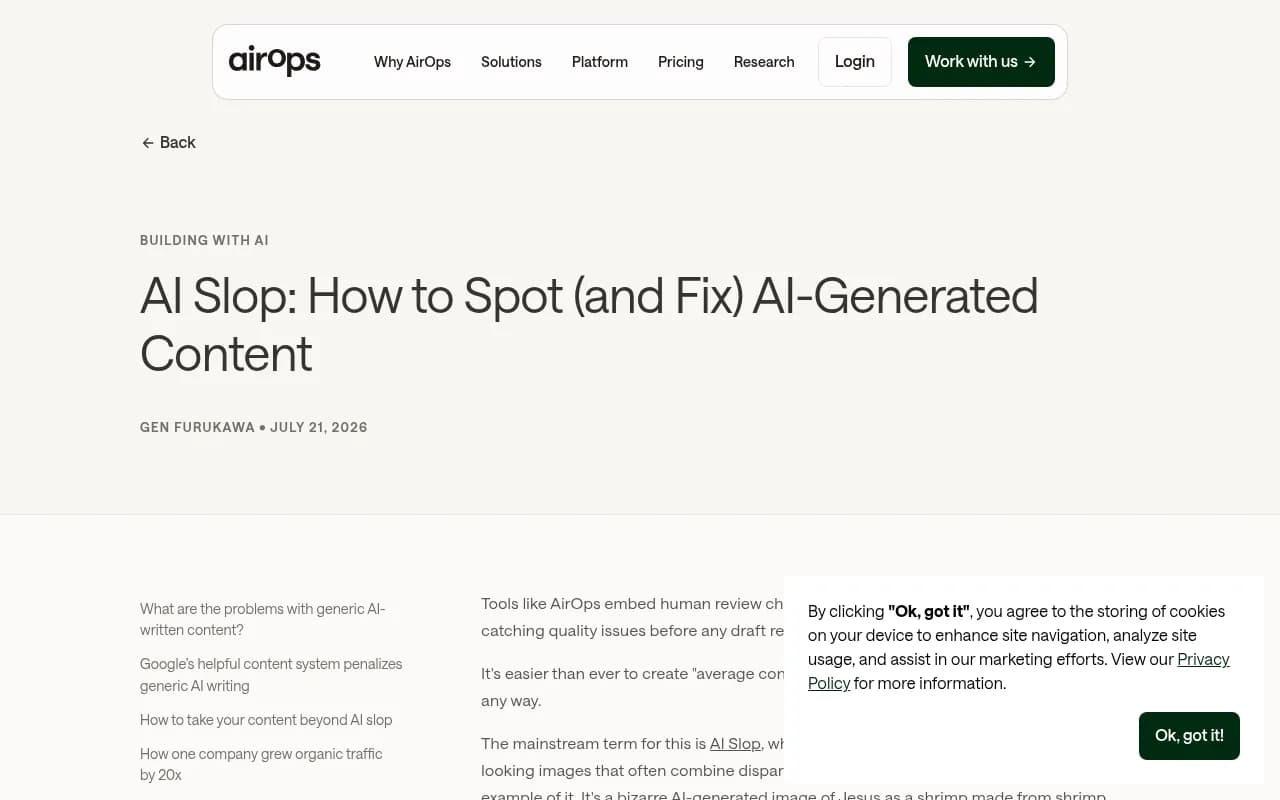
The title of this guide is a question people type into search boxes, so it deserves a straight answer. I could not find independent reviews or critiques showing that AirOps drafts are uniquely sloppy. What I did find is that AirOps published its own long post on the topic, dated July 21, 2026, called "AI Slop: How to Spot (and Fix) AI-Generated Content". It describes the problem in detail and pitches AirOps workflows, brand kits and human review checkpoints as the cure.

So this guide does not claim AirOps is a slop machine. It does something more useful. It takes the failure modes AirOps itself describes, adds a few it leaves out, and gives you a checklist for auditing any AI-assisted draft, whether it came from AirOps, a competing writer or a person with a ChatGPT tab open.
A platform that can run research, briefs, drafts and refreshes at scale makes publishing cheap. When publishing is cheap, bad habits scale as fast as good ones. That is the real risk.
What slop actually means for content teams
Merriam-Webster picked up the word for its cultural moment, and Coursera's explainer boils it down to low-quality content produced in large quantities by AI. That definition is fine for images and memes. For marketing content it needs sharpening.
A DEV Community essay makes the point I like best: AI-generated content and AI slop overlap but are not synonyms. One describes how something was made. The other is a judgment about quality, originality and usefulness. A human can write slop. An AI-assisted article with original data and verified sources is not slop.
That changes how you audit. Asking "does this sound like AI?" is a weak test, because fluent text, tidy structure and perfect grammar are exactly what a good model produces. The better question is what the page adds that the other nine results do not.
Problem 1: generic language patterns
This is the one everybody notices. Openers like "In today's fast-paced digital world", paragraphs that restate the heading, and verbs like "unlock" and "elevate". AirOps lists generic language patterns as its first slop problem, and it is first for a reason.
How to spot it:
- Delete the first paragraph. If nothing is lost, it was filler.
- Search the draft for stock phrases you have seen on competitor blogs.
- Read three sentences aloud. If you could paste them into an article about a different product unchanged, they are generic.
The fix is not a banned-words list alone. Feed the workflow your actual customer language: sales call transcripts, support tickets, founder posts. Brand kits and knowledge bases in tools like AirOps exist for this, but they only work if you put real material in them.
Problem 2: structural problems
AI drafts love symmetry. Every H2 gets three bullets, every section ends with a neat summary line, every list has exactly five items. Readers sense the template even if they cannot name it.
Signs to look for:
- Sections of nearly identical length
- Bullets that all start with the same bolded label and a colon
- Headings that promise something the section never delivers
- A conclusion that repeats the intro in different words
Fix it by deciding the structure from the search intent, not from the model's default. If the query is a comparison, lead with the table. If it is a how-to, lead with the steps and cut the throat-clearing. Let sections run long where the topic is hard and short where it is not.
Problem 3: SEO issues and topic drift
AirOps's post points to Google de-emphasizing content that strays too far from a site's core topic clusters, and cites HubSpot's organic traffic decline as an example. Treat that as AirOps's interpretation, not a proven cause. Still, the risk is real. Programmatic and high-volume workflows make it easy to publish hundreds of pages on adjacent topics that you have no authority on.
Spot it by exporting your last 50 published URLs and tagging each one by topic cluster. If a fifth of them sit outside your core offering, you have drift. Also check for near-duplicate pages targeting slightly different long-tail phrases.
On policy: the research I had did not include Google's current wording on scaled content abuse, so read Google's own spam policies directly before you scale any pipeline. Do not rely on a summary, including this one.
For on-page checking, optimization tools can show how a draft compares with ranking pages.

Treat their scores as a sanity check on coverage, not as a target. A page can score 90 and still say nothing new.
Problem 4: misinformation
This is the dangerous one. The Coursera piece gives a telling example of AI text that sounds authoritative: "Studies confirm listeners close 30% more deals by uncovering hidden needs this way." No study is named. The number is plausible. It is the sort of sentence a model writes when it has learned the shape of a statistic without a source behind it.
How to spot it:
- Highlight every number, percentage and "studies show" phrase.
- Ask for the source URL for each. If the writer or model cannot produce one, cut the claim.
- Check named people, product features and prices against the vendor's own page.
Human review checkpoints, which AirOps lists among its features, matter most here. A checkpoint is only worth something if the reviewer is assigned to verify claims, not to skim for tone.
Problem 5: no first-hand expertise
This one is my own addition, though AirOps's fix steps (add specific examples, apply your unique expertise) imply it. A draft built from a keyword and a few scraped competitor pages contains no experience. It cannot say "we tried this and it failed because our onboarding, not our feature set, was the issue". It can only say what other pages say.
The DEV essay has a useful contrast. Two people ask an AI for a LinkedIn post about startups. One types "write a post about startup challenges". The other describes a three-week feature that customers barely used, the five customer calls that revealed onboarding as the real issue, the tone wanted and the lesson to land. Same tool, completely different output. The difference is better thinking before prompting.
How to spot the missing expertise:
- Count the concrete details only a practitioner would know: numbers from your own data, named tools, mistakes, trade-offs.
- If the answer is zero, the page is a rewrite of the internet.
The fix is an input step. Before any draft, someone who does the work spends 15 minutes dictating what they would actually tell a customer. That material goes into the brief.
Problem 6: voice drift
Even a trained brand voice slides toward the model's default over long runs. Articles 1 to 10 sound like you. By article 200 they sound like everyone.
Spot it with a blind test. Take five recent posts, strip the bylines and logos, and ask someone on your team to pick which are yours from a mixed pile that includes competitors. If they cannot, your voice has drifted.
Rewriting assistants can help tighten a sentence, but they pull toward the middle too.

Better: keep a living style sheet of examples your best writer produced, and have the workflow retrieve from it. Voice-matching tools exist, and they are worth testing against your blind-test pile.
Problem 7: stale pages and no feedback loop
Automated refresh is one of AirOps's headline features: updates to links, structure and metadata on a schedule. That is useful and also a risk. A refresh that swaps a few links and bumps the date is cosmetic. It does not fix a page that was thin to begin with.
Promptwatch's own data on ChatGPT citation lifespans is a useful reminder here. In Promptwatch Data's half-life report, which tracked every page ChatGPT cited on July 6, 2026 for 90 days, landing pages and docs stayed cited longest, while news lost half its pages within 36 days. Content type decides how fast a page decays, so one refresh schedule for everything is wrong.
Spot it by pulling pages older than 12 months and checking three things: are the facts still true, did traffic or citations fall, and does the page still match what the top results cover?
A quick audit table
| Problem | Fast test | Typical fix |
|---|---|---|
| Generic language | Delete the intro, see if anything is lost | Feed real customer language into the brief |
| Structural sameness | Section lengths and bullet patterns match | Choose structure from search intent |
| SEO drift | Tag last 50 URLs by topic cluster | Prune or consolidate off-topic pages |
| Misinformation | Source every number | Cut unsourced claims, verify named facts |
| No expertise | Count details only a practitioner knows | Add a subject-matter input step |
| Voice drift | Blind test against competitors | Retrieval from a living style sheet |
| Stale pages | Review pages older than 12 months | Refresh by content type, not by calendar |
Does AI search change what counts as good?
It makes the originality point sharper. AI answer engines pull from many sources per response. Promptwatch's data from Sep 28 to Oct 4, 2026 found that almost half of ChatGPT responses cite 10 or more unique domains (unique domains report). A page that repeats what the other nine say has little reason to be one of those ten. Product pages were the most cited content type in the same period, at 22.4% of citations (content type report), which hints that specific, factual pages beat generic explainers.
If you want to check whether your AI-assisted pages earn citations at all, a GEO platform like Promptwatch can show which of your pages get cited and which AI crawlers read them. That closes the loop that a drafting tool alone leaves open.

The broader category is crowded, and the GEO software directory at bestgeosoftware.com is a reasonable place to compare options.
How AirOps compares with other drafting options
I have not tested these head to head, and quality depends on your setup more than the logo. Treat this as a map, not a ranking.
| Tool | Strength | Slop risk to watch |
|---|---|---|
| AirOps | Workflows, brand kits, refresh, human review steps | High volume with thin inputs |
| Jasper | Marketing agents and brand voice | Generic copy if the brand voice is not trained |
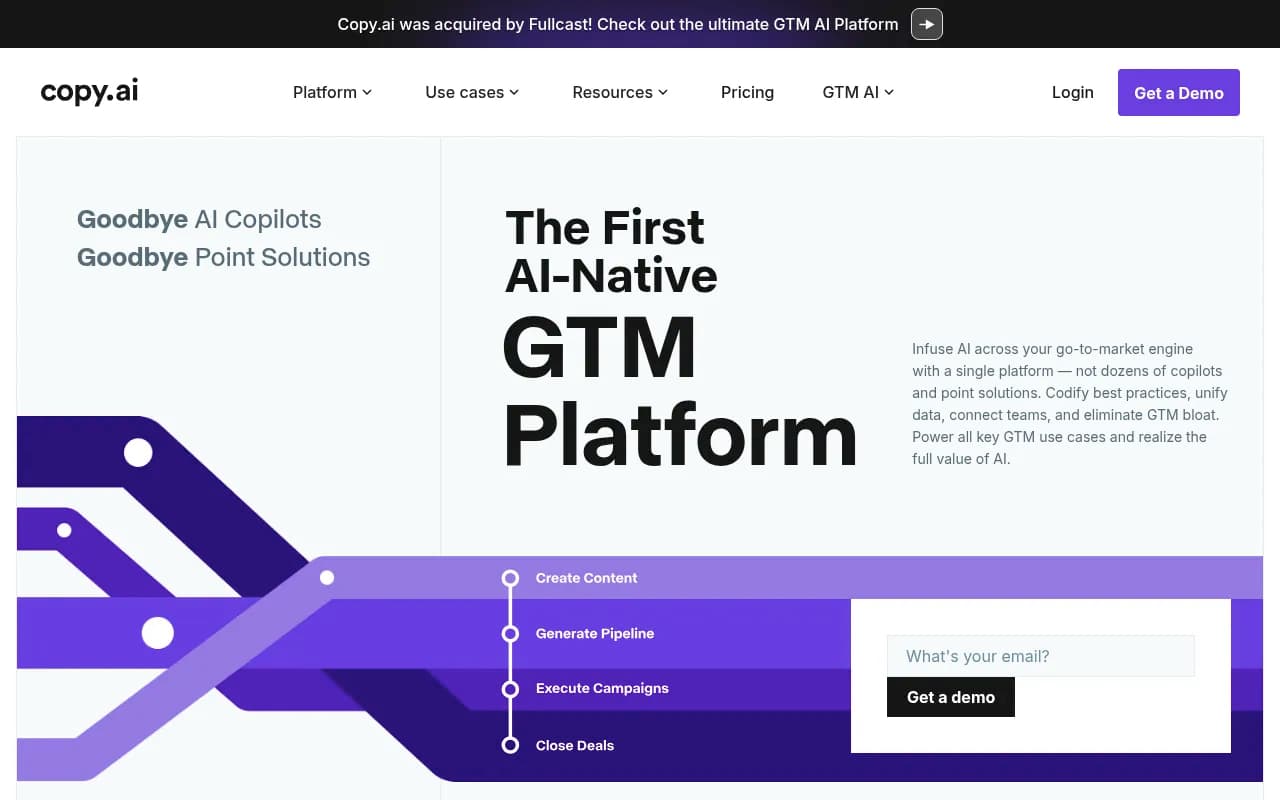
| Copy.ai | GTM workflow automation | Template-shaped output |
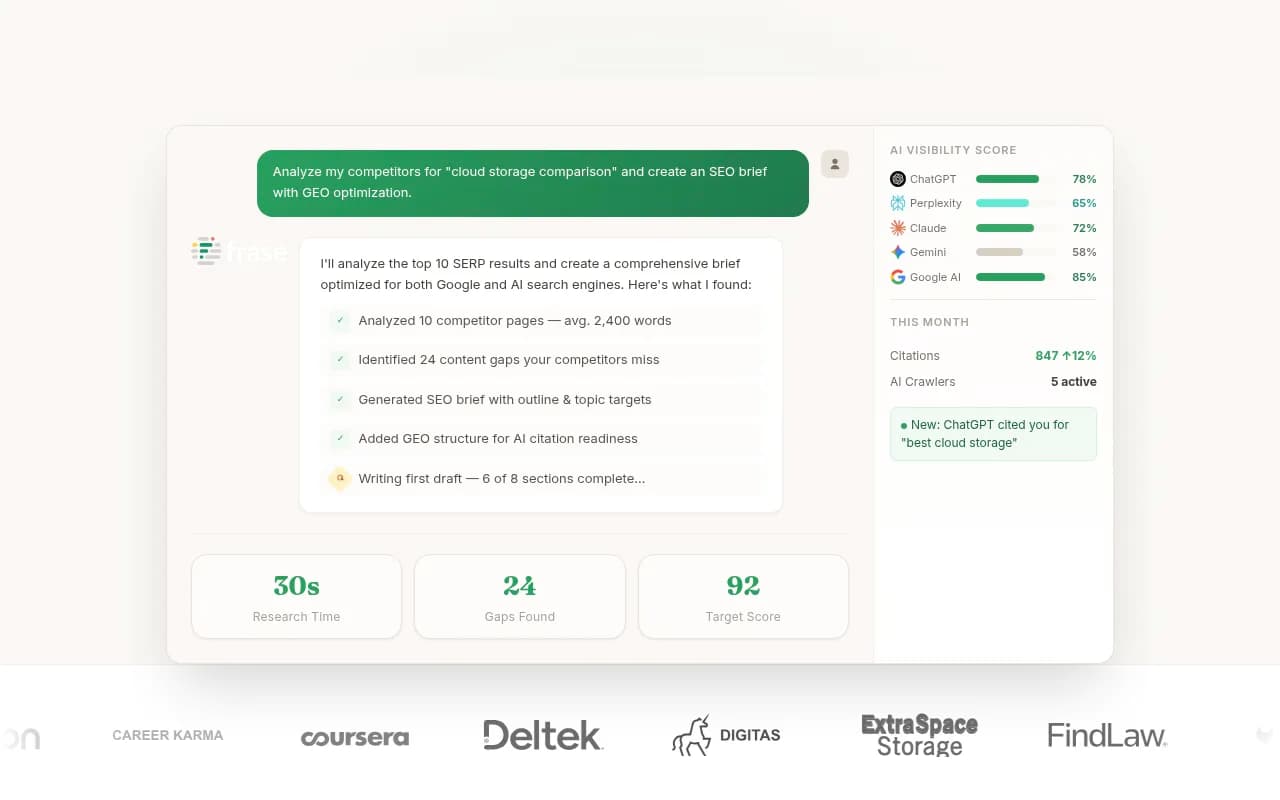
| Frase | Research plus optimization | Briefs that mirror the top results |
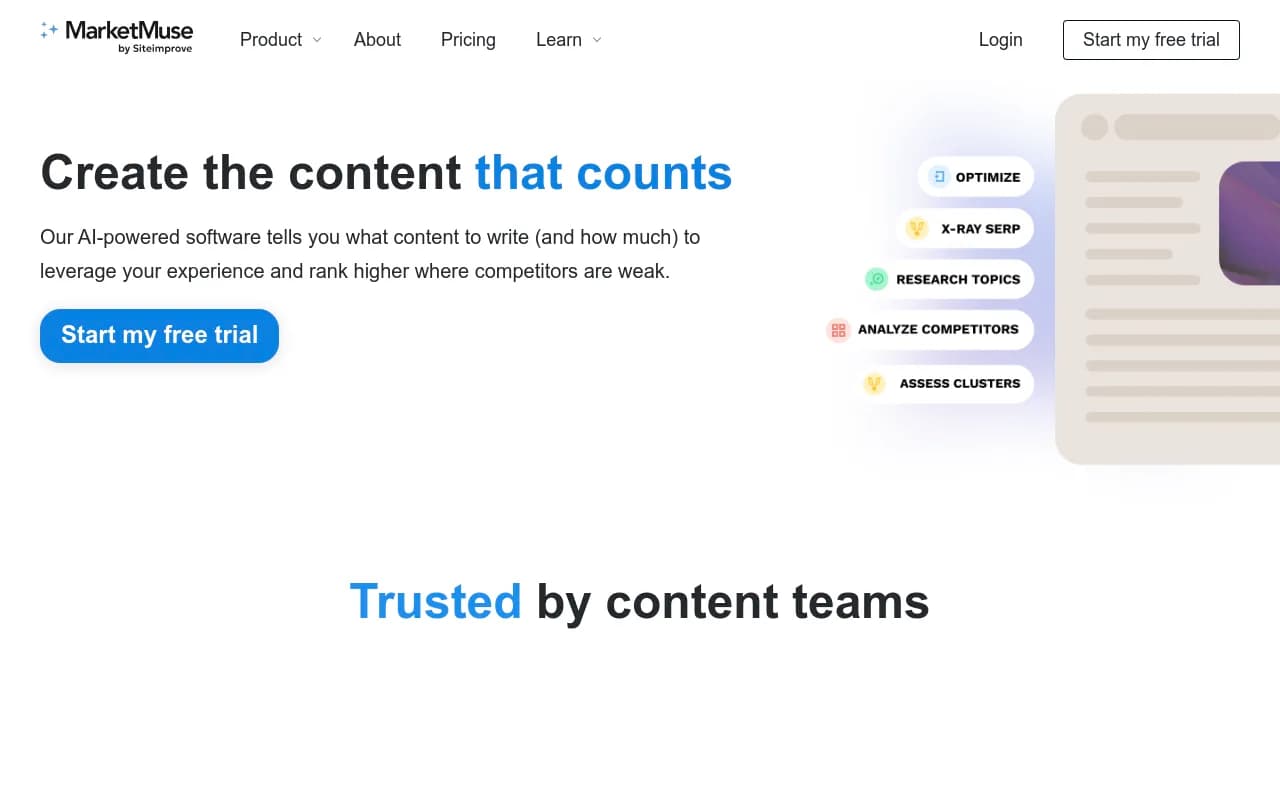
| MarketMuse | Planning and topical coverage | Scores mistaken for quality |
A practical review workflow
Here is a lightweight process that catches most of the seven problems without killing speed.
- Brief with substance. Include one real example, one opinion and one number from your own data.
- Draft with the voice kit and knowledge base loaded.
- First review: an editor deletes filler and fixes structure.
- Second review: a subject-matter expert checks every claim and adds one thing the model could not know.
- Publish, then tag the page with its topic cluster and content type.
- Review at 90 days: traffic, citations, accuracy. Refresh or consolidate.
If that sounds like a lot for each post, it is. The reasonable trade is fewer pages with the full process rather than hundreds with none. The DEV piece's five-step loop explains why: cheaper production leads to more volume, which leads to more competition for the same attention, and creators publish even more to stay visible. Nobody wins that race.
Bottom line
AirOps did not invent AI slop, and its own blog is candid about the problem. Whether the content your team ships through it, or any other platform, reads like slop depends on the seven things above: language, structure, topical focus, accuracy, expertise, voice and upkeep. Run the table against your last ten posts. If three or more rows fail, the tool is not the problem, the process is.